Command Palette
Search for a command to run...
읽을 수 없는 것을 읽기: 텍스트 인지 이미지 초해상화에는 추론이 필요하다
읽을 수 없는 것을 읽기: 텍스트 인지 이미지 초해상화에는 추론이 필요하다
Jaeseong Lee Jinwoo Kim Jinho Jeong Seon Joo Kim
초록
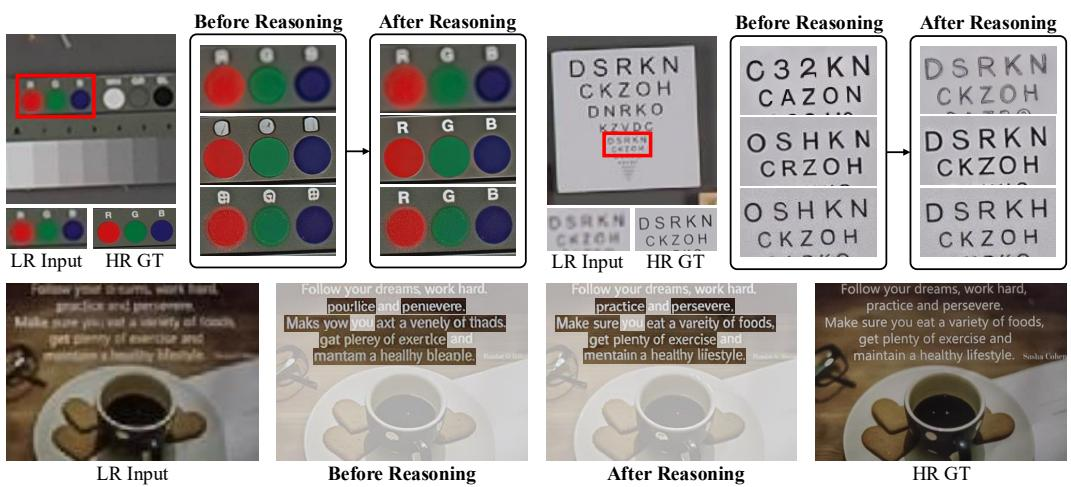
텍스트 인지 이미지 초해상화(TAISR)는 저해상도 입력에서 고해상도 이미지를 복원하면서 텍스트 내용을 보존하는 것을 목표로 한다. 기존 방법들은 이를 시각적 복원 문제로 다루지만, 심하게 손상된 텍스트는 국소적인 시각적 증거만으로는 판독할 수 없는 경우가 많다. 인간은 대신 이미지 맥락, 논리적 패턴, 사전 지식을 바탕으로 추론하여 텍스트를 읽는다. 이는 근본적인 질문을 제기한다: TAISR에 추론이 필요한가? 이 질문에 답하기 위해 우리는 두 가지 진단 도구를 소개한다. 첫 번째는 인간이 큐레이션한 벤치마크인 ReasonText로, 추론이 필요한 텍스트와 국소적으로 복원 가능한 텍스트를 구분한다. 두 번째는 Ground-Truth Text-Crop Accuracy(GTTCA)로, 텍스트 검출 오류 없이 텍스트 복원 품질을 측정하는 인식 기반 지표이다. 최근의 초해상화(SR) 모델 12종을 평가한 결과, 추론이 필요한 텍스트에서 일관되고 상당한 성능 저하가 나타나 체계적인 맹점이 드러났다. 두 가지 관찰이 해결 방안을 제시한다. 하나는 텍스트 조건부 SR 모델이 정답 텍스트를 제공받을 때 텍스트를 훨씬 더 잘 복원한다는 점이다. 다른 하나는 멀티모달 대형 언어 모델(MLLM)이 추론을 통해 저해상도 이미지의 손상된 텍스트를 읽을 수 있다는 점이다. 따라서 우리는 캡셔닝을 통한 추론 전이(RTC)를 제안한다. 이는 외부 MLLM을 사용하여 손상된 텍스트를 추론하고 그 결과 캡션을 텍스트 조건부 SR 모델에 제공하는 학습 불필요 플러그인이다. RTC는 평가한 6종의 텍스트 조건부 SR 모델 모두에서 일관되게 성능을 향상시켰으며, 특히 추론이 필요한 텍스트에서 두드러졌다. 놀랍게도 RTC를 적용한 실세계 SR 모델이 RTC를 적용한 TAISR 모델보다 더 나은 성능을 보일 수 있다는 점은 추론이 향후 TAISR의 핵심 설계 축이 되어야 함을 시사한다.
One-sentence Summary
Researchers from CIPLAB, Yonsei University introduce ReasonText and GTTCA, which diagnose text-aware image super-resolution by revealing a systematic drop on reasoning-required text, and propose Reasoning Transfer via Captioning (RTC), a training-free plug-in that uses an external MLLM to infer degraded text and feed captions to text-conditioned SR models, improving all six evaluated models and indicating reasoning as a core design axis.
Key Contributions
- Introduces ReasonText, a human-curated benchmark that separates reasoning-required text from locally recoverable text, and Ground-Truth Text-Crop Accuracy (GTTCA), a recognition-based metric that measures text restoration quality directly at ground-truth locations without text detection errors.
- Evaluation of twelve recent super-resolution models with ReasonText and GTTCA reveals a consistent and substantial performance drop on reasoning-required text, identifying a systematic blind spot in existing real-world SR and text-aware SR approaches.
- Proposes Reasoning Transfer via Captioning (RTC), a training-free plug-in that uses an external multimodal large language model to infer degraded text and feeds the resulting caption to a text-conditioned SR model; RTC consistently improves all six evaluated text-conditioned SR models, especially on reasoning-required text, and enables a real-world SR model with RTC to outperform a TAISR model with RTC.
Introduction
Real-world image super-resolution recovers high-resolution images from low-resolution inputs affected by unknown degradations, and recent text-to-image generative backbones produce visually plausible details but often hallucinate or corrupt text. Text-aware image super-resolution (TAISR) methods add text detection, segmentation, or spotting modules, yet these remain centered on local visual evidence and lack the contextual reasoning humans use to read degraded text. Existing benchmarks also do not separate reasoning-required text from locally recoverable text, and their metrics depend on text spotting, which can contaminate quality measurement. The authors introduce ReasonText, a human-curated benchmark with perception-grounded difficulty levels, and Ground-Truth Text-Crop Accuracy (GTTCA), a detection-free text restoration metric, then show that twelve recent SR and TAISR models fail sharply on reasoning-required text. They also propose Reasoning Transfer via Captioning (RTC), a training-free plug-in that uses a frozen multimodal large language model to infer degraded text into captions for frozen text-conditioned SR models.
Dataset

The authors introduce ReasonText as an evaluation benchmark for reasoning-required text restoration in super-resolution, built on RealSRv3 and DRealSR real-world LR-HR pairs.
-
Sources and composition: Existing benchmarks such as SA-Text-test and RealText lack per-instance reasoning labels, contain automatic annotation errors, and crop text without surrounding context. ReasonText instead uses manual annotations and context-preserving crops. After filtering, it contains 513 LR-HR pairs and 2,463 text instances: 1,754 Level 1 and 709 Level 2.
-
Annotation and processing: Trained annotators label word-level polygons, transcripts, and orientations in full HR images, with multiple rounds of verification. The authors crop a square HR patch around each text instance while keeping related context, then resize HR patches to 512×512 and aligned LR patches to 128×128 for the ×4 SR setting.
-
Difficulty labeling and filtering: Stage 1 shows a cropped LR text region without context. Instances readable from the text alone are Level 1, treated as locally recoverable text. Stage 2 shows remaining instances in the full LR patch with the text region highlighted. Instances readable only with context are Level 2, treated as reasoning-required text. The rest are Level 3, treated as unrecoverable text. Level 3 instances are excluded from evaluation, and LR-HR pairs containing only Level 3 instances are discarded.
-
Use in the paper: The paper does not describe a training split or mixture ratio for ReasonText; it is used as an evaluation benchmark to test whether SR models can recover reasoning-required text. For evaluation, the authors propose GTTCA, which crops each predicted text instance using the ground-truth polygon with padding, rotates and flips it by ground-truth orientation, recognizes it with PaddleOCR-VL-1.5 OCR, normalizes the result, and checks exact match with the ground-truth transcript. GTTCA is reported separately for Level 1, Level 2, and Overall.
Method
The authors propose an external approach to equip super-resolution (SR) models with reasoning capabilities, termed Reasoning Transfer via Captioning (RTC). Since conventional quality criteria and text-specific objectives fail to provide training signals for inferring locally illegible text, the authors bypass internal reasoning and instead extract reasoning-aware representations from an external model to inject into the SR model.
The design of RTC is grounded in two empirical observations. First, the authors observe that passing ground-truth transcripts through the existing text-conditioning channel of SR models significantly improves the restoration of reasoning-required text. By replacing the default caption with a natural-language caption listing the transcripts, the SR models can accurately render the text, settling the injection mechanism.
Second, to generate these transcripts from low-resolution (LR) images where ground-truth is unavailable, the authors evaluate various models. They find that while standard OCR models struggle with reasoning-required text, Multimodal Large Language Models (MLLMs) can successfully infer it. Specifically, Gemma 4, when prompted to use image context and logical patterns, achieves high text recall. To verify that this performance stems from genuine reasoning rather than memorization or exceptional local recognition, the authors conduct ablation studies on visible regions.
Refer to the framework diagram below:
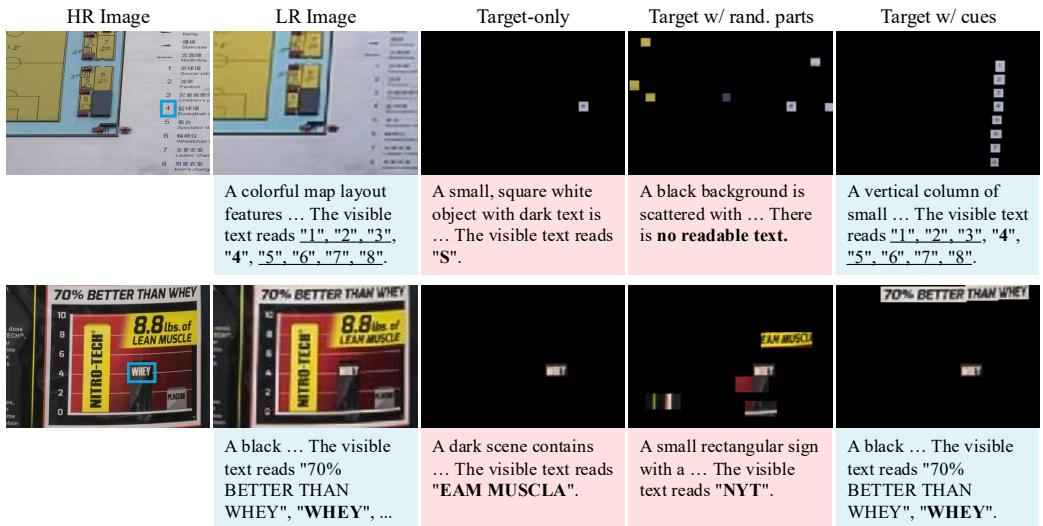
As illustrated, when only the locally illegible target region is visible, the MLLM fails to read the text. Adding random unrelated patches does not improve performance. However, when the relevant contextual cues are provided, the MLLM correctly infers the missing text, confirming its reliance on surrounding context for reasoning.
Building on these observations, the RTC pipeline operates in two training-free steps. First, in the caption by reasoning step, the authors query an MLLM with the LR image xLR and a reasoning prompt. The model returns a two-sentence caption c comprising a scene description followed by the inferred transcripts. Second, in the restore by conditioning step, this generated caption and the LR image are passed to a text-conditioned SR model, which replaces its default caption with the reasoning-aware caption to produce the final high-resolution output x^HR. This modular interface allows RTC to attach to any text-conditioned SR model without requiring additional training.
Experiment
The paper introduces ReasonText, a benchmark with human-annotated text instances labeled as locally recoverable, reasoning-required, or unrecoverable, and uses the GTTCA metric to evaluate restoration quality. Experiments on twelve real-world SR and text-aware SR models show that all models suffer a large accuracy drop on reasoning-required text, and that existing text-aware designs only help locally recoverable text. The authors then propose Reasoning Transfer via Captioning, which injects captions produced by a reasoning-prompted MLLM into text-conditioned SR models, substantially improving restoration of reasoning-required text without training and generalizing across benchmarks.
Across twelve real-world super-resolution and text-aware super-resolution models on ReasonText, text restoration quality drops sharply from Level 1 to Level 2 for every model, and the score ranges of the two levels do not overlap. The HR oracle remains far above all SR models on Level 2, indicating the gap is a model limitation. Text-aware design and conventional image quality metrics do not close or track this reasoning-required text gap. All twelve SR and TAISR models have non-overlapping GTTCA score ranges between Level 1 and Level 2, and the HR oracle remains far above every SR model on Level 2. The text-aware model UniT gains over DiT4SR only on Level 1, while PSNR, SSIM, LPIPS, DISTS, and NR-IQA metrics do not positively track overall text restoration.
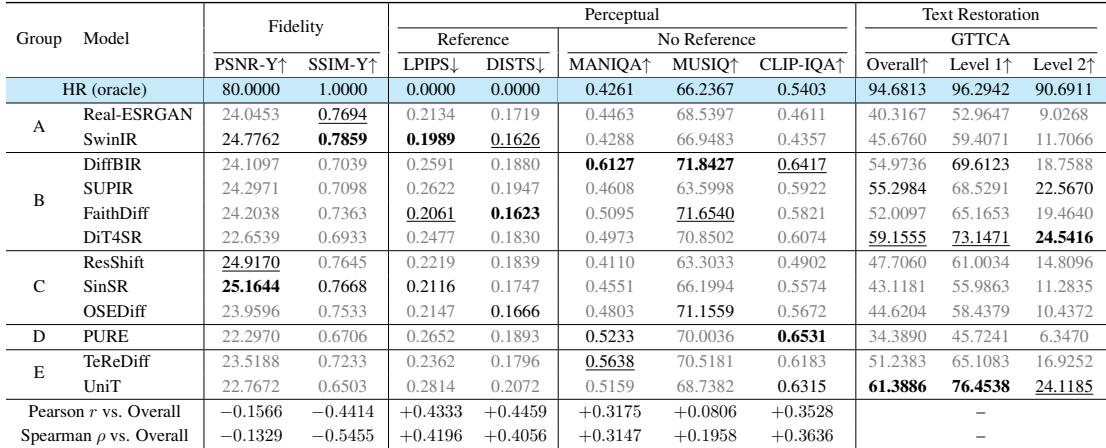
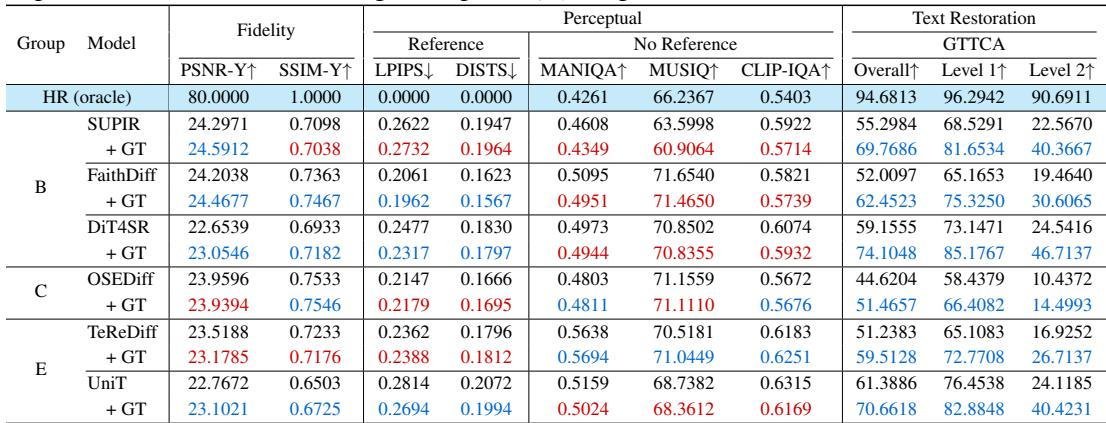
Injecting ground-truth transcripts into the caption input improves GTTCA for all evaluated text-conditioned super-resolution models, with especially large gains on Level 2 reasoning-required text. The improvement is accompanied by declines in several no-reference perceptual quality scores, indicating a trade-off between restoring reasoning-required text and preserving generic image quality. Ground-truth transcripts improve text restoration on both Level 1 and Level 2 for every model, with Level 2 improvements being most pronounced. SUPIR and FaithDiff show clear gains in overall GTTCA and Level 2 accuracy when ground-truth captions replace their original captions. Several models show lower MANIQA, MUSIQ, and CLIP-IQA scores under ground-truth captions, suggesting a perceptual quality cost. The existing text conditioning channel can carry reasoning-aware information, enabling better restoration of reasoning-required text without architectural changes.
Dedicated OCR models read ordinary text relatively well but their recall drops sharply on reasoning-required Level 2 text. MLLMs under a no-reasoning prompt also lag on Level 2, while adding a reasoning prompt improves every evaluated MLLM at both levels, with larger Level 2 gains. Gemma 4 with the reasoning prompt achieves the strongest Level 2 recall and exceeds the best OCR model by a substantial margin. The best OCR result on Level 2 is only 44.43%, while OCR Level 1 scores are considerably higher, showing a sharp drop on reasoning-required text. Reasoning prompts improve all three MLLMs on both text levels, and the Level 2 improvements are consistently larger than the Level 1 improvements. Gemma 4 with reasoning reaches 70.38% Level 2 recall, surpassing the best OCR model by 25.95 points and substantially narrowing the Level 2 gap.

RTC improves GTTCA on both reasoning levels for every text-conditioned SR model, with larger gains on Level 2 than Level 1 for most models. The approach keeps fidelity and reference-based perceptual scores stable and largely avoids the no-reference quality drop observed with transcript-only captions. It also reverses the ranking between a real-world SR model and a text-aware SR model, suggesting text-aware design may need to be rethought around reasoning. RTC improves GTTCA for every model on both Level 1 and Level 2, with larger gains on Level 2 for most models. With RTC, DiT4SR surpasses UniT on both levels despite sharing the same backbone and lacking a text-aware module.
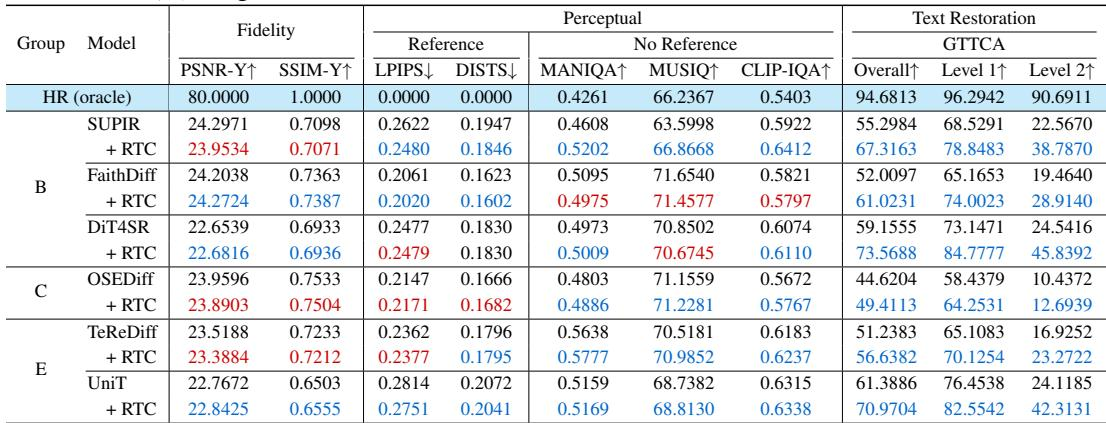
The experiments evaluate twelve real-world and text-aware super-resolution models on ReasonText, examine ground-truth transcript conditioning, compare OCR and MLLM recognition, and test the proposed RTC approach. All SR models show a sharp non-overlapping drop from Level 1 to Level 2 reasoning-required text, and conventional metrics fail to track this gap, while ground-truth transcripts improve restoration but reduce several no-reference perceptual scores. Dedicated OCR models also lose recall on Level 2, whereas MLLMs with reasoning prompts improve markedly, with Gemma 4 achieving the strongest recall. RTC improves GTTCA on both levels for every text-conditioned SR model, with larger Level 2 gains, preserves fidelity and reference-based perceptual quality, and can reverse the ranking between a real-world SR model and a text-aware SR model.