Command Palette
Search for a command to run...
BirdDreams: 그럴듯하고 반응적인 주행 세계 모델을 위한 관점 및 BEV 비디오 공동 생성
BirdDreams: 그럴듯하고 반응적인 주행 세계 모델을 위한 관점 및 BEV 비디오 공동 생성
Junyoung Seo Jaewoo Seo Seungryong Kim Laura Leal-Taixé Xiuming Zhang Seung Wook Kim
초록
주행 세계 모델은 서로 다른 자아 행동에 따라 장면이 어떻게 전개되는지 시뮬레이션하는 것을 목표로 한다. 이를 위해서는 주변 차량의 그럴듯한 움직임과 정밀한 자아 궤적 제어가 필요하다. 관점 비디오만으로 차량 움직임을 학습하는 것은 움직임이 외관과 얽혀 있고 차량이 가려질 수 있기 때문에 어렵다. 따라서 선행 연구는 차량 움직임을 명시하는 레이아웃을 조건으로 비디오 생성을 수행하여 주변 차량에 대한 제어를 제공하지만, 입력으로 미래 궤적이 필요하다. 우리는 관점 비디오와 개략적인 조감도(BEV) 비디오를 공동으로 생성하는 자기회귀적 주행 세계 모델인 BirdDreams를 소개하며, 이를 통해 장면 레이아웃이 예측된 미래의 일부가 된다. 훈련을 위해 장면 주석으로부터 렌더링되는 BEV는 도로와 차량을 고정된 미터법 축척의 단순한 형태로 묘사하여 차량 간 가림이 줄어든 하향식 위치 및 움직임 뷰를 제공한다. 반면 관점 비디오는 교통 신호나 객체 외관과 같이 BEV가 생략하는 장면 세부 정보를 유지한다. 스트림별로 하나씩 두 개의 비디오 확산 트랜스포머 간의 공동 어텐션을 통해 각 스트림이 생성 중에 서로에게 정보를 제공할 수 있다. 예측된 BEV는 또한 자아 제어를 위한 기하학적 인터페이스를 제공한다. 우리는 입력 자아 궤적을 따라 최신 프레임을 이동 및 회전시키고, 그 결과 프레임을 자아 차량만 움직였을 경우 장면이 어떻게 움직여 보일지 보여주는 소프트 조건으로 사용한다. 추론 시 BirdDreams는 HD 맵이나 차량 상태 입력 없이 단일 카메라 이미지로부터 두 비디오를 모두 생성한다. PhysicalAI-AV와 nuScenes에서 BirdDreams는 이전 주행 세계 모델보다 입력 자아 궤적을 더 충실하게 따르며, 자아 행동 조건 없이도 더 그럴듯한 자아 움직임을 생성한다. 인간 평가는 BirdDreams가 사실적인 주변 차량 행동 생성에서 관점 전용 기준선을 능가함을 보여준다.
One-sentence Summary
Researchers from NVIDIA and KAIST introduce BirdDreams, an autoregressive driving world model that jointly generates perspective and bird’s-eye-view (BEV) video with joint attention between two video diffusion transformers, uses the predicted BEV as a geometric ego-control interface, and from a single camera image follows input ego trajectories more faithfully on PhysicalAI-AV and nuScenes without requiring an HD map or vehicle-state inputs.
Key Contributions
- BirdDreams is an autoregressive driving world model that jointly predicts perspective video and a schematic bird's-eye-view (BEV) video, making scene layout part of the predicted future rather than an external input. The BEV stream represents roads and vehicles as simple shapes at a fixed metric scale, while joint attention between two video diffusion transformers lets the perspective and BEV streams inform each other.
- The predicted BEV provides a geometric control interface: its latest frame is translated and rotated along an input ego trajectory and the resulting frames are used as a soft condition. At inference, BirdDreams generates both videos from a single camera image without requiring an HD map or vehicle-state inputs.
- On PhysicalAI-AV and nuScenes, BirdDreams achieves lower ego-trajectory errors than prior driving world models with and without ego-action conditioning. Human evaluation shows that BirdDreams generates more realistic surrounding-vehicle behavior than a perspective-only baseline.
Introduction
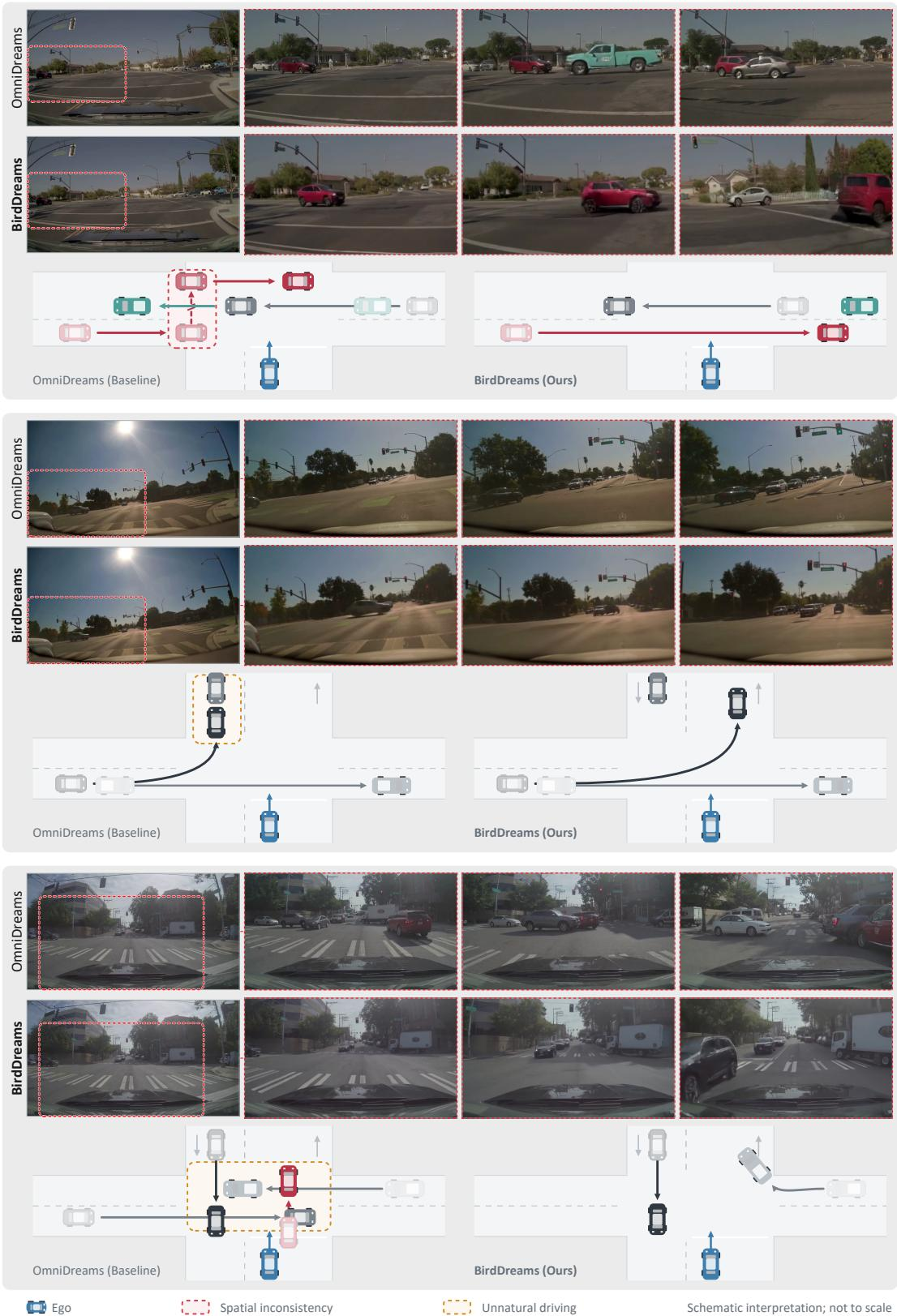
Simulation lets autonomous driving systems be tested in rare, dangerous scenarios that are hard to reproduce safely on real roads. Driving world models learn from real driving videos to synthesize future observations conditioned on ego actions, but surrounding vehicles must respond plausibly to changed ego maneuvers. Prior models such as OmniDreams condition generation on external scene layouts; when those layouts come from logged trajectories, surrounding vehicles are fixed to recorded motion and cannot react to a new ego maneuver, while models without layout inputs struggle because perspective motion is entangled with texture, lighting, occlusion, and camera distance. The authors introduce BirdDreams, an autoregressive driving world model that jointly generates perspective video and schematic bird’s-eye-view video, making scene layout part of the predicted future. The BEV stream provides a fixed metric scale, top-down view, and simplified semantic scene representation for vehicle motion, while joint attention couples it with photorealistic perspective video; the predicted BEV also serves as an action interface via reprojection along the ego trajectory to improve trajectory following.
Dataset

The authors construct paired training examples from front-camera RGB video and a rendered schematic bird’s-eye-view (BEV) video of the same scene.
-
Sources and scale: The data combines a subset of RDS-HQ-1M with about 670 hours of driving and the official nuScenes training split with 700 scenes and about 3.9 hours. The RDS-HQ-1M subset provides road-layout annotations, tracked object boxes, ego poses, and camera calibration. Road geometry is built from lanes, road boundaries, crosswalks, and wait lines. For nuScenes, the authors use HD vector maps and annotated 3D box tracks.
-
Pair construction: Each RGB frame is paired with a BEV frame rendered from object positions and orientations at the same capture time.
-
Track interpolation and filtering: Object boxes may be annotated less frequently than RGB frames. The authors use track IDs to interpolate the position and orientation of the same object between earlier and later annotations, including during temporary occlusions. Duplicate or excessively overlapping vehicle boxes are removed before rendering.
-
BEV rendering: BEV frames are rendered in orthographic overhead view with the ego vehicle centered and facing upward. Road elements are drawn as polylines and polygons, and objects as oriented cuboids. Each frame covers a square of roughly 69.3 m per side in both datasets, so pixel displacement maps consistently to physical distance across scenes. This pixel-to-meter mapping is also used for ego-action reprojection.
-
Visual schema: Road boundaries are magenta, crosswalks purple, and pedestrians yellow. Vehicle cuboids are shaded red at the front and blue at the rear to expose heading. The BEV representation preserves object positions and headings relative to the road while removing texture and perspective.
-
Model usage: The paired RGB and BEV videos are used as training data. The BEV video provides explicit supervision for vehicle motion relative to the road, complementing appearance and motion supervision from the RGB video.
Method
The authors introduce BirdDreams, a driving world model that jointly predicts photorealistic perspective videos and schematic bird's eye view (BEV) videos to capture scene dynamics and vehicle responses under ego actions. Given an initial perspective RGB image I0 and optional ego actions A0:T, the model generates the joint conditional distribution pϕ(I1:T,B0:T∣I0,c). By removing texture and lighting variations from the BEV prediction target, the architecture focuses learning on road relative vehicle motion while allowing the perspective branch to leverage explicit scene dynamics.
Refer to the framework diagram:
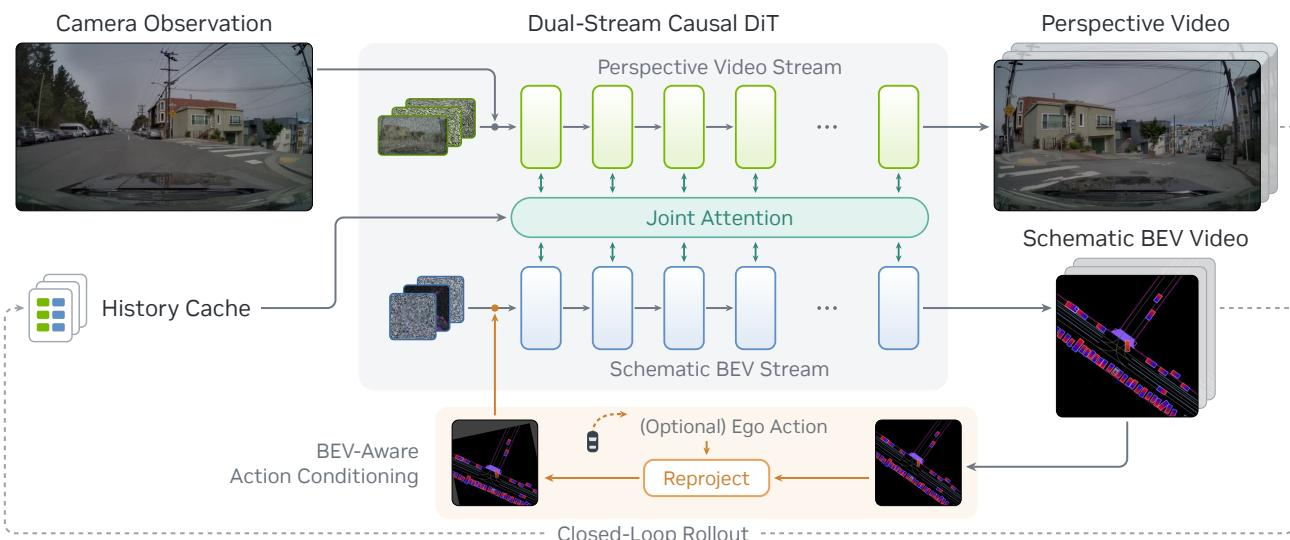
The core architecture is a dual stream causal mixture of transformers. The perspective branch inherits a pretrained OmniDreams backbone, while the BEV branch is initialized with a copy of its weights. A frozen video VAE encodes each stream into latents, which are partitioned into chunks of three latent frames. Attention is bidirectional within each chunk and causal across chunks. At every transformer block, joint attention allows queries from each branch to attend to keys and values from both streams, enabling the exchange of metric scene dynamics and visual details while retaining separate projections and output heads for specialization.
To train this joint generation, the authors employ Diffusion Forcing with per stream noise sampling. Noise levels are sampled independently for the perspective and BEV streams within each chunk. Clean VAE latents zks are corrupted via rectified flow interpolation:
xks=(1−σks)zks+σksϵks,ϵks∼N(0,I)where σks is shared across the three latent frames in a chunk but sampled independently across chunks and streams. The model predicts the flow velocity with a joint flow matching loss that averages the squared error over latent elements and chunks, weighting both streams equally to prevent the larger perspective frames from dominating.
As shown in the figure below:

For ego action conditioning, the model leverages the fixed metric scale of the BEV. The latest predicted BEV frame Br is reprojected to the target ego pose (pt,θt) to account for ego induced apparent motion. The reprojection maps each target pixel u back to the reference frame:
Bt(u)=Br(Π[R(θr)T(R(θt)Π−1(u)+pt−pr)])These reprojected frames are VAE encoded, slightly noised, and added to the BEV input tokens via a zero initialized projection. Joint attention then conveys this condition to the perspective branch.
During inference, the model performs a causal rollout, generating latents chunk by chunk while caching keys and values from previous chunks. To improve robustness during autoregressive generation, the authors fine tune the model with Resampling Forcing. This process corrupts ground truth chunks at a shared noise level τ and constructs the conditioning history autoregressively by denoising each chunk with a single Euler step:
zk=sg[xk(τ)−τvϕ(xk(τ),z<k,τ)]Target denoising then proceeds with independently sampled noise levels across chunks and streams.
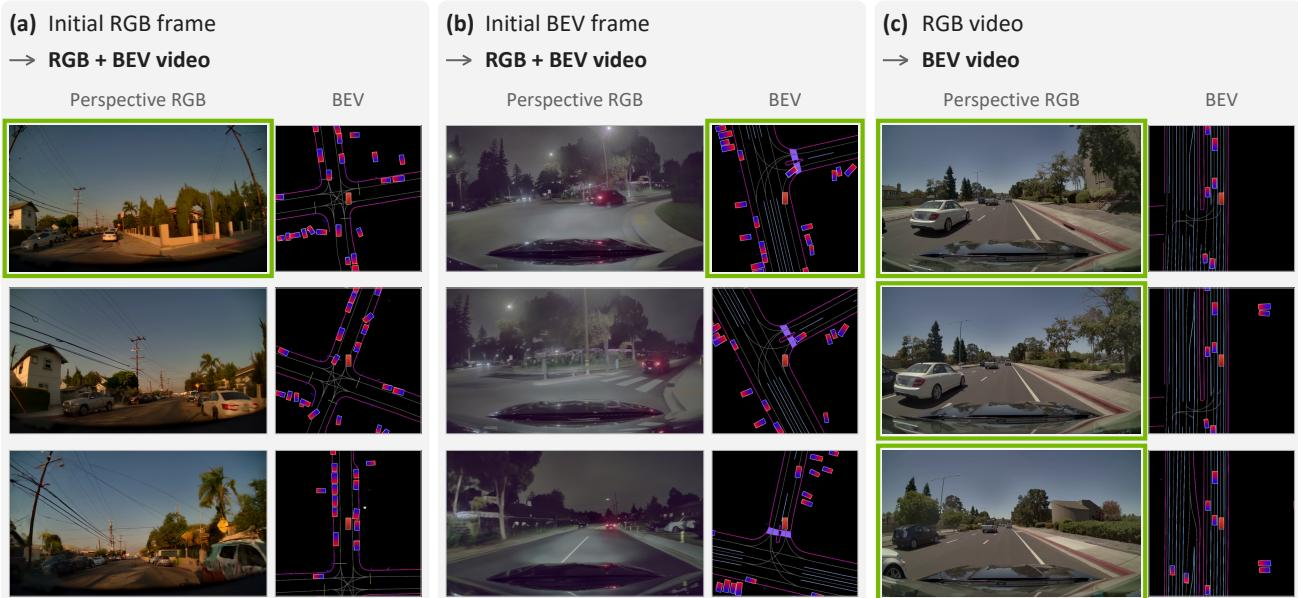
The per stream training also enables flexible conditioning at inference. The model can generate synchronized videos when a full video is provided in one stream, or it can generate both perspective and BEV videos from just an initial frame of either modality.
As shown in the figure below:
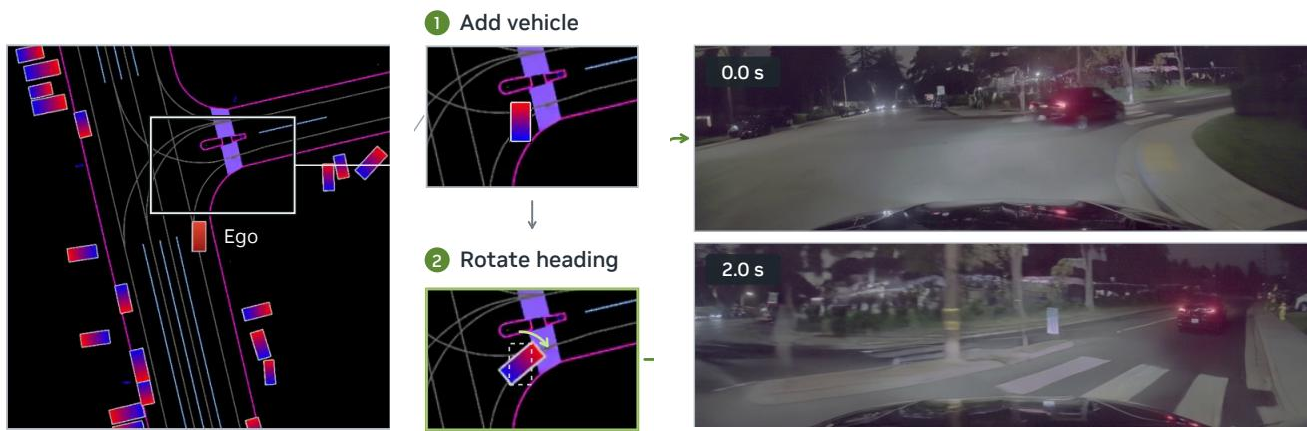
Furthermore, the schematic top view facilitates scenario editing. Users can customize driving scenarios by adding vehicles or adjusting their positions and headings directly in the projected BEV layout. The model then jointly generates the corresponding perspective and BEV videos from this edited initial layout, synthesizing scene appearance and subsequent vehicle motion without requiring a corresponding perspective image.
As shown in the figure below:
Experiment
The experiments evaluate BirdDreams on PhysicalAI-AV and nuScenes for perspective video generation and ego-trajectory control, both with and without ego-action conditioning, and compare it with open driving world models. Results show that BirdDreams generates more accurate ego motion and higher-quality video, while counterfactual rollouts and human evaluation indicate more realistic surrounding-vehicle reactions than baselines. Additional analyses validate that independent per-stream noise sampling improves generation quality, that joint perspective-BEV modeling offers a small benefit for ego-trajectory prediction, and that BEV editing supports controllable scenario generation.
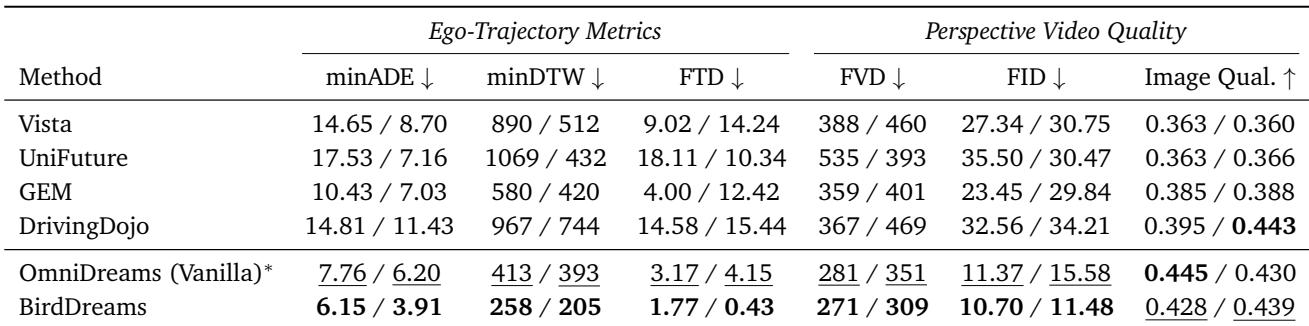
BirdDreams achieves the best ego-trajectory and video quality results among the compared methods when no ego-action conditioning is provided, including the lowest minADE, minDTW, FTD, FVD, and FID on both PhysicalAI-AV and nuScenes. Its frame-level image quality is not the best, ranking second on both benchmarks behind OmniDreams (Vanilla) on PhysicalAI-AV and DrivingDojo on nuScenes. The relative minADE improvement over OmniDreams (Vanilla) is larger on nuScenes than on PhysicalAI-AV. BirdDreams has the lowest ego-trajectory errors and the lowest FTD, FVD, and FID among all evaluated methods on both benchmarks. BirdDreams ranks second in image quality on both datasets, behind OmniDreams (Vanilla) on PhysicalAI-AV and behind DrivingDojo on nuScenes. The minADE improvement over OmniDreams (Vanilla) is larger on nuScenes than on PhysicalAI-AV.
With ego-action conditioning, BirdDreams executes the provided ego trajectory more faithfully than the compared driving world models on both PhysicalAI-AV and nuScenes, attaining the lowest trajectory error metrics. It also achieves the best perspective video fidelity metrics and ranks first for per-frame image quality on PhysicalAI-AV and second on nuScenes. The strongest baseline, OmniDreams (Plücker), uses Plücker ray embeddings for ego-motion conditioning. BirdDreams records the lowest ADE, DTW, and FTD among evaluated methods on both benchmarks. Relative to OmniDreams (Plücker), BirdDreams reduces ADE by 35% on PhysicalAI-AV and 36% on nuScenes. BirdDreams also achieves the best FVD and FID, while its image quality ranks first on PhysicalAI-AV and second on nuScenes.
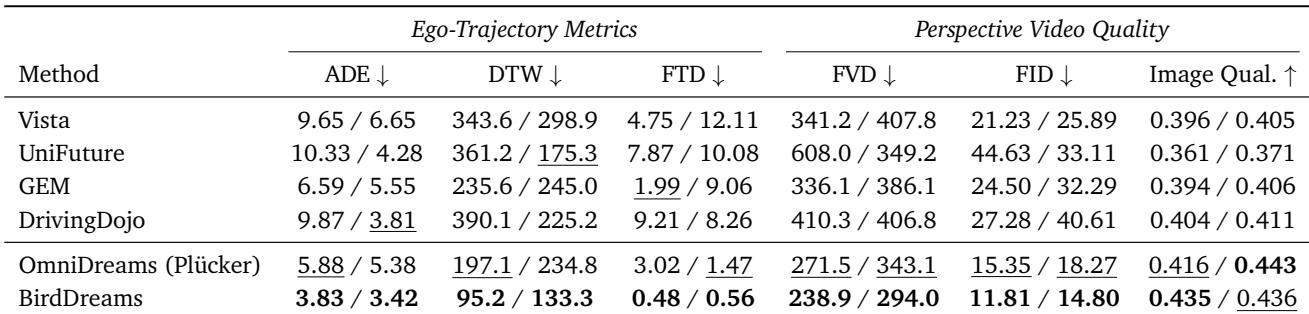
The first experiment evaluates unconditional generation quality for ego trajectories and visual fidelity on PhysicalAI-AV and nuScenes, where BirdDreams achieves the strongest overall trajectory and video quality while frame-level image quality ranks second. The second experiment adds ego-action conditioning to validate trajectory following and conditioned visual generation, showing that BirdDreams executes the provided ego trajectory more faithfully than baselines and delivers the best video fidelity, with image quality first on PhysicalAI-AV and second on nuScenes. Across both settings, BirdDreams consistently outperforms the strongest baseline, OmniDreams, with notably larger trajectory improvements under conditioning.