Command Palette
Search for a command to run...
에이전틱 로봇 조작을 위한 World In-Context Learning
에이전틱 로봇 조작을 위한 World In-Context Learning
Heng Fang Zehui Guo Yuehan Zhang Mingyang Du Dingkang Liang Xiang Bai
초록
학습된 행동 정책은 조작 기술을 네트워크 가중치에 기록하여, 학습된 내용을 그것이 학습된 분포에 묶어 둔다. 인컨텍스트 학습(ICL)은 이러한 결합을 피하지만, 다른 장면에서 기록된 시연은 로봇이 현재 마주한 세계로부터의 피드백을 전혀 담지 못하기 때문에 학습된 정책에 미치지 못했다. 우리는 에이전트가 컨텍스트에서 학습하는 내용이 의미론적이며, 시각적 외형보다는 과업 단계와 객체 역할을 기록하기 때문에 한 세계에서 수집한 경험이 다른 세계로 전이된다는 점을 관찰한다. 이 통찰에 기반하여, 우리는 동결된 모델이 시연에서 출발하여 시뮬레이터와 같은 세계에서 과업을 리허설하고, 그 피드백을 가중치가 아니라 컨텍스트에 기록하는 패러다임인 World In-Context Learning(WICL)을 제안한다. 우리는 에이전틱 조작을 위해 WICL을 구현하는 모듈형 인프라인 RoboScript를 구축한다. RoboScript는 단일 시연으로부터 시뮬레이션에서의 리허설을 통해 각 과업을 학습하고, 학습된 지식을 Task Memory로 동결하며, 모든 배포 입력이 실제 로봇에서 사용 가능함을 보장하는 데이터 격리를 갖추고 새로운 장면에 그 동결된 메모리를 배포한다. RoboTwin 2.0의 모든 50개 과업에서, RoboScript는 과업당 하나의 시연과 그래디언트 업데이트 없이 clean 및 randomized 설정 전반에 걸쳐 평균 83.4%의 성공률을 달성하여, 가장 강력한 학습된 행동 정책을 20포인트 이상 능가한다. 이 방법은 시각적 분포 전반에 걸쳐 일반화되고, 성찰(reflection)을 통해 개선되며, 파운데이션 모델에 따라 확장되고, 교차 구현(cross-embodiment) 메모리 적응을 통해 물리적 양팔 로봇으로 전이된다. 세계가 루프에 포함되면, 로봇은 가중치로 과업을 학습하는 것만큼이나 컨텍스트에서 조작 과업을 학습할 수 있다.
One-sentence Summary
Researchers from Huazhong University of Science and Technology and ArcheOne AI propose World In-Context Learning (WICL) and the RoboScript infrastructure, in which a frozen model rehearses each manipulation task in simulation from a single demonstration, stores the resulting feedback as Task Memory in context rather than in weights, and deploys that memory on new scenes to achieve 83.4% mean success across all 50 RoboTwin 2.0 tasks, exceeding the strongest trained action policy by over 20 points.
Key Contributions
- This work introduces World In-Context Learning (WICL), a paradigm in which a frozen model starts from a demonstration, rehearses the task in a world such as a simulator, and writes feedback into context rather than weights. RoboScript implements WICL as a modular infrastructure for agentic manipulation that stores the learned knowledge as a Task Memory and enforces deployment data isolation.
- The knowledge learned in context is semantic, encoding task steps and object roles rather than visual appearance, so it transfers across visual distributions, works with three different foundation models, and improves through reflection.
- On all 50 RoboTwin 2.0 tasks, RoboScript reaches 83.4% mean success across clean and randomized settings with one demonstration per task and no gradient updates, exceeding the strongest trained action policy by over 20 points. The same learned memories transfer to a physical dual-arm robot through cross-embodiment memory adaptation without re-recording demonstrations or repeating rehearsal.
Introduction
Robot manipulation has traditionally relied on trained action policies, such as vision-language-action models or world action models, which store skills in network weights. These policies perform well within their training distribution but degrade sharply under distribution shift, and every new task or domain requires new data and gradient updates. In-context learning avoids retraining, but prior in-context manipulation methods lack feedback from the world, so demonstrations from other scenes may not transfer and errors can accumulate without correction. The authors formalize World In-Context Learning (WICL), where a frozen model learns a manipulation task by rehearsing in a faithful world, distilling outcomes into reusable semantic context, and deploying without weight updates. They implement this in RoboScript, a modular agent-centric manipulation platform with strict data isolation, enabling single-demonstration learning, recursive self-improvement, and cross-embodiment transfer.
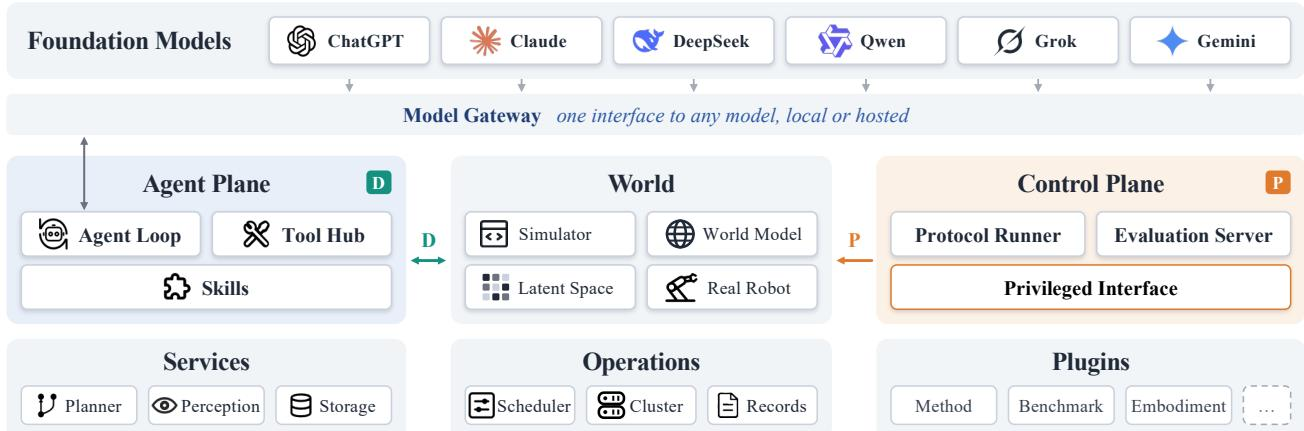
Method
The authors introduce RoboScript, an implementation of World In-Context Learning (WICL) for robot manipulation. WICL extends in-context learning by incorporating feedback from a world, alternating between rehearsal and revision to update a context C while keeping the foundation model weights θ frozen. The learned context, termed Task Memory C⋆, captures semantic knowledge about object roles, workflows, and relative geometry, allowing transfer across different environments.
Refer to the framework diagram:
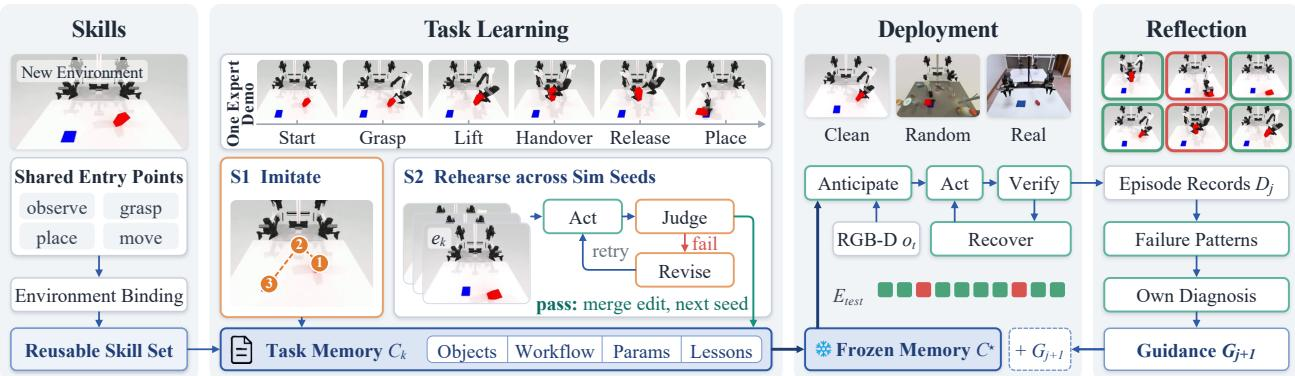
The RoboScript pipeline consists of four main stages: skill building, task learning, deployment, and reflection.
First, the agent builds a reusable skill set to establish its action interface. It perceives the environment through RGB-D images and proprioception, using geometric-first perception to detect and track objects. The agent acts through a three-layer API comprising shared entry points, environment bindings, and environment-specific skills. By segmenting a demonstration into action primitives, the agent identifies gaps and generates new skills via a coding agent, validating them until coverage stabilizes. Every action returns a receipt detailing the commanded and achieved poses, grounding the feedback r in concrete observations.
Next, the agent learns a Task Memory from a single expert demonstration through two stages: Imitation (S1) and Rehearsal (S2). In S1, a reader role initializes the memory C0=Tθ(d), and an acting role practices on the demonstration instance while a reviewing role revises the memory upon failure. In S2, the agent rehearses across new simulation seeds, updating the memory via Ck+1=Uθ(Ck,τk,rk). Revisions are merged only if they lead to success, and a memory linter ensures the Task Memory remains strictly semantic, rejecting absolute coordinates or simulator-specific facts. This strict data isolation guarantees that the acting agent relies solely on deployable data.
During deployment, the agent operates with the frozen Task Memory C⋆ on unseen instances without receiving world feedback, executing at∼πθ(⋅∣ot,C⋆). Before manipulation, it performs scene anticipation to map the semantic blueprint to the current layout and verify reachability. If an action fails, the agent recovers by moving to a safe pose and continuing without resetting the environment, bounded only by the step limit.
Finally, the system enables recursive self-improvement through a reflection loop. After evaluating on a disjoint block of instances, a reflection agent analyzes the episode records Dj, which contain only deployable observations and success indicators. It diagnoses failure patterns and generates a guidance document Gj+1=Vθ(Gj,Dj) for the next block. This process allows the agent to improve its generalization capabilities over multiple rounds without gradient updates or privileged data.
Experiment
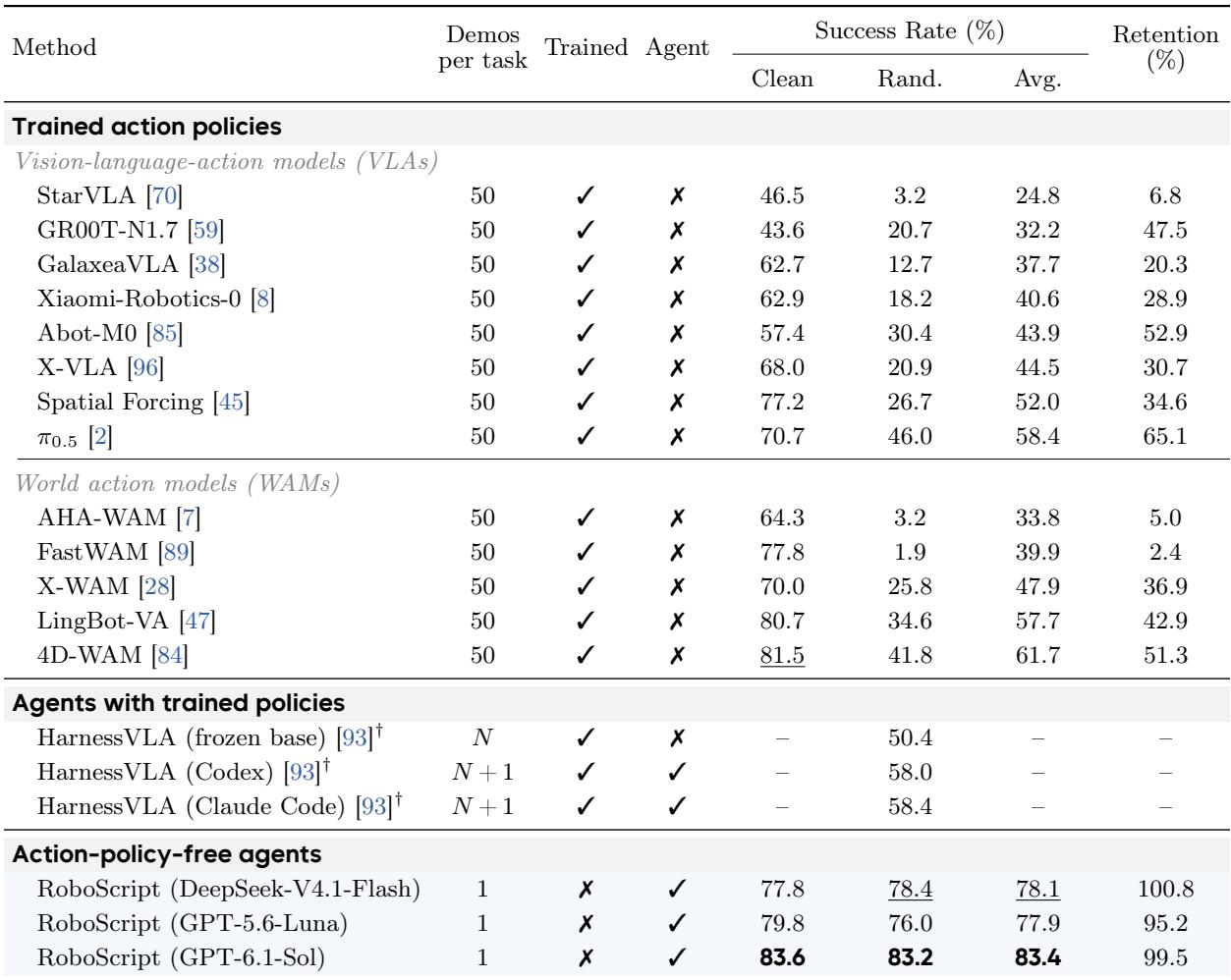
The experiments evaluate RoboScript on 50 dual-arm RoboTwin 2.0 tasks in clean and randomized settings, where the agent learns each task from one clean demonstration plus rehearsal on clean scenes and is tested in both conditions. Main results show that a single demonstration with rehearsal matches trained policies in clean scenes and substantially outperforms them under domain randomization, with gains attributed to semantic knowledge in context, demonstration anchoring, world interaction, rehearsal, and deployment recovery rather than privileged supervision. Additional experiments demonstrate recursive self-improvement from the agent’s own evaluations, report learning and inference costs, and show that the learned task memory transfers to a physical dual-arm robot with a different embodiment through parameter remapping.
RoboScript with a foundation-model agent and one demonstration per task outperforms trained action policies that use 50 clean demonstrations per task. Its clean and randomized success rates remain nearly equal, while trained policies lose most of their success under randomization. The advantage holds across different foundation models and stems from context-based memory rather than gradient updates or randomized training data. A single demonstration with rehearsal and no gradient update yields higher overall success than trained policies using 50 demonstrations per task. Foundation-model agents retain 95.2% to 100.8% of clean success under randomization, whereas trained policies retain at most 65.1%. The strongest trained policy is comparable to foundation-model agents in clean settings but drops sharply under randomization. Performance scales with model capability among foundation models, with the strongest model leading the others by about five points.
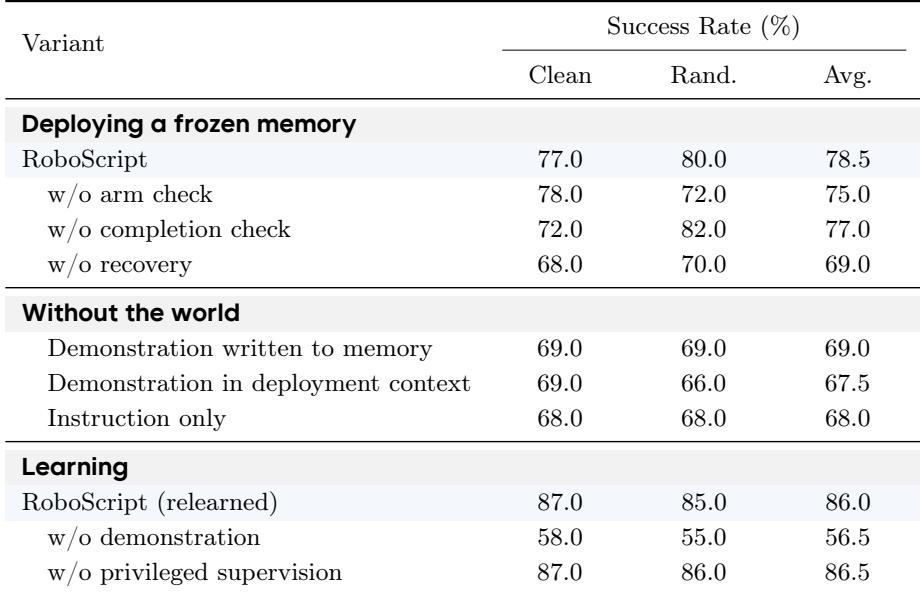
This ablation set isolates the roles of world interaction, demonstrations, and deployment components. The world and the demonstration are both necessary: removing either causes large drops, and rehearsal without a demonstration can be worse than no rehearsal. Deployment-time recovery is also important, and rehearsal adds the most on harder tasks with greater scene variation. World interaction after a demonstration produces a large gain over building a memory from the demonstration alone, while demonstration-only and instruction-only memories without world interaction differ by less than 1.5 points. Removing the demonstration before rehearsal yields the largest drop in the study, and rehearsal from the instruction alone underperforms deploying the same instruction-only memory without rehearsal by 11.5 points. Deployment-time recovery is the most important removed deployment component; removing it lowers success more than removing the arm or completion check. On harder tasks excluded from this set, rehearsal provides a larger average gain and an even larger gain under randomization, where scenes differ most from the demonstration.
Across the three foundation models, GPT-6.1-Sol achieves the highest average success rate but also the highest total cost, while GPT-5.6-Luna is the cheapest and DeepSeek-V4.1-Flash is intermediate. GPT-5.6-Luna passes the demonstration exit rule on the fewest tasks, whereas DeepSeek-V4.1-Flash passes on all tasks. Evaluation costs dominate total spending, and frozen Task Memory can be reused without additional learning cost. GPT-6.1-Sol has the highest average success rate but is the most expensive, while GPT-5.6-Luna is the least expensive. DeepSeek-V4.1-Flash passes the demonstration exit rule on all tasks but generates far more output tokens per call than GPT-6.1-Sol.

These experiments evaluate RoboScript, a foundation-model agent given a single demonstration and rehearsal, against trained action policies with many clean demonstrations, and isolate the contributions of world interaction, demonstrations, and deployment components. RoboScript retains nearly all of its clean success under randomized scenes whereas trained policies drop substantially, with gains coming from context-based memory rather than gradient updates and scaling with foundation-model capability. Ablations show the demonstration and world interaction are both necessary, deployment-time recovery and rehearsal contribute most on harder varied tasks, and cost results indicate the strongest model attains the highest success but is most expensive while frozen Task Memory can be reused.