Command Palette
Search for a command to run...
MIRIX-2.0: 다중 에이전트 메모리 시스템
MIRIX-2.0: 다중 에이전트 메모리 시스템
Wei-Chieh Huang Weizhi Zhang Jiayan Nan Peng Xia Yu Wang
초록
장기 메모리는 LLM 에이전트가 개인화되고, 일관성을 유지하며, 이전에 효과적이었던 것을 재사용할 수 있게 한다. 파라메트릭 메모리는 학습이 필요하고, 통합 과정에서 세부 사항이 영구적으로 손실될 수 있으며, 모든 기록을 보존하면 검색해야 할 저장소가 계속 증가한다. 본 논문에서는 실용성, 정확성, 효율성을 동시에 갖추도록 설계된 다중 에이전트 메모리 시스템인 MIRIX-2.0을 제시한다. 이 시스템은 5개의 QA 벤치마크 중 4개에서 비교 대상 시스템 중 가장 높은 정확도를 기록했다. LoCoMo에서 91.4%, LongMemEval-S에서 72.6%를 달성하여 가장 강력한 기준 모델보다 14.3포인트 앞섰으며, AutoDream을 비활성화한 경우 단일 홉 및 다중 홉 문서 QA에서 HyperMem보다 각각 31.0포인트와 22.0포인트 높은 성능을 보였다. 절차적 메모리로서 ALFWorld와 WebShop에서 비교된 메모리 방식 중 가장 높은 평균 성공률을 기록했고, MetaClaw-Bench에서는 49.2%를 달성하여 MetaClaw의 스킬 라이브러리 성능인 44.0%를 넘어섰다. 여섯 개의 유형화된 메모리 에이전트가 시스템 레코드로서 완전한 기록을 유지하며, 출처 하이퍼그래프가 자신의 행을 인용하는 n-항 프레임으로 일화적 및 의미적 레코드를 색인한다. 검색은 명시적 예산 하에 수행되므로 질문이 조사하는 증거의 양이 이력이 늘어나도 증가하지 않는다. AutoDream은 쓰기 경로 외부에서 중복 앵커를 병합하며 어떤 레코드도 다시 쓰지 않고, 작업 세션을 스킬로 증류한다. AutoDream을 비활성화하면 MIRIX-2.0은 5개의 시간 측정 벤치마크 모두에서 HyperMem보다 빠르게 응답한다. 파인튜닝이 필요 없고, 폐쇄형 및 개방형 모델과 함께 작동하며, 코드가 공개되어 있다.
One-sentence Summary
MIRIX AI researchers introduce MIRIX-2.0, a practical multi-agent memory system whose six typed agents, provenance hypergraph with n-ary frames, budgeted retrieval, and AutoDream consolidation achieve 91.4% on LoCoMo, 72.6% on LongMemEval-S, leading the strongest baseline by 14.3 points, the highest mean success among compared memory methods on ALFWorld and WebShop, and 49.2% on MetaClaw-Bench, all without fine-tuning.
Key Contributions
- MIRIX-2.0 is a multi-agent memory system in which six typed memory agents keep complete records as the system of record, and a provenance hypergraph indexes episodic and semantic records with n-ary frames that cite their source rows; retrieval runs under explicit budgets, so the evidence a question inspects does not grow with history.
- AutoDream consolidates outside the write path by merging duplicate anchors without rewriting any record and distilling task sessions into procedural skills.
- MIRIX-2.0 is the most accurate of the compared systems on four of five QA benchmarks, reaching 91.4% on LoCoMo and 72.6% on LongMemEval-S, where it leads the strongest baseline by 14.3 points. Its procedural memory achieves the highest mean success on ALFWorld and WebShop and reaches 49.2% on MetaClaw-Bench, and with AutoDream disabled it answers faster than HyperMem on all five timed benchmarks.
Introduction
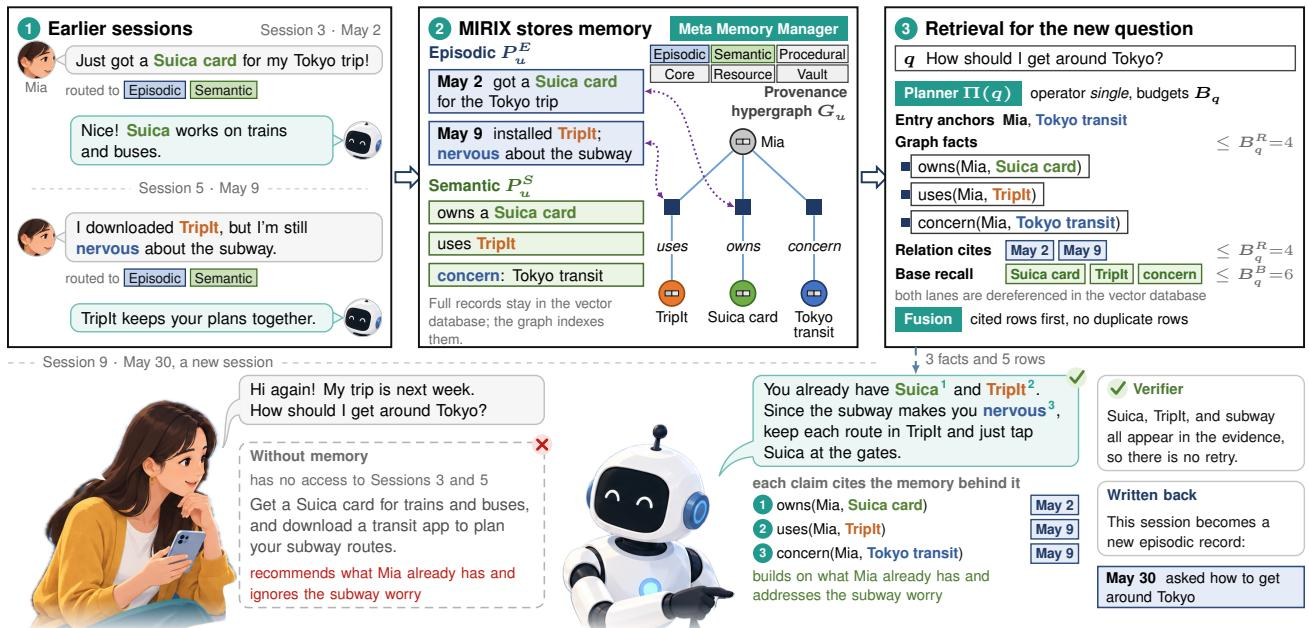
Large language model agents now operate across long sessions, so memory systems must preserve details for personalization, consistency, and reuse. Prior approaches tend to trade off competing requirements: consolidation-based memories are compact but discard details, retrieval-over-everything memories become expensive and noisy, graph and hypergraph memories often weaken n-ary relations or depend on top-down summaries, and parametric memories require training and exclude closed models. The authors introduce MIRIX-2.0, a multi-agent memory system that keeps complete typed records as the system of record and uses a provenance hypergraph only as a bounded index, with deterministic retrieval budgets and offline consolidation that merges duplicate anchors or distills skills without rewriting stored evidence.
Method
The authors design MIRIX-2.0 to separate storage from indexing, ensuring practical deployment, high accuracy, and bounded efficiency. The system operates on two distinct layers. A typed evidence plane stores complete memories and serves as the immutable system of record. A provenance hypergraph indexes the entities, events, relations, roles, and times within those memories, with every fact explicitly citing its source records. Three distinct paths operate on these layers to handle memory formation, retrieval, and consolidation.
As shown in the figure below:
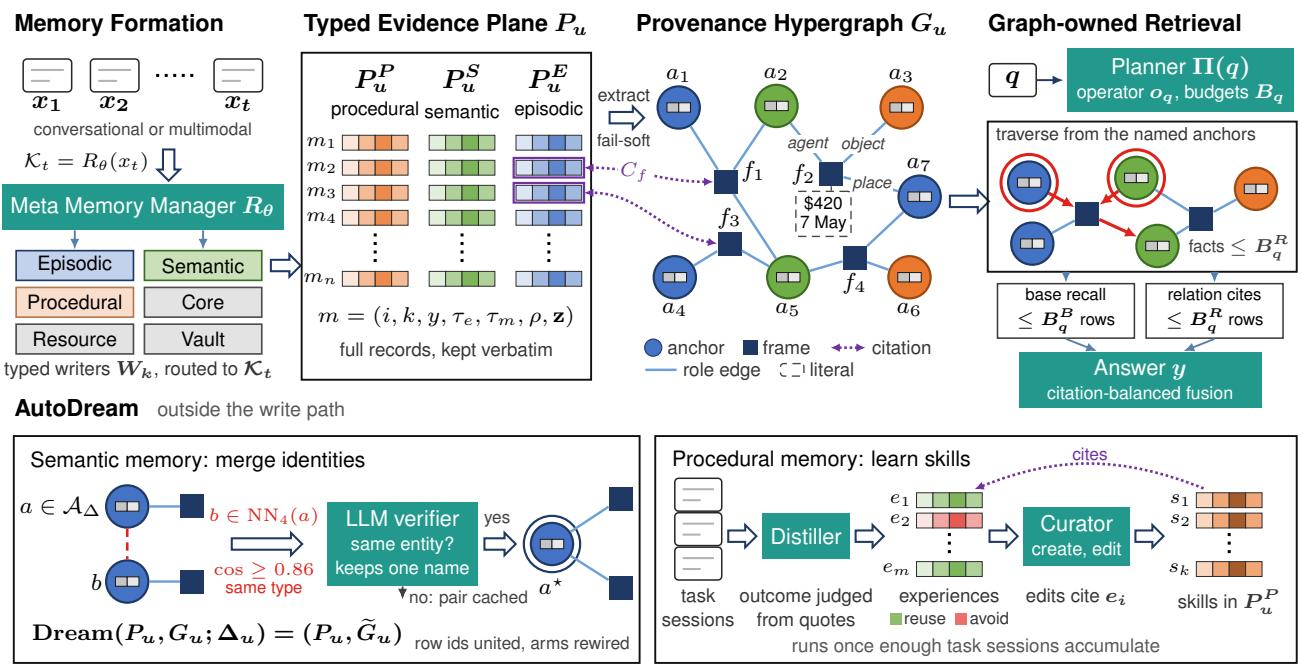
The write path begins with a Meta Memory Manager that routes each conversational or multimodal input to a subset of memory types, including Core, Episodic, Semantic, Procedural, Resource, and Knowledge Vault. Each type has a dedicated writer that produces a structured record. An evidence record is formally represented as:
m=(i,k,y,τe,τm,ρ,z)where i is an immutable row identifier, k is the memory type, y is the stored text, τe and τm are the event and mention times, ρ records source provenance, and z holds search embeddings. The system commits the record to the vector database before graph construction begins, ensuring that a failed graph write never rolls back a stored memory.
The second half of the write path transforms episodic and semantic records into graph structure. For each user, the system maintains a hypergraph defined as:
Gu=(Au,Fu,Eu)This structure consists of entity anchors Au, reified fact frames Fu, and role-typed incidence edges Eu. An anchor stores a canonical name, entity type, name embedding, and the identifiers of the episodic and semantic rows that mention it. To resolve entity identity, the system uses registry-guided canonicalization, where approximate nearest-neighbor search retrieves existing anchors, and a language model makes a conservative same-entity decision.
For each record, an extractor produces n-ary frames:
f=(p,{(rj,aj)}j=1df,ℓf,τe,τm,Cf)where p is a canonical predicate, rj is the open-vocabulary role of anchor aj, ℓf maps literal attributes to their values, and Cf is the set of cited vector-database records. Frame identity rules differ for semantic and episodic memory. A semantic frame is identified by a hash of the user, predicate, and sorted role-anchor keys, allowing repeated support for the same durable claim to accumulate citations. An episodic frame adds an occurrence key to ensure distinct events do not collapse merely because they are worded similarly.
The read path treats retrieval as the construction of a bounded evidence set rather than open-ended similarity search. Episodic and semantic candidates must enter through the graph, and the vector database dereferences only the identifiers selected by graph traversal.
Refer to the framework diagram:
A deterministic planner maps a query to a structured plan:
Π(q)=(oq,Pq,Cq,Yq,Tq,BqB,BqR)where oq is the query operator, Pq holds relation families, Cq holds non-relational constraints, Yq holds expected answer types, Tq holds temporal constraints, and BqB and BqR cap the base-recall and relation-cited rows. The query embedding recalls anchors by name, and the selected anchors open two bounded evidence lanes. The base-recall lane yields identifiers directly associated with the anchors, while the relation-citation lane seeds an indexed adjacency lookup over incident frames. Each relation-lane frame receives an additive fact score evaluating relation, entity, constraint, type, temporal, and role compatibility. Finally, a citation-balanced fusion reranks rows from both lanes, and an answer-time verification step checks the drafted answer against the evidence ledger.
The third path, AutoDream, runs outside the critical write path to consolidate memory without altering the underlying evidence store. It treats semantic and procedural memory in opposite ways.
As shown in the figure below:
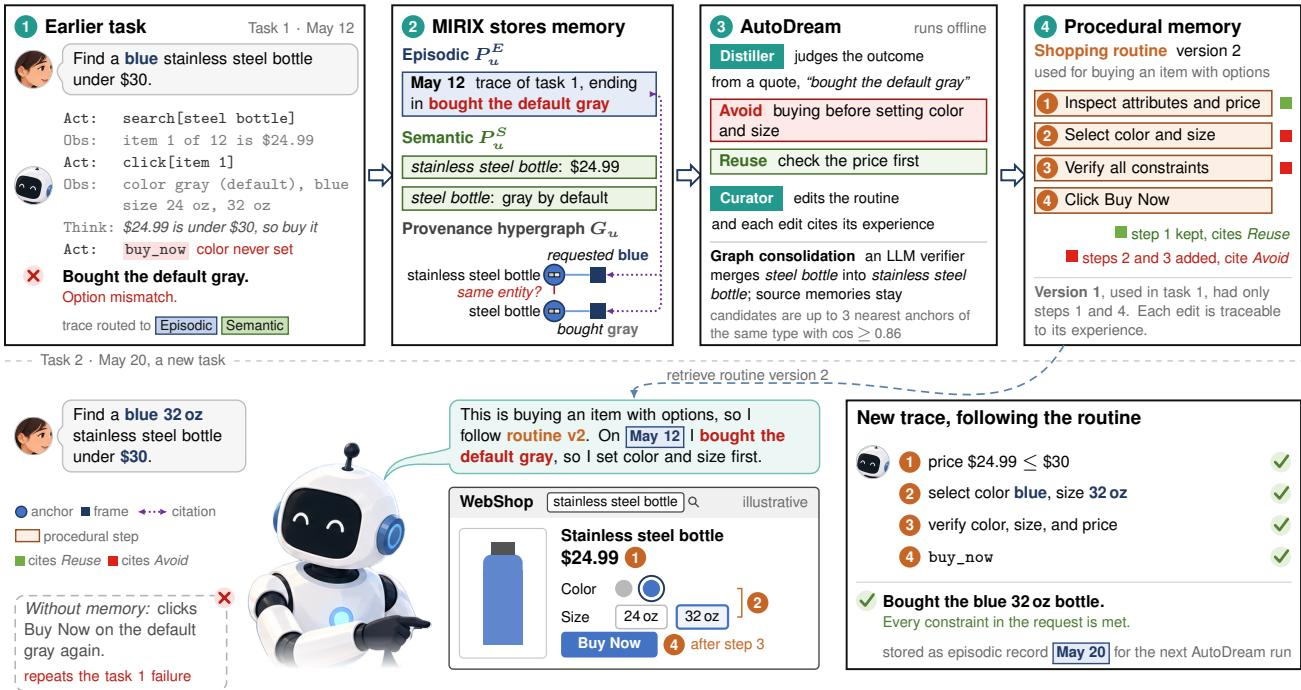
For semantic memory, AutoDream refines identities under the contract:
Dream(Pu,Gu;Δu)=(Pu,G~u)where Δu is the newly written semantic frontier. The system generates candidate anchor pairs based on embedding similarity and type matching, and a language model verifies if they denote the same entity. A confirmed merge unions the row identifiers, sums mention counts, and rewires role-typed frame arms, leaving the original evidence records completely unchanged.
For procedural memory, AutoDream distills task sessions into reusable skills. A distiller judges the outcome of pending sessions from transcript quotes, marking experiences as lessons to reuse or mistakes to avoid. A curator then turns these experiences into skills in the procedural store. The curator can create, edit, or delete a skill, and any edit must cite the specific experiences behind it. This ensures that a cited step in a skill can be traced back through its experiences to the original quoted sessions, maintaining strict source fidelity while refining the operational strategies of the agent.
Experiment
The evaluation compares MIRIX-2.0 variants (flat M0, graph-only M1, and full M2) on user-memory tasks for conversational recall, document QA, and personalized generation, and on agent-memory tasks including ALFWorld, WebShop, and MetaClaw-Bench. Graph indexing and AutoDream consistently improve conversational recall, especially for multi-hop and temporal questions, and MIRIX-2.0 leads most document QA and personalization benchmarks, though it trails baselines on DetectiveQA. For agent memory, learned procedures raise success on held-out interactive tasks and improve MetaClaw-Bench scores with several backbones, but gains vary by task type and backbone, and retrieved procedures can sometimes interfere. Efficiency results show faster answering than HyperMem with graph indexing but slower ingestion than flat memory, while procedural memory can reduce steps without reliably reducing token costs.
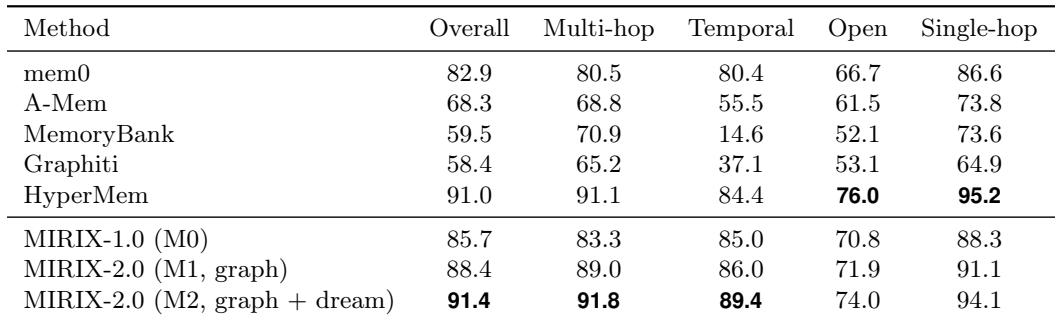
The LoCoMo results show a consistent ordering for the system variants: flat vector memory scores lowest, graph retrieval improves overall accuracy, and semantic AutoDream yields the strongest configuration. Improvements vary by question type; graph retrieval helps multi-hop questions most, while AutoDream adds gains across categories including temporal recall. The full configuration leads overall and in temporal and multi-hop recall, whereas HyperMem remains stronger on open-domain and single-hop questions. Flat vector memory, graph retrieval, and graph plus AutoDream configurations rank in increasing order on overall LoCoMo accuracy. Graph retrieval contributes the largest benefit on multi-hop questions, while semantic AutoDream adds further gains across categories including temporal recall. The full system surpasses HyperMem overall, with its advantage concentrated in temporal and multi-hop recall, while HyperMem retains higher open-domain and single-hop scores. Among external baselines, HyperMem is the strongest, and several other baselines perform particularly poorly on temporal questions.
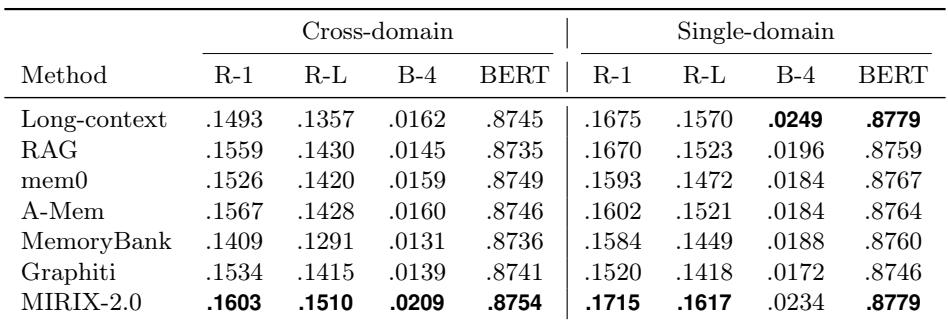
On MemoryCD review summarization, no single method leads every metric. Long-context performs best in single-domain evaluation and also leads cross-domain BLEU-4, while cross-domain ROUGE-1, ROUGE-L, and BERTScore are split among A-Mem, RAG, and mem0 with small differences. MemoryBank and Graphiti are generally weaker, with Graphiti lowest on all single-domain metrics. Long-context ranks first on all single-domain metrics: ROUGE-1, ROUGE-L, BLEU-4, and BERTScore. Cross-domain performance is more mixed, with A-Mem leading ROUGE-1, RAG leading ROUGE-L, Long-context leading BLEU-4, and mem0 leading BERTScore.
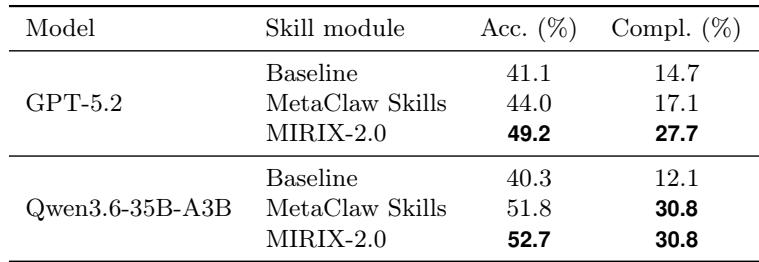
On MetaClaw-Bench Part I, agent memory improves accuracy and completion over a no-memory baseline for both tested backbones. MIRIX-2.0 achieves the highest accuracy with both backbones, while the completion gains are largest with MIRIX-2.0 on GPT-5.2. MetaClaw Skills alone already accounts for much of the gain on Qwen3.6-35B-A3B. MIRIX-2.0 leads accuracy on both backbones, lifting GPT-5.2 from the low forties to just under fifty percent and Qwen3.6-35B-A3B from the low forties to just over fifty percent. Completion improves most strongly with MIRIX-2.0 on GPT-5.2, while Qwen3.6-35B-A3B reaches the same completion level with MetaClaw Skills and MIRIX-2.0.
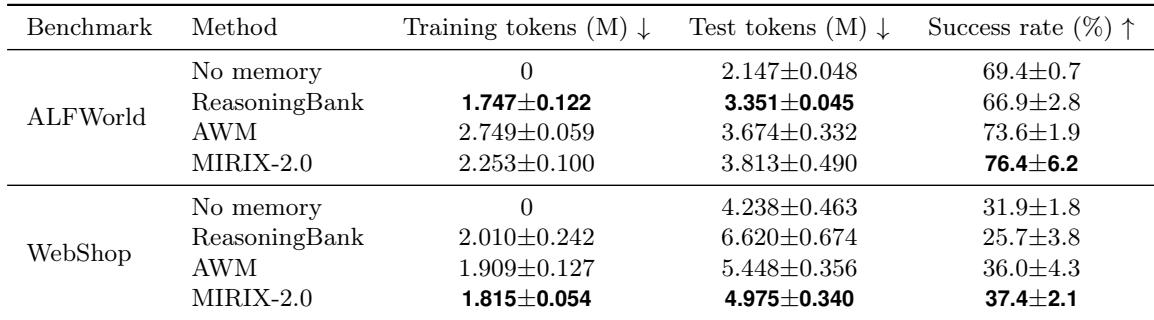
Across ALFWorld and WebShop, procedural memory methods increase test token use relative to no memory. On WebShop, MIRIX-2.0 achieves the highest mean success while using the fewest training and test tokens among the memory methods. On ALFWorld, MIRIX-2.0 records the highest test token use among memory methods even though its mean step count is lower. On WebShop, MIRIX-2.0 has the lowest training and test token use among the memory methods and the highest mean success. On ALFWorld, MIRIX-2.0 uses more test tokens than any other memory method despite requiring fewer interaction steps on average. Compared with no memory, test token use rises on both ALFWorld and WebShop, so procedural memory does not automatically reduce token cost.
Across four evaluations, memory components are assessed on long-form memory QA (LoCoMo), review summarization (MemoryCD), agent task execution (MetaClaw-Bench), and interactive decision-making (ALFWorld/WebShop). The experiments validate that graph retrieval and semantic consolidation improve LoCoMo accuracy, especially for temporal and multi-hop questions, while no single method dominates MemoryCD summarization and long-context is strongest in single-domain evaluation. Agent memory reliably improves task accuracy and completion, with MIRIX-2.0 leading most settings, but procedural memory increases token usage rather than reducing cost.