Command Palette
Search for a command to run...
USDCraft: 시뮬레이션을 위한 관절형 3D 자산의 기하학적 기반 프로그래매틱 모델링
USDCraft: 시뮬레이션을 위한 관절형 3D 자산의 기하학적 기반 프로그래매틱 모델링
Chuanrui Zhang Zaijia Yang Duomin Wang Lu Shi Daquan Zhou Ruihua Zhang Ziwei Wang
초록
기하학적으로 충실하고 기능적으로 작동하는 관절형 3D 자산은 시뮬레이션에서 훈련된 정책이 실제 물체로 전이되어야 하는 실물-대-시뮬레이션 로봇 조작에 필수적이다. 최근의 메시 기반 방법들은 주석이 달린 3D 자산으로부터 관절 구조를 추론하는 것을 학습하지만, 실제 세계의 물체가 훈련 분포를 벗어나거나 메시가 불완전하거나 손상된 경우 배포가 여전히 어렵다. 이러한 한계를 해결하기 위해, 우리는 관절형 자산 재구성을 부분적인 기하학적 증거에 기반한 프로그래매틱 모델링으로 정식화하고, 사전 훈련된 LLM이 작업별 훈련 없이 시뮬레이션 준비가 완료된 관절형 자산을 위한 실행 가능한 프로그램을 작성하고 수정하는 프레임워크인 USDCraft를 소개한다. 우리는 소스 메시를 관측된 표면과 미지의 공간을 구분하는 계량적 텍스트 설명으로 변환하는 소스 기하학 분석과, 각 후보를 동일한 표현으로 다시 인코딩하여 불일치가 프로그램 수정으로 이어지도록 하고 관측되지 않은 영역은 완성을 위해 열어 두는 반복적 기하학 재검사를 제안한다. 시각적 피드백과 물리적 저작 지침이 모델링 과정을 완성하며, 이는 수동 조정 없이 Isaac Sim에 로드되는 명시적 물리 속성을 가진 관절형 USD 자산을 생성한다. 실험은 두 벤치마크에서 최고 수준의 관절 복원 성능을 보여주고, 실물-대-시뮬레이션-대-실물 로봇 조작에 대한 USDCraft의 효과를 검증한다.
One-sentence Summary
Researchers from NVIDIA, NTU, and PKU propose USDCraft, a geometrically grounded programmatic modeling framework in which a pretrained LLM writes and revises executable programs for simulation-ready articulated 3D assets without task-specific training, combining source geometry analysis and iterative geometric rechecking to recover articulation from incomplete or corrupted meshes and achieving leading benchmark results and real-to-sim-to-real robot manipulation.
Key Contributions
- Articulated asset reconstruction is formulated as programmatic modeling grounded in partial geometric evidence, and USDCraft is introduced as a framework in which a pretrained LLM writes, compiles, and revises executable programs for simulation-ready articulated assets without task-specific training.
- Source geometry analysis converts the input mesh into a metric textual description distinguishing observed surface from unknown space, and iterative geometric rechecking re-encodes candidate programs so discrepancies point to targeted edits while unobserved regions remain open to completion.
- A generated library, USDCraft-10k, is also introduced; experiments demonstrate leading articulation recovery on two benchmarks and validated real-to-sim-to-real robot manipulation, with assets loading into Isaac Sim without manual adjustment.
Introduction
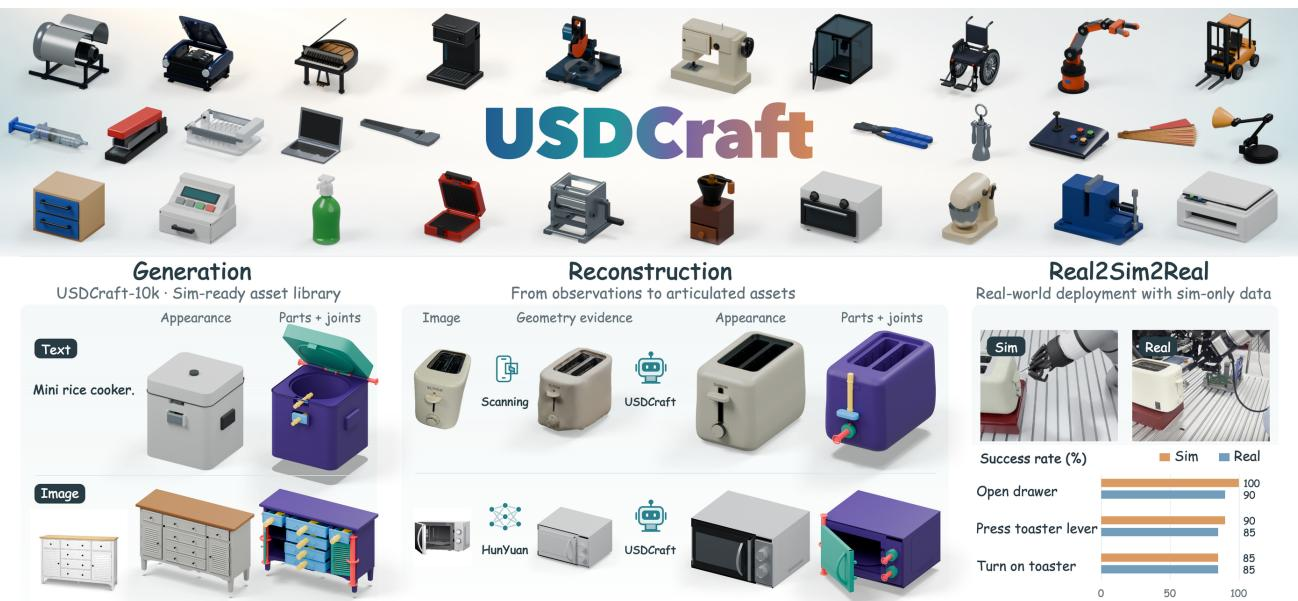
Articulated real-to-sim modeling has become important because robot learning increasingly relies on simulated interaction with everyday objects, which requires assets with coherent geometry, functional articulation, and explicit physical properties. Prior mesh-based reconstruction methods partition static meshes into parts and estimate joints, but they struggle with incomplete or fused surfaces and often depend on task-specific training, limiting generalization to out-of-distribution objects. Agentic methods use large language models to build objects as executable programs, yet without measured geometric guidance their generated dimensions and part placement may not match the target instance. To address this, the authors formulate articulated asset reconstruction as programmatic modeling grounded in partial geometric evidence and introduce USDCraft, a framework in which a pretrained LLM writes, compiles, and revises an editable asset program from a source mesh and a reference image. The framework grounds reconstruction through source geometry analysis and iterative geometric rechecking, while visual feedback helps identify missing parts and implausible assemblies.
Method
The authors present USDCraft, a framework that treats articulated asset reconstruction as programmatic modeling grounded in partial geometric evidence. The core of the system is a modeling agent powered by an off-the-shelf large language model. This agent iteratively refines an executable asset program against a source, supported by a modeling harness comprising various tools, guidance mechanisms, and feedback loops.
Refer to the framework diagram
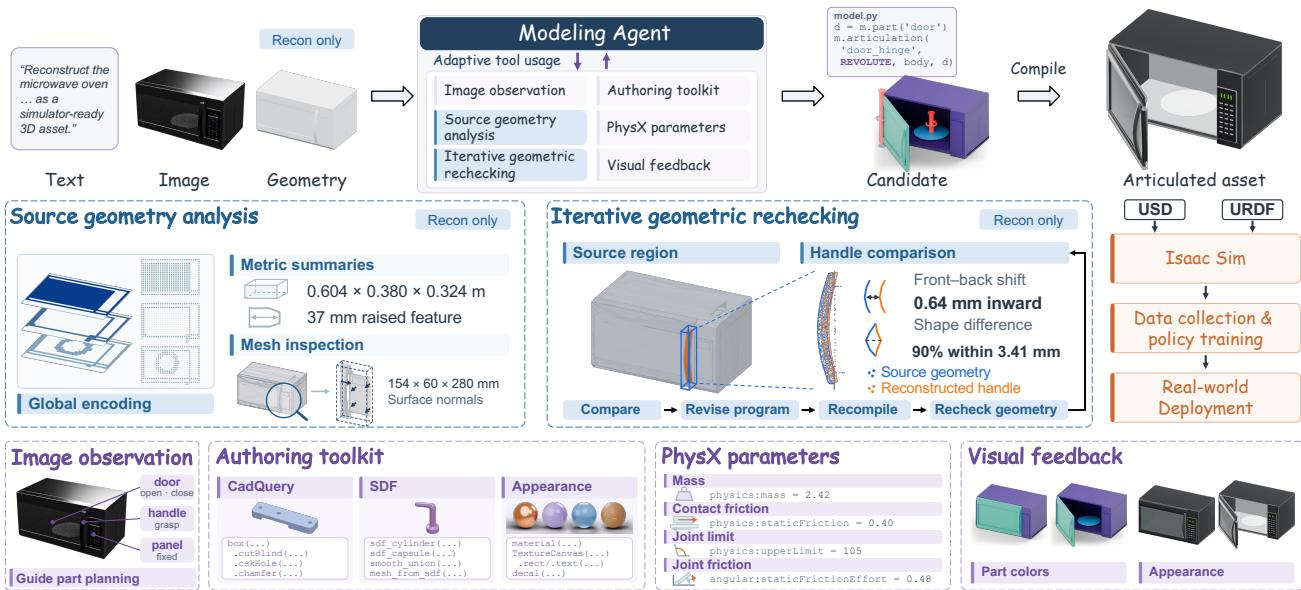
Because large language models cannot directly interpret 3D meshes, the authors introduce a source geometry analysis module. This module converts the source mesh into a compact metric text representation that separates observed surfaces from unknown space. It combines a global axial geometry encoding, which samples the surface support on a regular grid in a shared metric frame, with targeted mesh inspection. The axial encoding serializes the grid cells as an ordered sequence of axial slice maps along the vertical axis, alongside local metric summaries of bounds, protrusions, openings, and observed interior fittings. Cells outside the sampled source surface are marked as unknown rather than empty or solid, allowing the agent to complete missing regions based on the reference image and the object function.
The authors represent each asset as an executable program to expose the quantities required for feedback and modification. Parts, joints, and physical properties are defined by explicit parameters, enabling local edits instead of full regeneration when discrepancies are found. The authoring toolkit integrates parametric solid modeling with CadQuery for dimension-controlled mechanical parts and signed distance field modeling with analytic primitives for organic shapes. Physical properties are authored directly as PhysX parameters, setting masses, contact friction, joint limits, and drives in the native terms of the physics engine. This approach removes the need for conversion steps and ensures plausible physical behavior upon compilation into a USD asset.
To correct errors introduced during program generation, the system employs iterative geometric rechecking. This process expresses feedback in the same representation as the source evidence. At a given revision step, the current candidate is re-encoded on the source grid. Let SM denote the set of grid cells containing the sampled source surface, and St denote the cells containing the sampled candidate surface. The comparison yields source coverage and two discrepancy sets:
rt=∣SM∣∣SM∩St∣,Dt−=SM∖St,Dt+=St∖SM.Cells in Dt− represent observed source surface missing from the candidate, serving as a direct correction signal. Cells in Dt+ lie in unknown source regions and are treated as open questions for the agent to resolve using the image and object function. For finer comparison, first-surface maps from six axis-aligned directions measure face offsets and silhouette differences. The discrepancy is decomposed into a median offset b and a profile difference eprofile:
b=medianu∈Ωδ(u),eprofile=Q0.9({∣δ(u)−b∣:u∈Ω}),where δ(u)=dt(u)−dM(u) represents the depth residua. The median offset measures the front-back shift, while the profile difference measures shape variation, guiding the agent on whether to adjust placement or shape.
Finally, visual feedback complements geometric diagnostics by rendering the candidate with its materials and per-part colors from agent-selected viewpoints. The agent compares these renders with the reference image to identify missing components, implausible assemblies, incorrect appearances, and clearance issues during articulation, revising the program accordingly. In generation tasks without a source mesh, visual feedback serves as the primary validation mechanism.
Experiment
The experiments evaluate USDCraft on reconstruction and articulation recovery using USDCraft-bench and Lightwheel, real-to-sim-to-real robot manipulation, text- and image-conditioned asset generation, and component ablations. USDCraft consistently outperforms baselines by combining programmatic rebuilding with source geometry analysis, which improves part recovery, geometric accuracy, and joint placement, while the authoring harness provides the largest gains and transfers across model families. Manipulation studies confirm that structurally complete and correctly sized assets minimize sim-to-real policy drops, and generation results show USDCraft achieving the highest quality scores with the lowest runtime. Ablations attribute the main improvements to the authoring SDK and source geometry analysis, with iterative rechecking and visual feedback further enhancing geometric fidelity and catching missing parts.
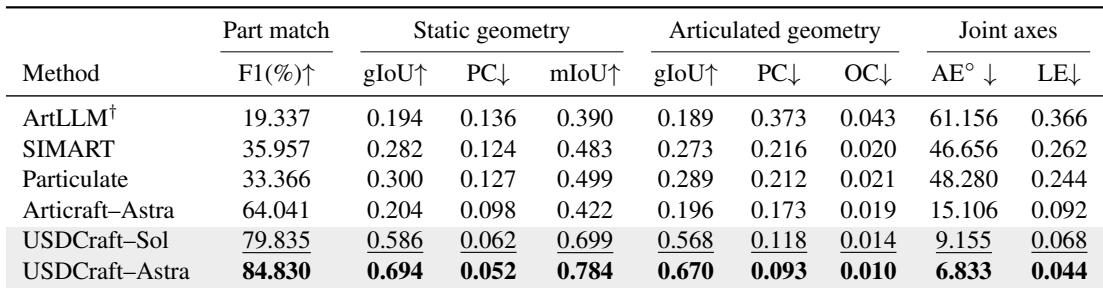
Both USDCraft configurations outperform all baselines on every reported reconstruction metric. USDCraft-Astra leads overall with the best part matching, static and articulated geometry, and joint estimation, while ArtLLM reports only successful outputs and still trails the other methods. Segmentation-based baselines remain limited because they can only partition the provided surface and cannot recover missing or fused parts. USDCraft-Astra achieves the strongest part matching and the lowest geometric and joint errors among all compared methods. USDCraft-Sol also exceeds all four baselines, showing the advantage is not limited to one USDCraft configuration. ArtLLM reports metrics only for successful reconstructions and still scores below the other approaches. SIMART and Particulate are constrained to partitioning existing surfaces, leaving fused or missing parts uncorrected.
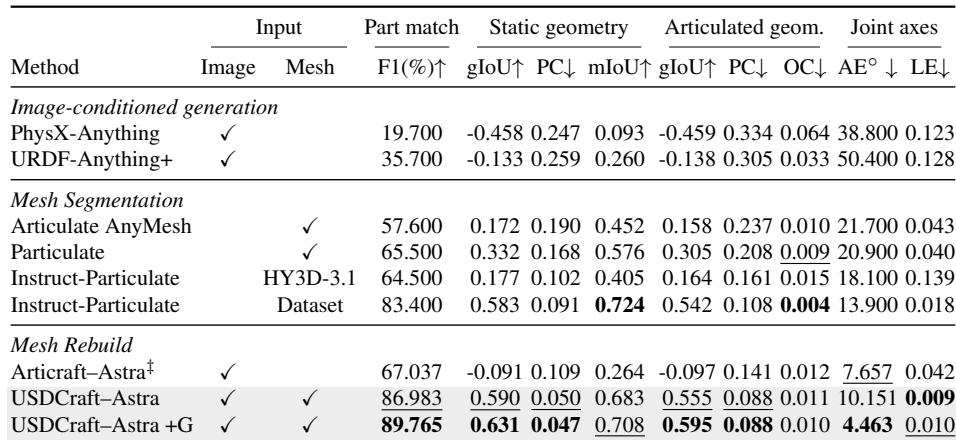
The comparison spans image-conditioned generation, mesh segmentation, and programmatic rebuilding on Lightwheel assets. Image-conditioned generation methods trail mesh segmentation substantially in part matching and geometric overlap, while Particulate is the stronger segmentation method compared with Articulate AnyMesh. Programmatic rebuilding with USDCraft-Astra achieves the best part matching, overlap, and joint location, though mesh segmentation preserves source surface accuracy more closely. Image-conditioned generation methods perform far worse on part matching and geometric overlap than mesh segmentation, with negative static and articulated gIoU values. Within mesh segmentation, Particulate yields better part matching and higher static and articulated geometry scores than Articulate AnyMesh. Mesh segmentation methods retain lower whole-object Chamfer and higher mIoU because they reproduce the supplied mesh surface exactly, whereas rebuilding accumulates small surface deviations. USDCraft-Astra attains the best part matching, static and articulated overlap, part Chamfer distances, and joint location error, while Articraft-Astra has lower angular error but matches fewer movable parts.
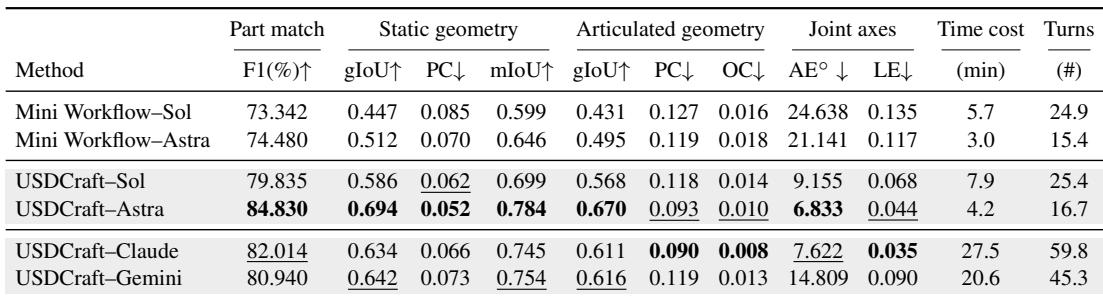
USDCraft improves reconstruction quality over Mini Workflow for both Sol and Astra backbones, with gains on all nine reported metrics and the largest improvements in joint-axis accuracy. The advantage is driven by harness tools and feedback, since source geometry analysis and iterative geometric rechecking anchor joints to measured hinge-bearing features. USDCraft-Sol also outperforms Mini Workflow-Astra on every metric, and the added analysis and rechecking cost about one to two extra minutes per asset for GPT backbones. USDCraft improves all nine reconstruction metrics over Mini Workflow with both Sol and Astra backbones. The largest gains appear in joint-axis accuracy, where measured geometry anchors hinge-bearing features such as openings, rails, and handles. USDCraft-Sol outperforms Mini Workflow-Astra on every metric, indicating the harness matters more than the backbone. Added analysis and rechecking cost about one to two extra minutes per asset for GPT backbones.
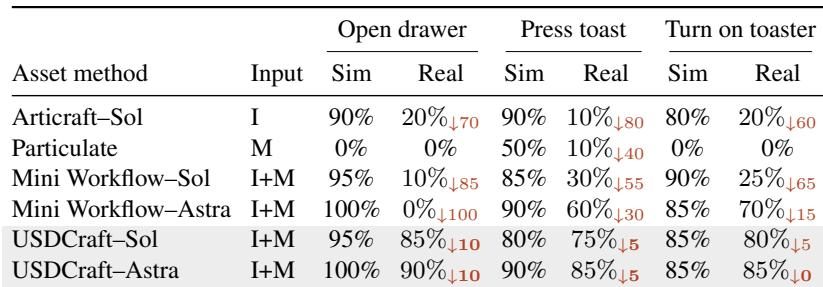
USDCraft variants show the most reliable simulation-to-real transfer, with high real success and only small drops from simulation across all tasks. Articraft, built from images alone, loses 60 to 80 points in real testing despite strong simulation performance, while Mini Workflow is inconsistent and can fail completely due to misplaced handles. Particulate supports only the lever-pressing task, indicating limited structural completeness. USDCraft variants maintain the highest real success rates and the smallest simulation-to-real drops across drawer, toaster-lever, and toaster-switch tasks. Articraft achieves high simulation success but suffers large real-world drops of 60 to 80 percentage points. Mini Workflow transfer varies widely across tasks and variants, including a complete failure on drawer opening for one variant. Particulate records nonzero success only on lever pressing, reflecting incomplete reconstruction coverage.
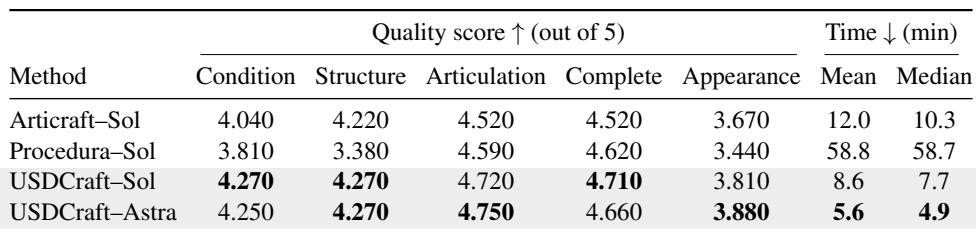
In text- and image-conditioned generation, USDCraft-Sol and USDCraft-Astra outperform Articraft-Sol and Procedura-Sol across condition adherence, structural quality, articulation, completeness, and appearance while also requiring the least generation time. All methods score relatively high on articulation and completeness, with the largest gaps appearing in condition adherence and appearance. Procedura-Sol is slower and has a lower structural quality score, while USDCraft variants improve appearance through material, texture, and decal authoring. USDCraft-Sol and USDCraft-Astra achieve the highest per-dimension quality scores and the lowest mean and median generation times. The largest quality differences among methods are in condition adherence and appearance, while articulation and completeness remain high across methods. Procedura-Sol is the slowest method and records the lowest structural quality score among the compared systems.
The experiments evaluate reconstruction quality on Lightwheel assets, ablation of the USDCraft harness against Mini Workflow, simulation-to-real transfer, and text- and image-conditioned generation. USDCraft variants consistently outperform all baselines in part matching, geometric accuracy, joint estimation, real-world task success, generation quality, and generation time, with the harness tools and iterative feedback providing the main advantage over backbone choice. Image-only and segmentation-based methods remain limited by missing or fused parts and large simulation-to-real drops, while USDCraft achieves the strongest overall reliability and structural completeness.