Command Palette
Search for a command to run...
nanoMuse: 당신이 소유한 모든 기기를 위한 오픈소스 개인 에이전트
nanoMuse: 당신이 소유한 모든 기기를 위한 오픈소스 개인 에이전트
Guangyi Liu Yong Liu Jiangning Zhang
초록
2011년의 어시스턴트는 응답하고 대기했고, 2023년의 에이전트는 작업 하나를 수행하고 멈췄다. 2026년 9월 Meta의 Muse는 한 사람을 위한 에이전트를 선보였는데, 계정, 기기, 기억, 지속되는 대화를 갖추었지만 특정 국가의 사업자 클라우드에 폐쇄적으로 존재했다. 그러한 에이전트는 사용자의 계정과 기기에서 행동하고, 여러 주에 걸쳐 사용자를 기억하며, 가치가 있을 때 먼저 말을 걸고, 자신이 한 일에 대해 답할 것이 기대된다. 이는 모델이 아니라 일종의 소프트웨어이며, 지금까지 공개된 대응물이 없었다. 본 보고서는 개인 에이전트를 다섯 가지 질문과 세 가지 지평으로 정의한다. Meta의 공개 기록과 프로덕션 프롬프트 사본을 바탕으로 Muse의 구축 방식을 파악하고, 각 진술에 출처를 표시한다. 이어서 GPL-3.0의 오픈소스 대응물인 nanoMuse를 제시한다. nanoMuse는 사용자가 소유한 모든 기기에서 하나의 에이전트로, 휴대전화와 컴퓨터 화면을 조작하는 손을 가진다. 이 에이전트들은 누구나 운영할 수 있는 릴레이를 통해 하나의 대화를 공유한다. 모든 행동은 Sentinel을 거치고, 기억은 사용자가 읽을 수 있는 파일이며, 모델은 사용자가 선택한다. 크기와 비용은 추정치로 제시된다. 공개 범위, 출처가 기록된 기억, 손을 위한 평가 스위트와 이를 위한 개방형 모델은 로드맵으로 제시된다.
One-sentence Summary
Researchers from Zhejiang University propose nanoMuse, an open-source GPL-3.0 personal agent that runs on every device a person owns and shares one conversation through a self-hostable relay with screen control, sentinel-gated actions, readable memory files, and user-chosen models, as the open counterpart to Meta's closed Muse.
Key Contributions
- The report defines the personal agent through five questions and three horizons, tracing the lineage from the assistants of 2011 to the agents of September 2026.
- It reconstructs how Meta’s Muse is built from Meta’s public record and a copy of its production prompt, with each statement marked by its source.
- It introduces nanoMuse, an open-source GPL-3.0 counterpart that runs on every device a person owns, with hands on the phone’s screen and the computer’s, a shared conversation relay anyone can run, a Sentinel over every action, memory as files, and model choice. Size and cost are given as estimates, and an open roadmap covers memory with provenance, an evaluation suite for the hands, and an open model for them.
Introduction
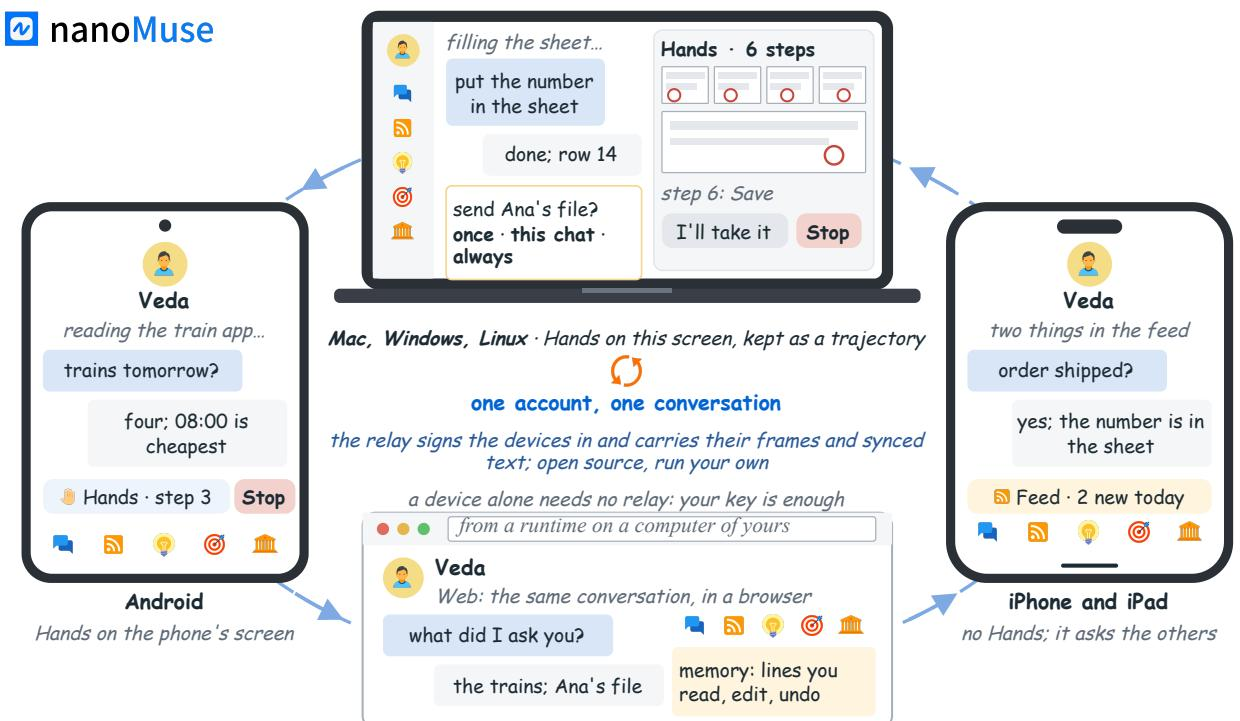
The authors trace the shift from task-oriented assistants to personal agents, culminating in the September 2026 wave led by Meta's Muse. A personal agent acts on one person's accounts, devices, and files over time and must be accountable, but commercial offerings like Muse run as closed, vendor-hosted Linux VMs with only a small gadget SDK opened. Prior agents either handled single tasks in vendor clouds or, if open, ran on user infrastructure without full screen control, and cloud-only agents cannot reach everyday mobile apps that lack APIs or web pages. To address this, the authors present nanoMuse, an open personal agent that runs on hardware the user already owns, with hands on phone and computer screens, a Sentinel over actions, memory as files, and reported size and cost.
Method
The authors design Muse as a background personal agent structured across three distinct security zones: the surfaces of the user, a dedicated cloud environment, and isolated host services.
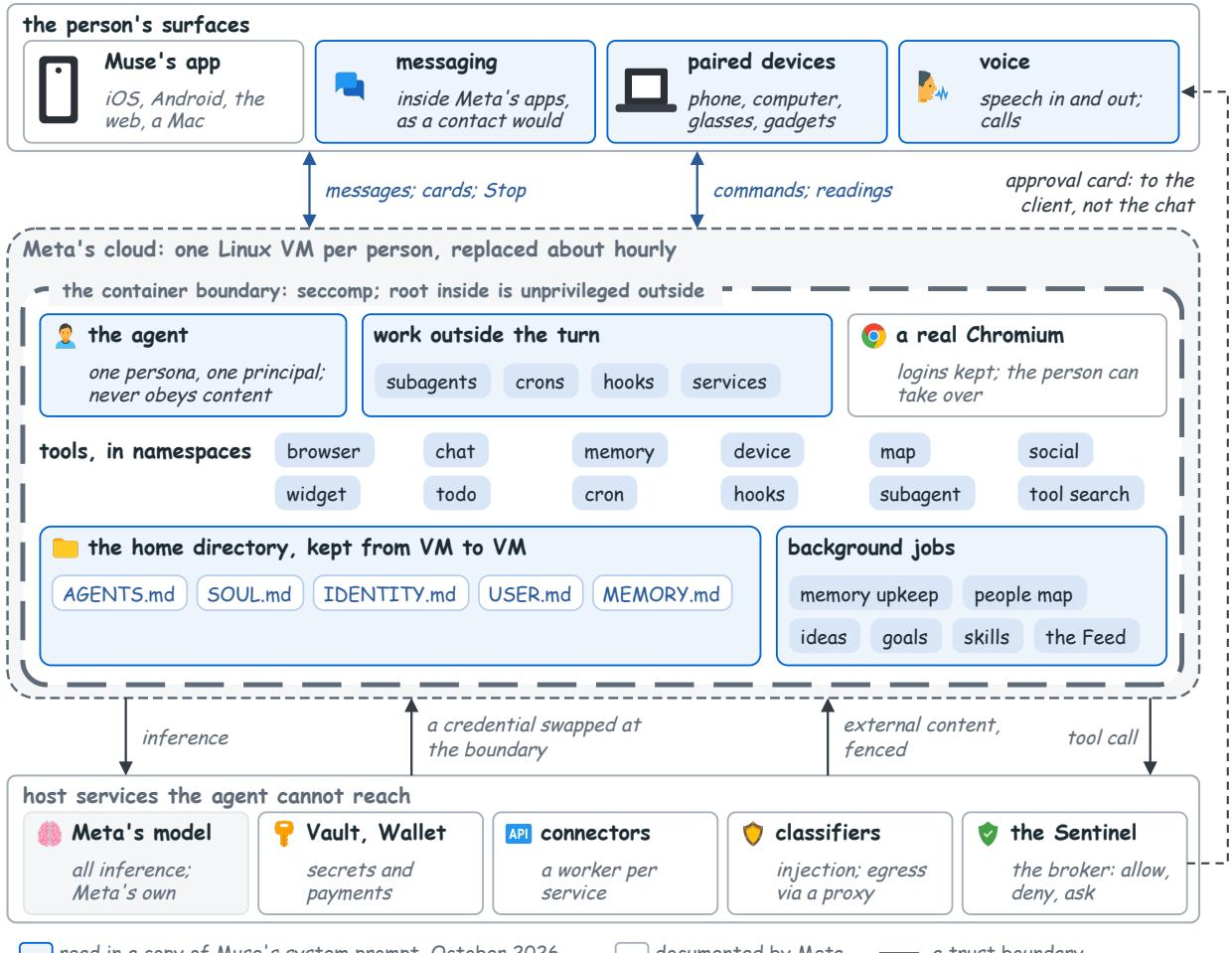
In this framework, each user is allocated a dedicated Linux virtual machine in the cloud, which is replaced approximately hourly while maintaining a persistent home directory. The agent and its tools operate within a container bounded by seccomp filters and reduced capabilities. The system prompt establishes a strict persona that works exclusively for the user, enforcing discretion and hard safety stops. The agent utilizes tools organized in namespaces, such as browser, chat, memory, and device control. A critical component of this architecture is the Sentinel, which acts as the sole permission authority for connector actions and network egress. The agent holds only surrogate tokens, which are swapped for real credentials at the network boundary after approval. The system employs kernel level taint tracking, where a tool process starts clean and becomes tainted upon reading user data, ensuring that only clean requests within a narrow policy pass without a prompt. Approvals are presented directly to the client as scoped capabilities rather than passing through the conversation.
In contrast, the authors develop nanoMuse as a decentralized personal agent where every device operates as a peer carrying a complete agent and its own Sentinel.
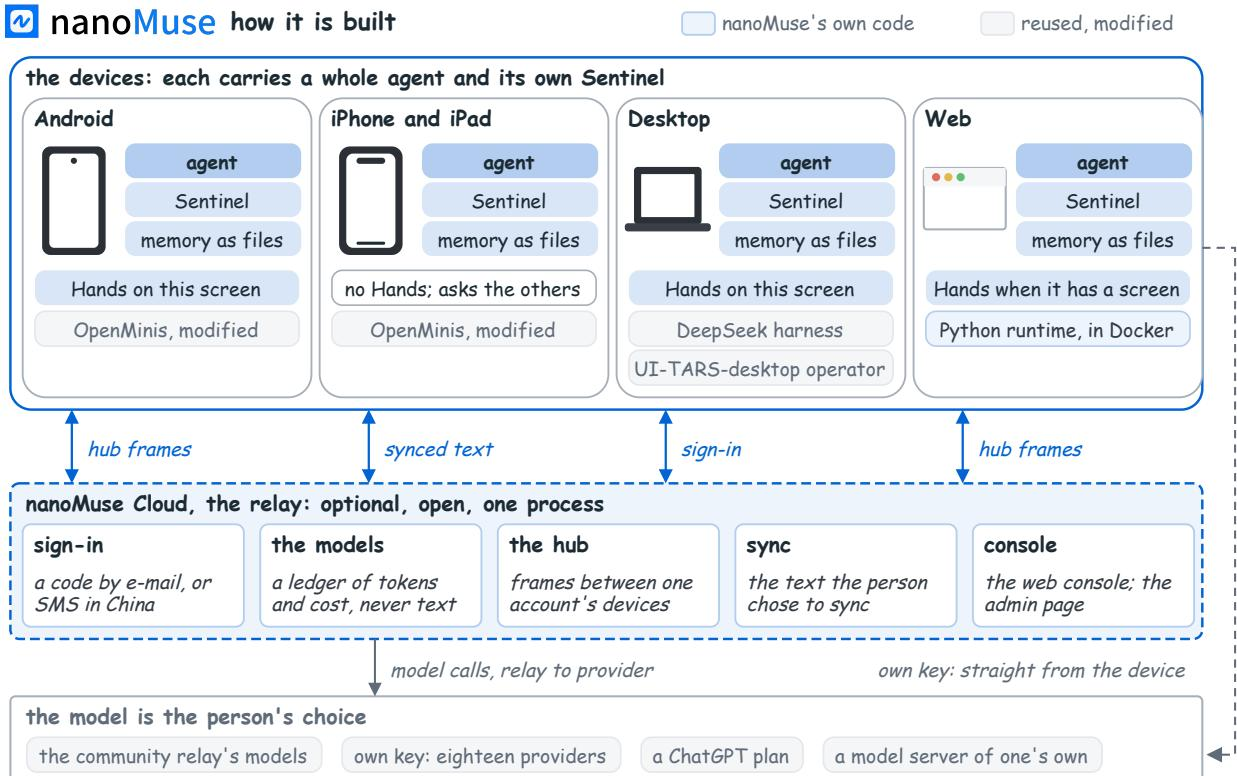
The Android implementation runs a complete agent inside the application, featuring a sandboxed Alpine Linux environment, a shell, a browser, and MCP servers. The desktop application utilizes an Electron shell around a harness with a Python runtime. Unlike the cloud hosted approach, nanoMuse places the agent directly on the device, granting it direct access to the phone screen. The Sentinel in this system functions as a policy boundary within the same process family, enforcing a fixed decision order that evaluates denied tools, user rules, allow and ask lists, data taint, and tool risk. Approvals are issued as scoped grants, and sensitive actions trigger mandatory warnings that cannot be bypassed. For screen interaction, the system employs a hybrid approach, climbing a ladder from skills and command line tools to a browser, and finally to direct screen manipulation via a one action per screenshot loop. Memory is managed as plain Markdown files that the user can open and edit, ensuring data portability and transparency. The architecture includes an optional and open relay that handles sign in, model call ledgers, and device synchronization without storing the actual content of the conversations.
The authors outline a structured development pipeline to advance the system capabilities across memory, device integration, and physical world interaction.
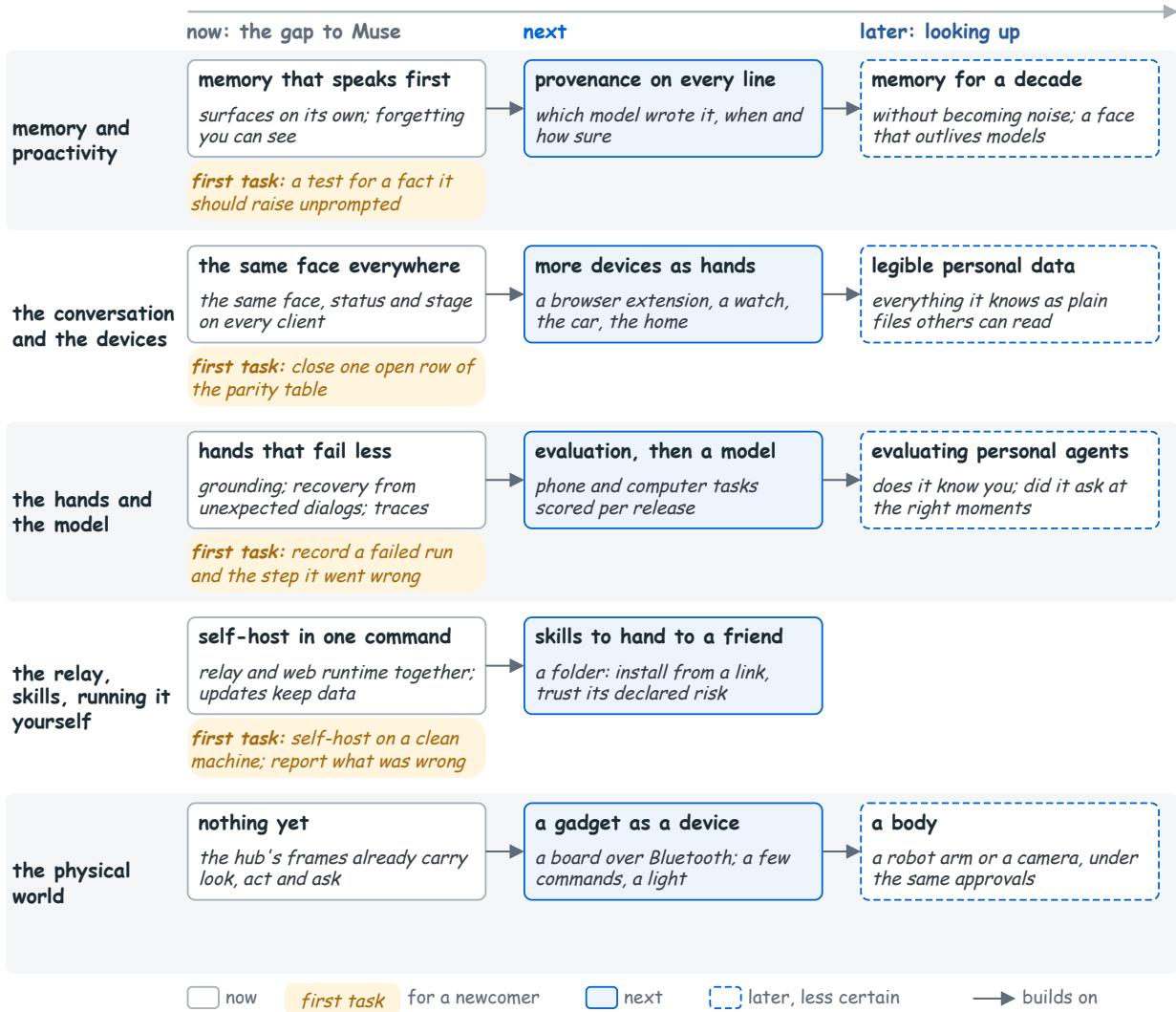
The immediate focus involves closing the feature gap by improving memory recall, reducing hand interaction failures, and enabling single command self hosting. The subsequent phase introduces an evaluation suite built from failed runs to score releases objectively, alongside the training of a small open model on user contributed traces to reduce vendor dependency. The long term vision extends the hands of the agent to the physical world, integrating cameras, appliances, and robot arms under the same approval and logging mechanisms, ultimately aiming to build an agent with memory and identity that survive across different models, devices, and vendors.
Experiment
This section outlines nanoMuse’s community roadmap in three horizons: near-term work focuses on memory, proactivity, conversation continuity, hand reliability, and one-command self-hosting; next steps introduce an evaluation suite built from failed runs and benchmarked with AndroidWorld, OSWorld, MemGUI-Bench, and OS-Harm, alongside a small open model for the hands trained on contributed traces to avoid vendor dependence; later work extends the hands to physical devices and long-lived agents with durable memory and identity. The roadmap concludes by inviting contributions such as skills, translations, devices, failing traces, and corrections.
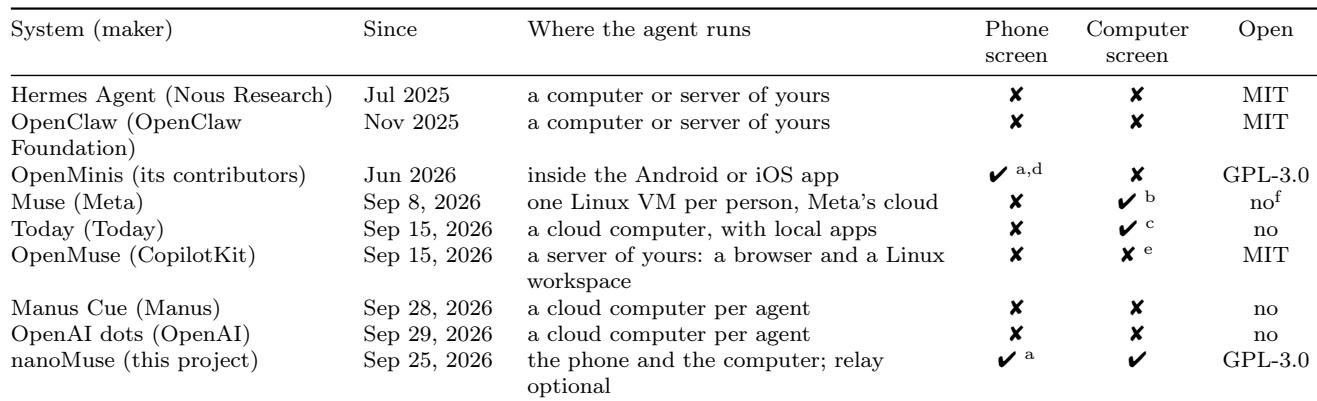
The comparison spans open projects from mid-2025 and 2026 plus a cluster of commercial agents launched in September 2026. Phone screen operation is rare and absent from the September launches, while computer screen operation appears only in two cloud-based systems, Muse and Today. Open licensing is concentrated in the earlier and self-hosted projects, whereas the commercial cloud agents are closed. Only OpenMinis can operate a phone screen, and only on Android; none of the September 2026 agents has phone screen access. Muse and Today are the only listed systems with computer screen operation; OpenMuse and Manus Cue run loops without screen control. Open source systems generally run on the user's own computer, server, or app, while the commercial launches run in per-person cloud computers or virtual machines. Among the September systems there is a tradeoff: Muse and Today offer computer screen use but are closed, while OpenMuse is open but lacks screen operation.
nanoMuse's footprint varies widely by component: the Android client is compact, the desktop client is substantially larger to download and install, and the relay is lightweight enough for a single small server. Estimated self-hosting costs are modest, on the order of a few US dollars per month outside mainland China or tens of yuan inside it, plus model usage. Model call pricing is low enough that ordinary daily chat costs only a few fen. The Android app is the smallest release artifact, while the desktop app is far heavier to download and also uses about half a gigabyte of memory at idle on Linux. The relay is the lightest runtime component, idling at roughly 85 MB of memory and sized for a server with 1 vCPU and 1 GB. Self-hosting a relay is estimated at US4to6 per month outside mainland China or ¥30 to ¥60 inside it before model usage. The hands model costs more per token than the chat model, but a typical day of chat remains a few fen.
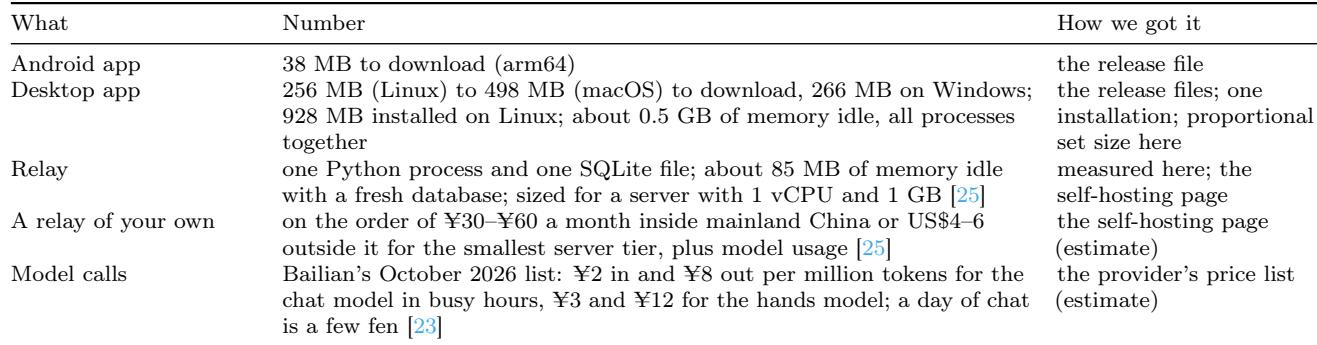
The first comparison examines screen-control capabilities and licensing across open and commercial agents, finding that phone screen operation is rare or absent in the September 2026 launches while computer screen operation appears only in the closed cloud agents Muse and Today, so users face a tradeoff between screen access and openness. The second evaluation assesses nanoMuse's component footprint and hosting model, showing that the Android client and relay are lightweight, the desktop client is heavier, and self-hosting remains modest in cost before model usage. Overall, the experiments indicate that nanoMuse is practical to self-host and that current commercial agents remain closed even when they offer screen control.