Command Palette
Search for a command to run...
FRAMEMORROW: 장기 지평선 비디오 생성을 위한 전향적 토큰 기반 미래 유도 프레임 선택
FRAMEMORROW: 장기 지평선 비디오 생성을 위한 전향적 토큰 기반 미래 유도 프레임 선택
Bo Yin Xiaobin Hu Jiaqi Zhao Shuicheng Yan
초록
장기 지평선 비디오 생성에서는 모델이 점점 길어지는 생성 이력을 효과적으로 활용해야 한다. 생성 이력이 커질수록 모든 이전 콘텐츠를 유지하는 것은 비용과 중복 측면에서 점점 더 부담이 되므로 효과적인 이력 선택이 필수적이다. 기존 접근법은 주로 현재 콘텐츠를 기준으로 이력의 관련성을 판단한다. 그러나 현재 시점에 관련성이 높은 정보가 미래 생성에 반드시 유용한 것은 아니며, 현재는 관련성이 낮아 보이는 이력이 나중에 중요해질 수도 있다. 본 연구의 핵심 통찰은 이력 정보가 미래의 정보 요구와의 관련성에 따라 선택되어야 한다는 것이다. 이러한 요구를 파악하는 데 전체 미래를 생성할 필요는 없으며, 다음에 중요해질 내용을 압축적으로 표현하는 것만으로도 이력 선택을 안내하기에 충분하다. 이러한 통찰을 바탕으로 본 연구는 미래 정보 요구를 나타내는 소수의 전향적 토큰을 예측하고 이를 이용해 이력에서 관련 정보를 식별하는 전향적 프레임 선택기 FRAMEMORROW를 제안한다. FRAMEMORROW는 모델별 내부 상태가 아니라 명시적인 이력 프레임을 선택하므로 비공개 소스 모델을 포함한 다양한 생성기에 거의 추가 추론 비용 없이 플러그 앤 플레이 방식으로 통합될 수 있다. 우리는 FRAMEMORROW를 장기 비디오 생성, 상호작용적 생성, 행동 조건부 세계 모델을 아우르는 5개 벤치마크와 11개 생성 모델에서 평가하였다. 광범위한 실험 결과 다양한 생성 환경에서 장기 일관성, 시각적 품질, 행동 정렬이 향상됨을 확인하였다. 프로젝트 페이지는 https://yinbo0927.github.io/FrameMorrow/ 에 있다.
One-sentence Summary
Researchers from National University of Singapore and Harbin Institute of Technology (Shenzhen) propose FRAMEMORROW, a future-guided frame selector that predicts prospective tokens representing future information needs and selects explicit historical frames accordingly, enabling plug-and-play integration across diverse generators, including closed-source models, and improving long-range consistency, visual quality, and action alignment across five benchmarks and 11 generative models.
Key Contributions
- Formulates historical frame selection for long-horizon video generation as conditioned on future information needs rather than on relevance to current content alone.
- Introduces FrameMorrow, a plug-and-play prospective frame selector that predicts a small set of prospective tokens representing future information needs and selects explicit historical frames, enabling compatibility with diverse generators including closed-source models and little additional inference cost.
- Evaluates FrameMorrow across five benchmarks and 11 generative models spanning long-video generation, interactive generation, and action-conditioned world models, showing improvements in long-range consistency, visual quality, and action alignment.
Introduction
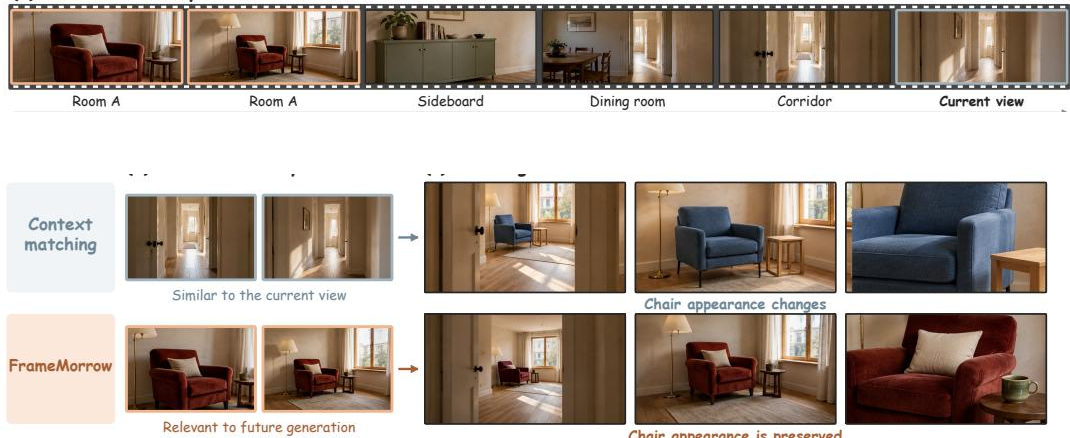
Long-horizon video generation requires models to maintain coherent subjects, objects, and scenes over time, but autoregressive generators have a limited input window and cannot keep all earlier frames without high computation and redundant context. Existing history-selection methods typically retrieve past information by matching the current visual content, which captures what is relevant to the present but may miss earlier content that will become important later. The authors argue that historical relevance should be determined by future information needs, even though the future has not yet been generated. To address this, they propose FRAMEMORROW, which predicts a small set of prospective tokens as a compact proxy for future needs and uses them to select explicit historical frames. This makes the selector lightweight and plug-and-play across diverse generators, including closed-source models, and improves long-range consistency, visual quality, and action alignment in evaluations.
Method
The authors propose FRAMEMORROW, a generator-external prospective selector designed to identify and retrieve relevant historical frames for video generation. Instead of generating future content, the model predicts a compact set of prospective tokens that represent future information needs. These tokens evaluate the relevance of eligible historical frames and guide the selection process, ultimately augmenting a compatible frozen generator.
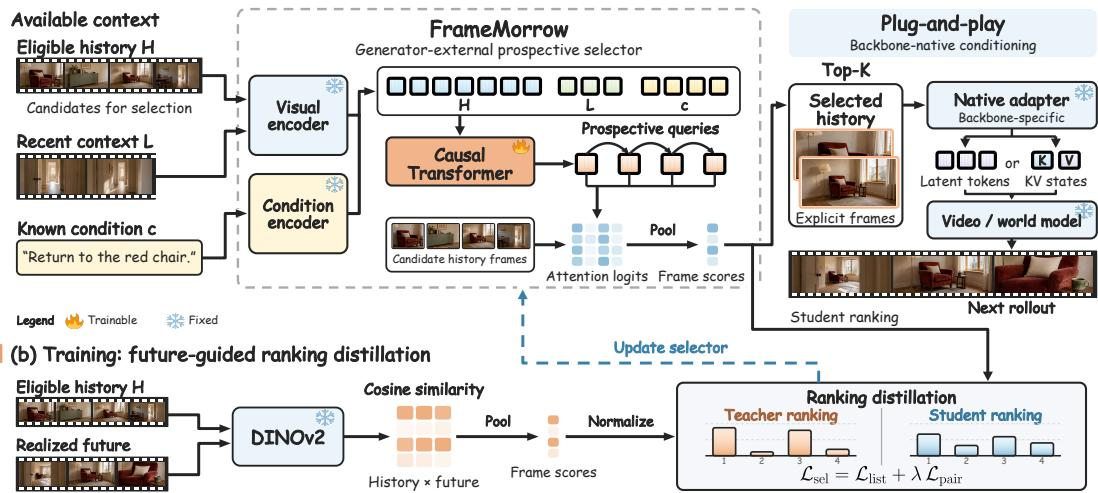
The framework operates by distinguishing the recent context from the eligible long-term history. At a given rollout step, the recent context informs the selection process without consuming the long-term memory budget, while the eligible history serves as the candidate pool for retrieval. A known rollout condition, such as a text prompt or action sequence, is also incorporated to guide the selection. The selector computes relevance scores for the eligible history and selects the top-K frames:
r^t=Sθ(Ht,Lt,ct+)∈RN,It=TopK(r^t,K)To represent future information needs, a causal Transformer autoregressively predicts a small set of prospective tokens. The eligible history, recent context, and rollout condition are first encoded using frozen visual and modality-specific encoders, followed by learned projections. The causal Transformer processes these encoded sequences and generates the prospective tokens:
qtm=Fψ(Ht,Lt,Ct+,qt<m),m=1,…,MEach token can condition on its predecessors, allowing the predictions to capture complex dependencies. These prospective tokens then serve as attention queries over the eligible historical frames. The model computes scaled dot-product attention logits between the projected tokens and the encoded historical frames, aggregating them using a smooth maximum function to produce a final relevance score for each historical frame.
During training, the authors employ a future-grounded ranking distillation strategy to supervise the prospective tokens. A frozen visual teacher, specifically a DINOv2 encoder, evaluates the correspondence between candidate historical frames and the realized future continuation. By computing the cosine similarity between the encoded historical and future frames, the teacher derives a visual relevance proxy. These similarities are aggregated using a smooth maximum to favor frames that correspond to at least a portion of the future content. Both the teacher and student scores are normalized into ranking distributions. The selector is optimized using a combination of listwise and pairwise ranking losses:
Lsel=Llist+λLpairThe listwise term aligns the full probability distribution of the student with the teacher, while the pairwise term preserves the relative orderings of frames separated by a specific margin in the teacher ranking. This distillation process ensures that the prospective tokens learn to identify historically relevant frames without requiring explicit future generation during inference.
At inference time, the continuation-based target construction is entirely removed. The selector encodes the observed frames and predicts prospective tokens using only the available history, recent context, and rollout condition. The selected explicit historical frames are then integrated into the generation pipeline through a plug-and-play mechanism. Each frozen backbone processes these selected frames through its own native conditioning mechanism, such as a reference-frame interface or memory adapter. This design allows the selector to dynamically decide which historical evidence to provide, while the generator retains its original architecture and processing methods, requiring no additional conditioning modules to be trained.
Experiment
The experiments evaluate FRAMEMORROW across five settings: long video generation, single-shot and multi-shot interactive generation, closed-source generators, and action-conditioned world models. Across open-source backbones, it consistently improves generation consistency and prompt alignment, with larger gains in later segments, and it remains effective through reference-conditioning interfaces for closed-source models. In world-model benchmarks, it strengthens visual consistency, anti-flicker, and action alignment while preserving motion quality. Ablations show that future-derived ranking targets, selecting relevant historical frames rather than simply increasing frame count, and four autoregressive prospective tokens provide most of the benefit, with only modest inference overhead.
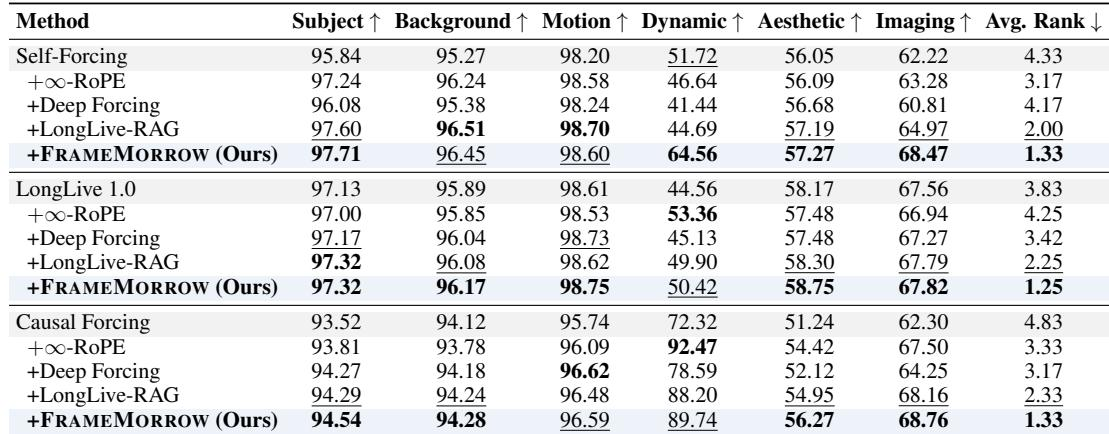
FRAMEMORROW achieves the best average rank among long-context methods on all three evaluated backbones for 60-second generation. On Self-Forcing, it delivers notable gains in imaging quality and dynamic degree, while LongLive-RAG keeps higher background and motion scores. The consistent average-rank advantage supports the effectiveness of frame selection across generators, with trade-offs in individual metrics. FRAMEMORROW achieves the best average rank on the Self-Forcing, LongLive 1.0, and Causal Forcing backbones. On Self-Forcing, FRAMEMORROW improves imaging quality from 62.22 to 68.47 and dynamic degree from 51.72 to 64.56. LongLive-RAG retains higher background and motion scores on Self-Forcing despite FRAMEMORROW's better average rank.
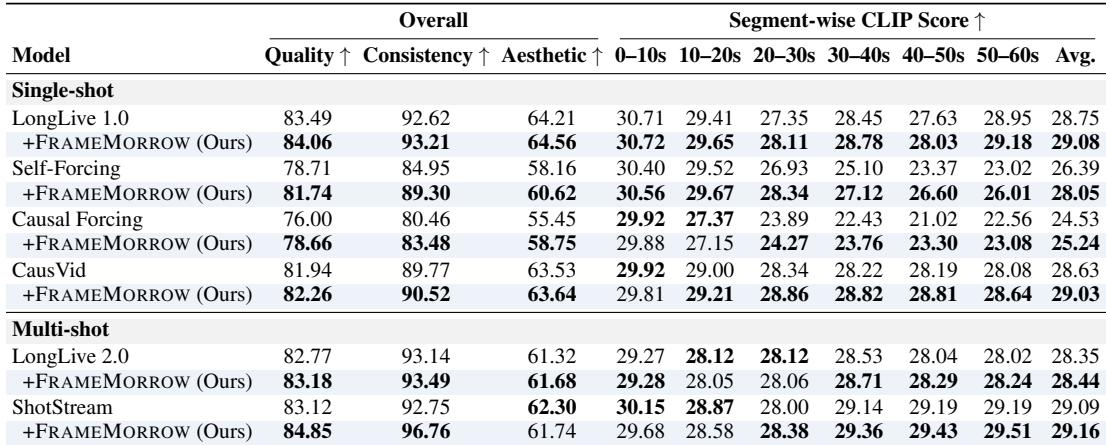
In single-shot interactive video generation over 60 seconds, FRAMEMORROW improves overall quality, consistency, and aesthetic scores over the reported native backbones. Segment-wise CLIP score gains are larger in later 10-second intervals, particularly for Self-Forcing, indicating stronger prompt alignment at later stages. For single-shot generation, FRAMEMORROW improves overall quality and consistency over LongLive 1.0 and Self-Forcing baselines. With Self-Forcing, consistency rises from 84.95 to 89.30, while segment-wise CLIP-score gains are smallest in the first 10 seconds and largest in the final 10 seconds. Aesthetic scores also improve modestly for the reported backbone pairs, and later 10-second windows show larger prompt-alignment gains.
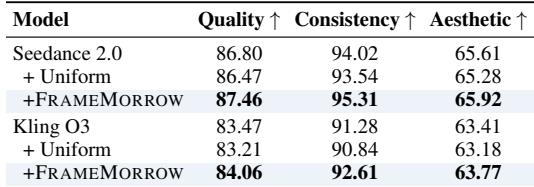
In closed-source generation tests across Seedance 2.0 and Kling O3, FRAMEMORROW improves quality, consistency, and aesthetic scores over both the original generators and uniform historical-frame selection when using the same reference budget. Uniform selection slightly degrades all reported metrics relative to the native baselines. The results indicate the approach can work through public reference-conditioning interfaces without access to generator internals. FRAMEMORROW outperforms uniform selection on all reported metrics for both closed-source generators. Uniform historical-frame selection lowers quality, consistency, and aesthetic scores compared with the original closed-source baselines. FRAMEMORROW achieves consistency gains over the native generators on Seedance 2.0 and Kling O3.
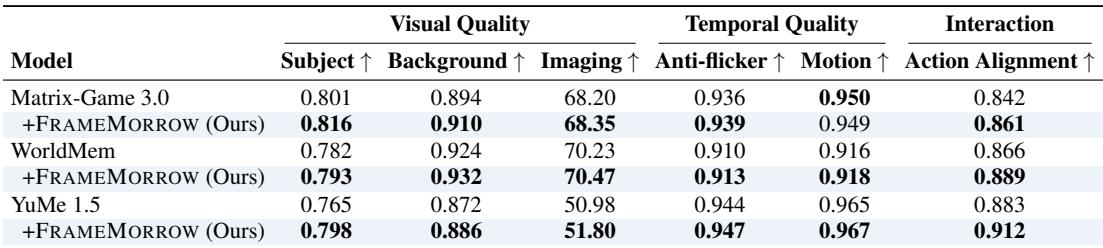
FRAMEMORROW consistently improves subject consistency, background consistency, imaging quality, anti-flicker, and action alignment across Matrix-Game 3.0, WorldMem, and YuMe 1.5. Motion quality remains largely stable, with only small changes in either direction. The gains occur within each base-model pair, indicating that the method benefits diverse interactive world models. FRAMEMORROW raises action alignment for all three backbones, with the largest improvement on YuMe 1.5. Subject and background consistency, imaging quality, and anti-flicker improve over the corresponding base model in every evaluated pair. Motion scores stay nearly unchanged, suggesting the method preserves motion quality while improving consistency and control alignment.
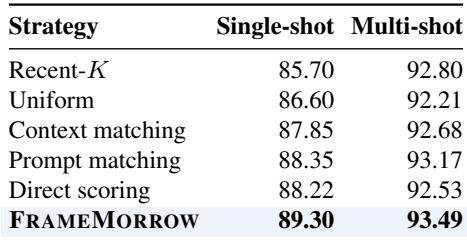
FRAMEMORROW outperforms all five historical frame selection strategies in both single-shot and multi-shot generation. Prompt matching is the strongest baseline, followed by direct scoring and context matching, while simple recency and uniform sampling lag behind. The performance gaps are more pronounced in single-shot generation than in multi-shot generation. FRAMEMORROW achieves the highest consistency scores in both single-shot and multi-shot settings. Prompt matching is the best-performing baseline, with direct scoring and context matching also competitive. Simple recency and uniform sampling trail the learned matching and scoring strategies. All strategies improve in multi-shot generation compared with single-shot generation. FRAMEMORROW's advantage over the strongest baseline is larger in single-shot generation than in multi-shot generation.
Across experiments, FRAMEMORROW was evaluated on long-context generation with multiple backbones, single-shot interactive video, closed-source APIs through public reference-conditioning interfaces, diverse interactive world models, and comparisons against several historical-frame selection baselines. It consistently achieves the best average rank or highest consistency and improves subject consistency, background consistency, imaging quality, aesthetic scores, and action alignment over native baselines, with motion quality remaining stable and occasional trade-offs in background or motion scores. Gains in prompt alignment are stronger in later 10-second intervals, and the approach outperforms uniform, recency, and learned scoring baselines, particularly in single-shot generation. Overall, the results indicate that FRAMEMORROW's frame selection benefits diverse generators and closed-source settings without requiring access to generator internals.