Command Palette
Search for a command to run...
Dr. Claw: 바이브 연구를 위한 AI 과학자 작업 공간
Dr. Claw: 바이브 연구를 위한 AI 과학자 작업 공간
초록
명령줄 코딩 에이전트(예: Claude Code, Gemini CLI)는 이미 파일을 읽고 쓰고 긴 세션을 유지할 수 있지만, 종단 간 연구는 여전히 채팅 도구, IDE, 터미널 및 작성 환경에 걸쳐 분산되어 있으며, 이를 감사 가능하게 만드는 결정은 거의 보존되지 않습니다. 우리는 또 다른 자율 에이전트를 도입하는 대신, 기존 코딩 에이전트 실행기를 제어 가능하고 감사 가능한 인간-인-더-루프 워크플로우로 감싸는 오픈소스 작업 공간인 Dr. Claw를 제시합니다. 영구 상태 객체, 재사용 가능한 스킬 라이브러리 및 다중 실행기 조정은 인간의 결정을 AI 실행에 연결하여 계획, 실행 및 작성을 하나의 추적 가능하고 복구 가능한 루프로 전환합니다. 우리는 대화형 3-뷰 시나리오와 장애 복구 워크스루를 통해 Dr. Claw를 시연하고, 동일한 백엔드 실행기를 공유하는 베어 명령줄 에이전트와 비교 평가하여, 비교가 전체 오케스트레이션 계층(작업 그래프, 상태 객체 및 스킬 라이브러리)과 그것이 감싸는 에이전트를 대조하도록 합니다. 실행기를 고정한 상태에서 Dr. Claw는 연구 완전성에서 더 높은 점수를 얻는 동시에 감사 가능하고 복구 가능한 프로세스 추적을 유지합니다. 데모 접근: 저장소 https://github.com/OpenLAIR/dr-claw, AGPL-3.0 및 GPL-3.0 업스트림 구성 요소로 출시됨.
One-sentence Summary
Researchers from Lehigh University, University of Illinois Chicago, University of Pennsylvania, University of Maryland, University of Notre Dame, and University of British Columbia present Dr. Claw, an open-source workspace that wraps existing coding-agent executors in a controllable, auditable human-in-the-loop workflow, using persistent state objects, a reusable skill library, and multi-executor coordination to link human decisions to AI execution, achieving higher research completeness and a traceable, recoverable process trail compared to a bare command-line agent with the same backend.
Key Contributions
- Formalizes Vibe Research, a controllable, human-in-the-loop research-orchestration paradigm that separates AI execution from human decision responsibilities, contrasting with end-to-end autonomous approaches.
- Implements this paradigm in Dr. Claw, an open-source workspace that wraps existing command-line coding agents using task-graph-centric orchestration, a chat-driven planner, a modular skill library (58 stage-mapped skills across five stages, 171 in the deployed catalogue), and a multi-agent execution layer compatible with mainstream coding agents.
- A controlled pilot evaluation, holding the backend executor fixed, shows Dr. Claw scores higher than the bare agent on research completeness by closing research-hygiene gaps, while persisting an auditable, recoverable process trail; a retrospective study additionally associates the integrated workflow with gains in efficiency, quality, and usability over non-integrated ones.
Introduction
Large foundation models and agentic tools have improved core research operations such as literature review, idea generation, and code implementation, but command-line coding agents optimize execution rather than control. Plans, intermediate decisions, and artifacts are often scattered or lost, leaving humans with few explicit takeover points. The bottleneck is full-process orchestration: researchers still switch across tools for decomposition, scheduling, tracking, and validation, which weakens reproducibility and delivery reliability. HCI evidence shows that collaboration costs are dominated by verification and context maintenance, and that process visibility and interruptible control are critical. Prior work in end-to-end automation or general multi-agent frameworks rarely prioritizes controllability or sustained human takeover in long-horizon workflows.
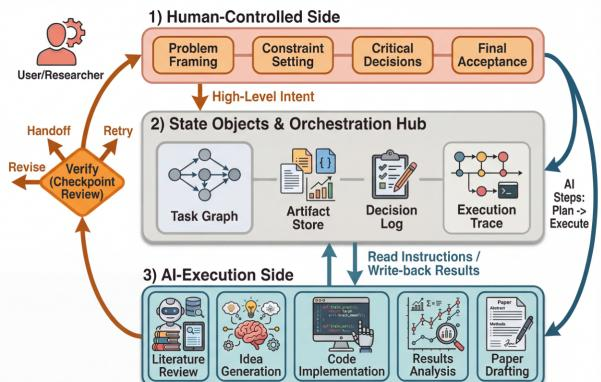
The authors introduce Dr. Claw, a one-stop workspace that unifies planning, execution, and writing into a controllable, traceable, recoverable, and auditable research loop. They formalize a paradigm called Vibe Research, where AI handles high-throughput execution tasks while humans own research direction, evaluation criteria, and final acceptance. Dr. Claw wraps an existing command-line coding agent rather than introducing a new executor, adding a state, control, and audit layer that such agents lack. It uses a task-graph-centric orchestration, a chat-driven planner, and a modular skill library with 58 stage-mapped skills across five research stages. The system persists four state objects: Task Graph, Artifact Store, Decision Log, and Execution Trace. A controlled pilot evaluation, holding the backend executor fixed, shows Dr. Claw scores higher on completeness than the bare agent while uniquely persisting an auditable, recoverable process trail. A retrospective human study provides complementary evidence on gains in efficiency, quality, and usability over non-integrated workflows.
Method
3 System Overview
Dr. Claw is designed around one central question: how to let researchers complete problem definition, experiment progression, and paper production in a continuous workflow rather than switching among isolated tools. It models research as an explicitly traceable workflow that organizes human decisions with AI execution into a stable collaboration structure.
3.1 Design Goals and System Abstraction
Dr. Claw orchestrates four state objects: Task Graph, Artifact Store, Decision Log, and Execution Trace. Together they convert interaction history into a reviewable process supporting iterative orchestration rather than one-shot generation: users provide high-level goals and constraints, and the system maps them to executable tasks with continuous inspection and takeover. One task interaction is a state transition:
Statet+1=f(Statet,Actiont,Obst),where State denotes the workflow state at time t (jointly formed by Task Graph, Artifact Store, Decision Log, and Execution Trace), Actiont is a system- or user-triggered action, and Obst is the observed feedback. This formulation highlights that Dr. Claw optimizes iterative state updates rather than single responses.
3.2 Three-Layer System Architecture
Dr. Claw uses three collaborative layers:
- Interaction: unified workspace for chat, task views, files, and version operations.
- Orchestration: state and lifecycle management from high-level intent to stage tasks.
- Execution: backend invocation, result return, and exception handling across heterogeneous executors.
This design enables backend switching without changing workflow semantics while preserving unified state and audit views.
3.3 Workflow-Centric Interaction Loop
Given a research idea, the system generates a structured brief and dependency-aware task plan, then runs workflow steps of Plan–Execute–Verify–Write-back. Execution outputs are written into Artifact Store, task states are updated in Task Graph, and all interventions are retained in Decision Log and Execution Trace. This workflow supports long-horizon iteration with explicit human checkpoints.
3.4 Skill-Based Capabilities and Multi-Executor Coordination
Dr. Claw provides a reusable skill library covering ideation, literature processing, experimentation, analysis, and writing. Each skill is a directory with a SKILL.md manifest whose YAML frontmatter declares a name and description, and commonly a version, license, allowed tools, and stage or domain tags. Skills are versioned and schema-checked before activation, and reach a task by three routes: a stage-skill map resolves the task's stage and type to a set of suggested skills, which are attached to the task node and injected into its next-action prompt; keyword detection over user instructions and task text can auto-load a skill; and users may invoke any catalogue skill manually from the Skills dashboard. Dr. Claw also coordinates multiple executors in one project context, so users switch execution strategy by task type, and on failure or constraint violation can retry, revise, or take over without breaking global state.
3.5 Safety and Controllability Mechanisms
Given risks from external calls and code execution, Dr. Claw treats permission management as a first-class mechanism, supporting fine-grained tool and command policies that distinguish secure defaults from trusted extended settings. Actions are allowed only if they belong to the action set defined by the current policy:
Actiont∈A(Policyt),where Policy is the permission configuration at time t and A(Policyt) is the executable action space, guaranteeing consistency between execution capability and safety boundaries.
Experiment
The evaluation uses a demo scenario and three studies to validate Dr. Claw, an orchestration layer over a command-line coding agent. In an open-ended research task comparison against the bare agent, Dr. Claw achieved higher completeness on two of three tasks (pooled 0.952 vs. 0.873), with gains driven entirely by research hygiene elements like limitations sections, subgroup analysis, and real citations, while both conditions matched on modeling rigor; however, the pilot result is not statistically significant, and Dr. Claw incurs bounded overhead. A separate single-condition demonstration shows non-destructive failure recovery, where an induced error is corrected in place with prior artifacts preserved. A retrospective human study with seven researchers across three stages associates Dr. Claw with shorter completion times, higher output quality, fewer tool switches, and the strongest significant improvement in self-reported experience.
The table compares Dr. Claw with prior systems across execution, orchestration, interaction, and autonomy dimensions, showing that Dr. Claw uniquely combines wrapping a CLI agent, built-in research state objects, and mid-run takeover. Most prior systems support only some of these features, while Dr. Claw is the only one that integrates all of them. Dr. Claw is the only system that fully supports built-in research state, in-place recovery, and mid-run takeover simultaneously. End-to-end autonomous systems like AI Scientist and Agent Laboratory prioritize unattended operation but lack built-in research state and mid-run takeover. Agent authoring tools such as AutoGen Studio support orchestration but do not wrap a CLI agent or provide built-in research state. Dr. Claw's design emphasizes human oversight through persistent state objects, contrasting with bare agents that persist no such state.
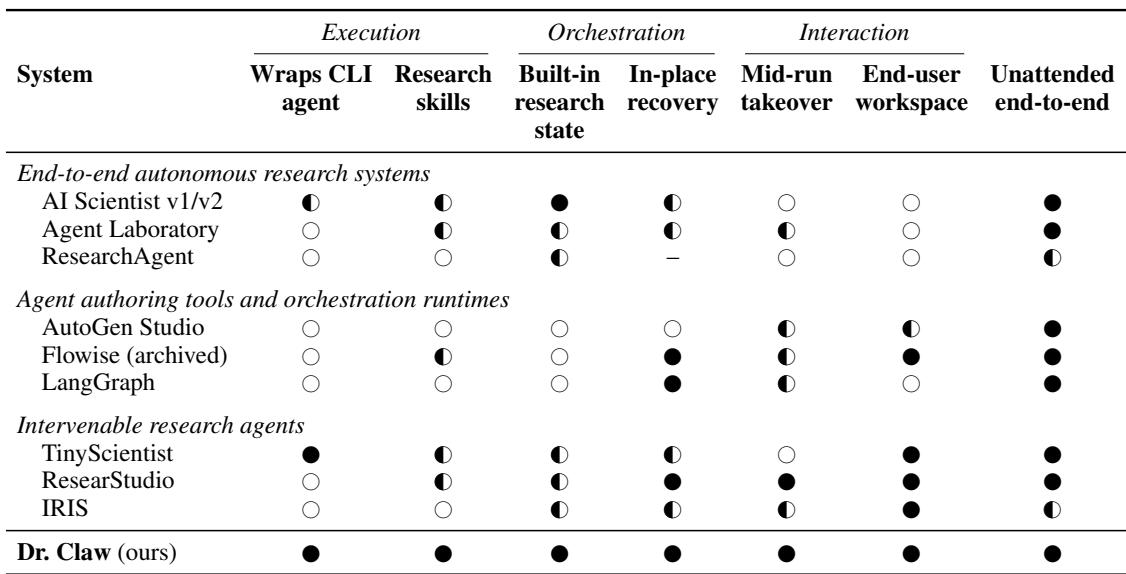
A comparative evaluation across execution, orchestration, interaction, and autonomy shows that Dr. Claw uniquely integrates a wrapped CLI agent, built-in research state objects, and mid-run takeover, while prior systems support only subsets of these capabilities. Unlike end-to-end autonomous systems that prioritize unattended operation and agent authoring tools that focus on orchestration, Dr. Claw is the only system combining all three features, emphasizing human oversight through persistent state objects rather than stateless operation.