Command Palette
Search for a command to run...
데이터 스케일링을 넘어서: 시각-언어-행동 모델을 위한 표현 중심 지속 사전학습
데이터 스케일링을 넘어서: 시각-언어-행동 모델을 위한 표현 중심 지속 사전학습
초록
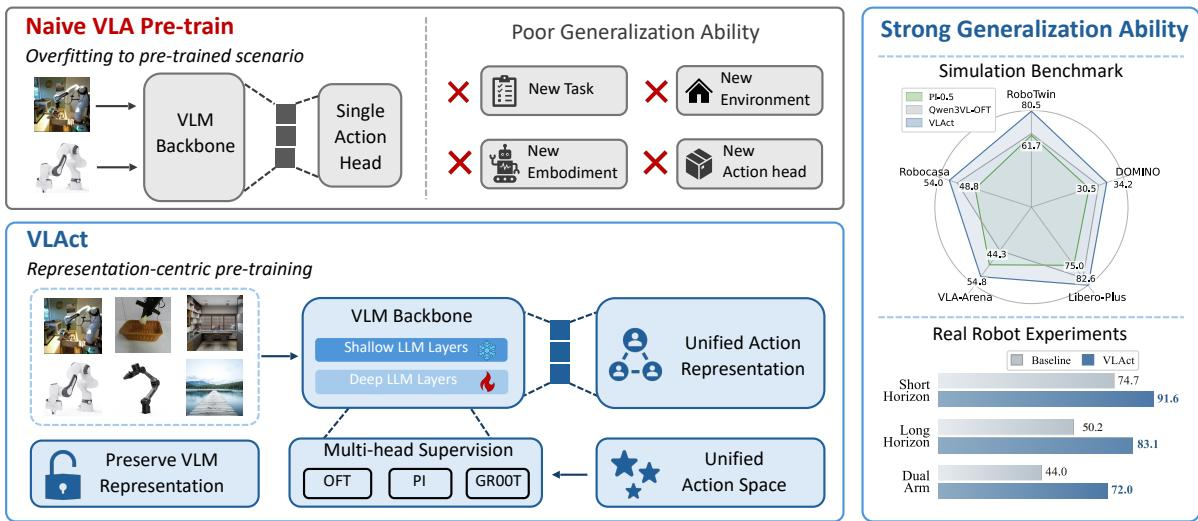
로봇 데이터의 스케일링은 범용 시각-언어-행동(VLA) 모델 구축에 필수적이지만, 로봇 궤적은 체화된 수집을 필요로 하고 물리 세계를 드물게만 포괄하기 때문에 웹 스케일의 이미지-텍스트 데이터보다 본질적으로 스케일링하기 어렵다. 이로 인해 표현 품질이 핵심 병목이 된다. 고정된 로봇 데이터 예산 하에서 VLA 지속 사전학습은 단순히 행동에 과적합하는 것이 아니라 제한된 궤적을 전이 가능한 시각-행동 지식으로 변환해야 한다. 본 연구에서는 표현 중심 지속 사전학습 레시피로 학습된 VLA 지향 VLM 백본인 VLAct를 제안한다. VLAct는 사전학습된 VLM에서 출발하여 하위 작업별 파인튜닝 이전에 광범위하고 이질적인 다중 체화 로봇 데이터로 학습된다. VLAct는 광범위한 VLM 사전 지식을 보존하고, 백본이 단일 행동 헤드에 과도하게 특화되는 것을 방지하며, VLM 사전 지식 보존, 다중 헤드 연속 행동 공동 지도, 부분적으로 통합된 교차 체화 행동 레이아웃을 통해 체화 간 공유 행동 의미를 장려한다. 동시에 하위 사용자가 파인튜닝 시 작업별 행동 헤드를 자유롭게 부착할 수 있도록 한다. 다중 체화 시뮬레이션 벤치마크, 실제 로봇 실험, 미학습 체화 전이 전반에서 VLAct는 고정된 파인튜닝 프로토콜 하에 하위 성능을 일관되게 향상시킨다. LIBERO-Plus와 RoboTwin 2.0에서 VLAct는 ABot-M0 및 LingBot-VLA와 같은 대규모 산업용 VLA 시스템을 능가하여 각각 82.6%와 92.5%의 성공률을 달성한다. 최근 공개된 RoboDojo 시뮬레이션 벤치마크에서 VLAct는 평균 점수 10.66과 성공률 7.60%를 기록하여 성공률 기준 전체 정책 중 6위를 차지한다. 두 지표 모두에서 명시적으로 지정된 모든 세계-행동-모델(WAM) 항목과 여러 산업계 개발 시스템을 능가한다. 가장 주목할 점은, 지속 사전학습 동안 한 번도 본 적 없는 휴머노이드 체화인 RoboCasa-GR1에서 하위 궤적의 20%만 사용한 VLAct가 전체 데이터로 학습한 GR00T-N1.6 기준선을 이미 능가한다는 것이다. 이러한 결과는 완전한 오픈소스 데이터와 16-GPU 학습 환경만으로 얻어졌으며, 이는 표현 중심 지속 사전학습이 적절한 컴퓨팅 예산 하에서도 높은 경쟁력을 갖춘 성능을 제공할 수 있고 데이터 스케일링을 넘어서는 VLA 발전의 중요한 독립적 축임을 보여준다. 모든 모델과 학습 파이프라인은 오픈소스로 공개된다.
One-sentence Summary
The authors propose VLAct, a representation-centric continued pre-training recipe for vision-language-action models that preserves VLM priors and employs multi-head continuous action co-supervision with a partially unified cross-embodiment action head, achieving state-of-the-art multi-embodiment performance including 82.6% on LIBERO-Plus and 92.5% on RoboTwin 2.0, and, with only 20% of the data, outperforming GR00T-N1.6 on an unseen humanoid embodiment.
Key Contributions
- VLAct is a VLA-oriented VLM backbone trained with a representation-centric continued pre-training recipe that starts from a pretrained VLM and uses broad heterogeneous multi-embodiment robot data; it combines VLM-prior preservation, multi-head continuous action co-supervision, and a partially unified cross-embodiment action layout while letting downstream users attach task-specific action heads during fine-tuning.
- Controlled probes show that discrete FAST-token pre-training discards fine-grained temporal and amplitude information, while single-head continuous supervision can cause head-specific representation collapse, motivating VLAct's multi-head continuous co-supervision.
- Under fixed fine-tuning protocols, VLAct reaches 82.6% success on LIBERO-Plus and 92.5% on RoboTwin 2.0, surpassing ABot-M0 and LingBot-VLA, and on RoboDojo it obtains a 10.66 average score and 7.60% success rate. On the unseen humanoid RoboCasa-GR1 benchmark, VLAct with only 20% of downstream trajectories outperforms the full-data GR00T-N1.6 baseline, using fully open-source data and a 16-GPU training setup.
Introduction
Vision-language-action (VLA) models seek to bring web-scale representation learning to robot control, but robot trajectories must be collected through physical execution and remain sparse samples of a combinatorial interaction space spanning scenes, objects, tasks, embodiments, and contact dynamics. Prior VLA continued pre-training often treats the stage as large-scale action fitting, which can erode the general vision-language prior, over-specialize the backbone to one action head's decoding geometry, and weaken cross-embodiment sharing through isolated robot-specific heads. The authors propose VLAct, a representation-centric continued pre-training recipe that preserves the VLM prior via shallow-layer protection and caption-data mixing, applies multi-head continuous action co-supervision to keep action features broadly decodable, and uses a partially unified cross-embodiment action layout with a wrap-aware loss for periodic joints. These components shape a transferable backbone before downstream task-specific fine-tuning.
Method
The authors propose VLAct, a representation-centric Vision-Language-Action (VLA) model that performs continued pre-training of a reusable VLA backbone initialized from a Vision-Language Model (VLM). The overall pipeline consists of a continued pre-training phase to shape the backbone, followed by a fine-tuning phase where the pre-training heads and caption stream are discarded. During fine-tuning, a freshly initialized task-specific action head is attached, ensuring that downstream improvements stem from the learned backbone representation rather than a pre-adapted action head.
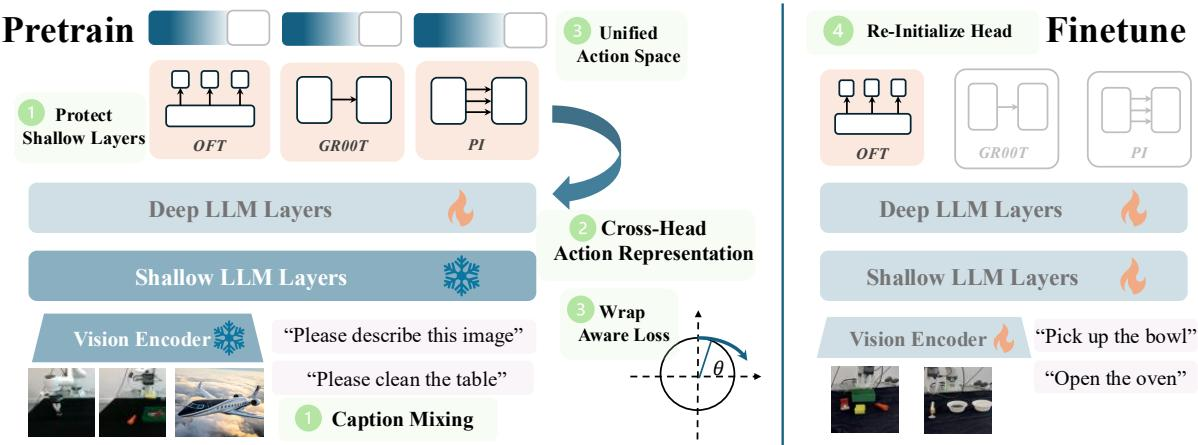
To prevent naive action-driven continued pre-training from overwriting the strong vision-language representations learned from broad web-scale data, the authors implement two preservation mechanisms. First, they apply shallow-layer protection by freezing the entire vision encoder and the lower half of the LLM layers during pre-training. This protects low-level visual processing and early vision-language alignment while allowing the upper layers to adapt to action-conditioned reasoning. Second, they utilize caption-mixed pre-training, mixing robot trajectories with caption data. Captions provide dense supervision over objects, attributes, and spatial relations, anchoring the trainable layers with robust vision-language supervision.
To ensure the backbone supports head transfer and learns high-quality action features rather than overfitting to a specific head geometry, the authors introduce co-supervised multi-head pre-training. Three representative continuous action heads (OFT, PI, and GR00T) are attached to the shared VLA backbone in parallel. Given the same vision-language input, the backbone produces a shared latent representation z, and each head predicts the same ground-truth action chunk a. The training objective is formulated as:
Laction=LOFT+LPI+LGR00T.This multi-head supervision forces the backbone to encode action information in a head-agnostic form, preventing representation collapse toward a single decoder geometry and improving transferability across different downstream heads.
To handle variation across different robot embodiments without forcing incompatible degrees of freedom into the same coordinates, VLAct employs a partially unified cross-embodiment action space. Rather than using isolated embodiment-specific heads or a naively fully unified space that pads lower-dimensional robots, the authors use a single shared action head where the action space is unified only along physically comparable dimensions.
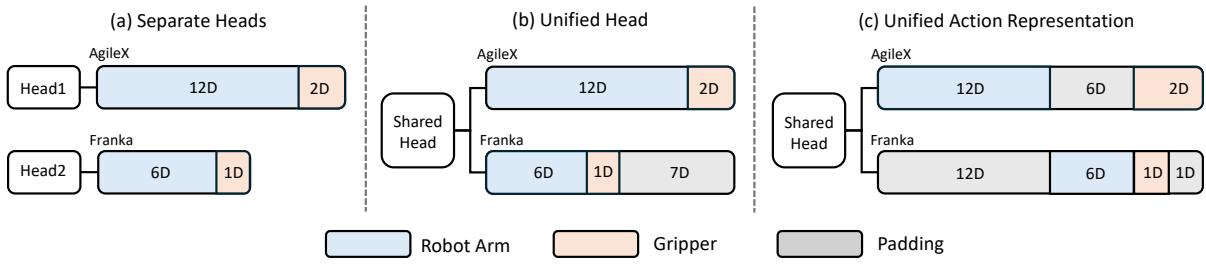
Concretely, gripper dimensions are shared across embodiments because open and close commands have comparable semantics, while arm dimensions remain embodiment-specific when robots possess different kinematics. During training, each sample contributes loss only on the active dimensions for its specific embodiment, and inactive dimensions are masked out. Furthermore, to address parameterization issues with absolute joint angles where standard regression treats 179∘ and −179∘ as far apart, the authors apply a wrap-aware loss on periodic joint-angle dimensions, measuring angular residuals modulo 360∘.
Experiment
The pilot study isolates the action-head axis by fixing the Qwen3-VL-4B backbone and varying discrete and continuous heads, showing that discrete supervision transfers coarsely but loses fine-grained action information, while single-head continuous supervision can cause head-specific representation collapse. The main experiments pre-train VLAct on open-source Franka and AgileX data with captioning for VLM preservation, then evaluate it on LIBERO-Plus, RoboTwin 2.0, DOMINO, real-world Franka tasks, and held-out GR-1 and ARX X5 embodiments. VLAct improves robustness and real-world generalization over same-backbone baselines, remains stable across downstream action heads, and transfers data-efficiently to unseen robots, supporting the conclusion that it learns reusable action representations rather than head-specific or embodiment-specific features.
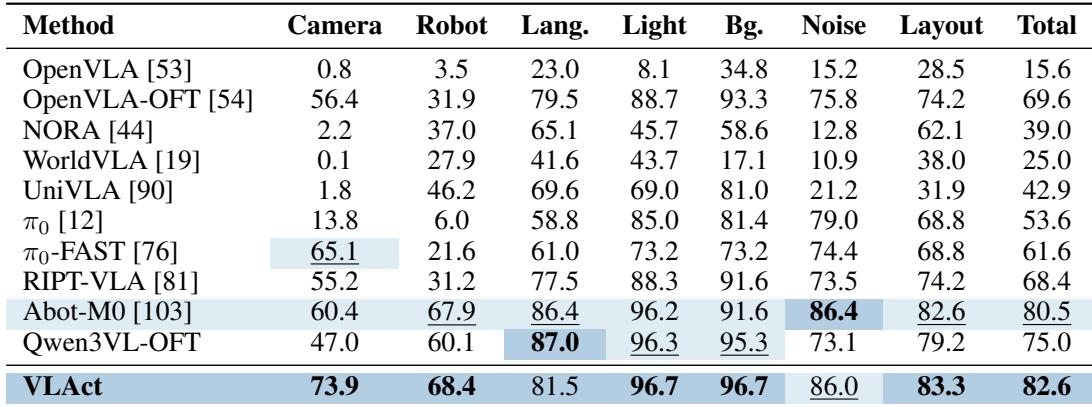
On the LIBERO-Plus robustness benchmark, VLAct reports the highest overall success rate at 82.6%, exceeding Qwen3VL-OFT by 7.6 points and Abot-M0 by 2.1 points. The improvement is concentrated in camera, robot, noise, and layout perturbations, indicating stronger visual-spatial robustness from continued pre-training. Among the listed prior methods, OpenVLA-OFT ranks highest with a 69.6% total, followed by π0-FAST at 61.6%. VLAct achieves the best overall success rate of 82.6%, outperforming Qwen3VL-OFT and Abot-M0 by 7.6 and 2.1 points respectively. Gains over Qwen3VL-OFT are largest on camera, robot, noise, and layout perturbations, pointing to improved visual-spatial representations.
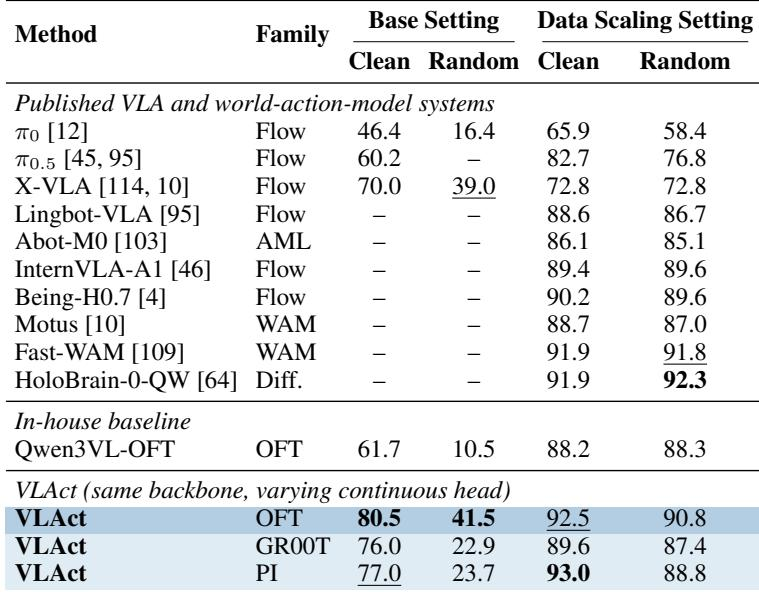
On RoboTwin 2.0, VLAct establishes the strongest Base-setting results among the compared methods and remains competitive in the Data Scaling setting. Its VLAct-OFT configuration reaches 92.5% Clean and 90.8% Random success, outperforming several larger-scale VLA and world-action-model baselines while staying close to the top systems. Strong Random performance after clean-only Base fine-tuning suggests the pretrained backbone improves both sample efficiency and generalization to visual distribution shifts. VLAct achieves the strongest Base-setting performance among the compared methods. In Data Scaling, VLAct-OFT outperforms large-scale systems such as InternVLA-A1, Being-H0.7, Motus, LingBot-VLA, ABot-M0, and π, while remaining close to HoloBrain-0 and Fast-WAM. After fine-tuning only on clean Base trajectories, VLAct still performs strongly on the randomized evaluation set, indicating improved clean-to-random generalization under visual and scene variation. Adding randomized expert demonstrations in the Data Scaling setting yields high Clean and Random success rates relative to published baselines.
VLAct ranks in the top quartile of the RoboDojo leaderboard by both average score and success rate, and its cross-embodiment transfer outperforms all designated world-action-model entries. It also surpasses several industry-developed systems despite using fully open-source data and a 16-GPU continued pre-training setup. The largest advantages appear on Precision and Long-Horizon tasks, while Memory remains a relative weakness. VLAct places eighth by average score and sixth by success rate among 35 policies, putting it in the top quartile on both metrics. It outperforms every explicitly designated world-action-model entry, including the strongest WAM, on both aggregate metrics. The largest gains over a Qwen3-VL-based entry occur on Precision and Long-Horizon tasks, while Memory is a clear limitation.
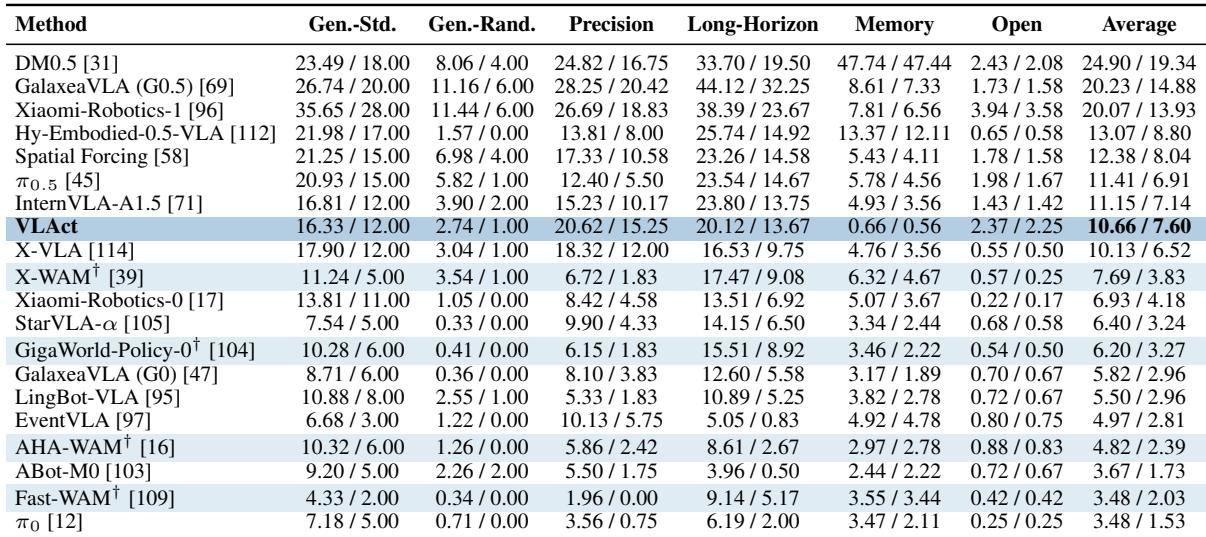
The evaluation spans robustness, generalization, and cross-embodiment skill transfer. On LIBERO-Plus, continued pre-training strengthens visual-spatial representations, with the largest robustness gains under camera, robot, noise, and layout perturbations. On RoboTwin 2.0, VLAct achieves the strongest base-setting results and maintains strong clean-to-random generalization after fine-tuning only on clean trajectories. On RoboDojo, VLAct ranks in the top quartile and surpasses world-action-model baselines, particularly on precision and long-horizon tasks, while memory remains a relative limitation.