Command Palette
Search for a command to run...
최근접 이웃을 활용한 고정보 사영의 효율적 추정
최근접 이웃을 활용한 고정보 사영의 효율적 추정
David Hofmeyr
초록
다변량 데이터에서 유의미한 사영을 찾는 데 매우 효과적인 직관적 차원 축소 방법을 제안한다. 여러 기존 기법들과 유사한 직관적 동기에 기반하여, 제안하는 방법은 데이터 내 최근접 이웃 관계를 강화하는 데 중점을 둔다. 제안하는 사영은 데이터의 국소 공분산 구조를 부호화하도록 설계된 행렬의 스펙트럼 분해로부터 도출되며, 여기서 한 지점에서의 국소 공분산은 해당 지점의 최근접 이웃 쌍들을 통해 포착된다. 표준적인 정규성 조건 하에서 이 행렬이 소위 '밀도 정보 행렬'(DIM)의 일치 추정량임을 보인다. DIM은 피셔 정보 행렬의 비모수적 유사체이다. DIM의 스펙트럼 분해는 독립 성분 분석 및 지도 학습 맥락에서의 충분 차원 축소라는 중요한 문제들과 연결되어 있는 것으로 알려져 있다. 그러나 기존 DIM 추정량들은 계산 비용이 많이 들고, 실제 기저 밀도의 제곱에 비례하는 대리 밀도의 DIM만을 추정 대상으로 한다는 한계가 있다. 나아가 군집 분석 및 이상치 탐지라는 후속 작업을 지원하는 데 있어 제안 방법의 실용적 유용성을 탐구한다.
One-sentence Summary
Researchers at Lancaster University introduce an efficient dimensionality reduction method that builds a matrix from nearest-neighbor pairs to capture local covariance, yielding a consistent estimator of the Density Information Matrix (a non-parametric analogue of the Fisher Information Matrix) that enables high-information projections for tasks such as cluster analysis and outlier detection, while avoiding the computational cost of previous surrogate-density-based estimators.
Key Contributions
- A dimensionality reduction method is proposed that constructs a projection from the spectral decomposition of a matrix encoding local covariance through pairs of nearest neighbors, designed to enhance nearest-neighbor relationships.
- Under standard regularity conditions, this matrix is a consistent estimator of the Density Information Matrix (DIM), a nonparametric analogue of the Fisher information, overcoming the high computational cost and surrogate-density limitation of previous DIM estimators.
- The method's practical utility is demonstrated in downstream cluster analysis and outlier detection tasks.
Introduction
Dimension reduction aims to preserve useful structure in multivariate data, either through global variance-based methods such as PCA or through local graph-based manifold learning. An alternative information-theoretic view treats projections with low entropy after accounting for scale as more informative, since multimodality and long-tailedness are associated with clusters and outliers. The Density Information Matrix provides a nonparametric analogue of the Fisher Information Matrix and has links to independent component analysis and departure from Gaussianity, but it is difficult to estimate directly. Prior work has largely estimated the DIM of a surrogate density proportional to the squared data density, which the authors find less effective in high-dimensional settings. The authors introduce a simple linear dimensionality reduction method based on a k-nearest neighbor estimator of the DIM. Their approach projects data onto leading eigenvectors of a local compactness matrix times the overall covariance, emphasising high-density local structure to produce low-entropy projections useful for clustering and outlier detection.
Method
The authors develop a nearest-neighbor-based estimator for the Density Information Matrix (DIM) and use it to construct a dimension reduction procedure. The core quantity is the matrix I(X,k), which is computed from the k-th and (k+1)-th nearest neighbor distances and difference vectors within a sample X. For each point Xi, the k-th and (k+1)-th neighbors are identified, and the outer product of their difference is normalized by the squared distances. Summing over all points yields an estimate that, under regularity conditions, converges in probability to the population DIM I(fX) as n→∞, provided k(n)→∞ and k(n)2−p/4/n1−p/4→0.
The theoretical analysis proceeds in two stages. First, for a fixed point x, the conditional expectation of the normalized outer product of the k-th and (k+1)-th nearest neighbor differences is expanded. Using the conditional independence structure of order statistics and a Taylor expansion of the density, the authors show that
E[Dx,n−1,(k)2Dx,n−1,(k+1)21(Xx,n−1(k)−Xx,n−1(k+1))(Xx,n−1(k)−Xx,n−1(k+1))′]decomposes into a leading isotropic term involving E[1/Dx,n−1,(k)2+1/Dx,n−1,(k+1)2] and a term proportional to fX(x)21∇fX(x)∇fX(x)′, plus higher-order contributions from the Hessian. Averaging this expression over the sample and using properties of order statistics, the expectation of I(Xn,k) is shown to converge to I(fX), while the variance vanishes under the rate condition on k(n). Lemma 2 provides uniform convergence of the ratio of consecutive neighbor distances, ensuring that the Hessian-dependent bias terms integrate to zero asymptotically.
To improve finite-sample performance, the authors introduce three practical modifications. First, variance is reduced by averaging I(X,k) over a range of k values, defining I(X,k0,k1)=k1−k0+11∑k=k0k1I(X,k). Provided both k0(n) and k1(n) satisfy the conditions of Theorem 1, this averaged estimator remains consistent.
Second, a bias adjustment is applied to the spectral decomposition of the averaged estimator. Let I(X,k0,k1)=UDU′. The diagonal entries of D are replaced by Dii∗=max{Dii,(ui′ΣXui+ϵ)−1}, where ΣX is the sample covariance matrix and ϵ a small constant. This correction exploits a known lower bound: for the population DIM, each eigenvalue Δii satisfies Δii≥1/Var(vi′X), where vi is the corresponding eigenvector. The adjusted matrix I(X,k0,k1)∗ thus respects this bound and converges to I(fX) as well.
Finally, the projection basis is obtained from the matrix product I(X,k0,k1)∗ΣX. Its eigenvectors are orthogonalised via singular value decomposition: if W contains the eigenvectors, the final projection directions are the columns of W∗=WuWv′, where Wu and Wv are the left and right singular vectors of W. This step ensures that the projected data retain more of the total variance, improving downstream tasks such as clustering and outlier detection. The overall pipeline thus estimates the DIM from nearest neighbor statistics, refines it through averaging and bias correction, and produces an orthogonalised projection that preserves the structure captured by the DIM.
Experiment
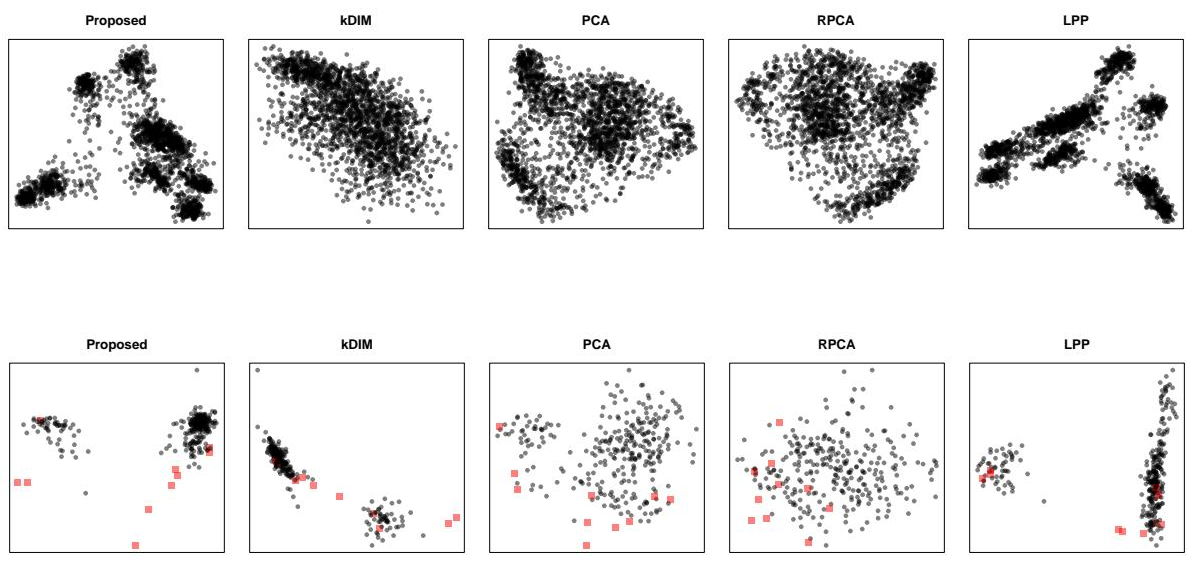
The experiments evaluate the proposed nearest-neighbors DIM (nnDIM) against PCA, robust PCA, LPP, and kDIM as dimension reduction tools for clustering and outlier detection on 45 classification datasets, with estimation accuracy validated on Gaussian data. For clustering, nnDIM is the only method that consistently improves performance across all four clustering algorithms when applied to higher-dimensional data. In outlier detection, nnDIM pairs well with sLOF and Isolation Forest for datasets with one or two inlier classes, though improvements are less conclusive for single outlier class setups.