Command Palette
Search for a command to run...
WithEveryone: 그룹 이미지 생성을 위한 통합 계획 및 신원 정합 프레임워크
WithEveryone: 그룹 이미지 생성을 위한 통합 계획 및 신원 정합 프레임워크
Hengyuan Xu Qixun Wang Yiji Cheng Miles Yang Zhao Zhong Wei Cheng Xingjun Ma Yu-Gang Jiang
초록
특정 인물이 다수 포함된 장면을 생성할 때 신원을 보존하는 이미지 생성의 신뢰도는 크게 저하된다. 각 신원을 유지하는 것 외에도, 모델은 모든 참조 대상을 고유한 인물 및 위치에 결합해야 하며, 학습 단계의 신원 손실 함수는 잡음이 섞인 여러 예측 얼굴 간의 대응 관계를 수립해야 한다. 본 논문에서는 최대 10명의 참조 신원을 포함하는 그룹 이미지 생성을 위한 통합 프레임워크인 WithEveryone을 소개한다. WithEveryone은 선택된 각 신원을 주소 지정 토큰으로 주입하고, 구조화된 신원-레이아웃 계획을 예측한 후, 이 계획을 시각적 조건으로 렌더링한다. 핵심 목적 함수인 레이아웃 기반 신원 손실(Layout-Grounded ID Loss)은 주석이 달린 얼굴 영역을 사용하여 의도된 신원을 직접 지도함으로써 불안정한 임베딩 기반 얼굴 매칭을 피한다. 또한, 신원 표현 강제(ID Representation Forcing) 기법은 이미지 합성 전에 각 신원에 대한 예측을 추가로 학습시킨다. 신원이 중복되지 않는 벤치마크에서 WithEveryone은 최고 수준의 목표-맥락 신원 유사도를 달성하여 얼굴 유사도를 GPT-Image 2의 0.462에서 0.499로 향상시켰으며, 복사-붙여넣기 인공물 발생률은 0.169에서 0.055로 감소시켰다. 또한 요청된 신원의 97.3%를 포함하면서 중복 생성률은 2.8%에 불과했다. 이러한 결과는 명시적인 신원-레이아웃 정합이 직접적인 참조 얼굴 복사에 의존하지 않고도 더 큰 그룹으로 신원 보존 생성을 확장할 수 있게 함을 보여준다.
One-sentence Summary
Researchers from Fudan University, Tencent, and The University of Hong Kong propose WithEveryone, a unified framework for group image generation that injects addressed identity tokens, predicts a structured identity–layout plan, and uses a Layout-Grounded ID Loss to directly supervise intended faces, achieving state-of-the-art identity similarity of 0.499 (versus 0.462 for GPT-Image 2) and reducing copy-paste artifacts to 0.055 (versus 0.169) for up to ten identities.
Key Contributions
- WithEveryone is a unified multimodal framework that generates group images with up to ten reference identities by binding each reference to an addressed token, predicting a structured identity-layout plan, and rendering that plan as a visual condition.
- Layout-Grounded ID Loss uses annotated face regions to supervise intended identities directly and avoids unstable embedding-based face matching, while ID Representation Forcing adds supervised per-identity predictions before image synthesis.
- On an identity-disjoint benchmark, WithEveryone achieves the highest target-context identity similarity of 0.499 versus 0.462 for GPT-Image 2, reduces copy-paste artifacts from 0.169 to 0.055, and covers 97.3% of requested identities with a 2.8% duplicate rate.
Introduction
Unified multimodal models now produce high-fidelity images from text, but identity-preserving generation for large groups (five to ten people) remains unsolved: existing methods handle only a handful of identities, and as the count grows, identity signals dilute, faces duplicate, and spatial relationships break down. Prior identity losses rely on embedding-based matching that fails when generated faces are nearly identical early in training, causing supervision to cancel out. The authors propose WithEveryone, a unified framework that binds each reference to an addressed ID token, applies ID Representation Forcing to keep identities distinct, and introduces a Layout-Grounded ID Loss that uses layout annotations to supervise each face in its own region, eliminating the matching problem. A structured Layout Chain of Thought plans person positions, poses, and identity–layout bindings, enabling coherent multi-person generation. On a five-to-ten-person benchmark, WithEveryone achieves higher identity similarity and fewer copy-paste artifacts than proprietary systems like GPT-Image 2.
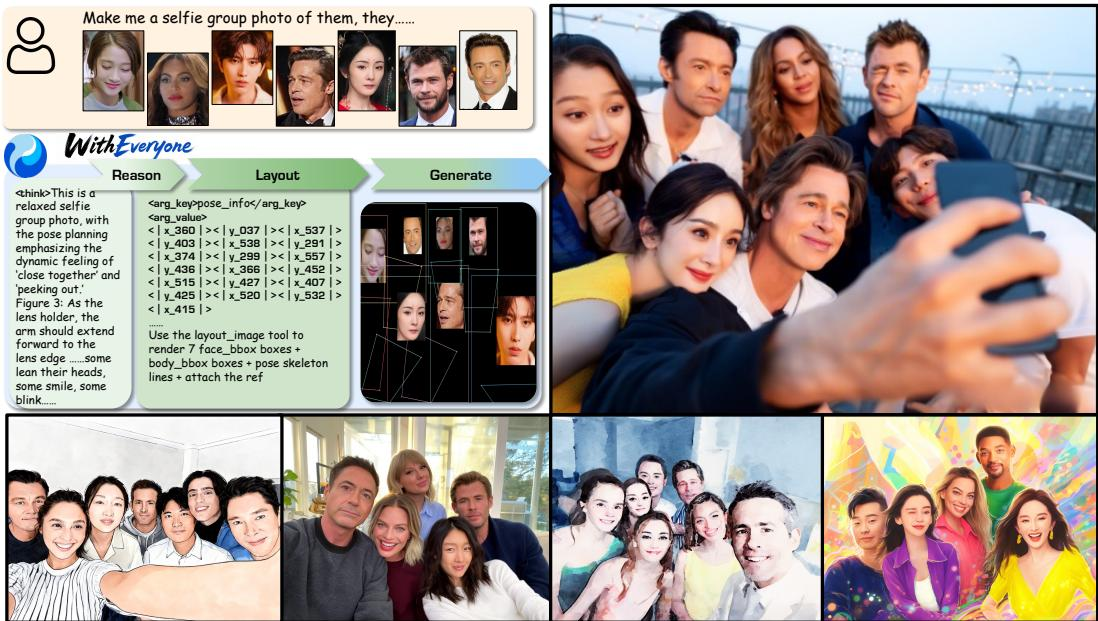
Dataset

The authors construct a training dataset from real group photographs, each containing multiple people. Every sample is a causally ordered sequence of:
- Reference images of the individuals appearing in the photo, together with a text prompt.
- Identity selection and ID loading steps that determine which identities are used.
- Layout planning that specifies bounding boxes and facial landmarks for each person.
- A rendered layout condition derived from the planned boxes and landmarks.
- A recaption (text description) of the group scene.
- An identity prediction (target ArcFace embeddings for each face).
- The target group image itself.
The full annotation pipeline, which extracts these signals automatically from real photographs, is detailed in Appendix C.1. The dataset is used to train a model in a causal, next-step prediction fashion: text tokens (connector text, layout tokens, summaries, recaptions) are supervised with next-token prediction; target-image latents are supervised with flow matching; and identity predictions are supervised with a cosine alignment loss.
A key processing detail is the Layout-Grounded ID Loss. Because the layout annotation provides a fixed bounding box for each referenced identity, the predicted and target images are cropped at these same regions. This yields perfectly paired face crops without any matching step, allowing identity supervision to work reliably even for groups of five to ten people. The crops are encoded by ArcFace, and the loss is applied only below a certain timestep threshold where the one-step clean-image estimate contains a recognizable face.
Method
The authors propose WithEveryone, a model designed for group-image generation from a text prompt and a set of five to ten reference identities. The model follows a transfusion-style mixture-of-transformers multimodal architecture. In this framework, text and structured reasoning are predicted autoregressively, while target-image latents are learned through flow matching. This shared causal context allows high-level decisions made before image generation to directly condition the subsequent image tokens.
Refer to the framework diagram:
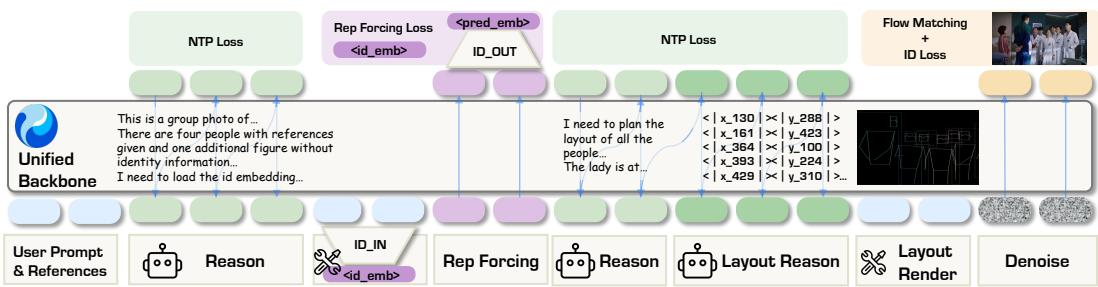
Before synthesizing the target image, the model prepares three complementary conditions. It selects the reference identities participating in the scene and loads a compact representation for each, predicts a structured multi-person layout together with the association between identities and planned people, and finally predicts target identity representations from the accumulated context. The rendered layout condition and the representation scaffold jointly condition flow-based image generation.
To handle identity binding, the model first identifies the participating identities from the available references. For each selected person, the authors extract a 512-dimensional ArcFace embedding, map it to the model hidden dimension with a lightweight MLP, and inject it at the corresponding ID-token position. Selection and binding are ordered rather than mutually dependent. The model emits the list of selected identities and loads one ID token per selection, and the binding to a concrete person follows in the layout stage. This ID-layout binding gives each loaded identity a spatial role.
However, loading ID tokens does not guarantee that image generation will use them. To address this, the authors introduce ID Representation Forcing. For every selected reference identity with a target correspondence, they place a representation token before the target image. The backbone computes its hidden state hirep from the preceding prompt, visual references, ID tokens, and layout reasoning, and an output projector gout maps it to the ArcFace space:
e^i=gout(hirep),LRF=M1i=1∑M(1−cos(e^i,eitgt)),where eitgt is the ArcFace embedding of the corresponding person in the target image and M is the number of supervised identities. This loss directly aligns a continuous identity prediction from the shared context, and the resulting hidden states remain causally available to the later image tokens, forming an identity scaffold for generation.
For spatial relationships, the authors formulate a structured Layout Chain of Thought (CoT). The model autoregressively predicts identity-layout bindings, person and face regions, body extents, and pose keypoints using a discretized coordinate vocabulary. The stages are emitted in a fixed causal order, so each decision is conditioned on the identities and regions already committed. The predicted plan is then parsed and rendered as a canvas, drawing the planned face regions, body regions, and pose skeletons onto a blank image at the target aspect ratio, which is inserted into the context as a condition image.
As shown in the figure below:
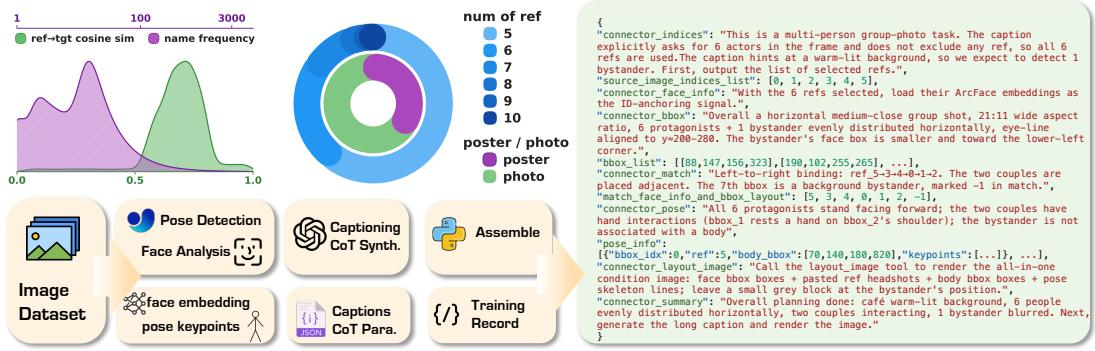
Each training sample interleaves reference images and the prompt, identity selection and ID loading, layout planning, the rendered layout condition, a recaption, the identity prediction, and the target image in that causal order.
To preserve identity in the generated faces, the authors introduce the Layout-Grounded ID Loss (LG-ID Loss). Instead of relying on noisy matching algorithms that fail as the group size grows, the correspondence is already known from the annotation that supervises the Layout CoT. Each referenced identity carries a fixed target face bounding box and its landmarks. Cropping the predicted and target images at these same regions makes every crop pair correct by construction. The crops are encoded by ArcFace, and the loss applies only below a timestep threshold. Given a noisy latent xt and predicted velocity vθ(xt,t) under the reverse-flow convention, the one-step clean-image estimate used by the LG-ID Loss is:
x^clean=xt−tvθ(xt,t).The overall objective combines next-token prediction for text and layout tokens, flow matching for target-image latents, and cosine alignment for identity predictions:
L=LNTP+λFMLFM+λRFLRF+λIDLID.The authors set λFM=1.0, λRF=1.0, and λID=0.5. At inference time, the model predicts identity selection, Layout CoT, and recaption autoregressively, and the renderer deterministically constructs the layout condition from the predicted plan. Target identity embeddings are used only as training targets for representation forcing.
Experiment
The evaluation uses a new benchmark of 210 group images with 5–10 held-out identities to test generalization. Cross-model comparisons show WithEveryone achieves the highest target-context identity similarity and coverage with low copy-paste, and it degrades more gracefully as group size increases. Ablations reveal that layout-grounded identity supervision (LG-ID Loss) is the largest contributor to identity and composition gains, while layout planning quality remains a key bottleneck. Analysis confirms that face size does not explain scaling degradation, and identity-specific attention emerges with Representation Forcing.
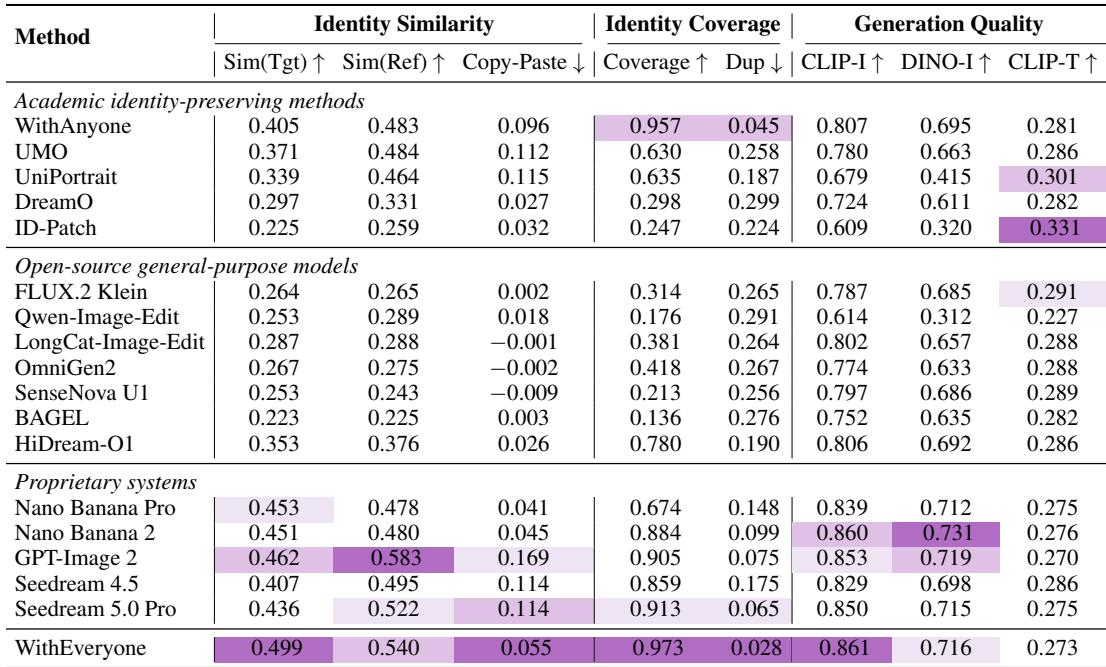
WithEveryone achieves the highest target-context identity similarity and nearly complete coverage of reference identities with minimal duplication, while keeping copy-paste artifacts low. General-purpose open-source models often fail to compose the full group, with coverage below 0.42. High reference similarity in some models like GPT-Image 2 comes with increased copy-paste, suggesting rigid face reproduction rather than contextual adaptation. WithEveryone reaches the highest Sim(Tgt) (0.499) and coverage (0.973) with the lowest duplicate rate (0.028), while its Sim(Ref) (0.540) is second only to GPT-Image 2 (0.583). GPT-Image 2's higher reference similarity is accompanied by a copy-paste score of 0.169, over three times WithEveryone's 0.055, indicating more rigid face copying.
Ablation experiments reveal that layout-grounded identity supervision (LG-ID Loss) provides the largest single improvement in both identity preservation and composition. Model-predicted layout (Layout CoT) also yields gains, while using ground-truth layout as an oracle shows that planning quality remains a key bottleneck. The full model combining all components achieves the highest scores, but the margin over LG-ID alone cannot be attributed to any individual addition due to concurrent changes. LG-ID Loss alone yields the largest gains among individual additions, substantially boosting identity similarity and composition metrics. Replacing the model's predicted layout with the ground-truth layout (oracle) further improves all metrics, indicating that better planning can significantly enhance identity and composition.
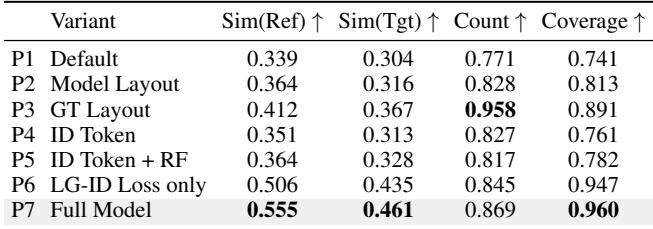
The experiments evaluate identity similarity to the target context, coverage of reference identities, duplication, and copy-paste artifacts. WithEveryone achieves the best balance, providing high coverage and low duplication with minimal copy-paste, unlike models that trade off rigid face copying for similarity. Ablation studies reveal that layout-grounded identity supervision is the primary driver of identity preservation and composition, while improved layout planning further enhances performance, suggesting planning quality as a key bottleneck.