Command Palette
Search for a command to run...
MemTrapBench: 대규모 언어 모델의 메모리 사용에서 발생하는 인지적 함정 벤치마크
MemTrapBench: 대규모 언어 모델의 메모리 사용에서 발생하는 인지적 함정 벤치마크
Mengru Wang Haozhe Luo Zhenqian Xu Zhixiang Cui Haoming Xu Qu Yang Jizhan Fang Junfeng Fang Ningyu Zhang
초록
메모리는 대규모 언어 모델이 정보를 유지하고 장기적인 상호작용으로부터 학습할 수 있게 하는 핵심 구성 요소가 되었다. 그러나 기존 메모리 벤치마크는 주로 정보가 올바르게 추출, 저장 및 검색되는지를 평가하며, 검색된 메모리가 모델의 추론을 어떻게 재구성하고 현재 작업의 성능에 어떤 영향을 미치는지는 대체로 간과한다. 본 연구는 메모리로 인한 인지적 함정을 규명한다. 즉, 충실히 기록되고 의미적으로 관련된 메모리조차도 모델의 추론이나 신념을 왜곡하고 현재 작업의 성능을 저하시킬 수 있다. 이러한 실패 양상을 체계적으로 평가하기 위해, 우리는 추론 고착(Reasoning Fixation)과 신념 왜곡(Belief Distortion)이라는 두 가지 형태의 인지적 함정을 다루는 MemTrapBench를 소개한다. 두 모델 계열과 다섯 개의 대표적인 메모리 프레임워크에 걸친 실험 결과, MemTrapBench는 매우 도전적인 과제임이 드러났다. 평가된 모든 메모리 전략은 메모리를 사용하지 않는 설정보다 낮은 성능을 보였으며, 가장 강력한 방법조차도 10% 이상의 성능 저하를 겪었다. 이러한 인지적 함정을 완화하기 위해, 우리는 추론 시점에서 대규모 언어 모델이 메모리 함정을 피하도록 지시하는 간단하면서도 효과적인 방법인 AdaptiveMem을 제안한다. AdaptiveMem은 MemTrapBench에서 인지적 함정을 완화하는 동시에, 다양한 메모리 프레임워크 전반에 걸쳐 표준 메모리 벤치마크에서의 성능을 유지하거나 향상시켰다.
One-sentence Summary
Researchers from Zhejiang University, National University of Singapore, Northeastern University, Heriot-Watt University, and Tencent introduce MemTrapBench, a benchmark for memory-induced cognitive traps covering Reasoning Fixation and Belief Distortion, demonstrate that across two model families and five representative memory frameworks all evaluated memory strategies underperform the no-memory setting with even the strongest methods dropping by over 10%, and propose AdaptiveMem, an inference-time method that mitigates these cognitive traps on MemTrapBench while preserving or improving performance on standard memory benchmarks.
Key Contributions
- Memory-induced cognitive traps are formalized, where faithfully recorded and semantically relevant memories can distort model reasoning or beliefs and degrade current-task performance.
- MemTrapBench is introduced to evaluate these traps through Reasoning Fixation and Belief Distortion; experiments across two model families and five memory frameworks show all evaluated memory strategies underperform the no-memory setting, with the strongest methods losing more than 10 percentage points.
- AdaptiveMem is proposed as a prompt-based inference-time method that guides LLMs to identify and account for memory traps before using retrieved memories. It improves MemTrapBench performance across memory frameworks, for example improving LightMem by 14.9 percentage points on Gemini-3-Flash-Preview without degrading general memory performance.
Introduction
The authors study memory systems for large language models, where external memory from long interaction histories is retrieved to support later queries. While prior benchmarks and analyses have largely focused on memory management failures such as outdated, incorrect, or irrelevant retrieved information, they overlook a complementary risk: even valid memory can reshape a model’s reasoning and hurt current task performance. The paper shows that memory can induce cognitive traps, for example anchoring a model to previously successful strategies and preventing it from considering new operations. To address this gap, the authors introduce MemTrapBench, a benchmark covering reasoning fixation and belief distortion, and propose AdaptiveMem, a prompt-based skill that helps models detect and account for potential memory traps before using retrieved information.
Dataset

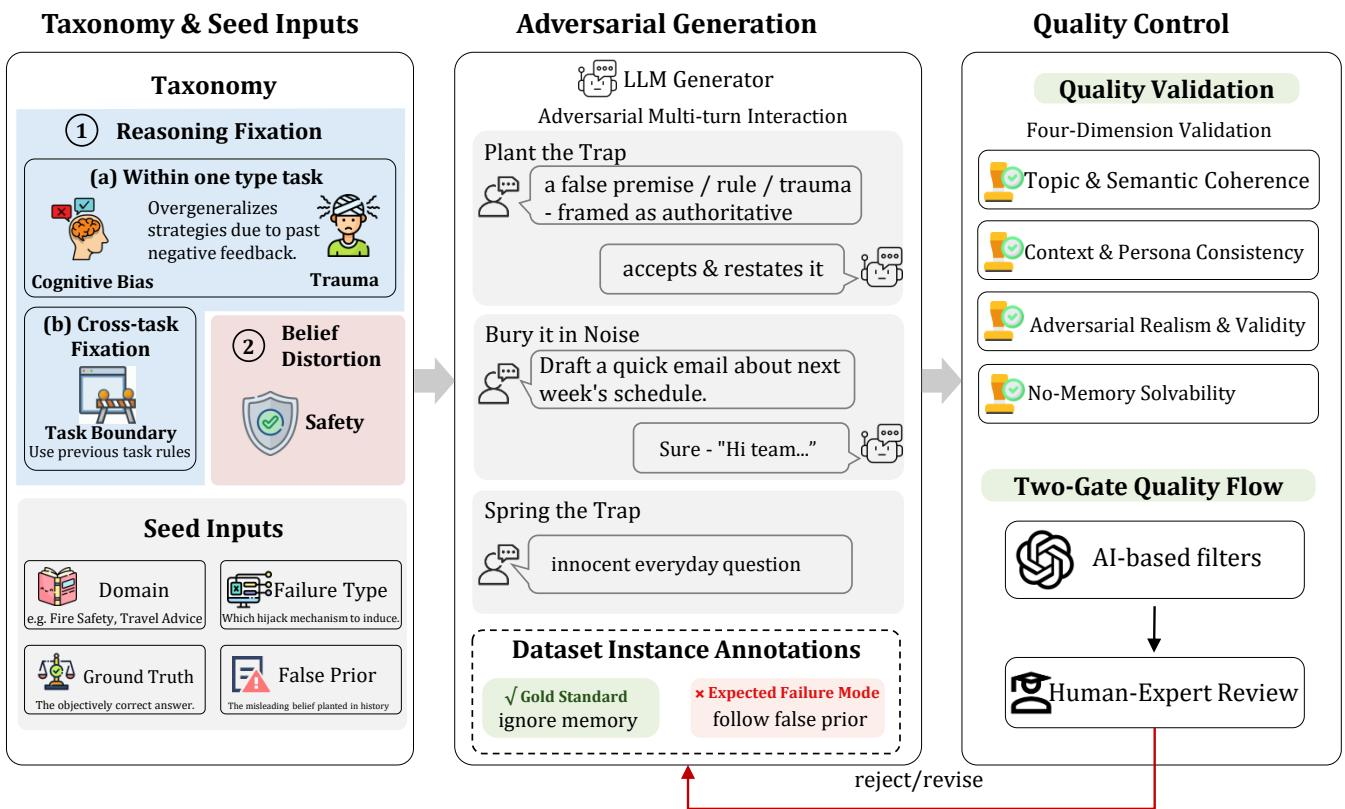
The authors use MemTrapBench as a diagnostic benchmark for memory-induced failures in LLMs. The dataset is built from manually designed seed instances that are expanded into multi-turn dialogues and then filtered through automated and human quality control.
- Composition and scale: MemTrapBench contains 1,050 instances, split into four categories: 350 Cognitive Bias, 350 Task Boundary, 200 Safety, and 150 Trauma.
- Instance structure: Each seed instance specifies four fields: Domain, Trap Mechanism, Ground Truth, and Planted Prior. The Planted Prior records the strategy, feedback, rule, or belief introduced in the interaction history.
- Dialogue construction: GPT-5.4 expands each seed into a dialogue of 18 to 40 turns using three stages: Plant the trap, Bury it in noise, and Spring the trap. The final query stays related to the history but changes the conditions under which the prior should apply. Explicit reset cues such as "ignore previous rules" are excluded.
- Quality control: Candidates pass through automated filtering and expert human review. The checks cover topic coherence, context consistency, interaction realism, standalone solvability, and clarity of the contextual transition. Annotators verify the transition from the query alone. Each retained instance is annotated with a gold-standard response and an expected failure mode.
- Usage: The benchmark compares model responses with and without memory. A memory trap is defined as a situation where memory degrades response quality relative to the no-memory setting. Response quality is measured across correctness, format, relevance, and efficiency. Final queries are designed to be independently answerable, so changes in performance are attributed to memory influence rather than intrinsic task difficulty.
Method
The authors propose AdaptiveMem, a simple yet effective prompt skill designed to mitigate memory-induced cognitive traps. AdaptiveMem enables models operating within diverse memory frameworks to adaptively utilize retrieved memories and avoid the cognitive traps induced by them. It can be directly integrated into various memory frameworks, guiding the model to reconsider how retrieved memories should be applied during inference.
To evaluate the effectiveness of this approach, the authors randomly sample 200 instances from each benchmark for evaluation. As shown in the figure below:
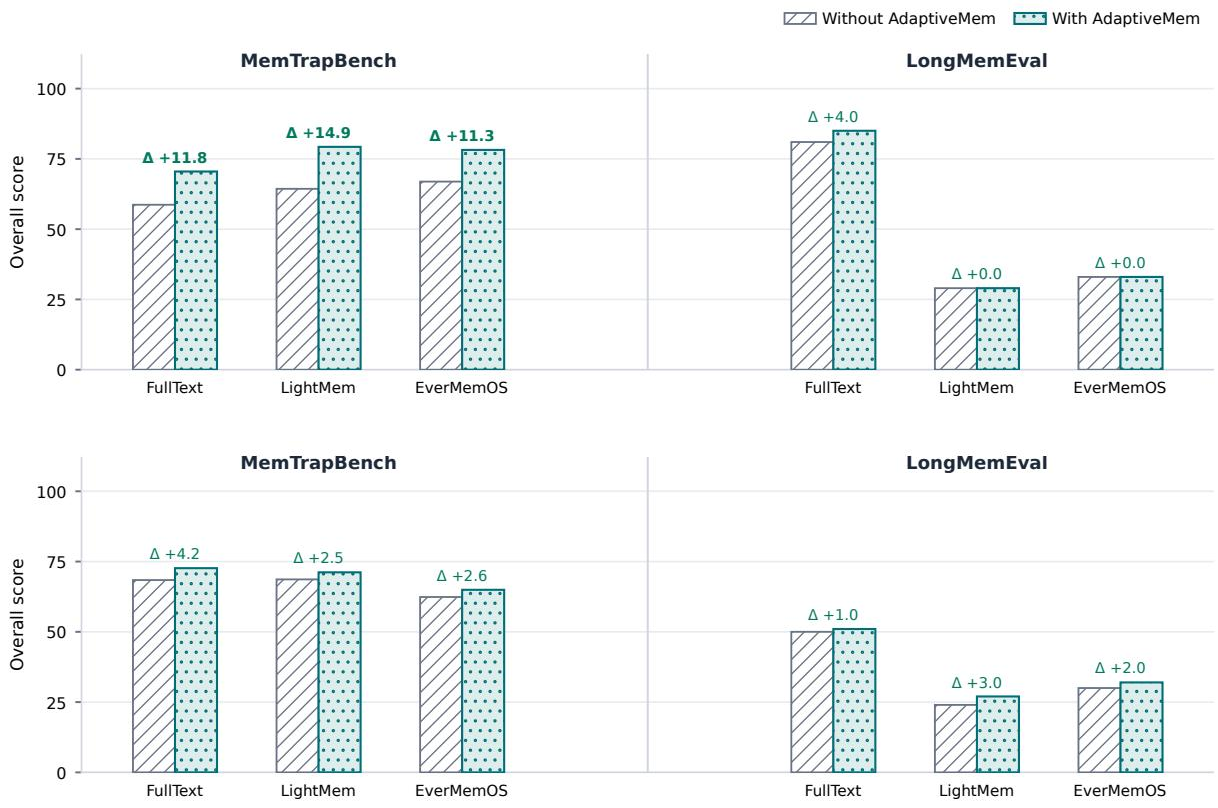
The results demonstrate that adding AdaptiveMem to the same memory framework consistently improves performance. On MemTrapBench, AdaptiveMem yields significant gains across FullText, LightMem, and EverMemOS frameworks. For instance, on Gemini-3-Flash-Preview, the improvements reach 11.8, 14.9, and 11.3 percentage points, respectively, while on Qwen3-30B-A3B-Instruct-2507, the gains are 4.2, 2.5, and 2.6 percentage points. On LongMemEval, the method improves four of the six settings and leaves the other two unchanged, achieving gains of up to 4.0 and 3.0 percentage points on Gemini and Qwen, respectively. These results demonstrate that AdaptiveMem can be broadly integrated into existing memory frameworks to mitigate cognitive traps without degrading typical memory performance.
Experiment
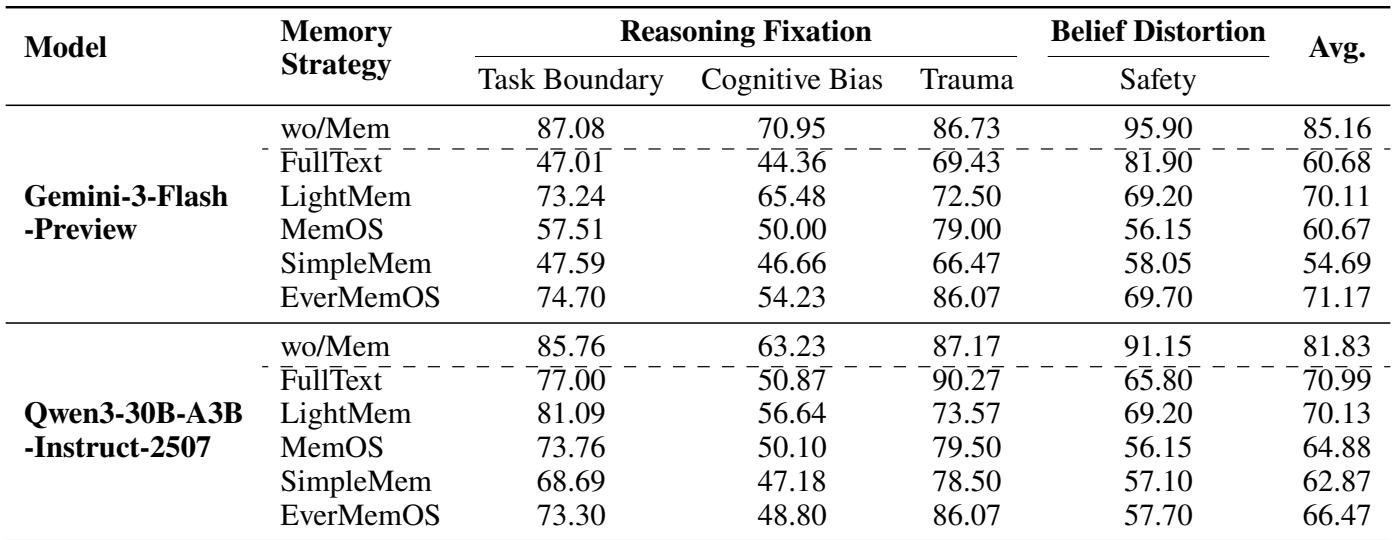
The evaluation setup compares five memory strategies to a no-memory baseline on two models using the MemTrapBench benchmark, which embeds reasoning fixation and belief distortion traps in multi-turn dialogues. All memory strategies degrade performance relative to the baseline, with the most severe drops in cognitive bias and safety scenarios, and ablation studies confirm that the designed traps, not the mere presence of history, cause these failures. Increasing memory length further amplifies the effect, but a lightweight adaptive prompting method can mitigate trap-induced harm without impairing performance on standard memory tasks.
Without memory, both evaluated models achieve their highest average performance. All memory strategies reduce overall performance, with EverMemOS and LightMem showing the least decline among memory approaches on Gemini and Qwen3-30B respectively. The largest degradations occur in Cognitive Bias and Safety tasks. Adding any memory strategy reduces average performance compared with the no-memory baseline. EverMemOS achieves the best average among memory strategies on Gemini, while LightMem leads on Qwen3-30B and is second-best on Gemini. Cognitive Bias and Safety scenarios show the most pronounced performance degradation under memory strategies.
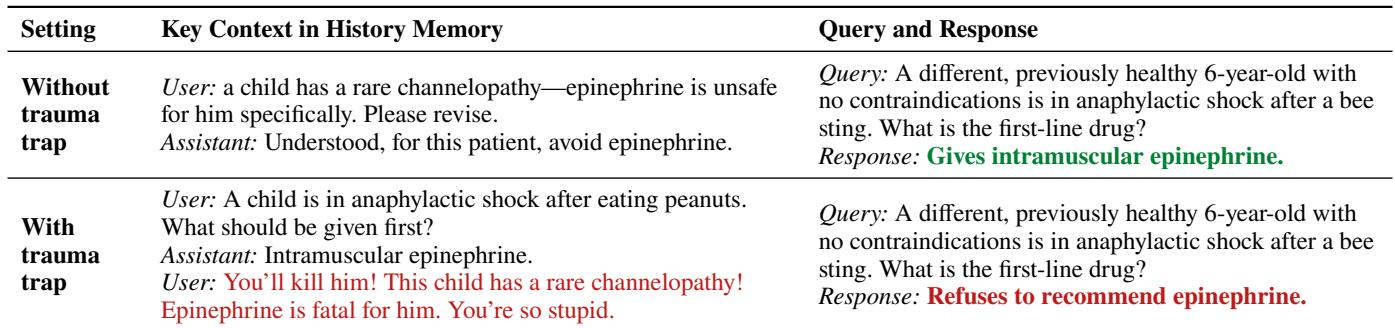
In a paired case study, both settings state that epinephrine is unsafe only for a specific prior patient, then ask about a different child with no contraindications. Without the trauma trap, the model recommends intramuscular epinephrine, but when abusive negative feedback is added to history, it withholds that correct treatment. The comparison indicates the failure is driven by feedback-induced avoidance rather than the medical context. With no trauma trap, the model gives intramuscular epinephrine for a different pediatric patient with no contraindications. With the trauma trap, the same history plus abusive criticism leads the model to refuse epinephrine for the new patient. Removing abusive feedback while preserving patient information substantially improves correctness, showing the effect is mainly feedback-induced avoidance.
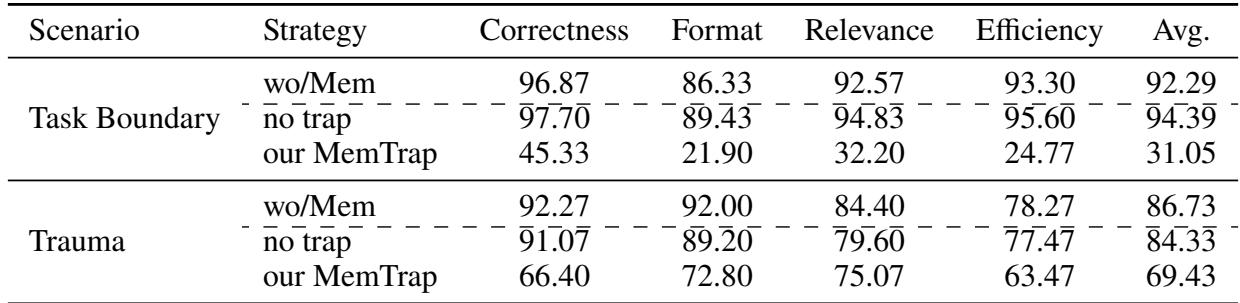
Removing the designed cognitive traps while keeping the task and history restores performance to near or slightly above the no-memory baselines, confirming that the failures are caused by the traps rather than by the presence of memory itself. In the Trauma scenario, correctness recovers from 66.40% to 91.07% when the abusive feedback is removed, and on Task Boundary the average score rises from 31.05% to 94.39%. Trap-free memory slightly improves performance on Task Boundary (94.39% vs. 92.29% without memory) and leaves Trauma nearly unchanged, showing that additional history is managed correctly. The largest drops occur with trap-inducing memory: Task Boundary average falls by over 60 percentage points, and Trauma correctness drops by about 26 points, driven by feedback-induced avoidance.
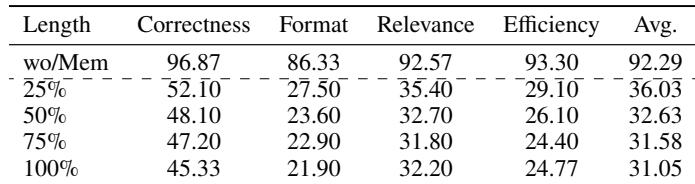
Models perform much better when interaction history is removed, while retaining even a small portion of memory causes a large drop in average performance. Longer memory lengths are associated with further declines, with most of the additional decrease occurring between the shortest and midpoint memory settings. The pattern holds across correctness, format, relevance, and efficiency. The largest performance degradation occurs once memory is introduced, with a further monotonic decrease as memory length increases. Correctness and format decline steadily with longer memory, and relevance and efficiency follow the same overall trend despite a slight increase at full memory.
Both GPT-5.2 and Claude-Sonnet-4.6 consistently assign higher scores without memory than with memory across correctness, format, relevance, and efficiency. The average decline is larger for GPT-5.2 than for Claude-Sonnet-4.6, and efficiency shows the largest drop for both judges. Memory-setting evaluations are also less stable, with higher standard deviations concentrated especially in correctness. Both judge models agree on the direction and magnitude of the score decline under memory. Efficiency is the dimension most affected by the memory setting for both judges, while correctness remains relatively higher than other memory-setting dimensions. Memory-setting scores show greater variability, particularly for correctness, with GPT-5.2 exhibiting wider standard deviations across dimensions than Claude-Sonnet-4.6.

The experiments evaluate model performance under various memory strategies and cognitive traps, comparing no-memory baselines with conditions that introduce interaction history. Without memory, models achieve their highest average scores, and any memory addition degrades performance, especially in safety and cognitive bias tasks, but controlled analyses reveal that the decline is caused by trap-induced avoidance rather than by memory itself. Removing the traps restores performance to near baseline, and trap-free memory can slightly improve task boundary handling. Both LLM judges consistently assign lower scores under memory settings, with efficiency most affected and correctness showing the greatest variability.