Command Palette
Search for a command to run...
Spark-to-Paper: 구성 가능한 기술로 구현된 종단 간 연구 논문 생성
Spark-to-Paper: 구성 가능한 기술로 구현된 종단 간 연구 논문 생성
Zhuoyang Qian Biao Wu Yiran Wang Chris D Yan Desan Dai Liangwei Zheng Jin Jiang Jusheng Zhang Wenhao Wang
초록
연구 아이디어를 완성된 논문으로 발전시키는 과정은 단순한 텍스트 생성을 넘어선다. 시스템은 문헌을 검색하고, 실험을 설계 및 실행하며, 증거에 따라 주장을 수정하고, 출판 가능한 수준의 그림을 생성하며, 긴 생성 과정 전반에 걸쳐 일관성을 유지해야 한다. 본 논문에서는 별도의 에이전트 플랫폼이나 오케스트레이션 서비스 없이, 기존 코딩 어시스턴트 내에서 13개의 구성 가능한 기술로 구현된 종단 간 연구 논문 생성 시스템인 Spark-to-Paper를 제시한다. Spark-to-Paper는 모델 기반 판단을 직접 실행 및 확인 가능한 결정론적 작업과 분리한다. 또한 실험 계획과 보고를 분리하여, 결과를 관찰하기 전에 필요한 증거를 명시하고 측정된 결과에 따라 원고의 주장을 수정하도록 한다. 긴 연구 과정에서의 신뢰성을 향상시키기 위해, 이 시스템은 결정론적 무결성 검사와 자기 비평을 결합하고, 반복된 실험이 원래의 연구 목표를 계속해서 기각하는 '자기 반박 루프'라는 실패 모드를 제한한다. Spark-to-Paper는 또한 실험 결과에 대한 프로그래밍 방식의 플로팅과 생성된 방법 다이어그램에 대한 코드 기반 재구성을 통해 편집 가능한 벡터 그림을 생성한다. 8개의 통제된 연구 주제에 걸쳐 Spark-to-Paper는 99.5%의 인용 유효성과 96.4%의 그림 편집 가능성을 달성했다. 통제된 절제 실험을 통해 조작 탐지율이 단일 패스 초안의 14%에서 전체 무결성 및 검토 스택을 적용했을 때 92%로 증가했으며, 적대적 검토는 74%의 정밀도를 달성했다. 전체 시스템은 1,190만 토큰을 사용하고, 논문 한 편당 8.1달러의 비용이 들며, 평균 3.2시간이 소요된다. 이러한 결과는 종단 간 연구 논문 생성이 기존 코딩 어시스턴트 내에서 경량화되고 구성 가능한 작업 흐름으로 구현될 수 있으며, 실험적 증거를 주장의 수용, 수정 또는 폐기 방식의 중심에 둘 수 있음을 보여준다.
One-sentence Summary
Vast Intelligence Lab and the University of Technology Sydney present Spark-to-Paper, an end-to-end research paper generation system built as thirteen composable skills inside a coding assistant that decouples model judgment from deterministic checks, separates experiment planning from reporting, and employs integrity checks and self-critique to avoid the Self-Refutation Loop, achieving 99.5% citation validity, 96.4% figure editability, and a cost of $8.1 per manuscript.
Key Contributions
- Spark-to-Paper is an end-to-end research paper generation system implemented as thirteen composable skills inside an existing coding assistant, reusing its native file, tool, and code execution capabilities without a separate agent platform. It separates model-based judgment from deterministic operations and decouples experiment planning from reporting, so required evidence is specified before results are observed and manuscript claims are revised accordingly.
- The system bounds the Self-Refutation Loop, a failure mode where repeated experiments reject the original research objective, by preserving the unsuccessful trajectory as a research report and moving to a new idea, ensuring claims are revised or abandoned according to evidence rather than forced toward a successful narrative.
- Spark-to-Paper generates editable vector figures through programmatic plotting for experimental results and code-based reconstruction for method diagrams, and applies deterministic integrity checks with self-critique to reduce fabrication. Across eight controlled research topics, citation validity reaches 99.5%, figure editability 96.4%, and a controlled ablation boosts fabrication detection from 14% to 92% while adversarial review achieves 74% precision.
Introduction
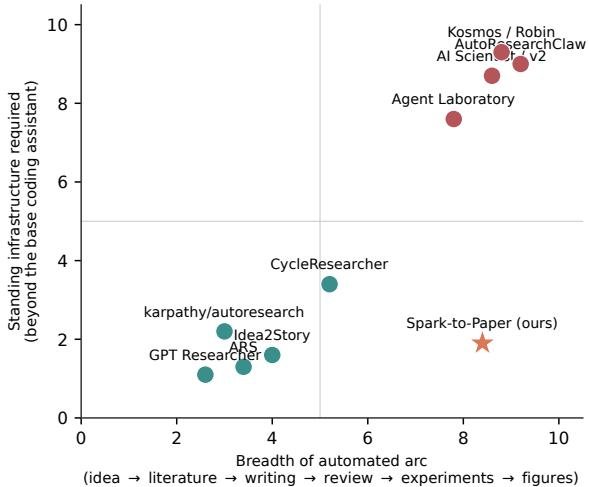
Automating the full research-to-paper pipeline requires more than just generating text; it involves literature search, experimentation, claim revision, and figure creation. Recent autonomous research agents can perform these tasks end-to-end, but they are typically built as standalone platforms with their own orchestration infrastructure, separate from the coding environments where researchers already work. Meanwhile, modern coding assistants offer file inspection, code execution, and tool use, yet existing skill-based tools only support partial workflows such as drafting or literature retrieval. The authors introduce Spark-to-Paper, a system that combines these capabilities into thirteen composable skills inside an existing coding assistant, enabling end-to-end paper generation with evidence-grounded claim revision, deterministic integrity checks, and editable vector figures, all without requiring a separate agent platform or orchestration service.
Method
The authors present Spark-to-Paper, a system composed of thirteen skills that operates within an existing coding assistant. Each skill addresses a specific research task, such as planning, literature search, writing, or figure generation. Rather than constructing a separate agent system, the framework leverages the coding assistant's native capabilities to read files, execute code, and invoke external tools. All skills share a common project directory, reading artifacts produced by previous steps and writing their outputs back to the project. This file-based interface allows the manuscript to evolve seamlessly across the entire pipeline.
Within each skill, the system separates tasks requiring judgment from those that can be executed mechanically. The language model handles context-dependent decisions, such as argument organization, literature selection, and claim evaluation. Conversely, operations with explicit rules, like checking manuscript structure, validating citations, and compiling LaTeX, are handled by deterministic scripts. This design ensures that open-ended generation is restricted to areas requiring semantic reasoning, while verifiable operations remain reproducible.
The execution of these skills is organized into a structured pipeline.
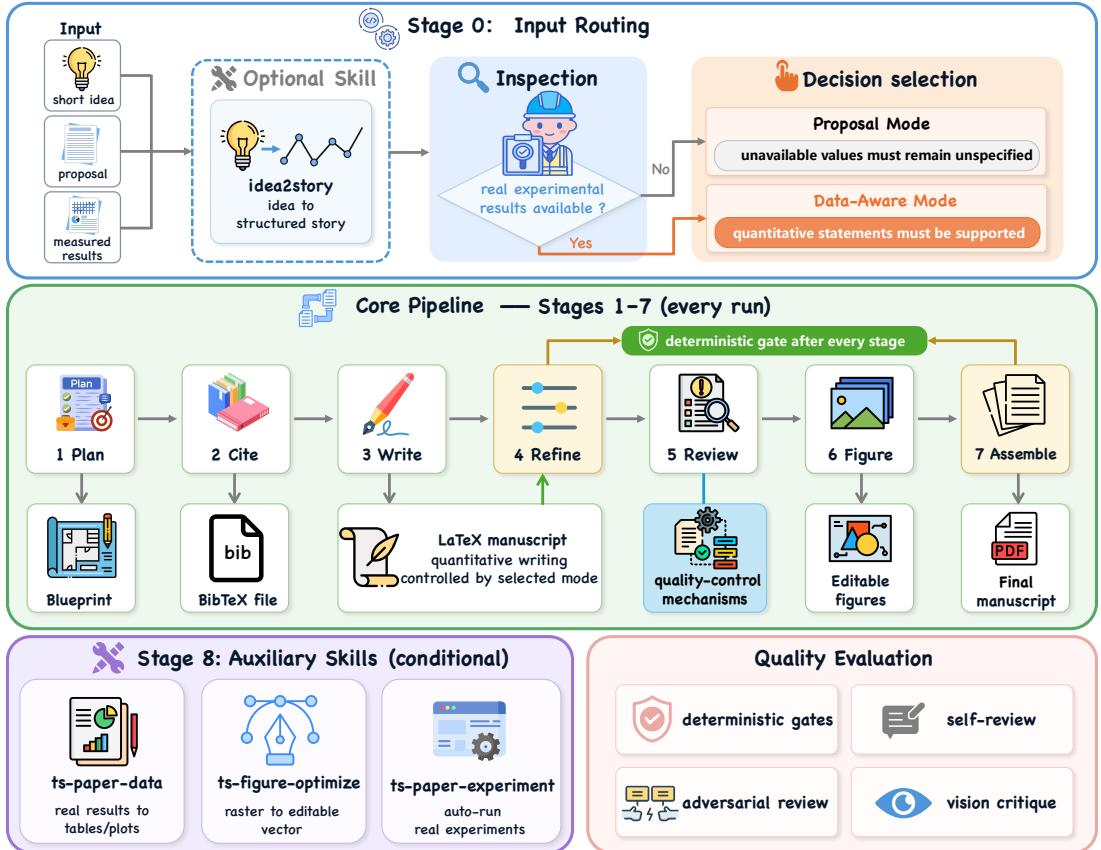
As illustrated in the framework diagram, the pipeline begins with Stage 0, Input Routing. The system inspects the user input to determine the starting point and selects a result-integrity mode. If no measured results are available, it enters Proposal Mode, where unavailable values must remain unspecified. If experimental data is present, it enters Data-Aware Mode, requiring quantitative statements to be supported by the provided data.
The core pipeline consists of Stages 1 through 7. The planning skill converts the input into a structured blueprint, identifying the research question, contributions, and section structure. The citation skill then builds a verified bibliography by searching for relevant literature and checking metadata, storing valid references in a BibTeX file. The writing skill generates the complete LaTeX manuscript using the blueprint and bibliography, maintaining consistency across sections. Following this, the refinement skill revises the manuscript as a whole to remove repetition and reconcile terminology, after which deterministic checks are rerun. The review skill then challenges the manuscript through multiple isolated passes examining technical soundness and experimental design. Confirmed issues are returned for further refinement. The figure skill generates visualizations, and the assembly skill combines all components into a final LaTeX project, compiling it and verifying the absence of errors.
Stage 8 handles experiment execution conditionally. If a complete draft is available and the planned experiments are feasible, the system runs them, records the outputs, and updates the manuscript with the new evidence. This connects the proposal and data-aware parts of the pipeline.
To maintain reliability over long generation horizons, the authors implement a dual integrity system. Deterministic gates enforce explicit constraints, such as citation consistency and successful compilation. For semantic errors that emerge over time, the system employs model-based self-critique. Self-Review operates locally after edits to fix terminology drift and local inconsistencies. Adversarial-Review operates at the manuscript level, where isolated passes examine the paper from complementary perspectives. Proposed issues must quote specific passages and are checked for validity before being accepted for revision.
To prevent self-refutation loops where the system repeatedly revises a research direction without converging, the number of experiment, critique, and revision cycles is bounded. If the research objective cannot be supported after seven cycles, the trajectory is terminated, and a failure report is generated. The system then initiates a new research trajectory from a different idea.
Figure generation follows two distinct paths. Method and explanatory figures are first created visually using an image-generation model and then reconstructed as editable vector graphics through code, iteratively adjusting the layout to match the visual target. Experimental result figures are generated directly from measured data using plotting programs, ensuring quantitative accuracy.
Experiment
The evaluation setup uses preregistered protocols and controlled experiments on eight topics, comparing Spark-to-Paper against human preprints, prior autonomous systems, and a single-pass baseline. Quality is assessed through citation validity, figure editability, and fabrication detection, with an ablation showing that the full quality-control stack sharply increases detection rates while adversarial review contributes high precision. Case studies confirm that the system autonomously refines its methods and prioritizes evidence over user-imposed prior expectations, leading to manuscripts with consistent, traceable claims.
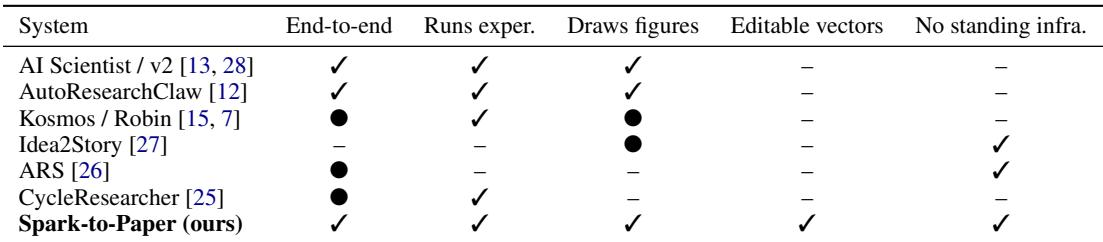
Spark-to-Paper is the only compared system that provides full end-to-end automation, runs experiments, draws figures, produces editable vector graphics, and requires no standing infrastructure. Other systems either lack editable vector output, require standing infrastructure, or offer only partial capabilities in one or more areas. Spark-to-Paper is the only system that combines full end-to-end automation, fully running experiments, drawing figures, editable vector output, and no standing infrastructure requirement. AI Scientist v2 and AutoResearchClaw match Spark-to-Paper on end-to-end, experiment running, and figure drawing, but they do not provide editable vectors and require standing infrastructure.
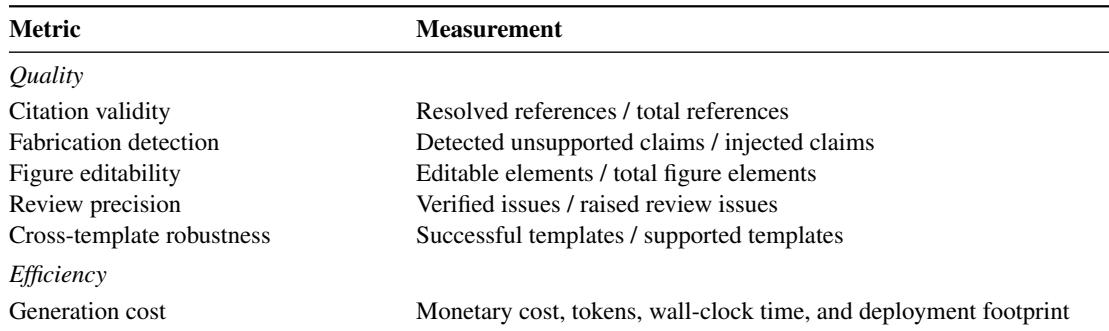
The evaluation framework defines five quality metrics, each as a ratio of verified or editable elements to total instances, and one efficiency dimension tracking incremental computational cost. Review precision is only assessed for configurations with an explicit review stage, and all measurements are reported on a fixed set of externally selected topics with uncertainty across topics. Efficiency is measured as token and dollar deltas relative to the preceding configuration, isolating the marginal cost of each quality-control component. Citation validity is the proportion of references that are successfully resolved. Fabrication detection measures the fraction of injected unsupported claims that are flagged as unsupported. Figure editability is the share of editable elements among all figure elements. Review precision is the percentage of raised review issues that are independently verified, excluding ambiguous judgments. Cross-template robustness is the number of successful templates over supported templates. Efficiency is measured by incremental token and dollar costs for each added layer, reported relative to the immediately preceding row.
Spark-to-Paper attains the highest citation validity and figure editability among all evaluated systems, surpassing both human-written preprints and prior autonomous research agents. Prior systems offer moderate citation validity but provide almost no editable figures, while a single-pass LLM baseline is far cheaper and faster yet suffers from substantially lower citation accuracy. The full pipeline therefore delivers human-competitive artifact quality at a moderate increase in cost and runtime. Spark-to-Paper’s citation validity (99.5%) exceeded human preprints (97.8%) and all prior autonomous systems, which ranged from 91% to 96%. Figure editability reached 96.4%, whereas prior systems provided at most 3% editable elements and human preprints averaged 58%. The single-pass LLM baseline cost 0.66andcompletedin16minutes,butitscitationvaliditydroppedto812.33, achieved 96% citation validity but had no editable figures.

Starting from a single-pass draft, introducing gating markedly improves fabrication detection from 14% to 69% while incurring the largest token and monetary overhead. Adding self-review and adversarial review further raises detection to 81% and 92% respectively, each at a smaller incremental cost. The adversarial review stage also achieves 74% precision, indicating that most flagged issues are verifiable. Without any quality-control steps, only 14% of seeded fabrication probes are detected. Gating raises detection to 69% but adds 8.1 million tokens and $5.3 per paper, the largest single-component cost. Self-review improves detection to 81% with a modest cost increase of 1.1 million tokens. The full stack with adversarial review reaches 92% detection and attains 74% review precision, meaning most issues raised are verifiable.

The evaluation compares Spark-to-Paper against prior systems and human preprints using metrics for citation validity, figure editability, fabrication detection, and cost. Spark-to-Paper uniquely provides full end-to-end automation, runs experiments, and produces editable vector figures without standing infrastructure. It achieves higher citation validity and figure editability than both human preprints and earlier agents. Ablations show that stacking gating, self-review, and adversarial review progressively lifts fabrication detection, with adversarial review offering high precision at a modest incremental cost.