Command Palette
Search for a command to run...
소규모 실험: 우리는 아직 거기에 도달했는가?
소규모 실험: 우리는 아직 거기에 도달했는가?
Nicholas Lourie Kyunghyun Cho Karen Ullrich Sanae Lotfi
초록
스케일링 법칙은 비용 효율적인 실험을 약속했지만, 6년이 지난 지금도 그 약속을 온전히 실현하지 못했다. 대신 연구자들은 스케일링 법칙이 소규모(400만 파라미터부터)에서 신뢰할 수 없음을 발견했고, 상당한 크기의 모델을 피할 수 없다고 결론지었다. 우리는 이것이 사실이 아님을 보인다. 혼란 요인은 하이퍼파라미터이다. 소규모 모델은 매우 민감하지만, 하이퍼파라미터 민감도는 규모가 커질수록 사라진다. 이러한 소규모 민감성 때문에 스케일링 법칙을 놓치기 쉬운데, 이는 스케일링 법칙이 완전히 튜닝된 프런티어에서만 나타나며, 그 프런티어에 도달하려면 대부분의 연구자가 실제로 수행하는 수준을 훨씬 넘어서는 광범위한 탐색이 필요하기 때문이다. 기본적인 스케일링 법칙 레시피를 제거 실험함으로써, 우리는 잘 튜닝된 하이퍼파라미터가 다른 어떤 요소보다 중요함을 보인다. 나아가 우리는 그 하이퍼파라미터들이 왜 더 찾기 쉬워지는지 밝힌다. 규모가 증가함에 따라 하이퍼파라미터 손실 표면이 더 낮은 차원이 되기 때문이다. 그럼에도 불구하고 스케일링 법칙은 소규모 모델에 존재하지만, 외삽은 통계적 한계에 부딪힌다. 총체적인 접근이 필요하다. 우리의 통찰과 최근 문헌을 종합하여, 우리는 모델 중심 연구를 위한 새로운 방법론을 개발하고, 한때 학계가 수년에 걸쳐 해결해야 했던 질문, 즉 트랜스포머 아키텍처에서 정규화 계층을 어디에 배치할 것인가에 적용하여 시연한다. 소규모 실험으로부터 우리는 대규모 결과를 재현한다. 사전 정규화가 모델 크기가 커질수록 더 잘 작동한다는 것이다. 올바른 도구와 더 나은 이해를 바탕으로, 소규모 실험은 스케일링 법칙의 오랜 약속을 실현할 수 있다.
One-sentence Summary
Researchers from FAIR at MSL Meta and New York University demonstrate that hyperparameter sensitivity, rather than model scale, confounds scaling laws, and introduce a model-centric methodology that recovers from small-scale experiments the large-scale result that pre-normalization works better as transformer models grow.
Key Contributions
- The paper shows that small models can exhibit scaling laws, but only after extensive hyperparameter tuning; it identifies hyperparameters as the main confounder and reports that well-tuned hyperparameters matter more than any other ingredient in the scaling law recipe.
- It explains the scale dependence of hyperparameter sensitivity by showing that sensitivity fades and the hyperparameter loss surface becomes lower dimensional as model size grows, which is why tuned small-scale configurations transfer to larger models with little adjustment.
- It develops a model-centric small-scale experiment methodology based on these insights and validates it by recovering the large-scale finding that pre-normalization works better as transformer models grow.
Introduction
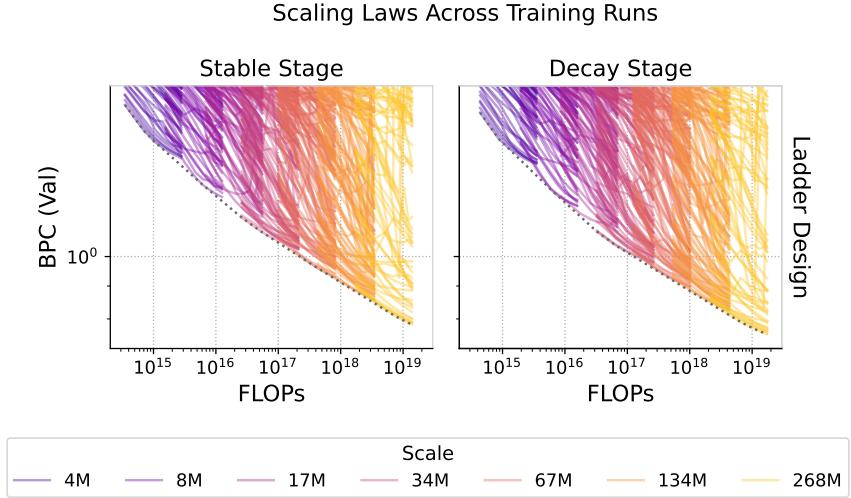
Foundation models depend heavily on scale, which makes large-scale experiments extremely expensive, so researchers have long hoped to run cheap small-scale studies and transfer the findings to larger models. However, scaling laws have been unreliable at small scales: influential prior work reached contradictory conclusions about how parameters and data should scale, and later studies found that laws fit to models with roughly 100M parameters or fewer often fail to reproduce. The authors trace the core problem to hyperparameter sensitivity in small models and show that with rigorous tuning, scaling laws can extend down to about 4M parameters, where models train in under an hour on a single GPU. They explain this behavior through a hyperparameter loss surface analysis in which larger models become easier to tune. Their main contribution is a practical methodology for model-centric research: thoroughly explore hyperparameters at small scale, use diagnostics such as the noisy quadratic limit, scaling laws, and perplexity-capability correspondence to check assumptions, then transfer the resulting insights to large models with simple rules.
Method
The authors propose a methodology for estimating scaling laws from small-scale experiments, emphasizing that hyperparameter tuning is the critical ingredient. They first investigate the impact of parameter definitions, noting that choices regarding attention, embedding, and unembedding layers lead to minimal differences in the resulting scaling law. As shown in the figure below, various parameter counting philosophies yield reasonable scaling laws, though the authors prefer effective parameters (accounting for attention and unembedding but excluding embedding) to align directly with FLOPs per token, keeping c=6pd exact.

Beyond parameter definitions, the authors refine the estimation process through specific methodological choices. While a recognizable scaling law emerges from fitting the best run at each scale, precision improves significantly with further refinements. Tuning hyperparameters for each parameter-data budget reduces test MSE by 50%, and decaying the learning rate reduces it by 98%. Tying the scaling exponents (ι=κ), however, offers inconsistent results.
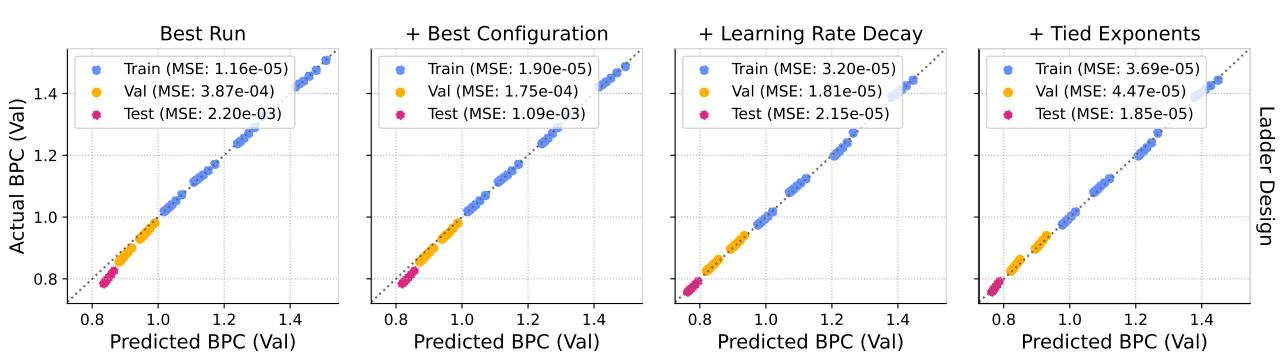
The core methodology for small-scale experiments rests on three principles: capabilities depend on pretraining loss alone, scaling laws extend to tiny scales with rigorous tuning, and models become less sensitive to hyperparameters as they scale. This implies that the hyperparameter loss surface becomes lower-dimensional and easier to optimize at larger scales. Consequently, small scales require extensive search, while large scales allow for easier adaptation.
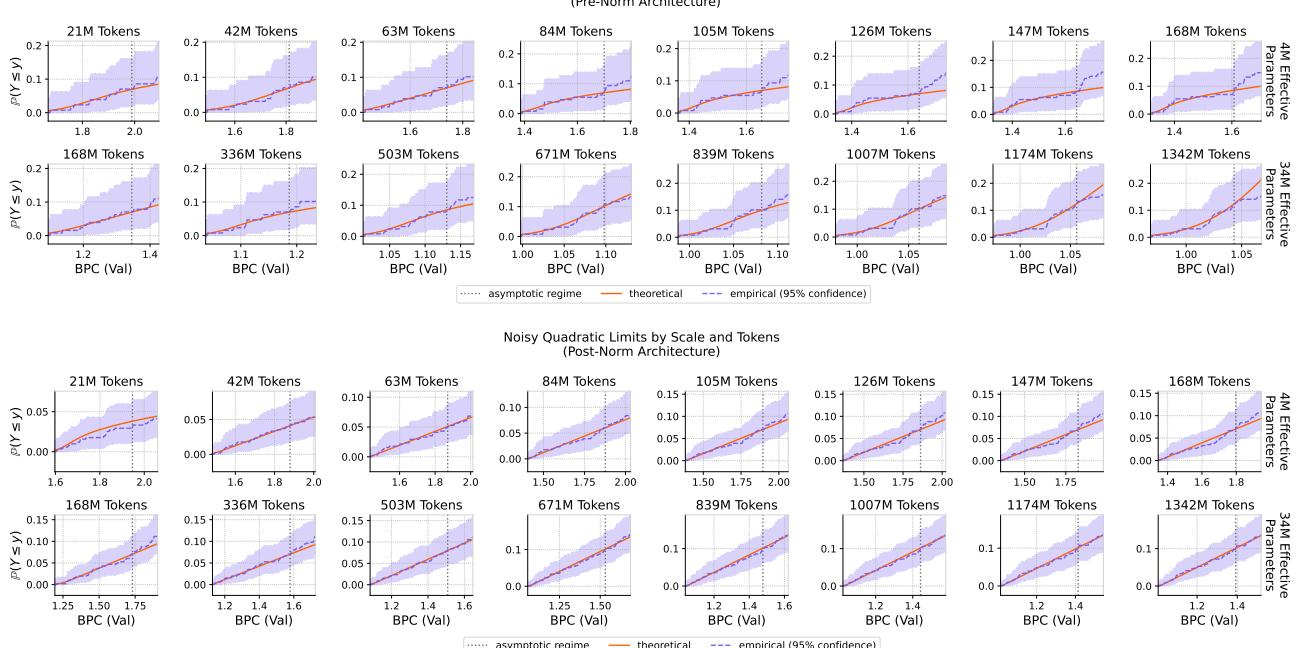
To demonstrate this approach, the authors conduct a case study comparing pre-norm and post-norm transformer architectures. They sample configurations across well-separated scales (4M, 34M, and 134M parameters) to fit and validate scaling laws. They employ a sequence of qualitative diagnostics to understand the architectures. First, they check if the noisy quadratic limit emerges, indicating thorough tuning. The limit emerges readily for pre-norm but only deeper into the tail for post-norm, signaling the latter's hyperparameter sensitivity.
Second, they examine how hyperparameter sensitivity scales. As models grow, good configurations should fill more of the space. While both architectures show this trend, post-norm maintains a suboptimal peak, confirming persistent tuning difficulty.

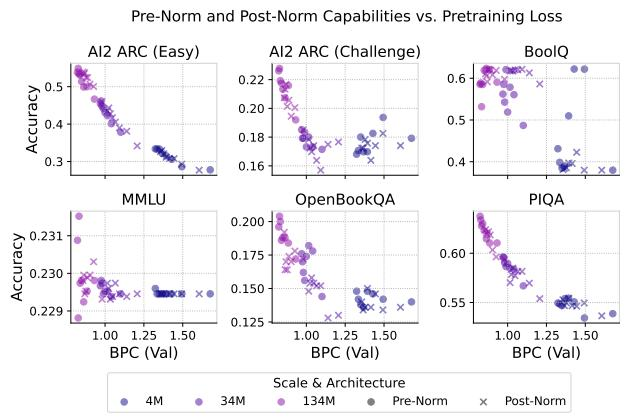
Third, they verify that pretraining loss tracks downstream capabilities. Across various tasks and architectures, equal pretraining loss implies similar capabilities, validating the use of loss as a proxy for performance.
Finally, they estimate the scaling laws by tuning hyperparameters per budget and decaying the learning rate, fitting the laws jointly with tied irreducible error or leaving them free to differ to validate the extrapolation on the held-out scale.
Experiment
The experiments use random search across model scales from 4M to 268M parameters with warmup-stable-decay schedules to study scaling laws and hyperparameter loss surfaces. They find that methodological choices like parameter definitions matter little, while per-budget hyperparameter tuning and learning-rate decay greatly improve scaling-law precision, and that extensive tuning is essential at small scales. The hyperparameter loss surface becomes lower-dimensional and less sensitive as models grow, making larger models easier to tune. A case study comparing pre-norm and post-norm transformers shows pre-norm scales more reliably and is easier to tune, though extrapolating scaling laws remains statistically limited.