Command Palette
Search for a command to run...
Ex-Omni-2D: 시각적 실재감을 갖춘 표현적 전방향 대화 모델
Ex-Omni-2D: 시각적 실재감을 갖춘 표현적 전방향 대화 모델
Haoyu Zhang Zhipeng Li Xiaoying Tang Tianshu Yu Yiwen Guo
초록
전방향 대화 모델은 다중 모드 입력을 이해하고 음성 응답을 합성할 수 있지만, 그 응답은 시각적으로 탈신체화된 상태로 남아 있다. 본 논문에서는 텍스트, 개인화된 음성, 그리고 참조 조건 기반 비디오로 구성된 조정된 응답을 생성하는 전방향 대화 프레임워크인 Ex-Omni-2D를 소개한다. 다중 모드 질의, 참조 이미지, 참조 오디오가 주어지면, 모델은 장면, 감정, 동작을 기술하는 구조화된 시각적 사고 계획(VTP)을 예측한 후 응답 텍스트와 네이티브 다중 코드북 음성 단위를 생성한다. 이 단위들은 공유된 음향-시간적 인터페이스를 형성하여 음성으로 디코딩되고 비디오 프레임과 온라인으로 정렬된다. 이 인터페이스는 응답 경로와 아바타 경로가 이질적인 음성, 대화, 아바타 비디오 데이터로부터 학습될 수 있게 하여, 대규모 질의-텍스트-음성-비디오 감독 데이터의 필요성을 없앤다. 전체 시퀀스 비디오 생성기가 주된 교사 역할을 한다. 효율적인 점진적 생성을 위해, 우리는 이를 소수 단계의 블록-인과적 스트리밍 학생 모델로 증류하며, 이 모델의 접두사 스트리밍 메커니즘은 연속된 청크 간에 깨끗한 잠재 변수를 전달하여 후반 청크의 누적 품질 저하를 줄인다. 4단계 추론을 통해 전체 4-GPU 파이프라인은 400×720/720×400 해상도에서 1.293의 종단 간 실시간 계수를 달성하여 실용적인 품질-효율성 작동점을 제공한다.
One-sentence Summary
Researchers from The Chinese University of Hong Kong, Shenzhen and LIGHTSPEED propose Ex-Omni-2D, an omni-modal dialogue model that generates text, personalized speech, and reference-conditioned video by predicting a Visual Thought Plan and shared acoustic-temporal speech units, enabling training from heterogeneous data without direct supervision, and distills a teacher video generator into a few-step streaming student with Prefix Streaming, achieving RTF 1.293.
Key Contributions
- Ex-Omni-2D is a dialogue-conditioned response formulation that uses a Visual Thought Plan (VTP) to explicitly describe scene, emotion, and motion, thereby guiding the coordinated generation of text, personalized speech, and reference-conditioned video.
- A native multi-codebook speech unit interface creates a shared acoustic-temporal representation that aligns speech decoding with frame-level video conditioning and enables training on heterogeneous speech, dialogue, and avatar-video data without paired video-response dialogues.
- A Prefix Streaming mechanism distills the full-sequence video generator into a block-causal streaming student, propagating a clean latent across chunks to reduce cumulative late-chunk degradation and achieving an end-to-end RTF of 1.293 at 400×720/720×400 with four-step inference.
Introduction
Omni-modal dialogue systems can understand speech, text, and visual inputs and produce spoken replies, but their responses remain visually disembodied. Existing talking-avatar and joint audio-video generation methods produce strong visual outputs, yet they are driven by completed waveforms, externally supplied prompts, or static content references rather than deriving visual intent directly from the dialogue state. The authors introduce Ex-Omni-2D, a framework that generates dialogue-native video responses by first inferring a structured Visual Thought Plan from the conversational context and then using a shared multi-codebook speech-unit stream to jointly control speech synthesis and frame-aligned avatar animation. This factorization sidesteps the need for large-scale dialogues paired with target video, training each modality-specific pathway on the heterogeneous data available to it, and a distilled streaming student model with prefix streaming enables efficient incremental inference for interactive deployment.
Method
Ex-Omni-2D receives a multimodal user query x=(xt,xs) containing text, speech, or both, along with a reference image Iref and reference audio aref. It generates an omni-modal response comprising text y, personalized speech, and a reference-conditioned video V. The framework is organized around two intermediate interfaces: a structured Visual Thought Plan (VTP) p that conveys high-level visual intent, and native multi-codebook speech units U that provide the acoustic content and timing shared by speech and video generation.
As shown in the figure below:
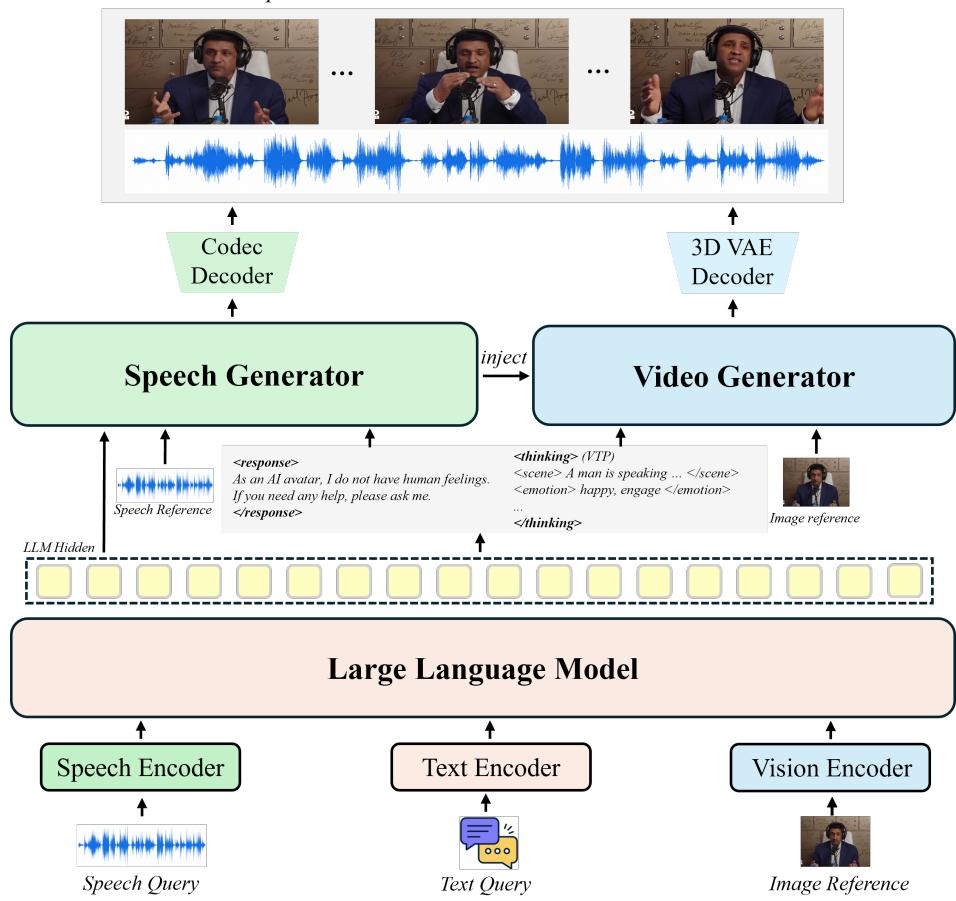
The authors leverage distinct pathways for character grounding. Text and speech queries are embedded and projected into a shared hidden space to form the multimodal query representation Ex. The reference image is processed by a vision tower and projected into the dialogue-model space as zIllm, while independently being encoded by a 3D VAE within the Video Generator to obtain an appearance-reference latent Rref. Reference audio is handled inside the Speech Generator, where a speaker encoder extracts the voice embedding sref.
For visual response planning, the dialogue backbone follows a structured protocol that separates the internal visual plan from the user-facing response. The model outputs a sequence containing a thinking block restricted to the structured VTP and a response block for the user-facing text. The VTP contains five fields describing the first-frame scene, overall scene, emotion, movement style, and detailed motion. This textual interface is encoded into a semantic condition Lvtp for the Video Generator. The final-layer hidden states over the response span, denoted Hyℓ, are retained for speech generation.
The Speech Generator predicts a sequence of multi-codebook acoustic units U∈NN×C conditioned on the response states, response tokens, and reference voice. These units serve as the shared representation of the generated speech. A codec decoder renders them as waveform audio, while an adapter maps them into frame-aligned video-conditioning features A. Since units are produced at 12.5 Hz and video at 25 FPS, each acoustic feature is repeated for two video frames, providing an explicit temporal alignment.
The Video Generator has two realizations. The full-sequence Teacher generates the primary video response using bidirectional temporal context. It receives the reference latent Rref, frame-aligned acoustic condition A, and VTP condition Lvtp. The denoising network is conditioned on these inputs, and acoustic features are injected into specific DiT blocks. To enable incremental deployment, the authors distill the Teacher into a Prefix-Streaming Student. The Student uses bidirectional attention within four-latent denoising windows and causal attention across windows. It employs a Prefix Streaming mechanism where the last clean latent of the preceding chunk is reused as a one-latent prefix for the next window, anchoring the chunk boundaries and preventing temporal drift.
Training proceeds in four stages. Stage 1 aligns the speech interface using ASR and TTS data. Stage 2 adapts the omni-modal response with the VTP-response protocol. Stage 3 trains the full-sequence Video Generator on avatar clips to realize the semantic and acoustic-temporal interfaces, freezing it as the Teacher. Stage 4 distills the Teacher into the Streaming Student using flow-map learning and on-policy distribution matching.
Experiment
The evaluation uses CommonEval for audio-video generation, OmniCharacter for multi-turn dialogue, and VoiceBench for speech QA, comparing Ex-Omni-2D against cascaded baselines that share a common response controller. Multitask experiments show that the model can generate personalized speech and video with a controllable quality–efficiency trade-off, while maintaining competitive dialogue fluency and coherence. Ablations confirm that response-specific visual planning improves subject consistency and lip synchronization, and that prefix streaming reduces late-chunk subject degradation. Overall, the system achieves strong cross-modal generation but reveals capability trade-offs in dialogue and end-to-end latency, without uniform improvement across all metrics.
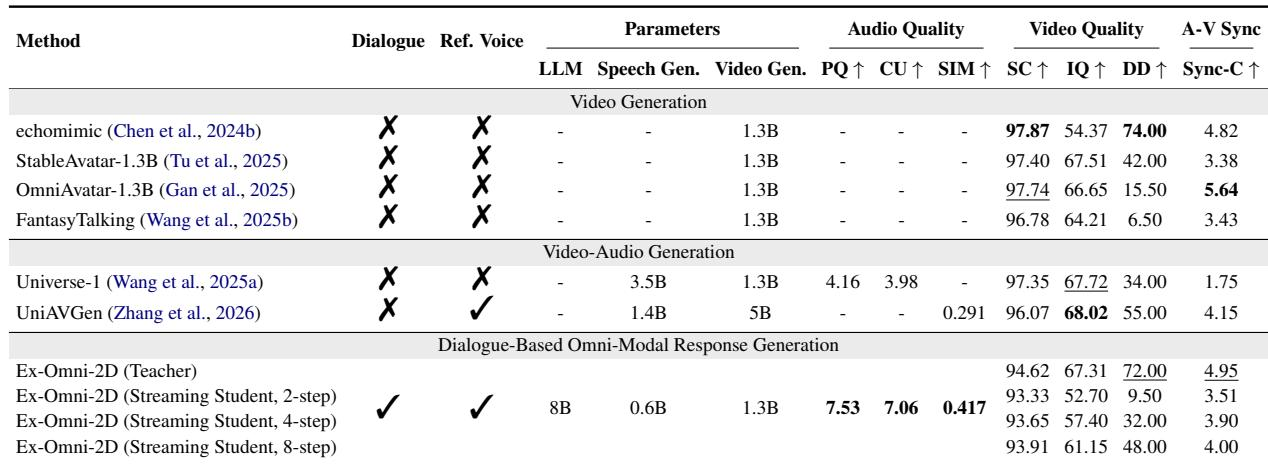
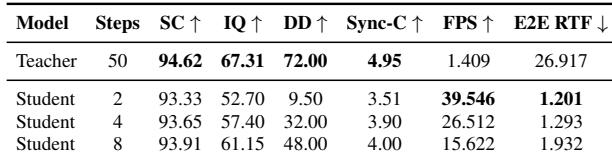
The comparison spans video-only, joint video-audio, and dialogue-based omni-modal generation paradigms. Standalone video renderers like echomimic and OmniAvatar-1.3B lead in subject consistency, motion, and lip-sync respectively, while the Ex-Omni-2D Teacher integrates dialogue, personalized speech, and visual planning at the cost of not dominating any single rendering metric. The Streaming Student variant exposes a controllable quality–efficiency trade-off through denoising step budget. Among video-only baselines, echomimic achieves the highest subject consistency and dynamic degree. OmniAvatar-1.3B obtains the strongest lip-speech synchronization score. The Ex-Omni-2D Teacher adds dialogue response and personalized speech generation, sacrificing standalone rendering scores for omni-modal capability. Increasing the Streaming Student's denoising steps from two to eight consistently improves video quality and sync scores. Replacing the visual plan with a fixed neutral plan reduces subject consistency and lip-sync, while motion incidence increases, revealing sensitivity to planning.
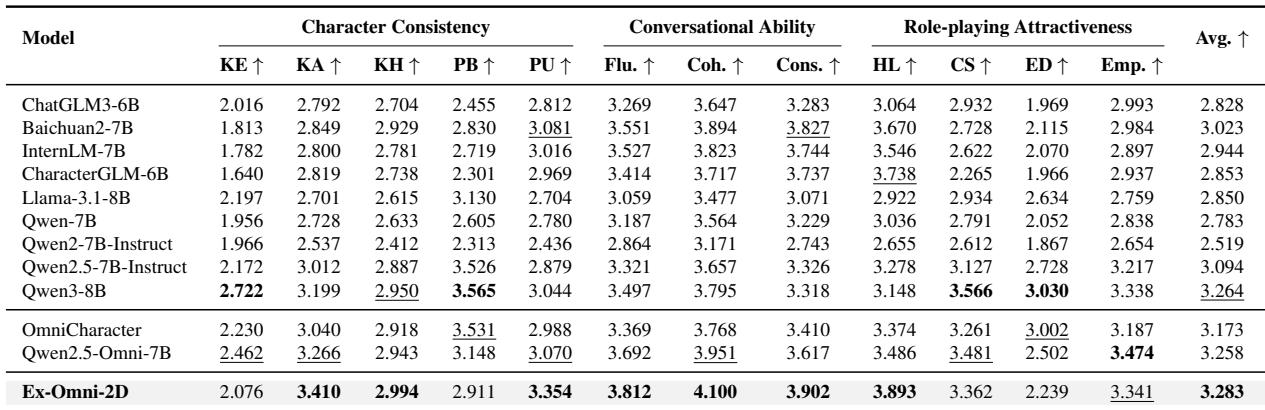
Ex-Omni-2D achieves the highest Fluency, Coherency, and Consistency among evaluated models on OmniCharacter's multi-turn dialogue benchmark, surpassing its Qwen3-8B backbone. Its overall twelve-dimension average is only marginally higher than Qwen3-8B, and some metrics decrease, indicating a capability trade-off rather than uniform improvement. Ex-Omni-2D reached the top Fluency, Coherency, and Consistency scores (average 3.938), compared to Qwen3-8B's 3.537. Ex-Omni-2D's twelve-dimension average (3.283) is close to Qwen3-8B (3.264), with both increases and decreases in individual metrics, revealing a trade-off.
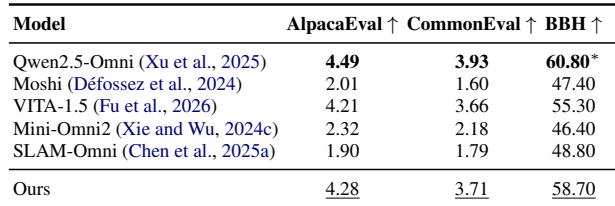
The proposed model achieves the second-highest scores across all three speech QA benchmarks, trailing only Qwen2.5-Omni. It outperforms other open-source alternatives such as VITA-1.5, Moshi, Mini-Omni2, and SLAM-Omni by clear margins, with the largest advantage on the BBH benchmark. The model ranks second in every metric, with AlpacaEval 4.28, CommonEval 3.71, and BBH 58.70. It improves over VITA-1.5 by 0.07 on AlpacaEval, 0.05 on CommonEval, and 3.4 points on BBH.
The Streaming Student offers a tunable quality–efficiency trade-off. With only 2 denoising steps it achieves very high throughput and maintains a competitive SC score, but dynamic degree and sync quality are low. Increasing steps to 8 recovers much of the Teacher's quality, nearly matching SC and Sync-C while still delivering over 10× higher frame rate. At 2 denoising steps, the Student reaches 39.5 FPS and an end-to-end real-time factor of 1.2, whereas the Teacher runs at 1.4 FPS with a factor of 26.9. Raising Student steps from 2 to 8 improves DD from 9.50 to 48.00 and Sync-C from 3.51 to 4.00, closing the gap to the Teacher's 72.00 DD and 4.95 Sync-C.
Ablating response-specific visual planning reduces semantic consistency and synchronization while inflating a motion quantity metric, particularly when personalized speech is present. Removing personalized reference speech and using a fixed public utterance improves no-reference audio quality and clarity but nearly eliminates speaker similarity. The visual plan's first-frame field is much less grounded in the reference image than the remaining fields, which show strong cross-modal consistency. Removing response-specific visual planning lowers semantic consistency and sync, while increasing optical-flow motion incidence, especially with personalized speech. Replacing personalized reference speech with a fixed public utterance boosts no-reference audio quality and clarity but collapses speaker similarity. The first-frame field of the visual plan is far less grounded in the reference image (43%) than the other fields (average 85%). Co-generated emotion and movement style fields achieve high cross-modal consistency, with scores around 90–94%.

The evaluation compares video-only, joint video-audio, and omni-modal dialogue generation, with Ex-Omni-2D Teacher integrating dialogue and personalized speech but sacrificing standalone rendering metrics. The model achieves the highest dialogue fluency, coherency, and consistency and ranks second on speech QA benchmarks, outperforming other open-source alternatives. Ablations confirm that response-specific visual planning and personalized speech are crucial for semantic consistency and synchronization, while the Streaming Student offers a tunable quality-efficiency trade-off, recovering near-Teacher quality at over 10× higher frame rate.