Command Palette
Search for a command to run...
행위자 시스템의 공진화: 인간 설계를 넘어선 자기 주도적 진화를 향하여
행위자 시스템의 공진화: 인간 설계를 넘어선 자기 주도적 진화를 향하여
초록
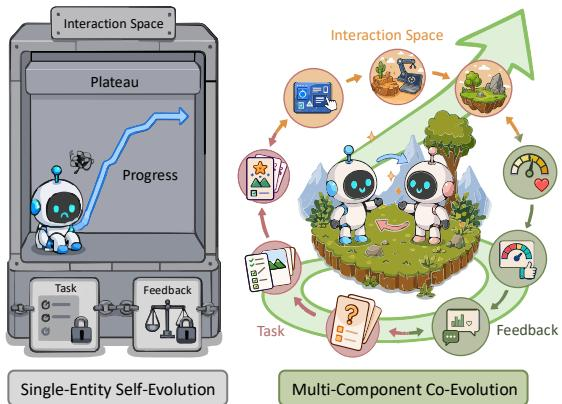
행위자 시스템은 배포 후에도 지속적으로 개선될 것이 기대되지만, 단일 개체의 자기 진화는 고정된 작업 및 피드백과 같은 정적인 학습 맥락에 의해 제한되는 경우가 많다. 본 조사 논문은 행위자 시스템의 공진화에 초점을 맞추는데, 이는 여러 행위자와 그 환경이 서로에게 적응적 압력을 가하는 다중 구성 요소 형태의 자기 진화이다. 기존 연구를 체계화하기 위해, 우리는 시스템이 어떻게 인간이 설계한 제약을 점진적으로 벗어나는지 추적하는 3단계의 점진적 분류 체계를 제안한다. '행위자-행위자 공진화'는 적대적, 협력적, 조직적 적응을 포함하여 행위자들이 동적인 동료들을 통해 어떻게 적응하는지 연구한다. '행위자-환경 공진화'는 이러한 순환 고리를 행위자와 함께 변화하는 적응적 작업, 피드백, 상호작용 공간으로 확장한다. '메타 공진화'는 진화 메커니즘 자체를 진화 가능하게 만드는 가능성을 더 탐구한다. 또한 이러한 시스템을 평가하고, 여러 구성 요소에 걸쳐 확장하며, 점점 더 자율화되는 진화 과정을 안전하고 제어 가능하게 유지하는 데 따르는 공개된 과제들을 논의한다. 본 조사는 고정된 인간 설계 경로를 넘어 개선될 수 있는 강건하고 개방적인 행위자 시스템을 구축하기 위한 통합된 기반을 제공한다.
One-sentence Summary
Researchers from Hong Kong University of Science and Technology, University of Illinois Urbana-Champaign, The Chinese University of Hong Kong, The University of Hong Kong, and Peking University present a survey on co-evolution in agentic systems, proposing a progressive three-stage taxonomy of agent–agent, agent–environment, and meta co-evolution that traces how adaptive pressure among multiple components gradually sheds human-engineered constraints, and discuss open challenges in evaluating, scaling, and ensuring safety for such systems to build robust, open-ended agentic systems that improve beyond fixed human-designed paths.
Key Contributions
- The survey provides a formal definition of co-evolution that requires mutual evolutionary pressure between at least two components, and organizes the field through a progressive three-stage taxonomy: Agent–Agent, Agent–Environment, and Meta Co-Evolution.
- A dynamic evaluation paradigm is proposed for co-evolving systems, moving beyond static benchmarks by measuring component-level improvements, cross-play transferability, and using held-out evaluators to detect exploitative behaviors.
- Meta Co-Evolution, where the evolution mechanism itself becomes evolvable, is identified as a critical frontier for reducing human intervention and enabling open-ended, self-improving agentic systems.
Introduction
As AI systems shift from isolated models to agentic systems that autonomously use tools, memory, and skills, a central challenge is enabling continual improvement after deployment. Self-evolution lets agents update themselves from experience, but it remains bounded by fixed external conditions, a limitation akin to the Red Queen effect. No existing survey has made co-evolution, where multiple components adapt jointly and reshape each other’s evolution, the central focus. The authors fill this gap by offering the first focused survey of co-evolution in agentic systems, organizing the literature with a progressive three-stage taxonomy that expands evolutionary freedom from agent–agent co-evolution, through agent–environment co-evolution, to meta co-evolution where the evolution mechanism itself becomes adaptive.
Method
The authors propose a three-stage taxonomy that follows the expanding scope of what a system is allowed to evolve, gradually removing human-engineered constraints.
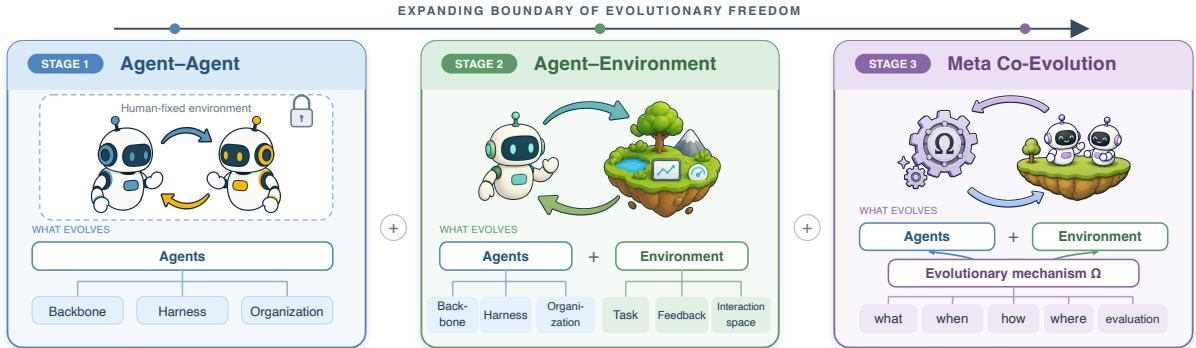
Stage 1 focuses on Agent-Agent Co-Evolution. Coevolution begins when an agent no longer learns against a static counterpart. As agents respond to one another, each agent's progress changes the challenges and opportunities facing its peers, and the collective may also reorganize its structure Π. This creates a coupled evolutionary process within the agent collective defined as:
At+1=({ait+1}i=1n,Πt+1)=Ω(At,E,τt).Stage 2 extends this to Agent-Environment Co-Evolution. While the coupled process in Stage 1 continuously changes the agents, the environment remains fixed, limiting new experiences. Stage 2 allows agent behavior to reshape the whole conditions that subsequently shape the agents:
(At+1,Et+1)=Ω(At,Et,τt).Stage 3 introduces Meta Co-Evolution. In Stage 2, the evolution mechanism remains human-designed. Meta co-evolution is defined as a stage where the lower-level co-evolving system further revises its evolution mechanism through a self-generated revision process Γt:
Ωt+1=Γt(St,Ωt,τt),St+1=Ωt+1(St,τt).This recursion provides a pathway toward open-endedness, characterized by continuous novelty Ωt+1=Ωt and unbounded divergence with adaptive capability H satisfying limt→∞H(St,Ωt)=∞. The authors decompose the evolution mechanism into five adaptive decisions: what to evolve selects the adaptation target, when to evolve triggers updates after failures or plateaus, how to evolve produces variants through training or revision, where to evolve covers the domain and setting, and how to evaluate judges evolution quality.
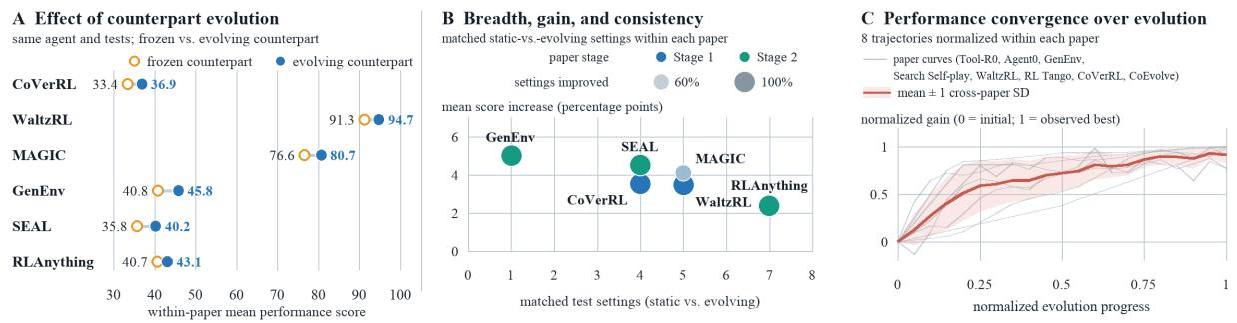
As shown in the figure below, Stage 1 and Stage 2 improve performance across most settings, but the gains become smaller as evolution approaches a plateau. By allowing the evolution mechanism to change, meta co-evolution moves beyond this bottleneck and opens new directions for improvement.