Command Palette
Search for a command to run...
얕은 깊이에서 공유된 고전적 무작위성을 통한 단일 및 채널 양자 생성 모델 간의 표현적 분리
얕은 깊이에서 공유된 고전적 무작위성을 통한 단일 및 채널 양자 생성 모델 간의 표현적 분리
Arunava Majumder Marius Krumm Hendrik Poulsen Nautrup Hans J. Briegel
초록
단기 양자 하드웨어는 회로 깊이를 제한하고 양자 생성 모델에 기하학적으로 국소적인 연결성을 부과하는 경우가 많아, 얕은 단일 본 모델이 접근할 수 있는 출력 분포를 제한한다. 단일 양자 본 모델에 확률성을 도입하면 결과적인 채널 모델의 경험적 생성 성능이 향상될 수 있으며, 제한된 소규모 아키텍처의 경우 단일 모델보다 엄격히 더 큰 분포군을 표현할 수 있음이 입증되었다. 그러나 이러한 무작위성이 임의로 큰 시스템의 고정된 얕은 깊이에서 증명 가능한 분리를 제공하는지 여부는 미해결 과제로 남아 있었다. 본 연구에서는 얽힘 이론에서 비교적 약한 자원인 공유된 고전적 무작위성만으로도 해당 얕은 단일 본 모델에 대해 엄격하고 확장 가능한 표현적 분리를 확립하기에 충분함을 보인다. 구체적으로, 계산 기저 측정이 뒤따르는 제한된 연결성의 얕은 단일 회로에 공간적으로 분리된 국소 파울리 연산을 추가하고, 이 연산들의 결합 적용을 단일 고전적 무작위 비트로 제어한다. 그 결과 생성된 얕은 깊이 채널 모델은 순수하게 단일인 제한된 연결성의 얕은 깊이 모델로는 재현할 수 없는 장거리 상관관계를 고전적 출력 분포에 생성한다. 1차원 최근접 이웃 아키텍처의 경우, 순수 단일 모델로 이러한 분포를 재현하려면 최악의 경우 Ω(N)의 깊이가 필요할 수 있다. 나아가 측정 기반 양자 계산(MBQC)이 무작위 측정 결과의 적절한 적응을 통해 필요한 공유된 고전적 무작위성의 자연스러운 구현을 제공함을 보인다. MBQC 기반 생성 모델에 대한 수치 실험은 분석 결과를 뒷받침한다.
One-sentence Summary
Researchers at the University of Innsbruck prove that augmenting shallow, bounded-connectivity unitary Born models with shared classical randomness—implemented via a single random bit controlling spatially separated local Pauli operations—establishes a strict scalable representational separation by generating long-range correlations that purely unitary shallow-depth models cannot reproduce and may require depth Ω(N) in one-dimensional architectures.
Key Contributions
- Augmenting shallow, bounded-connectivity unitary circuits with shared classical randomness, specifically spatially separated local Pauli operations controlled by a single random bit, creates a strict and scalable representational separation by generating long-range correlations that no purely unitary shallow model of the same depth and connectivity can reproduce.
- For one-dimensional nearest-neighbor architectures, reproducing such distributions with a purely unitary model requires depth Ω(N) in the worst case.
- Measurement-based quantum computation provides a natural implementation of the required shared classical randomness, and numerical experiments on MBQC-based generative models support the analytical results.
Introduction
Quantum generative models such as quantum circuit Born machines produce classically hard-to-simulate distributions, but their expressivity is severely constrained in near-term devices by limited circuit depth and local qubit connectivity. Shallow local circuits cannot establish correlations between distant qubits because information propagation is restricted to a finite spatial range, and prior attempts to overcome this with mid-circuit measurements and feedforward introduce experimental overhead. The authors show that shared classical randomness alone, without additional quantum depth, long-range gates, or adaptive operations, strictly enlarges the family of output distributions accessible to shallow local quantum generative models. They construct a stochastic channel model where a tunable shared Pauli string coordinates local Pauli gates on spatially separated qubits, creating long-range correlations that a purely unitary Born model of the same depth and connectivity cannot reproduce.
Dataset

The paper does not introduce a new dataset in the traditional sense. Instead, the authors provide the code and numerical data that support the theoretical and numerical findings of the study. This material is available at a repository (the link is given in the paper). The work is primarily theoretical, proving shallow-depth separations between unitary and correlated channel models for quantum generative modeling, and the numerical experiments rely on synthetic constructions rather than real-world data. Therefore, there is no dataset composition, filtering, or training split to describe.
Method
The authors propose a quantum generative model that augments shallow local unitary circuits with shared classical randomness to enhance expressivity. The method is built upon a generic brickwall unitary circuit architecture, which is then extended into a channel model and implemented natively within a measurement-based framework.
Generic Brickwall Unitary and Channel Circuits
The foundation of the model is a shallow one-dimensional local quantum circuit on N qubits, composed of D layers. The unitary operator is defined as U(θ)=UD(θD)…U1(θ1), where each layer consists of parametrized two-qubit gates acting on nearest-neighbor bonds. These layers alternate between sub-layers acting on disjoint even and odd bonds, forming a brickwall structure.
To extend this unitary model, the authors introduce correlated stochastic Pauli operations. A Pauli string PM is controlled by a single classical Bernoulli variable s∈{0,1}. This variable determines whether the entire Pauli string is applied to a subset of qubits M at a specific insertion slot between circuit layers. This creates a spatially correlated stochastic operation. The resulting channel model Eθ,p is a convex combination of unitary branches, where the Pauli string is applied with probability p and omitted with probability 1−p.
As shown in the figure below:
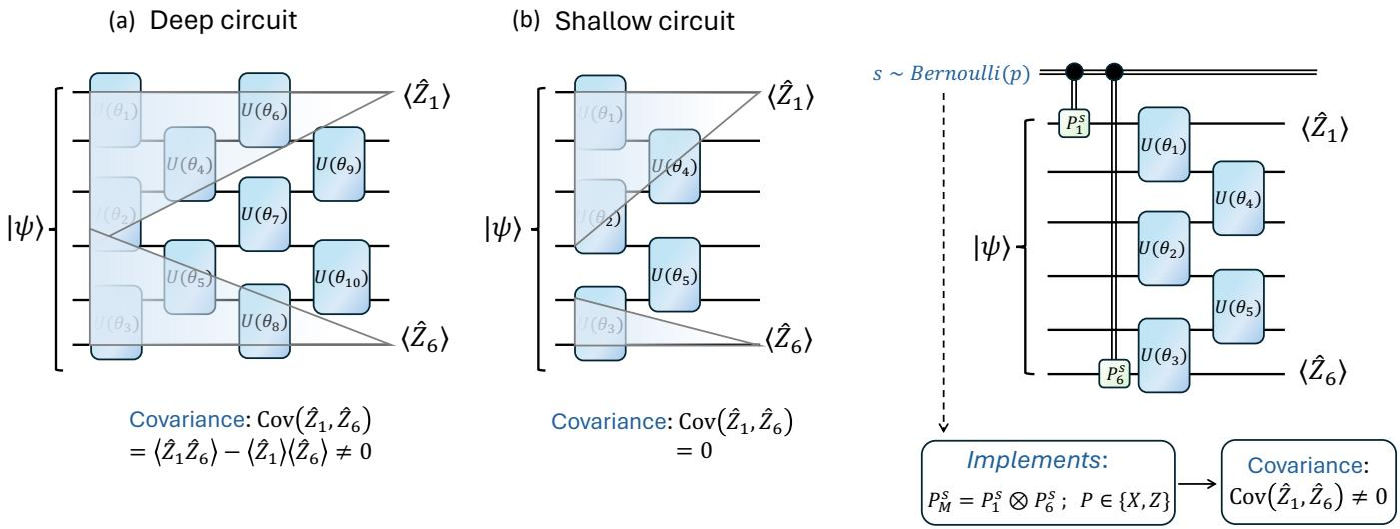
The figure illustrates the advantage of this approach. While a standard shallow circuit (panel b) has disjoint backward light cones for distant observables Z^1 and Z^6 resulting in zero covariance, a shallow circuit augmented with shared randomness (panel c) can generate non-zero covariance between these distant qubits. This capability mimics the long-range correlation generation of a deep circuit (panel a) without increasing the circuit depth.
Learning Model Architecture
For the explicit learning model, the authors specify a depth-D circuit where each layer k consists of nearest-neighbor entangling rotations Rzz followed by local single-qubit rotations Rz and Rx. The layer unitary is given by:
Uk(θk)=i=1⨂NRx(θik,x)i=1⨂NRz(θik,z)i=1∏N−1Rzz(θi,i+1k,zz)A shared classical bit sl∼Bernoulli(pl) controls the insertion of a stochastic Pauli-Z string ZMsl between layers Ul and Ul+1. This string acts simultaneously on a subset of qubits M.
Refer to the framework diagram:
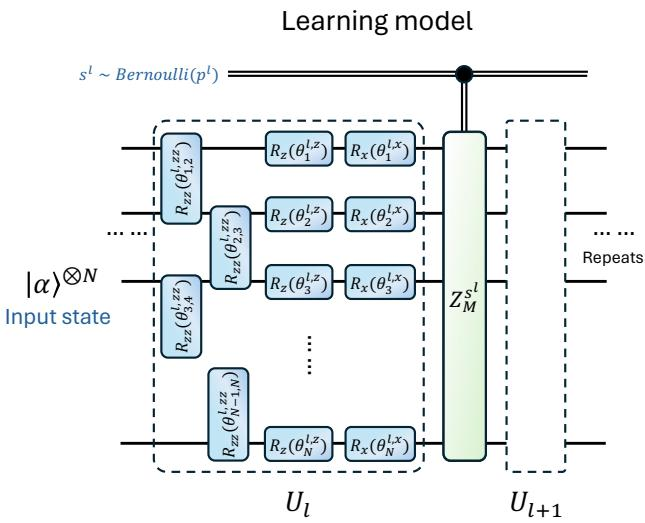
This diagram details the learning model structure. The input state ∣α⟩⊗N passes through parametrized layers Ul. At a designated slot, the stochastic Pauli string ZMsl is inserted. The shared random variable sl ensures that the local Z operations on the subset M are either applied jointly or all omitted, creating correlated branches in the circuit evolution.
Endpoint Pauli Correction
To ensure the stochastic Pauli string modifies the circuit dynamics non-trivially without merely relabeling the final measurement outcomes, an endpoint correction procedure is employed. The inserted Pauli string is propagated through the subsequent layers U>l(θ). During propagation, commuting gates remain unchanged, while anticommuting Pauli rotations undergo sign flips in their rotation angles. Specifically, PMslexp(−iθQ)=exp(−i(−1)slθQ)PMsl if the operators anticommute.
A final Pauli correction layer is appended to cancel the accumulated Pauli string at the output. Since the final string is diagonal in the computational basis (for Z-strings) or corrected explicitly, it does not alter the output probabilities. The effective action of the stochastic Pauli string is thus reduced to branch-dependent sign flips of the rotation angles.
As shown in the figure below:
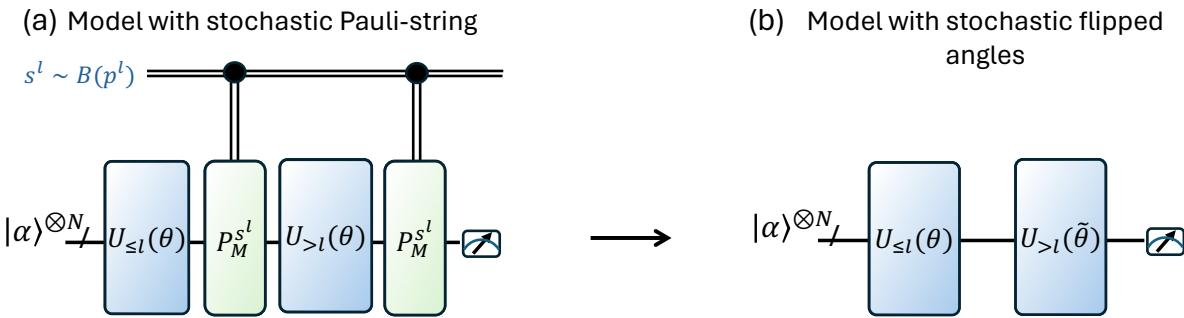
Panel (a) depicts the model with the stochastic Pauli string inserted after layer l and applied again at the output for correction. Panel (b) shows the equivalent effective model where the propagation results in stochastic flipped angles θ~ in the subsequent unitary U>l, while the final Pauli string is removed.
Native Implementation in VMBQC
The authors demonstrate that this correlated channel model can be realized natively within Variational Measurement-Based Quantum Computation (VMBQC). In MBQC, computation is performed via adaptive single-qubit measurements on an entangled resource state, such as a cluster state. Measurement outcomes induce Pauli byproducts. Standard MBQC corrects these byproducts via classical feedforward.
The authors introduce an effective classical control mechanism where byproducts can be deliberately retained or introduced (anti-correction) with a tunable probability pl. By processing the raw measurement outcomes, a single shared binary variable sl can control the collective Pauli byproduct ZMsl acting on a subset of spatially separated qubits.
Refer to the framework diagram:
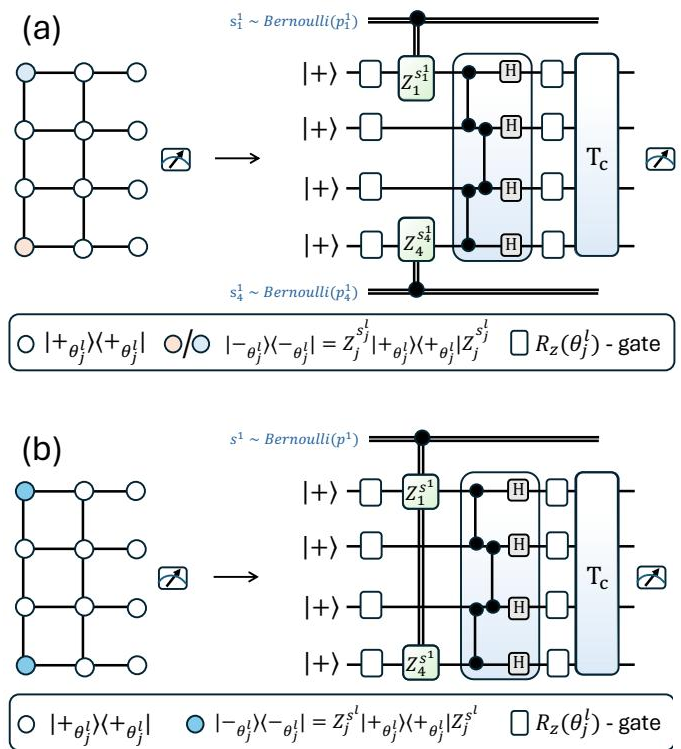
This figure illustrates a 4×3 cluster state and its equivalent circuit representation. Panel (a) shows independent randomness where distinct classical variables control byproducts on different qubits (Z1s11 and Z4s41). Panel (b) shows shared randomness where a single variable s1 controls correlated byproducts on spatially separated boundary qubits (Z1s1 and Z4s1), realizing the correlated channel model natively.
To prepare the specific product input state ∣α⟩⊗N required for the learning model, an auxiliary column of qubits is attached to the cluster state.
As shown in the figure below:
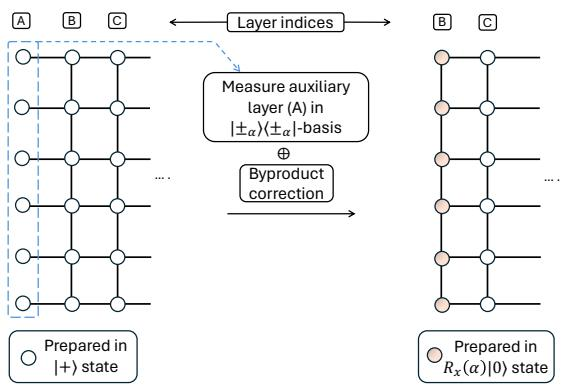
The auxiliary column (A) is initialized in the ∣+⟩ state and measured in the {∣±α⟩} basis. After applying the corresponding byproduct correction, the state Rx(α)∣0⟩ is teleported to every qubit of the first computational column (B), effectively preparing the desired input state ∣ψin⟩=(Rx(α)∣0⟩)⊗N for the subsequent circuit layers.
Training Process
The model is trained using the squared Maximum Mean Discrepancy (MMD) as the loss function L(θ,p). This implicit loss quantifies the distance between the model's output distribution PE(θ,p) and a target distribution Y using a kernel function K(x,y):
L(θ,p)=Ex,y∼P[K(x,y)]−2Ex∼P,y∼Y[K(x,y)]+Ex,y∼Y[K(x,y)]The training involves updating both the circuit parameters θ and the application probabilities p. The gradients with respect to the probabilities pl are computed by evaluating the loss twice: once with pl=1 and once with pl=0, while keeping other parameters fixed. The gradients with respect to the variational angles θ are evaluated using standard parameter-shift rules. This allows the model to jointly learn the unitary evolution and the optimal stochastic branching probabilities to approximate the target distribution.
Experiment
The analytical results prove that for one-dimensional nearest-neighbor circuits, a correlated channel model with shared randomness can generate output distributions that are unreachable by any shallow-depth unitary circuit, requiring depth linear in the qubit separation to match. This separation extends to all finite-range local architectures and can be realized natively in measurement-based quantum computing. A numerical experiment on a 6-qubit, depth-2 circuit targeting a two-branch mixture distribution validates the representational advantage, with the channel model achieving substantially lower training loss and less variability than the purely unitary baseline.