Command Palette
Search for a command to run...
실시간 복강경 수술 안내를 위한 AI 기반 단일 촬영 구조광 깊이 복원
실시간 복강경 수술 안내를 위한 AI 기반 단일 촬영 구조광 깊이 복원
Wayne Wonseok Rodgers Xiangyi Le Seonghoon Jang Shuwen Wei Justin Opfermann Michael Kam Axel Krieger Jin U. Kang
초록
중요성: 정확한 수술 중 깊이 인식은 자율 및 반자율 로봇 복강경 수술의 전제 조건이다. 기존의 프린지 투영 프로파일로메트리(FPP)는 밀리미터 단위의 정확도를 달성할 수 있지만, 일반적으로 다중 촬영, 디지털 마이크로미러 장치(DMD) 투영, 프로젝터-카메라 동기화에 의존하므로 소형 복강경 수술 플랫폼으로의 통합이 복잡해진다. 목표: 능동형 DMD 투영을 발광 다이오드(LED)로 조명하는 수동형 이진 마스크로 대체하고, 벡터 양자화 변분 오토인코더(VQ-VAE) 사전 정보와 맞춤형 U-Net 깊이 헤드를 결합하여 단일 프레임에서 조밀한 깊이를 복원하는, 동기화가 필요 없는 단일 촬영 깊이 감지 플랫폼을 개발하고 특성을 분석한다. 접근법: 소형 LED/이진 마스크 투영 모듈을 설계하여 이중 채널 복강경(Intuitive)의 한 채널에 결합했다. 나머지 채널은 프린지가 조명된 표적을 촬영하는 데 사용되었다. 3D 비전 카메라(Zivid, 노르웨이)를 사용하여 팬텀 표적의 참조 이미지 722장을 획득했다. 제안된 단일 촬영 구조광 내시경 카메라(SSLE)를 사용하여 해당 이미지를 획득하고 정합했다. 측면에 장착된 Zivid 카메라와 SSLE의 깊이 측정값으로 깊이 맵을 생성했다. 그런 다음 Zivid 깊이 맵을 SSLE 이미지 프레임으로 재투영하여 지도 학습 및 평가를 위한 참조 깊이 맵을 제공했다. VQ-VAE는 패턴이 왜곡된 이미지를 이산 잠재 표현으로 인코딩하고, 잠재 공간에서 작동하는 U-Net이 깊이 생성을 위한 별도의 마스크 예측 분기 없이 해당 깊이 맵을 예측한다. 결과: SSLE–Zivid 쌍으로 구성된 이진 패턴 팬텀 데이터셋에서 고정된 학습/검증/테스트 분할을 사용하여 평가한 결과, 제안된 VQ-VAE + U-Net 모델은 3.70 mm의 MAE, 0.0326의 AbsRel, 0.962의 정확도 δ=1.1, 0.970의 정확도 δ=1.1^2를 달성했다. 제안된 방법은 이중 U-Net MaskNet + DepthNet 기준선보다 낮은 MAE를 달성한 반면, 기준선은 약간 더 높은 임계값 정확도를 보였다. 기성 단안 깊이 모델과 비교하여 제안된 방법은 MAE, AbsRel 및 임계값 정확도를 개선하여 보정된 내시경 깊이 복원을 위한 작업별 학습의 이점을 입증했다. 제안된 파이프라인은 NVIDIA A100 GPU에서 301개의 연속 프레임에 대해 26.0 Hz로 작동했다. 결론: 소형 LED 조명 이진 패턴 단일 촬영 표면 형상 측정 시스템과 잠재 공간 깊이 복원의 결합은 로봇 복강경 수술을 위한 동기화 없는 비디오 속도 깊이 인식으로 가는 실용적인 경로를 제공한다. 결과는 깊이 생성 경로에 명시적인 분할 단계 없이 팬텀 데이터셋에서 Zivid 참조 복원을 보여주는 동시에, 교차 카메라 지도 학습을 위한 데이터셋 크기와 SSLE–Zivid 보정 정확도의 중요성을 강조한다.
One-sentence Summary
Researchers from Johns Hopkins University propose a synchronization-free, single-shot depth-sensing platform for laparoscopic surgery that uses an LED-illuminated binary mask and a vector-quantized variational autoencoder prior coupled with a U-Net depth head to reconstruct dense depth from a single frame, achieving a mean absolute error of 3.70 mm and a processing rate of 26.0 Hz on a phantom dataset.
Key Contributions
- A compact LED-illuminated binary-pattern projection module replaces the DMD projector, fits within a dual-channel laparoscope, and enables synchronization-free single-shot structured light acquisition.
- A learned depth-reconstruction pipeline uses a VQ-VAE to encode the pattern-distorted image into a discrete latent representation and a U-Net decoder to predict depth directly, eliminating a separate mask-prediction branch.
- The training protocol decouples ground truth from conventional FPP by using an independent Zivid structured-light camera reprojected into the endoscopic frame; on a 722-image phantom dataset, the method achieves 3.70 mm MAE, δ=1.1 accuracy of 0.962, and stable 26.0 Hz inference on an NVIDIA A100 GPU.
Introduction
Autonomous laparoscopic robotic surgery demands dense, real-time metric depth maps for both visualization and closed-loop tool control. Prior learning-based monocular endoscopy approaches recover depth only up to an unknown scale, while conventional fringe projection profilometry (FPP) systems require multi-shot acquisition, bulky DMD projectors, and precise hardware synchronization, all of which complicate clinical translation. The authors present a single-shot structured light endoscopic camera that replaces the DMD projector with a compact LED-illuminated passive binary mask, and they introduce a VQ-VAE-regularized depth reconstruction network that operates synchronization-free at the camera frame rate. Their training protocol decouples ground truth from the legacy FPP algorithm by using an independent Zivid structured-light camera, achieving a mean absolute error of 3.70 mm and stable 26 Hz inference on phantom data.
Dataset
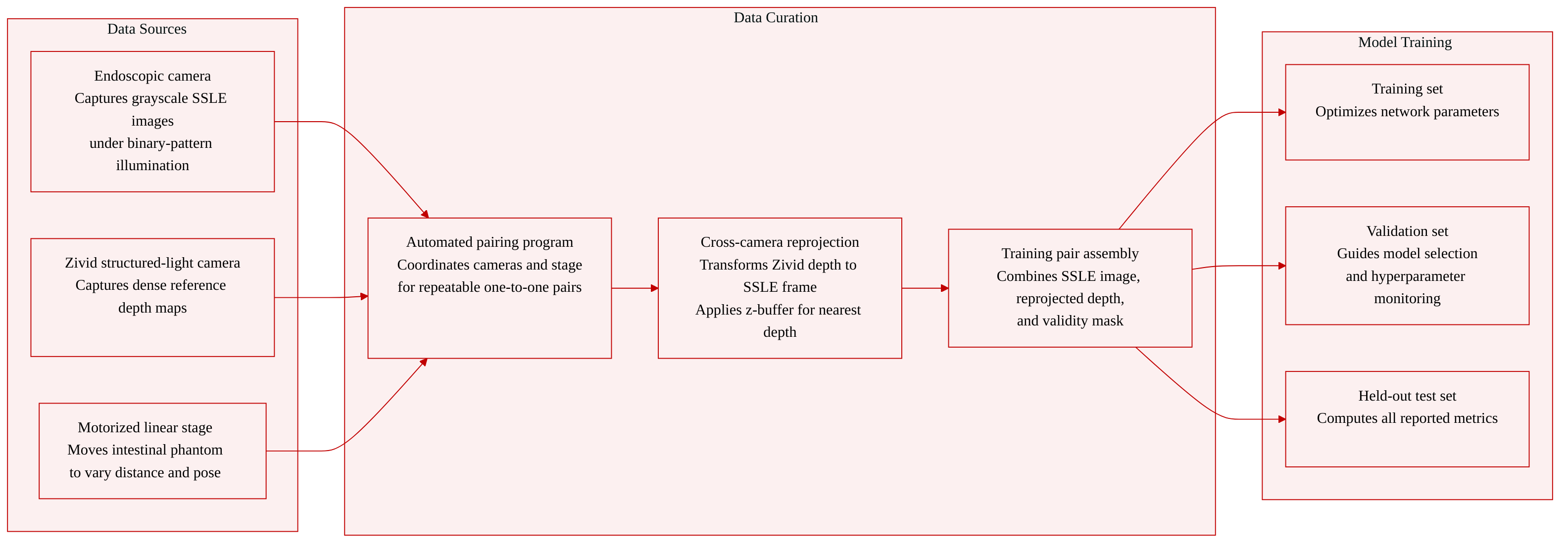
The authors construct a dedicated phantom dataset to train a single-shot depth estimation network for laparoscopic imaging. The data is collected with a custom system that pairs a CMOS endoscopic camera with a laterally mounted Zivid structured-light camera, while an intestinal phantom moves along the viewing axis on a motorized linear stage.
-
Dataset composition and sources
- The dataset contains 722 paired acquisitions.
- Each pair consists of a grayscale SSLE image (captured under binary-pattern illumination through the laparoscope) and a dense reference depth map from the Zivid camera.
- An automated program coordinates the endoscopic camera, the Zivid camera, and the linear stage to guarantee repeatable one-to-one pairing and to sample different working distances and surface poses.
-
Subset split and usage
- The 722 acquisitions are divided into training, validation, and held-out test subsets.
- The training set optimizes the network parameters.
- The validation set is used for model selection and hyperparameter monitoring.
- All reported quantitative metrics are computed exclusively on the held-out test set.
-
Reference-depth generation and processing
- The Zivid depth map is reprojected into the SSLE coordinate frame through a one-time stereo calibration that provides the intrinsic matrices and the rigid transform between the two cameras.
- The reprojection chain back-projects each Zivid pixel to a 3D point, transforms it into the SSLE frame, and projects it onto the SSLE image plane.
- A z-buffer retains the nearest depth where multiple Zivid rays fall onto the same SSLE pixel.
- The procedure produces a dense reference depth map and a binary validity mask that marks pixels with a valid reprojected depth inside the SSLE image bounds.
-
Training pair format
- A training sample is a triplet: the processed SSLE grayscale image, the reprojected SSLE depth map, and the validity mask.
- The reconstruction loss and evaluation metrics are computed only at pixels where the mask equals 1, decoupling the supervision target from the single-shot algorithm and anchoring it to an external structured-light measurement.
Method
The authors design a single-shot structured light endoscopy (SSLE) platform that projects a static binary pattern through the illumination channel of a dual-channel laparoscope and reconstructs dense depth maps from a single camera frame using a latent-space deep network. The overall pipeline spans a custom optomechanical integration, automated data acquisition with cross-camera depth supervision, and a VQ-VAE–based depth prediction architecture.
The mechanical integration mounts a passive binary mask, an LED source, and relay optics inside a compact sealed enclosure that threads directly onto the illumination port of a laparoscope. Because the mask is static and the LED is DC-driven, no synchronization between projection and imaging is required; every captured frame carries a valid pattern.
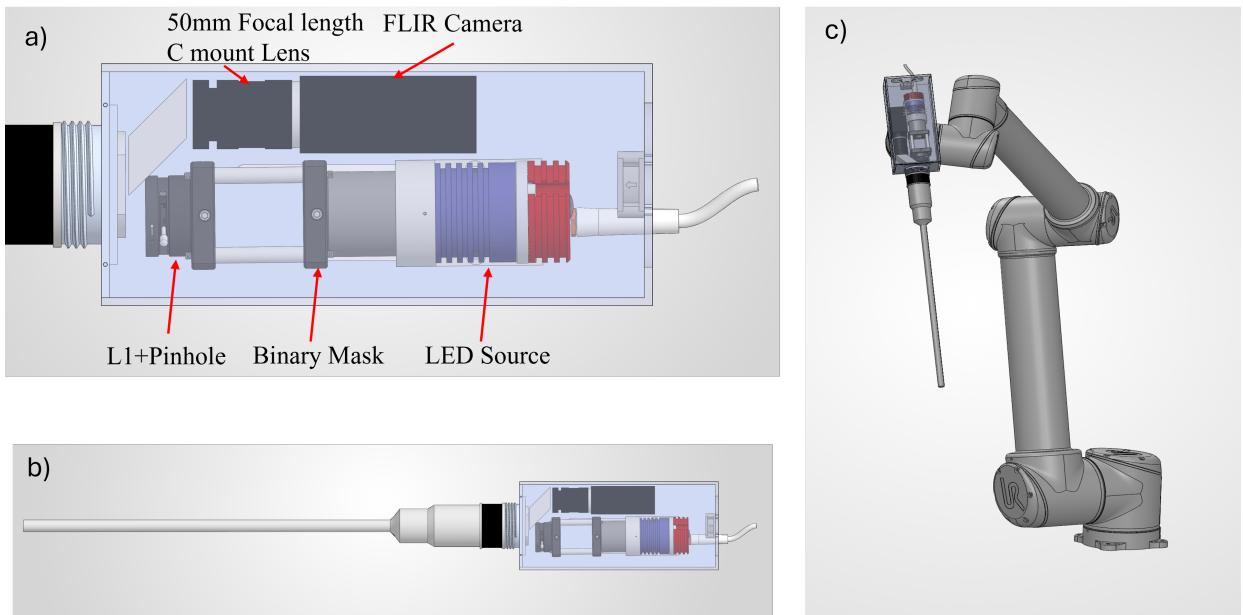
The cutaway view shows the LED, relay, and mask arranged in a volume comparable to a standard light-guide connector, while the imaging channel of the endoscope remains unobstructed. The assembled laparoscope can be mounted on the camera arm of a UR5-style robotic platform without interfering with the tool-arm articulation envelopes.
The optical configuration relays the binary pattern from the LED-illuminated mask through lens L₁ and a pinhole into the illumination channel of the dual-channel laparoscope. The imaging channel collects the pattern-distorted scene and directs it via a folding prism onto a monochrome FLIR camera.
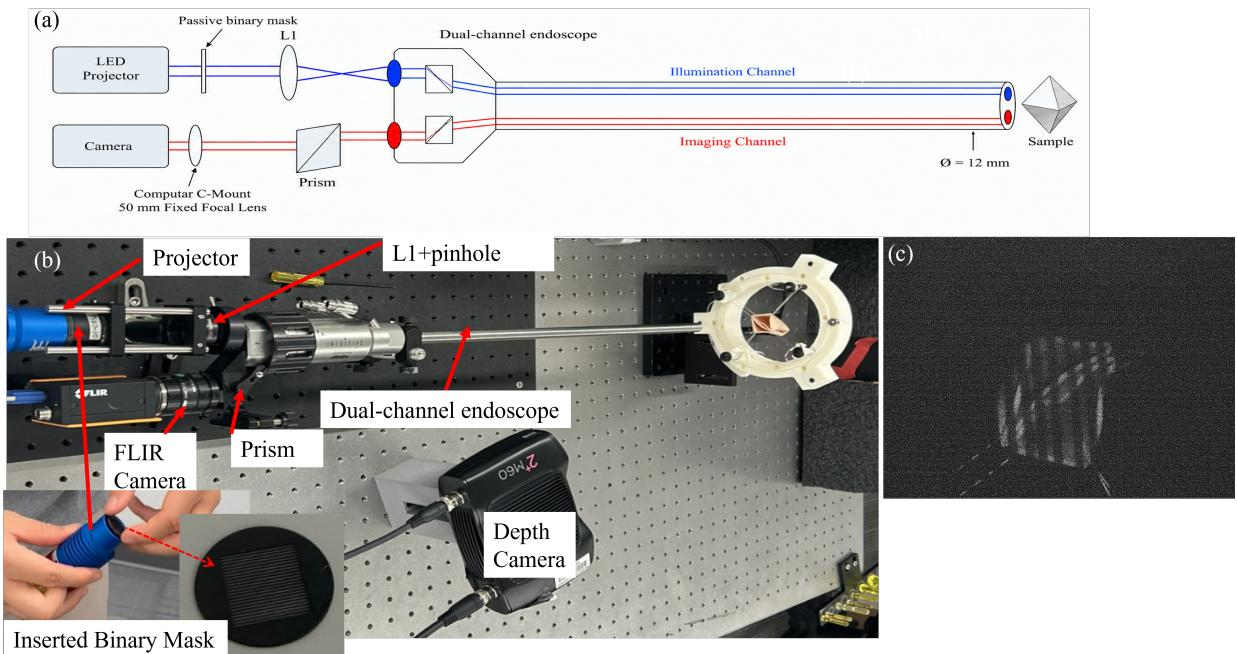
The bench-top realization places all components on an optical breadboard. A laterally mounted Zivid 2⁺ M60 structured-light depth camera is used only during data collection to provide independent ground-truth depth; at deployment the Zivid camera is removed and the endoscope operates as a stand-alone single-shot sensor. A representative endoscopic image of an intestinal phantom under binary-pattern illumination confirms that the projected stripes are clearly visible.
To ensure the pattern remains usable across typical laparoscopic working distances, the authors characterize the binary-pattern visibility on an inclined depth-of-field target.
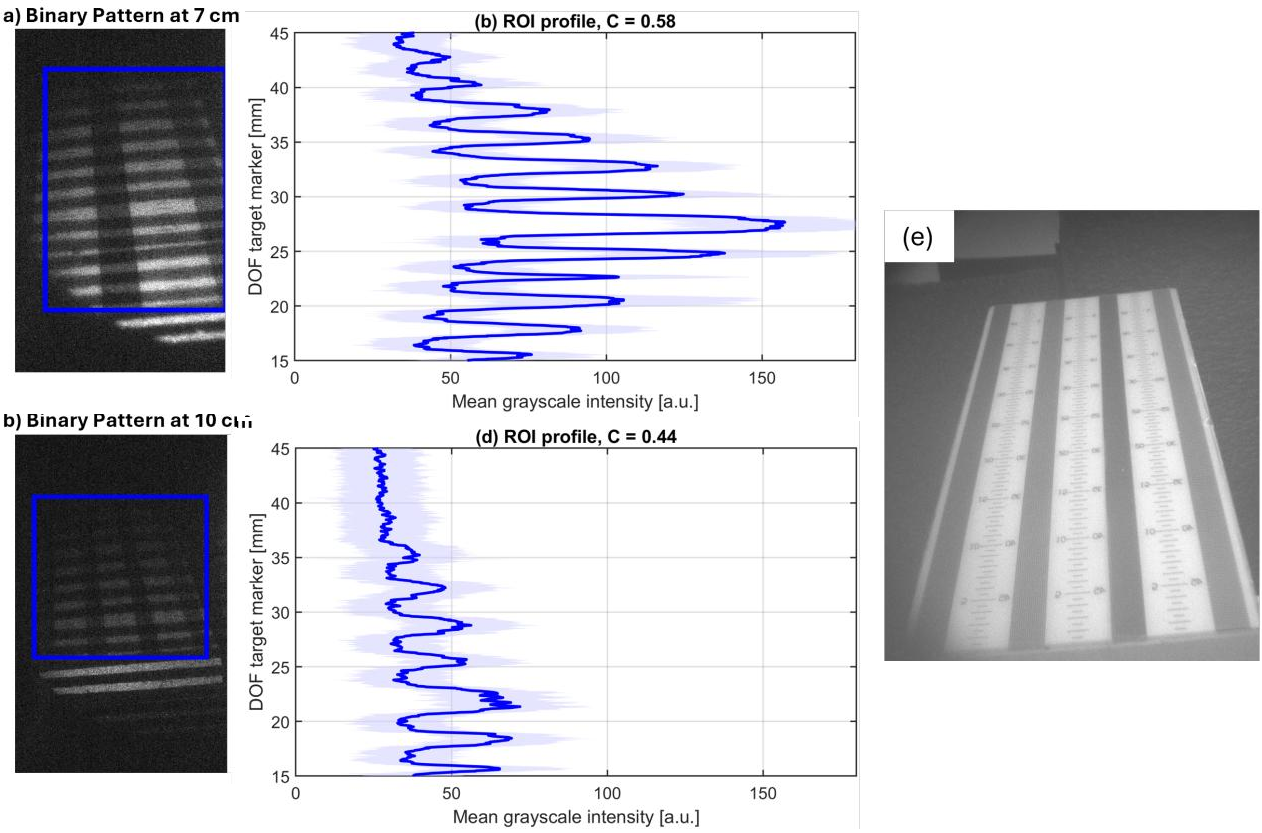
At working distances of 7 cm and 10 cm, the projected stripes remain visually resolvable. Extracted intensity profiles show repeated peak-to-valley modulation with Michelson contrasts of 0.58 and 0.44, respectively, confirming sufficient pattern contrast for single-shot depth reconstruction.
Training data are collected with an automated acquisition program that coordinates the CMOS endoscopic camera, the Zivid camera, and a motorized linear stage. An intestinal phantom is translated along the endoscope viewing direction to sample different working distances and surface poses. At each position, a grayscale SSLE image under binary-pattern illumination is captured together with a Zivid RGB image, point cloud, and depth map. A common frame index preserves pairing between the SSLE input and the reference depth.
For every SSLE frame, the Zivid depth map is reprojected into the SSLE image frame using a one-time stereo calibration. Each valid Zivid pixel is back-projected to a 3-D point in the Zivid frame, transformed by the rigid-body transform (R, t) into the SSLE frame, and projected onto the SSLE image plane. A z-buffer retains the nearest depth where multiple Zivid rays map to the same SSLE pixel, producing a dense reference depth map D_SSLE and a binary validity mask M. This reprojection decouples the training target from the reconstruction algorithm and provides pixel-aligned supervision.
The depth-reconstruction network replaces a prior two-branch U-Net design with a single-branch pipeline that incorporates a vector-quantized variational autoencoder (VQ-VAE) as a latent-space prior.
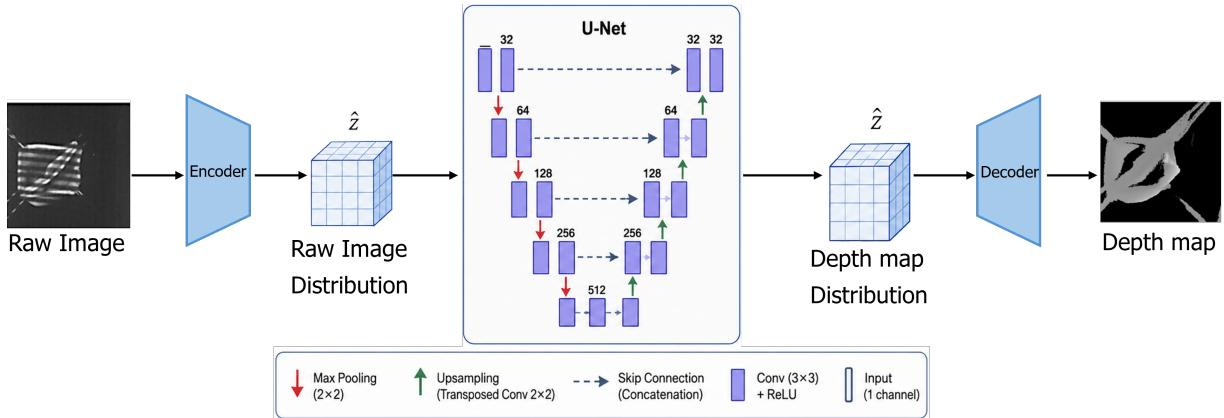
A 256×256 grayscale fringe image x is processed through three sequential components. First, a VQ-VAE image encoder maps x to a continuous latent tensor z_in ∈ ℝ^{64×128×128}, then independently quantizes each spatial position by nearest-neighbor lookup in a learned codebook of K_img = 512 entries to produce the discrete latent representation \hat{z}_in. Second, a four-level multi-resolution residual U-Net (MRD U-Net) operates directly on \hat{z}_in, successively halving spatial resolution through max-pooling and doubling channel width, then reconstructing via bilinear upsampling with skip connections and a multi-level residual branch. The output is a latent depth representation \hat{z}_depth ∈ ℝ^{64×128×128}. Third, a VQ-VAE depth decoder mirrors the image encoder in reverse, using a codebook of K_depth = 1024 entries and a transposed-convolution upsampling step, followed by a tanh activation and linear rescaling to produce the final dense depth map \hat{D} ∈ ℝ^{1×256×256}. Operating in the quantized latent space eliminates the need for explicit foreground segmentation and provides a compact reconstruction pathway with stable inference timing.
The network is trained with a total loss that combines a spatial reconstruction term and a latent-space matching term:
Ltotal=Lspatial(D,D^,M)+β(t)Llatent(zd,z^d).The spatial loss is a weighted sum of an ℓ₁ loss and a structural similarity (SSIM) loss evaluated only over valid pixels indicated by M. The latent loss is the ℓ₁ distance between the standardized reference-depth latent representation z_d (obtained from a pretrained depth VQ-VAE encoder) and the predicted depth latent representation \hat{z}_d. The weight β(t) follows a linear ramp schedule that gradually increases during training, encouraging alignment with the learned quantized structural prior as training stabilizes.
Separate VQ-VAE models are pretrained for the input-image domain and the reference-depth domain using the taming-transformers framework. The MRD U-Net depth-prediction network is then trained for 161 epochs with the Adam optimizer, a cosine annealing learning-rate schedule, and an effective batch size of 4. All images and depth maps are resized to 256×256. Evaluation uses standard depth metrics—MAE, AbsRel, and accuracy at thresholds δ=1.1 and δ=1.1²—computed exclusively on the held-out test set over the Zivid validity mask.
Experiment
The evaluation uses a Zivid-referenced phantom dataset with 722 paired SSLE–Zivid acquisitions, comparing the proposed VQ-VAE + U-Net pipeline against a dual U-Net baseline and off-the-shelf monocular depth models. The proposed model achieves lower average error and its raw unmasked predictions already approximate the valid foreground, eliminating the need for an explicit mask branch, while inference runs at a stable 26 Hz. Remaining reconstruction errors are partly attributable to cross-camera reprojection mismatch from the Zivid supervision, and both task-specific models substantially outperform the monocular baselines, underscoring the importance of task-specific supervision for calibrated depth recovery in endoscopic structured-light settings.
The VQ-VAE + U-Net model achieved lower average depth error than the dual U-Net baseline on the Zivid-referenced phantom dataset, reducing MAE by about 14% and AbsRel by 42%, while retaining comparable accuracy at the stricter threshold. Public monocular depth models produced substantially higher errors, and the proposed model learned to implicitly represent the foreground without requiring an explicit mask branch. The proposed model reduced MAE from 4.30 mm to 3.70 mm and AbsRel from 0.0560 to 0.0326 compared to the MaskNet + DepthNet baseline, with only a marginal drop in δ=1.1 accuracy (0.962 vs. 0.965). Off-the-shelf monocular models (MiDaS DPT-Large and Depth Anything) yielded MAE above 7.8 mm, more than double the error of the proposed method. The raw unmasked predictions of the proposed model closely matched the phantom foreground, showing that the network learned an implicit segmentation without a separate mask prediction branch. Both the proposed and baseline models reported higher MAE than previously published FPP-supervised results because the Zivid cross-camera reprojection introduces a floor of misalignment error that cannot be compensated by the network.

The evaluation compares a VQ-VAE plus U-Net architecture against a dual U-Net baseline and public monocular depth models on a Zivid-referenced phantom dataset. The proposed model reduces average depth error substantially over the baseline, achieving lower mean absolute error and absolute relative error while maintaining comparable strict-accuracy, and it learns to implicitly represent the foreground without an explicit mask branch. Off-the-shelf monocular models produce more than double the error of the proposed method. All models exhibit higher error than previously published fringe projection profilometry-supervised results due to a floor of cross-camera misalignment introduced by the Zivid reprojection.