Command Palette
Search for a command to run...
SFT는 충돌하고 RL은 공존한다: 대규모 언어 모델을 위한 다중 작업 학습 패러다임의 이론적 및 경험적 분석
SFT는 충돌하고 RL은 공존한다: 대규모 언어 모델을 위한 다중 작업 학습 패러다임의 이론적 및 경험적 분석
Kejian Zhu Zhuoran Jin Shangqing Tu Hongbang Yuan Yushi Bai Kang Liu Juanzi Li Jun Zhao
초록
지도식 미세 조정(SFT)과 강화 학습(RL)은 대규모 언어 모델(LLM)의 다중 작업 추론 능력을 향상시키는 데 있어 근본적으로 다른 행동 양식을 보인다. 우리의 예비 실험은 한 가지 현상을 드러냈다. 즉, SFT는 다단계 학습에서 심각한 작업 간 충돌을 겪는 반면, RL은 다양한 작업에 걸쳐 안정적인 공존을 가능하게 한다. 경험적으로 우리는 이를 매개변수 수준까지 추적하여, RL이 작업 전반에 걸쳐 희소하고 거의 직교하는 업데이트를 유도한다는 점을 관찰했다. 우리는 다중 작업 기울기 간섭을 분석함으로써 이 메커니즘에 대한 이론적 설명을 제공한다. 우리의 결과는 한 가지 차이점을 밝혀낸다. SFT의 간섭은 절대 기울기 크기에 따라 규모가 결정되는 노름 제한적(norm-limited)인 반면, RL의 간섭은 이점 정규화 및 온폴리시 최적화에 의해 유도된 기울기 분산에 의해 제한되는 분산 제한적(variance-limited)이다. 이 작은 분산 한계는 작업 전반에 걸쳐 거의 직교하는 최적화 방향을 만들어낸다. 이러한 통찰을 활용하여 우리는 다중 작업 학습을 분리하여 효율성과 유연성을 크게 향상시키는 패러다임인 Parallel-RL을 제안한다.
One-sentence Summary
The authors propose Parallel-RL, a multi-task training paradigm for large language models that decouples tasks by exploiting the insight that reinforcement learning yields sparse, near-orthogonal gradient updates due to variance-limited interference, in contrast to the norm-limited conflicts of supervised fine-tuning, thereby improving efficiency and flexibility.
Key Contributions
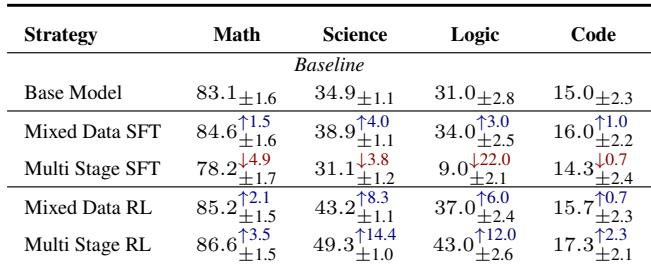
- Multi-stage supervised fine-tuning (SFT) causes a severe performance decline across tasks (averaging 23.1% below the base model), whereas multi-stage reinforcement learning (RL) achieves stable, cumulative improvements (24.9% average gain), demonstrating a coexistence property of RL in multitask settings.
- Gradient interference analysis reveals distinct mechanisms: SFT interference is norm-limited and scales with absolute gradient magnitudes, while RL interference is variance-limited, bounded by low gradient variance from advantage normalization and on-policy optimization, producing sparse, approximately orthogonal updates that avoid task conflicts.
- Parallel-RL is proposed as a paradigm that decouples multi-task training by independently training tasks based on the near-orthogonal RL updates. Experiments show it matches single-task performance, improves training efficiency, and ablation studies confirm effective decoupling of task-specific capabilities.
Introduction
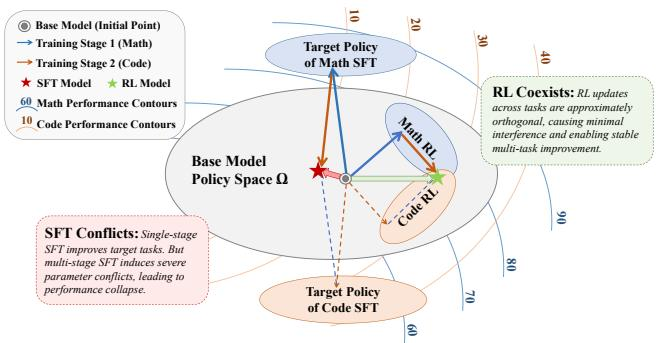
Enhancing reasoning in large language models via supervised fine-tuning (SFT) and reinforcement learning (RL) is central to the pursuit of robust multi-task capabilities, yet prior work has mostly studied these methods in single-task settings, leaving their multi-task behavior underexplored. Existing practice often uses mixed-data training for SFT to avoid forgetting, while RL frequently adopts a multi-stage, per-task approach; the reasons for this divergence and its impact were not systematically understood. The authors address this gap with a combined empirical and theoretical analysis, revealing that multi-stage SFT suffers severe performance collapse due to conflicting parameter updates, whereas RL yields nearly orthogonal updates that coexist and enable stable cumulative gains across tasks. Building on the finding that RL’s gradient interference is variance-limited rather than norm-limited, they introduce Parallel-RL, a paradigm that trains tasks independently and merges updates, achieving strong multi-task performance with improved efficiency.
Method
The authors begin by establishing a theoretical foundation for their proposed method, analyzing the distinct parameter update behaviors of Supervised Fine-Tuning (SFT) and Reinforcement Learning (RL). They demonstrate that RL updates exhibit sparsity, small magnitude, and near-orthogonality across different tasks. This orthogonality arises from two key mechanisms in RL algorithms like GRPO. First, the advantage function acts as a filter that removes the dense mean gradient direction, leaving only intra-group residuals. Second, the on-policy nature of RL ensures these residuals remain minimal. Consequently, gradient interference in SFT is norm-limited and prone to dense conflicts, whereas RL interference is strictly variance-limited by the diversity of intra-group rollouts.
To empirically validate this geometric property, the authors analyze the distribution of score functions sampled during training.
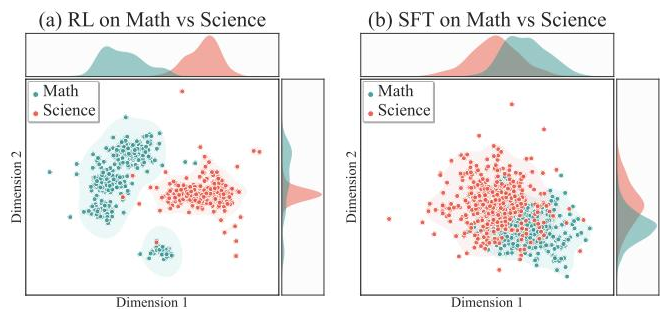
As illustrated in the figure above, RL score functions form distinct, separable clusters for different tasks, indicating that RL updates occupy nearly orthogonal subspaces. In contrast, SFT distributions exhibit heavy overlap, confirming that SFT suffers from dense, conflicting updates while RL naturally decouples task optimization.
Motivated by this insight, the authors propose Parallel-RL, a decoupled post-training paradigm that leverages the orthogonal nature of RL updates. In this framework, a set of diverse reasoning tasks is optimized independently. Formally, given a set of tasks T={T1,…,TN}, the authors launch N parallel RL training processes. Each process i produces a task-specific parameter update ΔWi. The final model parameters Wfinal are then obtained by merging these independent updates:
Wfinal=Wbase+M(ΔW1,…,ΔWN)where M represents a merging function, such as linear averaging or Singular Value Decomposition. This approach allows for the harmonious coexistence of different task updates within a single model without the interference typically observed in multi-task SFT.
Experiment
This study compares SFT and RL (GRPO) on a Qwen model across math, science, code, and logic tasks. Multi-stage SFT causes catastrophic forgetting, while RL supports stable growth because its updates are sparse, minimal, and nearly orthogonal across tasks, thus avoiding interference. This natural decoupling enables Parallel-RL, where task-specific RL updates can be merged with negligible conflict and even surpass single-task performance after light adaptation.
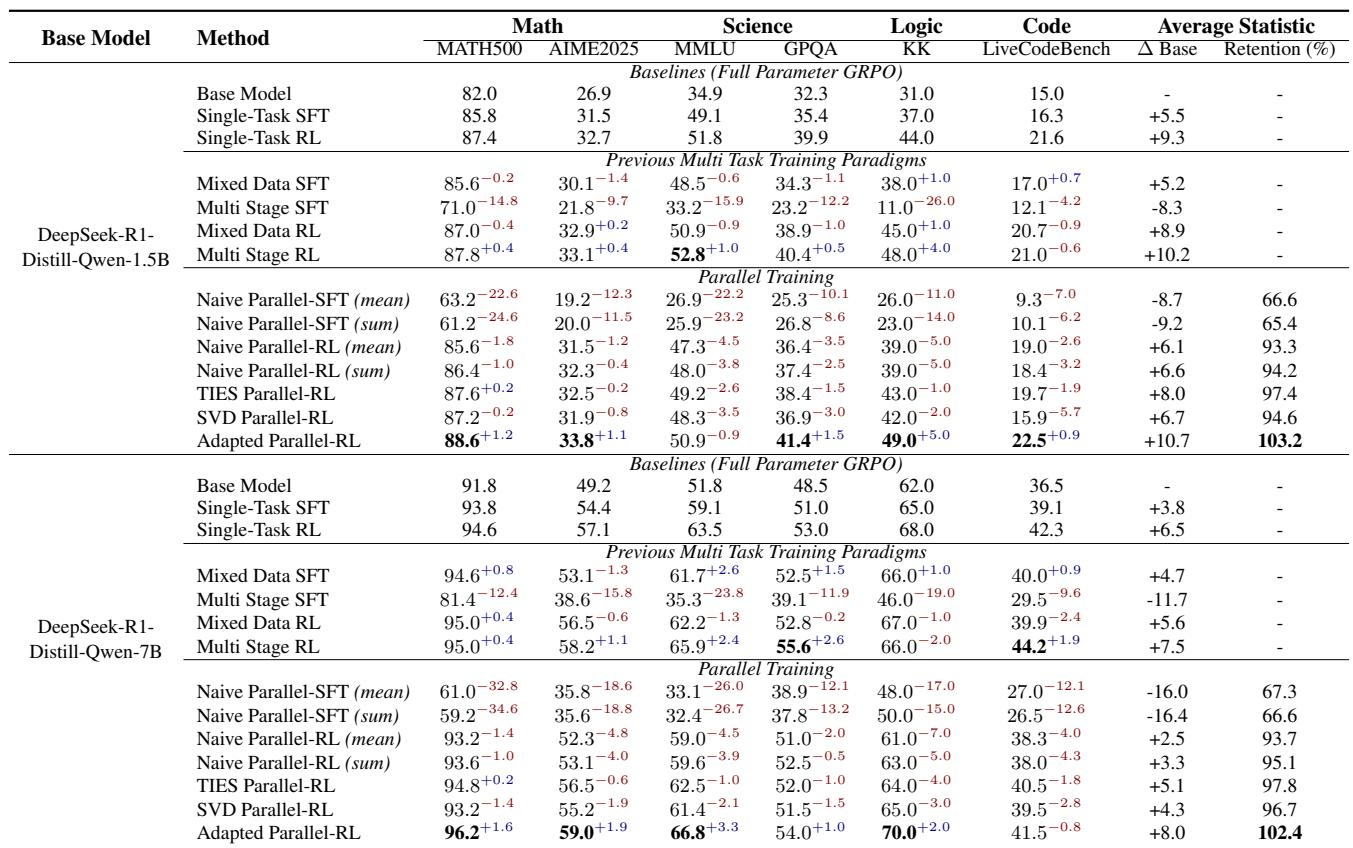
When training on multiple tasks, mixing data during supervised fine-tuning yields small improvements, but training tasks one after another causes severe performance collapse, especially in logic. In contrast, reinforcement learning benefits from both mixed-data and sequential strategies, with the sequential multi-stage approach delivering the largest gains, particularly in science and logic. Multi-stage supervised fine-tuning led to catastrophic forgetting, with logic accuracy plummeting far below the base model, while mixed-data fine-tuning avoided this collapse. Reinforcement learning proved robust across strategies: multi-stage training achieved the highest accuracy on every task, with especially large improvements in science and logic. Mixed-data reinforcement learning improved all tasks but was outperformed by its multi-stage counterpart, which saw cumulative growth rather than interference.
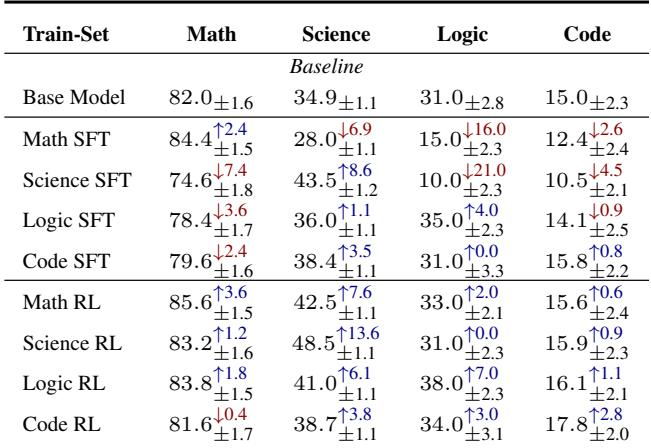
After single-task training, supervised fine-tuning (SFT) improves the target task but causes clear degradation on other tasks, whereas reinforcement learning (RL) not only boosts the target task more but also yields small, consistent gains across all other evaluated tasks. SFT on a single task caused nontarget accuracy drops as large as 21 percentage points (logic after science SFT). RL on math improved math and simultaneously lifted science by over 7 points, showing positive cross-task transfer.
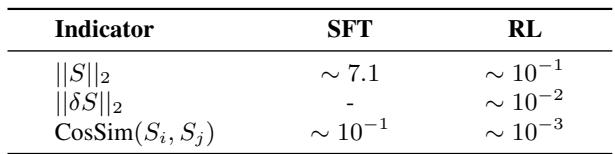
Supervised fine-tuning (SFT) yields score function vectors with large magnitude and moderate inter-task cosine similarity, indicating dense and overlapping updates. In contrast, reinforcement learning (RL) produces score functions with much smaller magnitude, a bounded residual term, and near-zero cosine similarity, showing that RL updates are nearly orthogonal and naturally decoupled across tasks. The score function L2 norm for SFT is approximately 7.1, while for RL it drops to roughly 0.1, reflecting substantially smaller update magnitudes. Inter-task cosine similarity for RL is around 0.001 compared to about 0.1 for SFT, confirming that RL gradients occupy almost orthogonal subspaces.
Parallel reinforcement learning (RL) merges task-specific updates with far less conflict than supervised fine-tuning (SFT): naive sum merging retains 95% of single-task RL performance versus only 66% for SFT. Sparsification strategies like TIES and SVD further raise retention to 96–98%, and a light adaptation step after merging pushes performance beyond single-task models (102.8% retention) while achieving a 9.4% average gain over the base model. Naive Parallel-RL (sum) retains 95% of single-task RL performance, whereas Parallel-SFT (sum) retains only 66%, showing RL updates are more compatible. Sparsifying RL updates with TIES or SVD increases retention to 96–98%, reducing task interference. Adapted Parallel-RL with a small post-merge fine-tuning step surpasses single-task models (102.8% retention) and delivers a 9.4% improvement over the base model.
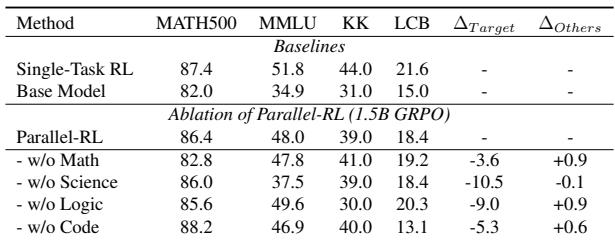
Removing a task-specific update from the Naive Parallel-RL merged model causes a large accuracy drop on that task (averaging -7.1%), while performance on the remaining tasks stays robust, even showing a small average improvement of 0.6%. This demonstrates that Parallel-RL yields strongly decoupled task representations, allowing selective module exclusion without harming unrelated capabilities. Excluding the math update reduces MATH500 accuracy by 3.6 points (from 86.4 to 82.8), while the other three benchmarks collectively improve by 0.9 points on average. Excluding the science update causes a 10.5-point drop on MMLU (48.0 to 37.5), yet the other tasks' scores are nearly unchanged, shifting by only -0.1 points on average.
The experiments assess supervised fine-tuning (SFT) and reinforcement learning (RL) on math, science, and logic tasks under single-task, sequential multi-stage, and parallel merging strategies. RL updates are naturally decoupled and near-orthogonal across tasks, preventing catastrophic forgetting and enabling positive cross-task transfer, while SFT produces dense, interfering updates that cause severe performance drops in untargeted skills. Parallel RL merging preserves up to 95% of single-task performance with simple summation, and sparsification plus light adaptation can yield models that surpass single-task counterparts, with removal of individual task modules demonstrating perfectly isolated task representations.