Command Palette
Search for a command to run...
자동 발견에는 보편적으로 우월한 하네스가 존재하지 않는다
자동 발견에는 보편적으로 우월한 하네스가 존재하지 않는다
Akshat Gupta Jermaine Lei Alexander Lu Gopala Anumanchipalli Leshem Choshen
초록
OpenEvolve 및 TTT-Discover와 같은 자율 발견 시스템은 종종 범용 하네스로 사용된다. 그러나 실제로 이들은 아카이브, 부모 선택, 탐색, 예산 할당에 관한 여러 설계 선택을 단일 레시피로 결합한 복합 시스템이다. 발견 실행은 비용이 많이 들고 본질적으로 확률적이기 때문에, 기존 하네스들은 주요 방법론적 개선과 실행 간 분산을 구별하기에는 너무 적은 수의 독립 시행만으로 비교되는 경우가 많다. 우리는 OpenEvolve 스타일의 진화적 탐색과 TTT-Discover 탐색 하네스를 구성 요소로 체계적으로 분해하고, 310만 회 이상의 LLM 롤아웃과 반복 시행 통계 분석을 사용하여 12개의 모델-문제 쌍에 걸쳐 예산이 일치된 30개의 하네스를 체계적으로 평가한다. 우리의 결과는 발견 하네스에 일반화 문제가 있음을 보여준다. 평가된 모델-문제 쌍 전반에 걸쳐 신뢰성 있게 우월한 고정 하네스는 없으며, OpenEvolve의 변형들은 일반적으로 더 단순한 대안보다 성능이 낮다. 따라서 하네스 선택은 보편적 레시피라기보다 하이퍼파라미터로 간주하는 것이 더 나으며, 특정 문제와 기반 모델에 맞게 조정되어야 한다. 또한 초기 발견 진행 상황이 최종 성능을 예측한다는 사실을 발견하고, 이 특성을 활용하여 여러 하네스를 시작하고 약한 부분 실행을 제거한 후 계산 자원을 더 강력한 생존 하네스에 재할당하는 예산 일치 적응형 할당 실험을 제시한다. 이 방식은 무작위로 샘플링된 고정 하네스에 전념하는 방식과 비적응형 하네스 앙상블 모두를 능가한다. 이러한 결과는 고정 하네스 선택에서 초기 성능에 기반한 온라인 적응으로의 전환을 뒷받침한다. 우리는 모든 모델-문제 쌍에 대한 기준선 귀무 분포를 포함한 모든 실행 풀을 향후 하네스 제안을 위한 재사용 가능한 통계적 인프라로서 공개한다.
One-sentence Summary
After systematically decomposing and evaluating 30 discovery harnesses across 12 model–problem pairs and finding no universally superior harness, researchers from UC Berkeley, MIT, and the MIT-IBM Watson AI Lab propose an adaptive-allocation method that leverages early progress to prune weak runs and reallocate compute, outperforming both fixed harnesses and ensembles.
Key Contributions
- The paper systematically decomposes the OpenEvolve and TTT-Discover discovery harnesses into their constituent components and evaluates 30 budget-matched harness variants across 12 model–problem pairs using over 3.1 million LLM rollouts and repeated-trial statistical analysis.
- The study demonstrates that no fixed discovery harness generalizes reliably across models and problems; harness choice is better treated as a model- and problem-dependent hyperparameter, with simpler alternatives often outperforming OpenEvolve-style configurations.
- The work presents an adaptive harness ensemble that uses early-run progress to prune underperforming harnesses and reallocate compute to stronger survivors, achieving average final performance gains over both a single fixed harness and a non-adaptive ensemble.
Introduction
The authors investigate LLM-guided autonomous discovery systems that iteratively generate, evaluate, and improve candidate solutions. In these systems, a harness controls archive construction, parent selection, exploration, and budget allocation, but prior work evaluates composite harnesses with only a few trials, making it impossible to separate meaningful design choices from run-to-run variance. The authors conduct a large-scale, statistically controlled evaluation of 30 budget-matched harnesses across 3.1 million rollouts and 12 model–problem pairs, finding that no single fixed harness reliably transfers across settings. They then show that treating harness choice as an online, problem-dependent hyperparameter—with partial-run feedback used to prune and reallocate compute—improves final performance over committing to a single harness upfront.
Method
The authors develop a framework for program discovery that unifies two popular search harnesses and extends them with an online budget allocation strategy. The method begins with a greedy sequential best-of-N baseline, which at each iteration selects the single highest-scoring program from the history Ht as the parent:
pt=argx∈HtmaxS(x).This deterministic top-1 selection, pt∼Et1, generates N candidate children that are evaluated and appended to the history. The total rollout budget is fixed at B=NT across iterations.
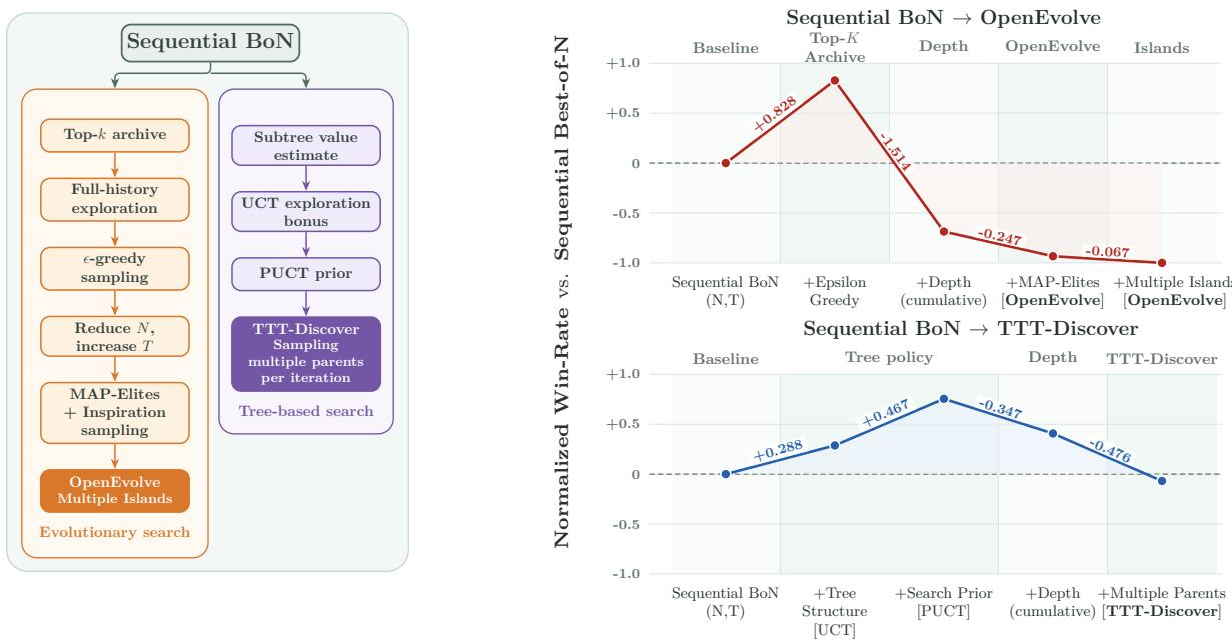
Moving from this baseline to the OpenEvolve harness involves four progressive relaxations: replacing the top-1 archive with a top-K archive EtK, introducing epsilon-greedy exploration by occasionally sampling from the full history Ht, shifting the budget from breadth to depth by decreasing N and increasing T, and finally adding inspiration sampling, MAP-Elites diversity maintenance, and multi-island evolution with crossovers. To derive the TTT-Discover harness, the scoring function is transformed into a value estimate of the subtree rooted at a program, an Upper Confidence Bound (UCT) exploration bonus is added based on visitation counts, and the bonus is modified to a PUCT rule with a prior estimate. TTT-Discover also samples multiple parents per time step rather than a single parent.
Because the optimal fixed harness varies across model–problem pairs, the authors introduce an online allocation policy that dynamically selects among harnesses using intermediate feedback. The adaptive harness ensemble starts multiple harness configurations, advances them to one or more checkpoints (e.g., 25%, 50%, 75% of a full run), ranks the partial runs by the best evaluator score observed so far, prunes weaker runs, and spends the remaining compute on the survivors. The total budget is fixed to Be=5 full-run equivalents, matching the standard best-of-five evaluation. A single-stage policy satisfies the budget constraint
mq+s(1−q)≤Be,where m partial runs are advanced to checkpoint q, and s survivors are completed. Multi-stage pruning uses several checkpoints 0=q0<q1<⋯<qL=1, with mℓ active configurations at stage ℓ, leading to
ℓ=1∑Lmℓ(qℓ−qℓ−1)≤Be.The strongest policies begin with a broad portfolio at early checkpoints and progressively concentrate the budget as more informative feedback becomes available. For example, a three-stage 12→5→2→1 schedule prunes at 25%, 50%, and 75% of a full run, outperforming both fixed-harness commitment and an unpruned harness ensemble under the same compute budget.
Experiment
The evaluation compares search harnesses across four LLMs and three mathematical discovery tasks under a fixed rollout budget. Pair-level and cross-pair significance tests reveal that no single fixed harness consistently outperforms the simple Sequential BoN baseline, and the strongest observed harness varies across model–problem pairs. Early-run performance is shown to be predictive of final outcomes, and an adaptive online allocation strategy that starts many harnesses and prunes based on intermediate feedback yields higher average performance than both single-harness commitment and an unpruned harness portfolio.
Under a fixed compute budget of five full-run equivalents, adaptive online harness allocation policies that start multiple configurations, evaluate partial progress, and prune weaker runs consistently outperform fixed strategies. The strongest adaptive schedule, a three-stage pruning approach, raised the average final score from 84.35% to 85.75% by beginning with a broad portfolio and progressively concentrating resources on the most promising candidates. This demonstrates that early partial-run feedback is effective for directing compute toward better solutions. Every adaptive pruning schedule surpassed the single-harness baseline, the unpruned harness portfolio, and the Sequential BoN reference in average final score. The top-performing policy, which prunes at 25%, 50%, and 75% of a full run, achieved the highest average score of 85.75% and outperformed the unpruned portfolio on 11 of 12 model–problem pairs.
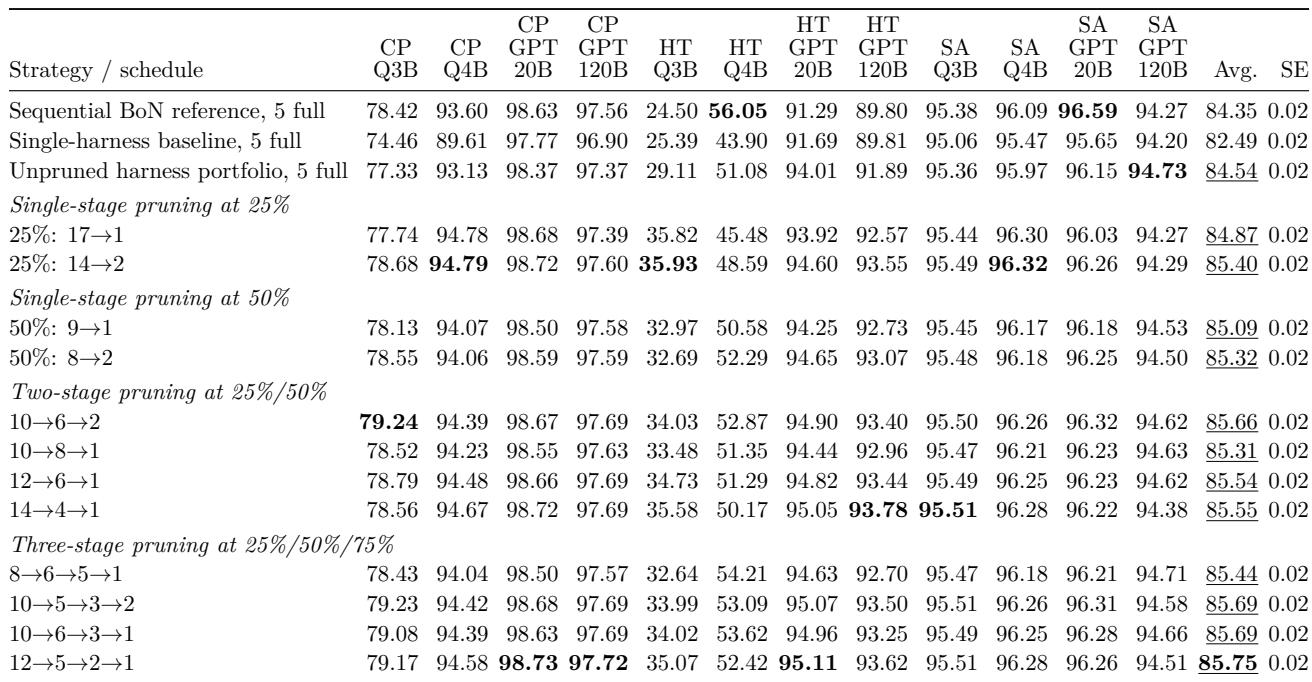
Under a fixed compute budget of five full-run equivalents, adaptive online allocation policies that launch multiple configurations, assess partial progress, and prune weaker runs consistently outperform static strategies. A three-stage pruning schedule that starts with a broad portfolio and progressively concentrates resources on the most promising candidates raised the average final score, demonstrating that early partial-run feedback effectively directs compute toward better solutions. All adaptive pruning schedules surpassed the single-harness baseline, the unpruned harness portfolio, and the Sequential BoN reference, with the best policy (pruning at 25%, 50%, and 75% of a full run) outperforming the unpruned portfolio on 11 of 12 model–problem pairs.