Command Palette
Search for a command to run...
FAIR GraphRAG: 의미적 데이터 분석을 위한 검색 증강 생성 접근법
FAIR GraphRAG: 의미적 데이터 분석을 위한 검색 증강 생성 접근법
Marlena Fluh Soo-Yon Kim Carolin Victoria Schneider Sandra Geisler
초록
검색 증강 생성(RAG)은 대규모 언어 모델(LLM)이 도메인 특화 질문에 응답할 때의 한계를 해결한다. GraphRAG와 같은 그래프 기반 RAG 접근법은 지식 그래프(KG) 내 의미적 관계를 포착하여 검색을 향상시킨다. FAIR 원칙(발견 가능성, 접근성, 상호 운용성, 재사용 가능성)이 특히 의학과 같은 복잡한 도메인에서 과학적 데이터 관리에 널리 채택되고 있지만, 기존 RAG 접근법은 기반 지식 자원의 구조화된 FAIR화가 부족하다. 이러한 부족은 해당 도메인에서 FAIR 정보 검색의 잠재력을 제한한다. 이 격차를 해소하기 위해, 우리는 FAIR 디지털 객체(FDO)를 그래프 기반 검색 시스템의 기본 단위로 통합한 새로운 프레임워크인 FAIR GraphRAG를 소개한다. 각 그래프 노드는 핵심 데이터, 메타데이터, 영구 식별자, 의미적 링크를 포함하는 FDO를 나타낸다. 우리는 LLM을 활용하여 스키마 구축과 데이터 소스로부터의 콘텐츠 및 메타데이터 자동 추출을 지원한다. 이 프레임워크는 기술적 및 임상적 관련성을 보장하기 위해 의사와 컴퓨터 과학자들이 공동 설계했다. 우리는 FAIR GraphRAG를 위장병학의 생물의학 데이터셋에 적용하여 RNA 시퀀싱 데이터에 대한 적용 가능성을 입증한다. FAIR 원칙 준수를 보장하는 것 외에도, FAIR GraphRAG는 특히 메타데이터와 온톨로지 링크를 포함하는 복잡한 질의에 대해 질문 응답 정확도, 범위, 설명 가능성을 크게 향상시킨다. 이 연구는 FAIR 데이터 관행과 그래프 기반 검색 기술을 결합하는 가능성을 보여준다. 우리는 교육 및 비즈니스와 같은 다른 전문 분야에도 우리의 접근법을 적용할 잠재력이 있다고 본다.
One-sentence Summary
Researchers at RWTH Aachen University and University Hospital RWTH Aachen propose FAIR GraphRAG, a framework that integrates FAIR Digital Objects as graph nodes in retrieval-augmented generation and leverages LLMs for schema construction and metadata extraction to enhance question-answering accuracy, coverage, and explainability on biomedical data such as RNA-sequencing in gastroenterology.
Key Contributions
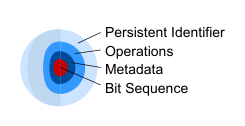
- FAIR GraphRAG is a graph-based retrieval framework that uses FAIR Digital Objects as nodes, embedding core data, metadata, persistent identifiers, and semantic links to enforce FAIR principles throughout the knowledge graph.
- The framework leverages large language models for automated schema construction and extraction of content and metadata, enabling scalable FAIRification of domain-specific knowledge resources.
- Experiments on a gastroenterology RNA-sequencing dataset show that FAIR GraphRAG improves question answering accuracy, coverage, and explainability over baselines, particularly for complex queries involving metadata and ontology links, while achieving higher FAIR compliance.
Introduction
In clinical settings, AI systems must connect patient records to standardized ontologies such as SNOMED CT to answer medication dosing queries correctly, but mismatches between custom diagnosis terms and formal vocabularies lead to incomplete or erroneous results. Large language models (LLMs) can extract information from diverse sources, yet they hallucinate when domain-specific knowledge is absent from their training data. Retrieval-augmented generation (RAG) addresses this by supplying external knowledge, and graph-based RAG (GraphRAG) further leverages knowledge graphs to capture semantic relationships. However, existing methods do not systematically apply FAIR (Findable, Accessible, Interoperable, Reusable) principles to the knowledge that underpins RAG systems, limiting automated discovery, linking, and reuse of heterogeneous data. The authors introduce FAIR GraphRAG, a framework that models each knowledge graph node as a FAIR Digital Object with persistent identifiers, metadata, and core data, and employs LLMs to automate schema design and entity extraction. This approach unifies FAIRification with graph-based retrieval, improving interoperability and answer quality, as demonstrated on a biomedical dataset.
Dataset

The authors describe a flexible pipeline that turns a user-supplied dataset into a FAIR knowledge graph. The dataset itself is not a fixed benchmark; it is any collection of structured or unstructured documents that the user provides, along with a short description of the entities of interest (e.g., patient, disease). The pipeline processes this input as follows:
- Schema construction – An LLM uses few‑shot prompting on the input dataset to extract relevant features for each user‑defined entity (e.g., name, sex for “patient”), producing a JSON schema that acts as a blueprint for extraction.
- Information extraction – For structured data, a rule‑based approach maps fields directly to the schema. For unstructured data, the LLM is one‑shot prompted with the schema and one document at a time, filling the schema with entity instances.
- FAIR Digital Object (FDO) creation – Each filled schema becomes a dataset FDO, and every entity instance becomes a separate entity FDO. This step adds:
- Persistent identifiers (PIDs) for findability.
- Metadata extracted by an LLM from provided metadata files, aligned to domain‑specific standards.
- Ontology term mappings via repository APIs (e.g., Bio‑Portal) to enhance interoperability.
- Relation enrichment – Semantic relations between FDOs are identified based on metadata or core‑data similarities (both within and across datasets) and added to the schema.
- Knowledge graph integration – FDOs become nodes, relations become edges, and the resulting property graph is stored in a graph database, queryable with standard languages (Cypher/SPARQL).
The pipeline does not split the data into training/test sets; it processes the entire user‑provided collection document by document to produce a structured, FAIR‑compliant knowledge graph.
Method
The authors propose a novel FAIR GraphRAG framework designed for analyzing domain-specific datasets. Unlike traditional Retrieval-Augmented Generation (RAG) approaches that often overlook interconnected structures, this method constructs a Knowledge Graph (KG) where each node represents a FAIR Digital Object (FDO). This ensures that every component of the graph is inherently findable, accessible, interoperable, and reusable.
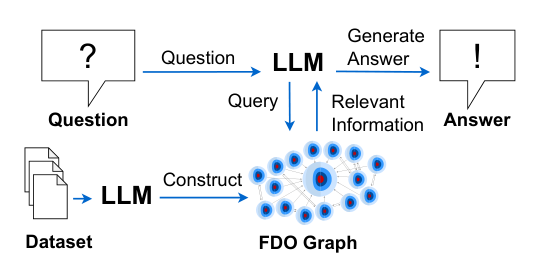
The framework leverages Large Language Models (LLMs) for both the construction of the KG from raw datasets and for user interaction via natural language queries.
The underlying structure adopts a property graph model, chosen for its alignment with LLM outputs like JSON structures. The authors define the FAIR property graph formally as a tuple: G=(F,E,ρ,λ,σ,ϕ) Here, F represents a finite set of FDOs (nodes), and E represents edges. The function ρ associates edges with pairs of FDOs, while λ and σ assign labels and properties (metadata) to nodes and edges. The function ϕ assigns node types, such as 'dataset' or 'entity' (e.g., patient, disease).
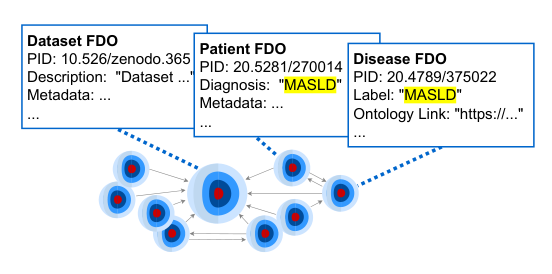
As illustrated in the figure above, the graph contains a central dataset node providing an overview, surrounded by user-defined entity nodes. Relationships indicate interrelations between core data or metadata, such as a matching disease label.
The construction of the FAIR KG follows a multi-stage pipeline that integrates FAIR principles.
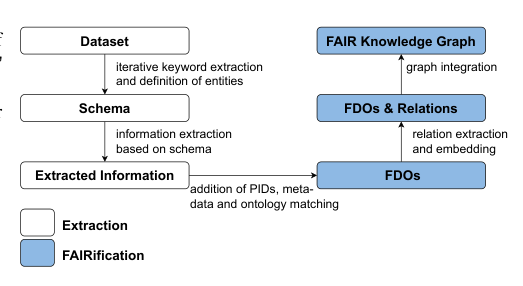
The process begins with Schema Definition, where users specify entity types and an LLM extracts relevant features to create a JSON blueprint. Next, in the Information Extraction phase, the system populates this schema. For structured data, rule-based mapping is used, while unstructured data is processed by an LLM using one-shot prompting. The extracted information is then transformed into FAIR Digital Objects (FDOs). This involves generating Persistent Identifiers (PIDs) for findability, extracting metadata, and mapping schema entries to domain-specific ontology terms to ensure interoperability. Subsequently, Relations are established between FDOs based on metadata or core data similarities, allowing for both inner-dataset and cross-dataset linking. Finally, these FDOs and their relations are integrated into a property graph database to form the FAIR Knowledge Graph.
The retrieval mechanism moves beyond simple embedding-based similarity searches to a query-based approach for higher flexibility.
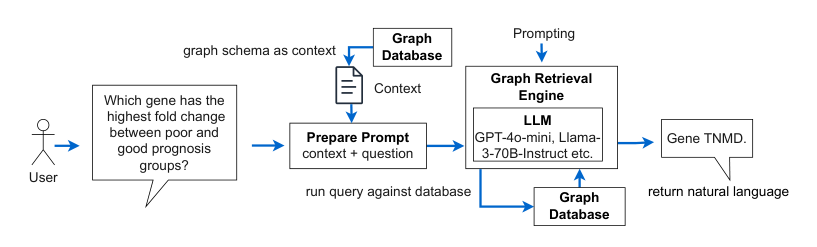
When a user poses a question, the system prepares a prompt incorporating the graph schema as context. This prompt is fed to an LLM within the Graph Retrieval Engine, which generates a graph database query (e.g., in Cypher or SPARQL). The query is executed against the graph database, and the resulting FDOs are retrieved. Finally, the engine interprets these results and translates them into a natural language answer for the user, while also displaying the original query and the retrieved FDO metadata for transparency.
Experiment
This study evaluates a FAIR GraphRAG approach on a biomedical RNA sequencing dataset, comparing it to a Non-FAIR baseline that omits persistent identifiers, metadata, and ontology terms. The FAIR system meets all FAIR criteria except licensing and achieves markedly higher accuracy and full explainability, particularly for metadata and ontology questions, while the baseline fails on those types. The results confirm that enriching a knowledge graph with FAIR principles substantially improves both compliance and the semantic richness of question answering, providing stronger provenance and traceability.
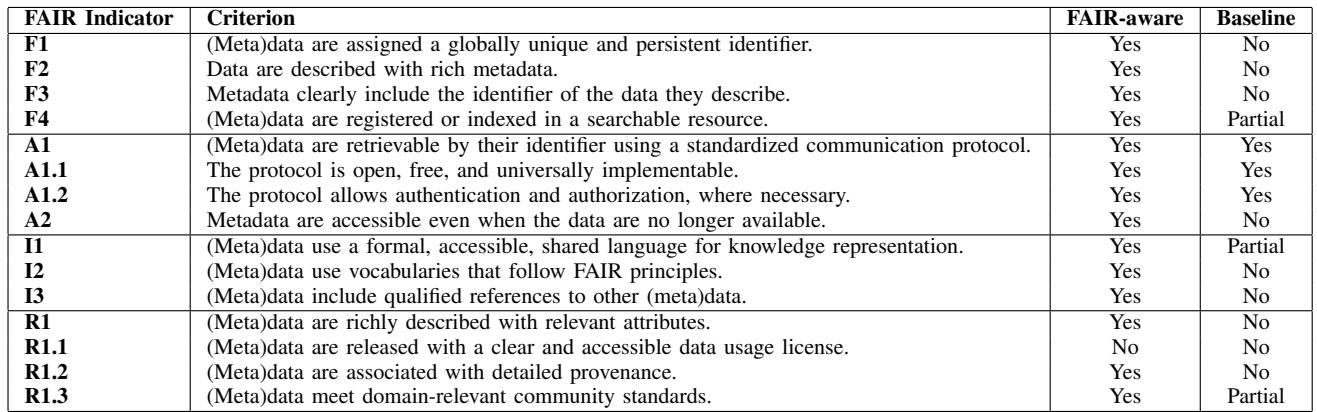
The FAIR-aware GraphRAG approach satisfies all evaluated FAIR indicators except licensing, whereas the baseline fails on findability, interoperability, and reusability due to missing persistent identifiers, rich metadata, and ontology mappings. Both systems support open, standardized access protocols and authentication, but only the FAIR-aware system provides globally unique identifiers, rich metadata, and clear data-metadata links. The FAIR-aware approach meets all criteria from F1 to A1.2, with the sole exception of licensing (R1.1), while the baseline lacks identifiers and metadata (F1–F3: No) and is only partially indexed (F4: Partial). Both implementations are accessible via open, free, and universally implementable protocols (A1, A1.1) and support authentication and authorization (A1.2).
The FAIR-aware system with gpt-4o-mini achieved the highest overall accuracy (92.86%), with strong performance across general, metadata, and ontology questions, while the baseline system failed completely on metadata and ontology questions. Coverage matched accuracy for gpt-4o-mini, and explainability was perfect in the FAIR setting, demonstrating that a FAIR-aligned knowledge graph substantially improves answer quality. Llama-3.3-70B showed some improvement with FAIR but still lagged behind, often producing invalid queries. Overall accuracy for gpt-4o-mini more than doubled from 42.86% in the baseline to 92.86% in the FAIR setting. Metadata and ontology accuracy were 0% for both models in the baseline, but rose to 90% for gpt-4o-mini and 20% for Llama-3.3-70B with the FAIR system.

The first experiment assesses FAIR compliance, showing that the FAIR-aware GraphRAG satisfies all evaluated indicators except licensing, while the baseline fails on findability, interoperability, and reusability due to missing persistent identifiers and metadata. The second experiment evaluates question-answering performance, revealing that the FAIR-aligned knowledge graph dramatically boosts accuracy, particularly for metadata and ontology questions, with gpt-4o-mini reaching 92.86% overall accuracy and perfect explainability, compared to the baseline's complete failure on those question types. These results demonstrate that embedding FAIR principles into the knowledge graph is essential for reliable and interpretable retrieval-augmented generation.