Command Palette
Search for a command to run...
고치기 전에 알라: 소프트웨어 이슈 해결을 위한 QA 기반 저장소 지식 습득
고치기 전에 알라: 소프트웨어 이슈 해결을 위한 QA 기반 저장소 지식 습득
초록
LLM 기반 코딩 에이전트는 자동화된 소프트웨어 이슈 해결을 크게 발전시켰지만, 저장소 이해 부족으로 인한 사실적 오류에 여전히 취약하다. 최근 방법들은 사전 수리 저장소 탐색을 통해 이 한계를 완화하려 하지만, 이들의 수정 중심 전략은 에이전트의 지식 격차를 파악하지 않고 저장소를 탐색하여 근본적인 이해 부족을 메우지 못하는 부정확한 맥락을 제공하는 경우가 많다. 본 논문에서는 소프트웨어 이슈 해결을 위한 QA 기반 프레임워크인 ACQUIRE를 제안한다. 숙련된 개발자가 수정을 시도하기 전에 낯선 코드를 먼저 이해하는 방식을 반영하여, ACQUIRE는 수리 전에 저장소 지식을 명시적으로 습득한다. 이 프레임워크는 지식 습득과 패치 생성을 두 단계로 분리한다. 첫 번째 단계에서는 질문자와 답변자가 협력하여 구조화된 저장소 지식을 습득하는데, 질문자는 표적 질문을 제기하고 답변자는 자율적 탐색을 통해 증거 기반 답변을 생성한다. 두 번째 단계에서는 해결자가 결과 QA 지식을 활용하여 정보에 기반한 패치를 생성한다. 암묵적 지식 격차를 명시적이고 사실적으로 신뢰할 수 있는 이해로 전환함으로써, ACQUIRE는 지식 집약적 수리 단계를 가속화하고 더 정확한 해결을 가능하게 한다. SWE-bench Verified에서의 실험은 ACQUIRE가 대표적인 사전 수리 방법들을 일관되게 능가하며, 적당한 추가 비용과 시간으로 Pass@1을 최대 4.4% 포인트 향상시킴을 보여준다.
One-sentence Summary
Researchers from Shanghai Jiao Tong University, University of Pittsburgh, and Guangdong Technion–Israel Institute of Technology propose ACQUIRE, a QA-driven framework that acquires structured repository knowledge by having a Questioner pose targeted questions and an Answerer ground answers in repository exploration, then a Resolver generates patches informed by that knowledge, raising Pass@1 by up to 4.4 percentage points on SWE-bench Verified.
Key Contributions
- ACQUIRE is a QA-driven framework that decouples knowledge acquisition from patch generation by using a Questioner to pose targeted questions and an Answerer to autonomously explore the repository and produce evidence-grounded answers, transforming implicit knowledge gaps into explicit, structured understanding.
- The framework acquires repository knowledge independently from repair in a two-stage pipeline, so the Resolver generates patches informed by the resulting QA knowledge, which accelerates knowledge-intensive repair stages and shifts agent effort toward verification.
- Experiments on SWE-bench Verified show that ACQUIRE consistently outperforms representative pre-repair methods, raising Pass@1 by up to 4.4 percentage points with modest additional cost, and ablation studies attribute the gains to decomposing issues into targeted, answerable questions and category-guided question generation.
Introduction
Large language model (LLM) coding agents have advanced automated software issue resolution, yet a critical failure mode persists: the agent lacks deep repository understanding, leading to shallow, keyword-based localization and violations of implicit API contracts. Existing pre-repair methods attempt to enrich context with structural summaries, but they remain driven by issue keywords rather than identifying what specific repository knowledge is missing, often producing incomplete or imprecise context. The authors propose ACQUIRE, a framework that decouples repository knowledge acquisition from patch generation. ACQUIRE deploys a Questioner and an Answerer to decompose an issue into targeted questions across multiple knowledge dimensions and autonomously explore the repository for grounded answers, providing structured QA pairs that a Resolver then uses to generate informed patches.
Dataset

The evaluation of ACQUIRE relies on a single curated benchmark. Here is how the dataset is composed and used.
- Dataset – SWE‑bench Verified, a subset of the original SWE‑bench.
- Sources – 500 real GitHub issues drawn from open‑source Python repositories.
- Filtering – The subset keeps only issues that isolate functional bugs; each instance runs in a controlled, portable environment so that the unit tests are deterministic and reliable.
- Instance structure – Every example supplies the agent with a natural‑language problem description and the full code repository at the faulty commit. No extra hints, issue comments, or patch snippets are given.
- Evaluation – Correctness is judged by executing the developer‑written unit tests that accompany the issue. The test framework provides a consistent, automated pass/fail signal.
- Usage in the paper – The authors treat SWE‑bench Verified purely as a zero‑shot evaluation set. There is no training split; the agent is tasked with understanding the bug, searching the repository, and generating a patch in one shot. The benchmark is used to compare the bug‑fixing performance of two different backbone LLMs (DeepSeek‑V3.2 and GPT‑5‑mini) when paired with the ACQUIRE agent framework.
Method
The authors propose ACQUIRE, a two-stage framework designed to mirror the workflow of experienced developers tackling an unfamiliar codebase. The process begins by acquiring necessary repository knowledge, followed by performing an informed repair. Given an issue description I and an execution environment E, the framework systematically bridges knowledge gaps before attempting any code modifications.
As shown in the figure below:
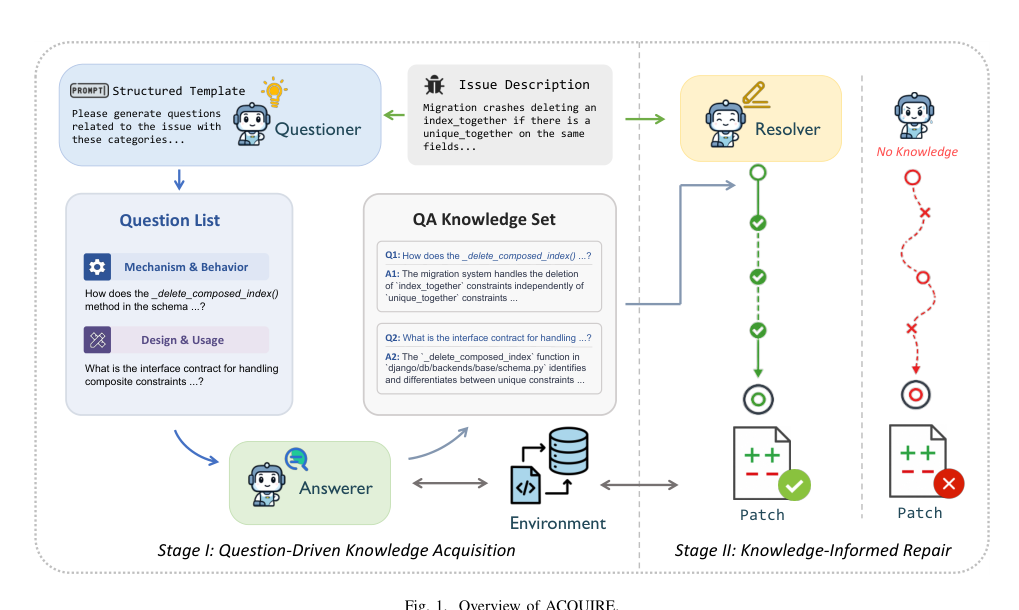
The first stage focuses on question-driven knowledge acquisition. To ensure the acquired knowledge covers dimensions most relevant to the repair, a Questioner module generates N targeted questions. This generation is guided by a structured prompt template that encodes four distinct knowledge categories: Mechanism & Behavior, Design & Usage, Locating & Structure, and Ecosystem & Standards. These categories target functional logic flows, API definitions, codebase layout, and external dependencies, respectively. The Questioner autonomously selects the appropriate category for each question based on the issue context.
Once the questions {q1,…,qN} are generated, they are dispatched to N independently instantiated Answerer instances. Each Answerer explores the repository in a read-only mode within the execution environment E. The Answerer is prompted to produce grounded answers by referencing concrete repository artifacts, such as file paths and function names, rather than relying on parametric knowledge. If sufficient evidence cannot be found, the agent explicitly acknowledges the gap. Because each Answerer instance receives only the issue description I and its assigned question qi, the exploration remains focused and unbiased by other instances. This isolation enables fully parallel execution, reducing the wall-clock latency to that of the single slowest instance. Upon completion, the resulting question-answer pairs are assembled into a knowledge set K={(q1,a1),…,(qN,aN)}.
In the second stage, knowledge-informed repair, a Resolver module performs the actual issue resolution. The Resolver receives the issue description I alongside the acquired knowledge set K. The N QA pairs are serialized into a structured text block and prepended to the Resolver's messages before the repair instruction begins. This static pre-injection ensures that complete repository understanding is established prior to the first repair action, preventing early-stage decisions from being made under partial information. The injected QA pairs serve as supplementary context, informing the Resolver's strategies without overriding its ability to independently verify observations. Operating within the execution environment E, the Resolver engages in an iterative loop of code navigation, editing, and test execution until a candidate patch is successfully produced.
Experiment
The evaluation compares ACQUIRE against localization-based and debate-based pre-repair methods on SWE-bench Verified, using Mini-SWE-Agent as the shared repair backbone and measuring Pass@1, cost, and time. ACQUIRE consistently achieves the highest resolution rates across different backbone models while maintaining competitive efficiency, because its QA-driven paradigm decouples knowledge acquisition from repair and injects targeted, reliable repository knowledge. A human audit confirms that nearly all generated QA pairs are factually supported, and the knowledge accelerates repair by reducing blind exploration in the locating and fixing stages. Ablation studies reveal that decomposing the issue into focused questions and using a category-guided template are both essential for performance, and a single QA pair already yields meaningful gains, with an optimal trade-off at two pairs.
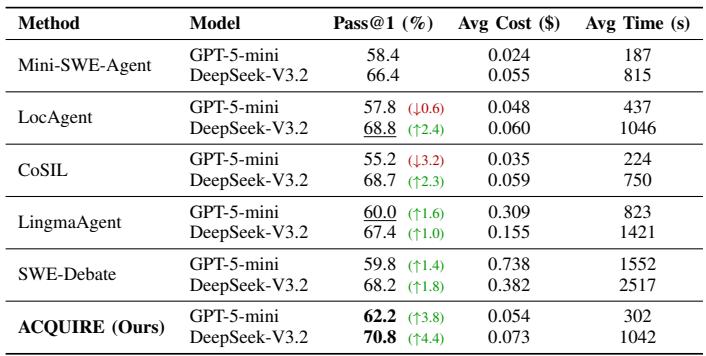
The table compares four methods on SWE-bench Verified using GPT-5-mini and DeepSeek-V3.2. DeepSeek-V3.2 consistently delivers higher pass@1 scores than GPT-5-mini, but at greater inference time and cost. Among GPT-5-mini runs, LingmaAgent achieves the highest accuracy, while CoSIL is the most cost-efficient. DeepSeek-V3.2 improves pass@1 by 2.3 to 2.4 percentage points on LocAgent and CoSIL relative to the Mini-SWE-Agent baseline, with both methods exceeding 68%. LingmaAgent with GPT-5-mini reaches the top pass@1 (60.0%) but costs over 0.30 dollars, roughly 13 times more than the cheapest method. CoSIL is the most economical method, with a cost of 0.035 dollars per run, though its pass@1 is 3.2 points lower than the Mini-SWE-Agent baseline.
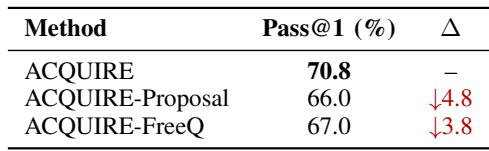
The full ACQUIRE system achieves a Pass@1 of 70.8% on SWE-bench Verified, outperforming both question-generation ablation variants. Removing the question decomposition component (ACQUIRE-Proposal) reduces performance by 4.8 percentage points, while replacing category-guided questions with free-form questions (ACQUIRE-FreeQ) reduces it by 3.8 points, confirming that structured pre-repair knowledge acquisition improves repair outcomes. Full ACQUIRE attains the highest Pass@1 (70.8%), surpassing ACQUIRE-Proposal (66.0%) and ACQUIRE-FreeQ (67.0%). Ablating question decomposition (ACQUIRE-Proposal) drops Pass@1 by 4.8 percentage points, highlighting the importance of decomposing knowledge needs before repair. Replacing category-guided questions with free-form questions (ACQUIRE-FreeQ) leads to a 3.8 percentage point decline, showing that structured question templates yield better repair results.
The evaluation setup compares multiple agent methods on SWE-bench Verified using GPT-5-mini and DeepSeek-V3.2, while also assessing the ACQUIRE system with ablation variants. DeepSeek-V3.2 consistently improves accuracy over GPT-5-mini but at higher inference cost and time, with LingmaAgent achieving the top pass@1 on GPT-5-mini at a much higher expense, and CoSIL offering the most economical solution though with a slight accuracy trade-off. In the ACQUIRE experiments, the full system outperforms both ablation versions, and removing question decomposition or replacing structured category-guided questions with free-form questions notably degrades repair performance, confirming that structured pre-repair knowledge acquisition is critical.