Command Palette
Search for a command to run...
MobileForge: 계층적 피드백 유도 정책 최적화를 통한 모바일 GUI Agents를 위한 주석 없는 적응
MobileForge: 계층적 피드백 유도 정책 최적화를 통한 모바일 GUI Agents를 위한 주석 없는 적응
초록
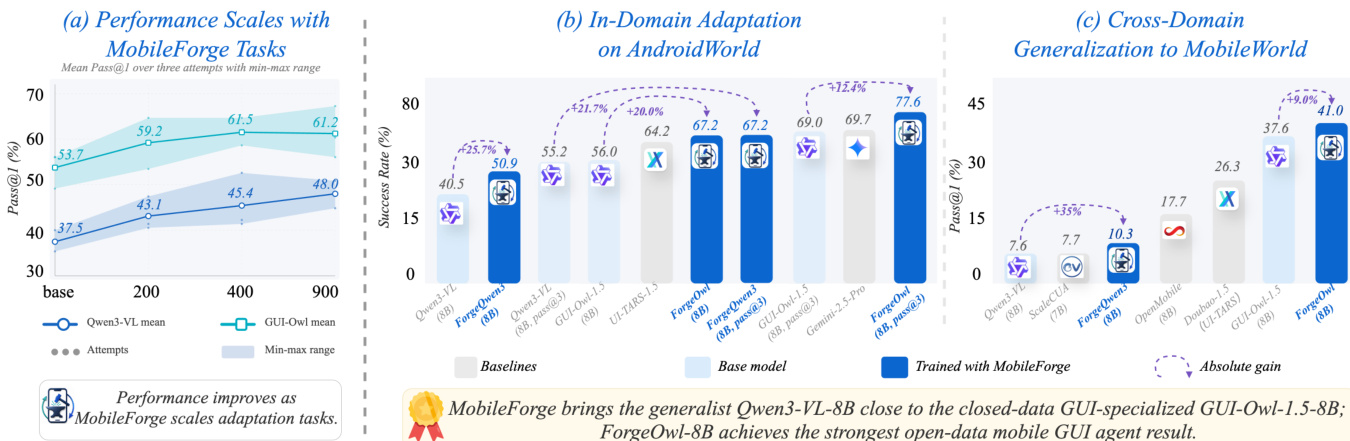
MLLM 기반 모바일 GUI agents는 UI 이해 및 동작 실행 분야에서 상당한 진전을 이루었으나, 모바일 앱이 다수 존재하고 빈번하게 업데이트되며 인간이 작성한 작업, 데모, 또는 보상 라벨로 모두를 커버하기 어렵기 때문에 실제 대상 앱에 적응시키는 데에는 여전히 높은 비용이 소요된다. 기존 주석 없는 GUI 학습은 수동 감독을 줄이지만, 대상 앱 탐색, 커리큘럼 마이닝, 롤아웃 실행 및 피드백을 연결하는 통합된 기반을 결여하고 있으며, 정책 최적화는 종종 신뢰할 수 있는 개선 신호로 전환하기 어려운 고립된 롤아웃과 coarse한 보상에 의존하는 경향이 있다. 본 논문에서는 모바일 GUI agents를 위한 주석 없는 적응 시스템인 MobileForge를 제시한다. MobileForge는 실제 모바일 앱 상호작용에 기반하여 작업 생성 및 롤아웃 평가를 수행하는 MobileGym과, 궤적 결과, 단계별 과정 피드백, 수정 힌트를 힌트 문맥 기반 단계별 GRPO 업데이트로 전환하는 계층적 피드백 기반 정책 최적화(Hierarchical Feedback-Guided Policy Optimization, HiFPO)로 구성된다. 자동으로 생성된 주석 없는 적응 데이터만을 사용하여 MobileForge는 AndroidWorld에서 Qwen3-VL-8B를 Pass@3 67.2%로 적응시키며, 이는 폐쇄 데이터 기반 GUI 전문 GUI-Owl-1.5-8B 베이스 모델의 69.0%에 근접한 수치이다. MobileForge로 적응된 ForgeOwl-8B는 AndroidWorld에서 Pass@3 77.6%, 도메인 외부 MobileWorld의 GUI 전용 분할에서 41.0%의 성공률을 달성하여, 본 평가에서 가장 강력한 오픈 데이터 기반 모바일 GUI agent의 위치를 확립한다. 코드, 데이터 및 학습된 모델은 https://mobile-forge.github.io/에서 공개될 예정이다.
One-sentence Summary
MobileForge is an annotation-free adaptation system that employs MobileGym to ground task generation and rollout evaluation in real mobile app interaction, while its Hierarchical Feedback-Guided Policy Optimization (HiFPO) component converts trajectory outcomes and corrective hints into hint-contextualized step-level GRPO updates, enabling the Qwen3-VL-8B model to achieve 67.2% Pass@3 on AndroidWorld and the adapted ForgeOwl-8B variant to reach 77.6% Pass@3.
Key Contributions
- This work introduces MobileGym, an interaction and evaluation substrate that grounds task generation and rollout execution directly within real mobile application traces. The component extracts executable tasks and provides hierarchical outcome feedback alongside corrective hints to align evaluation with policy learning.
- The framework incorporates Hierarchical Feedback-Guided Policy Optimization (HiFPO), which filters trajectories through hierarchical feedback and converts step-level process signals into hint-contextualized GRPO updates. This mechanism accumulates reusable experience across multi-attempt rollouts to refine agent capabilities beyond isolated optimization loops.
- Evaluations on the AndroidWorld and MobileWorld GUI-only benchmarks demonstrate that the adaptation pipeline effectively transfers to both generalist and specialized models. The resulting ForgeOwl-8B agent achieves a 77.6% Pass@3 score on AndroidWorld and 41.0% success on MobileWorld GUI-only, establishing the strongest open-data mobile GUI agent in the evaluation.
Introduction
Modern mobile GUI agents powered by multimodal language models demonstrate strong UI comprehension, yet adapting them to real-world applications remains costly due to the vast and rapidly evolving app ecosystem. Prior annotation-free approaches attempt to reduce manual supervision but suffer from fragmented pipelines that fail to connect app exploration, curriculum mining, and feedback execution. Their policy optimization also typically treats interactions as isolated episodes with sparse rewards, preventing the accumulation of reliable step-level improvement signals. The authors address these gaps with MobileForge, an annotation-free adaptation framework that grounds task generation and evaluation in real app interactions through MobileGym and introduces Hierarchical Feedback-Guided Policy Optimization to convert corrective hints into hint-contextualized GRPO updates for significant benchmark improvements.
Dataset

-
Dataset Composition and Sources: The authors construct an adaptation task pool anchored by 527 reference trajectory identifiers drawn from 20 distinct applications. This foundation yields a comprehensive candidate pool of 3,249 tasks specifically designed for AndroidWorld environments.
-
Subset Details and Filtering Rules: Each source application contributes a curriculum-generated subset of three to eight new tasks. The authors apply strict generation constraints to ensure tasks span different core functionalities, vary in length between one and forty steps, and remain pedagogically useful. Redundancy is actively avoided, and parameter variations are limited to a maximum of three per functionality to emphasize meaningful behavioral differences over minor tweaks.
-
Data Usage and Processing: The curated tasks feed directly into the model training pipeline to support annotation-free adaptation. Before integration, every candidate undergoes automated evaluation to filter out low-quality samples. The authors process the data through a scoring mechanism that measures task reasonableness, completion likelihood, and step quality, retaining only high-confidence trajectories for hierarchical feedback-guided policy optimization.
-
Metadata Construction and Processing Details: The final dataset entries are formatted as JSON objects that pair evaluation metrics with task specifications. Each record contains a self-contained instruction, estimated step count, targeted core functionality, variation type, and explicit prerequisites. The accompanying metadata block supplies confidence scores and explanatory summaries, which the authors use to guide the training loop and validate step-level quality during policy updates.
Method
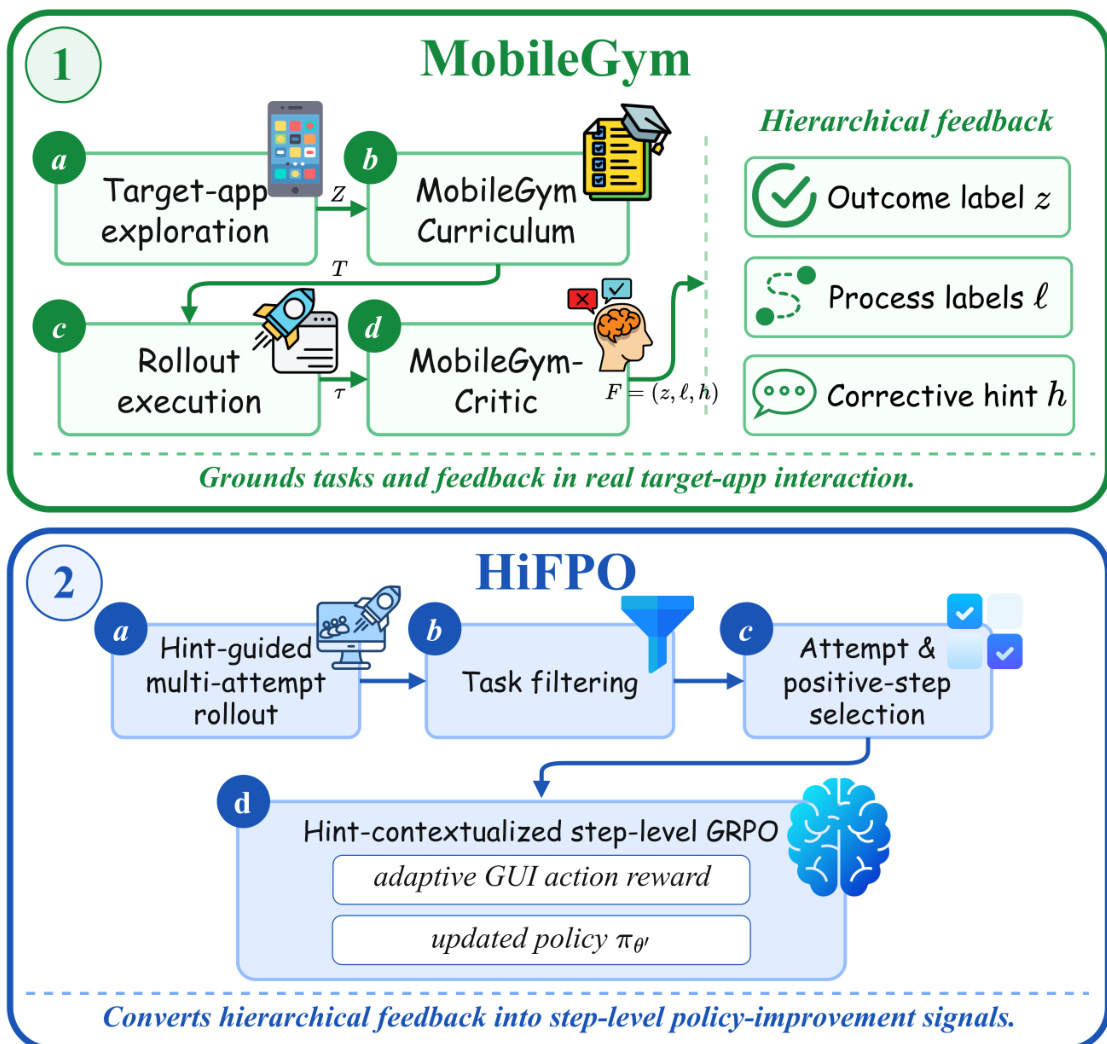
The authors propose MobileForge, an annotation-free adaptation framework designed to autonomously adapt mobile GUI agents to target applications without relying on human-written tasks, expert demonstrations, or reward labels. The architecture is divided into two coupled components: MobileGym, which serves as the interaction and evaluation substrate, and HiFPO, which drives the feedback-guided policy optimization. Refer to the framework diagram for the overall adaptation loop.

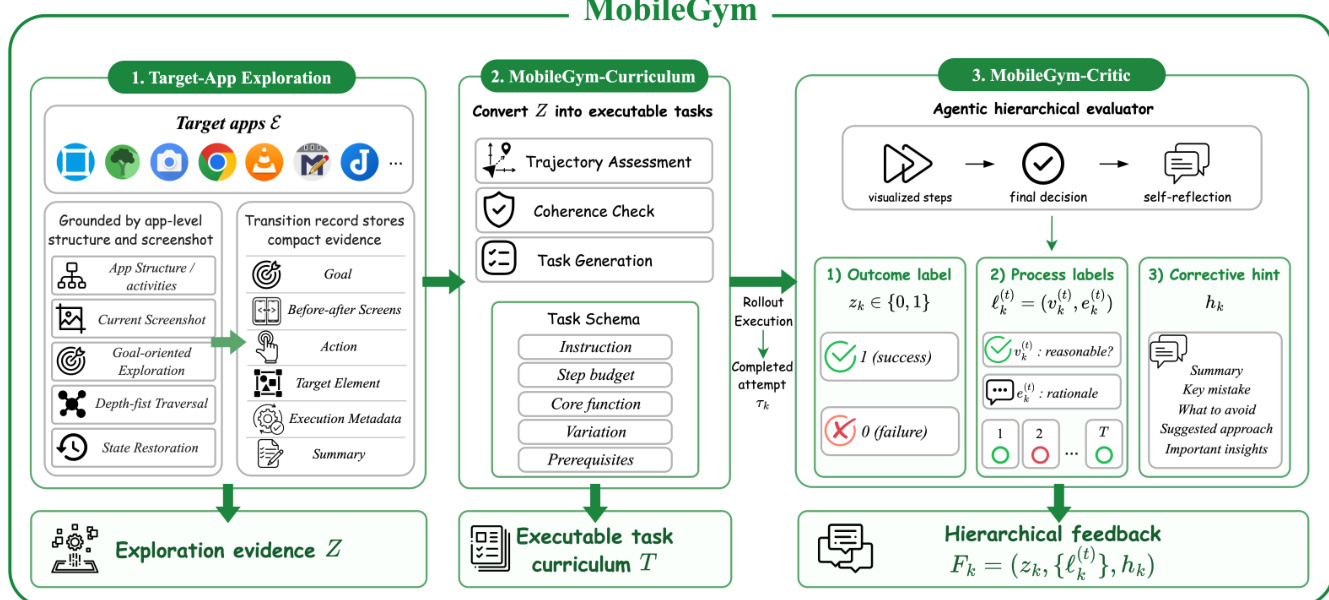
MobileGym grounds the adaptation process in real target-app interactions. It begins with a function-aware exploration phase that records reachable GUI transitions, app-level structural anchors, and interaction summaries to form an exploration evidence pool Z. This evidence is then processed by the MobileGym-Curriculum module, which assesses trajectory coherence and generates a set of executable tasks T grounded in observed app behavior. During rollout execution, the MobileGym-Critic evaluates completed attempts to produce hierarchical feedback. As shown in the figure below, this critic operates as an agentic evaluator that transforms raw execution logs into visual action traces and generates a structured verdict containing an outcome label zk∈{0,1}, step-level process labels ℓk(t), and corrective hints hk.
HiFPO leverages this hierarchical feedback to drive policy updates through a multi-attempt rollout protocol. For each task in the curriculum, the system executes K attempts in a serialized manner. Before each attempt k, the framework aggregates corrective hints from previous attempts to form a hint context η<k=Aggregate(h1,…,hk−1). The policy then generates a new rollout attempt conditioned on this accumulated context. The system filters out mastered tasks where the success rate equals one, retaining only partially solved or failed tasks for further optimization.
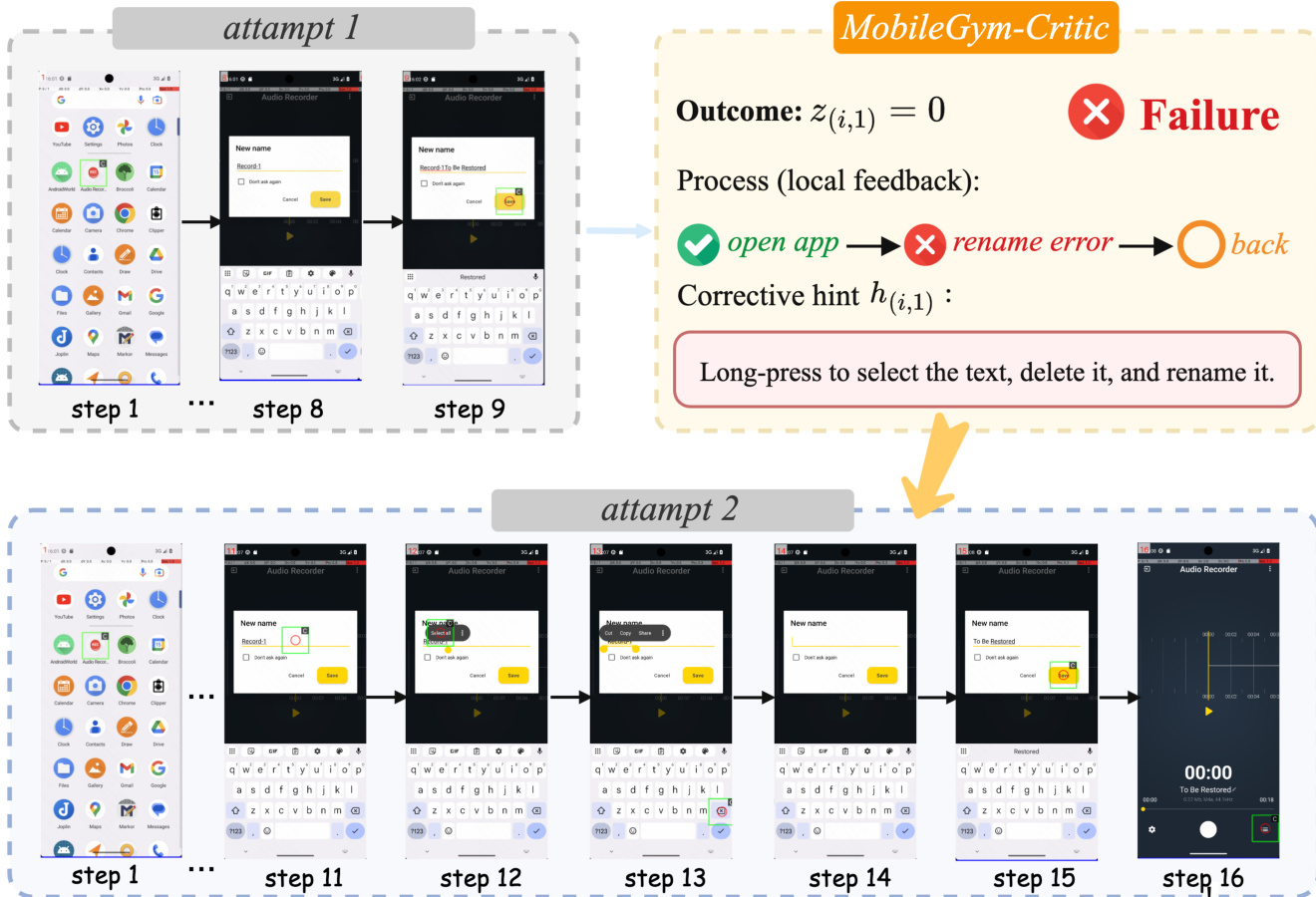
To convert long-horizon trajectories into dense supervision signals, HiFPO performs dual-feedback filtering. It selects the most informative attempt for each retained task by prioritizing successful rollouts with the highest fraction of reasonable local steps, or the best-failed attempt otherwise. From the selected attempt, only locally reasonable steps are extracted to form the step-level training set D. The corrective hints are appended to the task instruction before the next rollout attempt, allowing the agent to learn from past mistakes. An example of this hint-guided refinement is illustrated in the figure below.
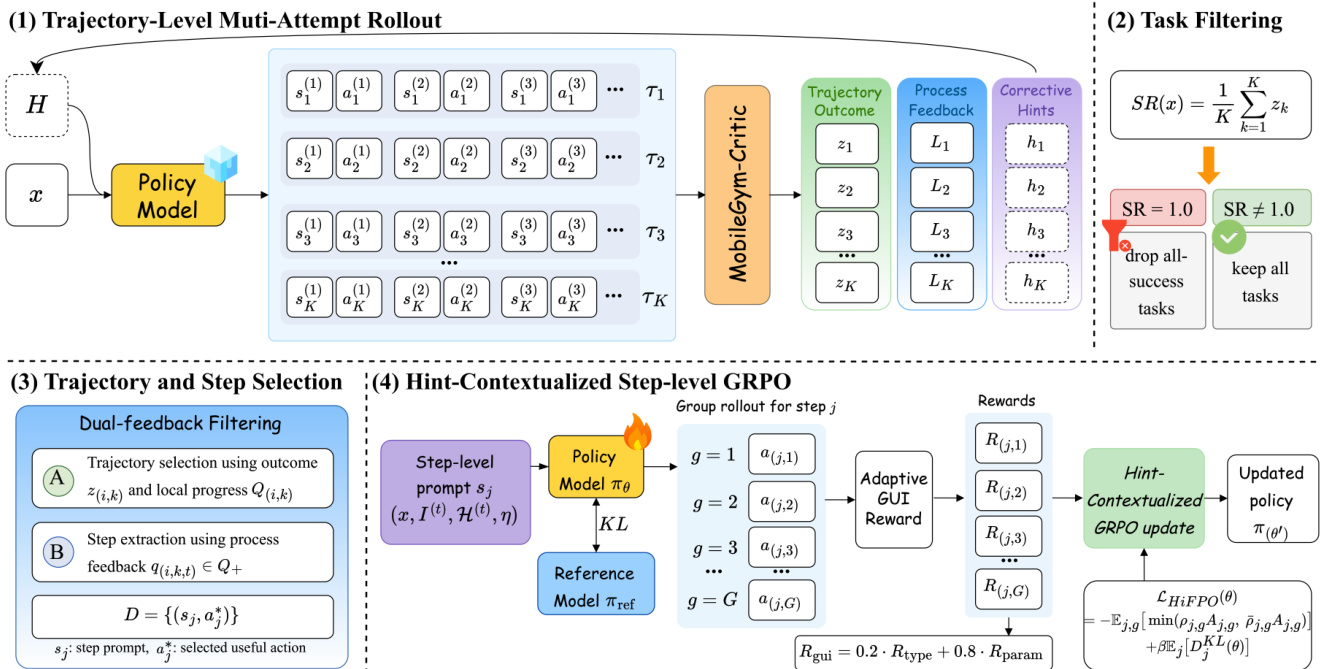
The final training stage employs a hint-contextualized step-level GRPO algorithm. For each selected step, the decision state is augmented with the corrective hint context and rendered into a prompt s~j. The policy samples a group of G candidate responses from the old policy. Each response is parsed into a structured GUI action and scored using an adaptive GUI action reward that separates action type correctness from argument precision. The reward for a response is computed as Rj,g=λtyperj,gtype+λargrj,garg. Rewards are normalized within the response group to compute the relative advantage Aj,g=(Rj,g−μj)/(σj+ϵstd). The policy is then updated via a clipped GRPO objective with KL regularization:
LHiFPO(θ)=−Ej,g[min(ρj,gAj,g,ρˉj,gAj,g)]+βEj[DjKL(θ)],where ρj,g and ρˉj,g represent the importance ratio and its clipped version, respectively. This design ensures that the policy optimization is strictly conditioned on the feedback-aware state, enabling robust step-level credit assignment without relying on external reward models.
Experiment
The evaluation assesses annotation-free adaptation across an in-domain AndroidWorld benchmark and an out-of-domain MobileWorld split using two 8B-scale base agents, with performance scaled across 200 to 900 generated tasks. The primary experiments demonstrate that the proposed adaptation framework successfully aligns generalist models with specialized GUI agents in-domain while enabling meaningful cross-domain generalization. Ablation studies validate that multi-attempt corrective hints, hint-contextualized GRPO optimization, strategic filtering that retains difficult or partially solved tasks, and trajectory-grounded curriculum design are all essential for effective learning. Qualitative analysis confirms that these components collectively strengthen the agent's capacity to maintain task intent through complex UI sequences and improve core interaction skills, although limitations persist for extended multi-step and cross-application workflows.
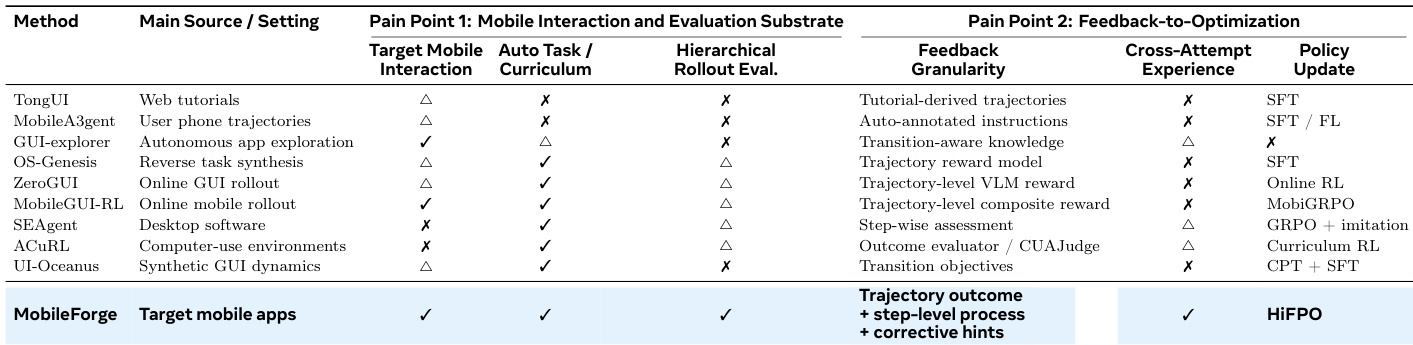
The authors present MobileForge, a framework that addresses mobile interaction and feedback challenges by employing auto-generated curricula, hierarchical rollout evaluation, and corrective hints within a cross-attempt experience loop. Results indicate that this annotation-free adaptation significantly enhances both generalist and GUI-specialized agents, enabling generalist models to approach the performance of specialized systems on in-domain benchmarks while demonstrating transferability to out-of-domain environments. Ablation studies confirm that specific design choices, such as hint-contextualized optimization, retaining difficult tasks through strategic filtering, and using trajectory-grounded curriculum generation, are essential for maximizing these improvements. MobileForge utilizes corrective hints and cross-attempt experience to substantially improve multi-attempt rollout success rates. The adaptation process allows generalist models to achieve performance levels comparable to GUI-specialized agents on in-domain tasks. Trajectory-grounded curriculum generation provides broader functional coverage than methods relying solely on initial app screens.
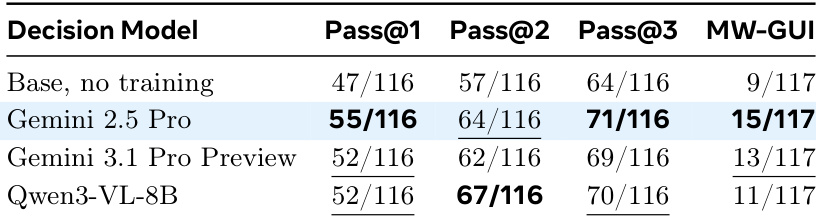
The experiment evaluates the impact of different decision models on the adaptation loop. Results indicate that Gemini 2.5 Pro yields the strongest performance across most metrics, while the open-source Qwen3-VL-8B model also significantly outperforms the untrained baseline. This demonstrates that the adaptation process remains effective even with a less powerful or open-source evaluator. Gemini 2.5 Pro achieves the highest success rates across the majority of Pass@k metrics. Qwen3-VL-8B as a decision model significantly outperforms the base untrained policy. The feedback-to-optimization loop provides benefits regardless of whether a proprietary or open-source decision model is used.
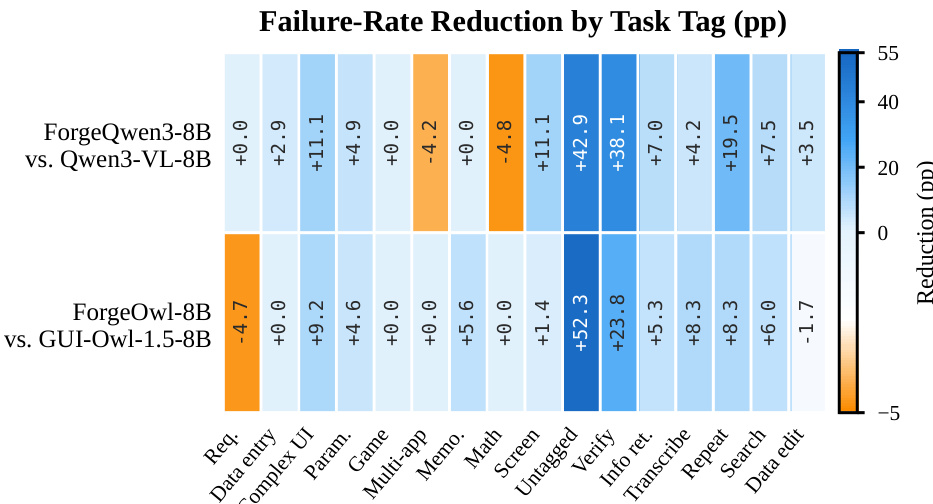
The authors analyze the reduction in failure rates across various task categories for two adapted models compared to their base agents. The data indicates that the adaptation process significantly improves performance in specific UI-related skills, while performance in complex or multi-step reasoning tasks remains challenging. Verification and search tasks show the largest reductions in failure rates for both adapted models. Adaptation leads to notable improvements in handling complex user interfaces and information retrieval. Multi-application tasks and game-playing scenarios exhibit regressions or a lack of improvement.
The experiments demonstrate that MobileForge significantly enhances mobile GUI agent performance through annotation-free adaptation on AndroidWorld. The adapted models, specifically ForgeQwen3 and ForgeOwl, show substantial gains over their base versions and competitive performance against specialized baselines. Furthermore, the method generalizes well to out-of-domain MobileWorld tasks, with ForgeOwl achieving the strongest results among open-data agents. Performance consistently improves as the number of adaptation tasks increases, indicating effective scaling with more training data. The adapted ForgeOwl model achieves the highest success rate on AndroidWorld tasks, surpassing both base models and other specialized baselines. The adapted ForgeOwl model demonstrates strong generalization to MobileWorld, achieving the highest success rate among the evaluated models in the out-of-domain setting.
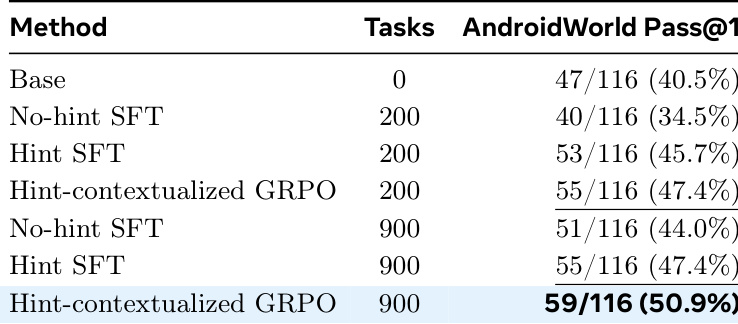
The authors investigate the effectiveness of different training objectives and hint usage on model adaptation across varying task scales. The results demonstrate that training without hints can lead to performance degradation relative to the base model, while the inclusion of hints yields improvements. The hint-contextualized group relative policy optimization approach consistently outperforms supervised fine-tuning methods, establishing it as the most effective strategy for adaptation. Training without hints results in lower performance compared to the base model. Incorporating hints into supervised fine-tuning improves performance over the base model. Hint-contextualized group relative policy optimization achieves the highest performance across all task scales.
The experiments evaluate the MobileForge framework across in-domain and out-of-domain mobile environments to validate its annotation-free adaptation process, which integrates corrective hints, trajectory-grounded curricula, and a cross-attempt experience loop. Comparisons across different decision models, training objectives, and task categories confirm that hint-contextualized optimization and strategic filtering are essential for maximizing agent performance, particularly for user interface navigation and information retrieval. Ultimately, the framework enables generalist models to approach specialized systems in-domain while scaling effectively with additional tasks and maintaining robust transferability even with open-source evaluators.