Command Palette
Search for a command to run...
다중 턴 성찰적 마스킹이 마스크 디퓨전 모델에서 추론을 이끌어낸다
다중 턴 성찰적 마스킹이 마스크 디퓨전 모델에서 추론을 이끌어낸다
Yanming Zhang Yihan Bian Jingyuan Qi Yuguang Yao Lifu Huang Tianyi Zhou
초록
자기회귀(AR) 모델에서의 추론은 종종 사고사슬(chain-of-thought) 추론과 반성을 통해 수행되지만, 이전 출력의 정제는 국소 수정만 필요하더라도 여전히 완전한 순차적 생성에 의존한다. 반면, 마스킹 확산 모델(MDMs)의 마스킹 메커니즘은 이전 출력에 대한 명시적인 국소 수정을 자연스럽게 지원하여, 이전 답변을 폐기하고 처음부터 새로운 답변을 생성하지 않고도 선택적 정제를 가능하게 한다. 이러한 특성은 인간이 반복적인 국소 정제를 통해 실수를 수정하는 방식과 더 밀접하게 부합하지만, 기존 MDMs는 다중 턴 마스킹 및 디노이징을 지원하지 않는다. 우리는 경량 사후 학습을 통해 MDMs에서 이러한 내재적 추론 능력을 이끌어내는 반성적 마스킹(Reflective Masking, RM)을 제안한다. RM은 MDM이 변화하는 문맥에 기반하여 이전 출력을 반복적으로 재방문하고 수정하는 네이티브 테스트 타임 스케일링을 제공한다. AR 추론과 유사하게 이전 턴에서의 통찰을 활용하기 위해, 우리는 수정 과정에서 중간 디노이징 상태를 활용하는 파라미터 없는 메커니즘인 History Reference를 추가로 도입한다. 본 접근법은 아키텍처 변경이 필요 없으며 기존 MDMs에 쉽게 적용할 수 있다. 텍스트 생성, 스도쿠, 이미지 편집을 포함한 다양한 작업과 모달리티에 걸쳐 반성적 마스킹은 표준 마스킹 기반 베이스라인을 일관되게 상회하며 강력한 일반성을 입증하여, RM을 MDMs에서의 추론을 위한 근본적인 기본 구성 요소로 자리매김한다.
One-sentence Summary
The authors propose Reflective Masking, a lightweight post-training method that elicits iterative reasoning in Mask Diffusion Models by enabling multi-turn masking for selective local refinement without relying on autoregressive sequential generation, and when combined with a parameter-free History Reference mechanism, it delivers native test-time scaling for iterative self-correction across existing architectures without structural modifications.
Key Contributions
- Reflective Masking is introduced as a lightweight post-training technique that formulates token masking as an uncertainty-driven decision process to enable iterative self-correction in Mask Diffusion Models. This method permits selective refinement of prior outputs without architectural modifications, establishing a native test-time scaling mechanism distinct from sequential autoregressive generation.
- A scalable training paradigm coupled with a specialized data generation strategy activates this capability by aligning optimization signals with the model's native output distribution. Evaluations across image editing, Sudoku reasoning, and text generation tasks demonstrate consistent performance improvements, confirming the approach's cross-modal applicability.
- History Reference is proposed as a parameter-free mechanism that preserves intermediate denoising states to maintain a temporal view of the decoding trajectory. This component explicitly incorporates past predictions into iterative updates, enhancing revision consistency and preventing repeated errors during multi-turn refinement.
Introduction
Large language models dominate reasoning tasks but frequently propagate errors in multi-turn settings, a structural weakness that forces full sequence regeneration and wastes computation. Mask diffusion models offer a compelling alternative by supporting localized token updates, which could maintain cleaner intermediate contexts and enable efficient self-correction. However, standard decoding follows a passive process that locks in early predictions, leaving models unable to actively revisit or fix previously committed errors. To unlock this latent capability, the authors introduce Reflective Masking, a post-training framework that treats token masking as an uncertainty-driven decision process for selective revision. They combine this with a lightweight training pipeline and History Reference, a parameter-free mechanism that preserves intermediate decoding states to guide iterative refinement. Together, these innovations shift mask diffusion generation from linear forward expansion to a self-correcting reasoning loop that consistently improves performance across text, structured, and image tasks.
Method
The authors propose Reflective Masking (RM), a framework that transforms Mask Diffusion Models (MDMs) into iterative reasoning engines capable of local editing. Standard MDMs typically follow an absorbing Markov process, whereas RM introduces a per-position decision mechanism that allows the model to selectively refine its outputs over multiple denoising steps without discarding previous answers.
At each timestep t, the model evaluates the current state x~(t) and determines the next state x~(t+1) for each position i based on its output probability distribution pθ(⋅∣x~(t))i. The transition is governed by a deterministic rule that splits on whether the position is currently masked:
x~i(t+1)=⎩⎨⎧Mx~i(t)argmaxv∈Vpθ(v∣x~(t))iif x~i(t)=M and pθ(M∣x~(t))i>pθ(x~i(t)∣x~(t))iif x~i(t)=M and pθ(M∣x~(t))i≤pθ(x~i(t)∣x~(t))iif x~i(t)=MAs shown in the framework diagram:
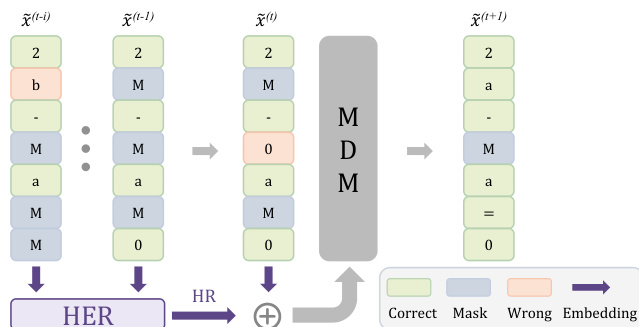
The diagram illustrates the iterative refinement process where a wrong token (orange) is re-masked (blue) and subsequently revealed as the correct token (green). To prevent the model from entering loops where identical states are repeatedly generated, the authors incorporate a History Reference (HER) module. This parameter-free mechanism aggregates intermediate denoising states into a history-aware embedding, providing the model with context about its revision trajectory and stabilizing the multi-turn refinement process.
To align the model with this inference behavior, the authors design a training paradigm that supervises the model with per-position oracle labels. The training data is constructed by simulating synthetic trajectories. Starting from a clean sequence, specific positions are corrupted either with mask tokens or wrong tokens sampled from a corruption distribution.
As illustrated in the figure below:
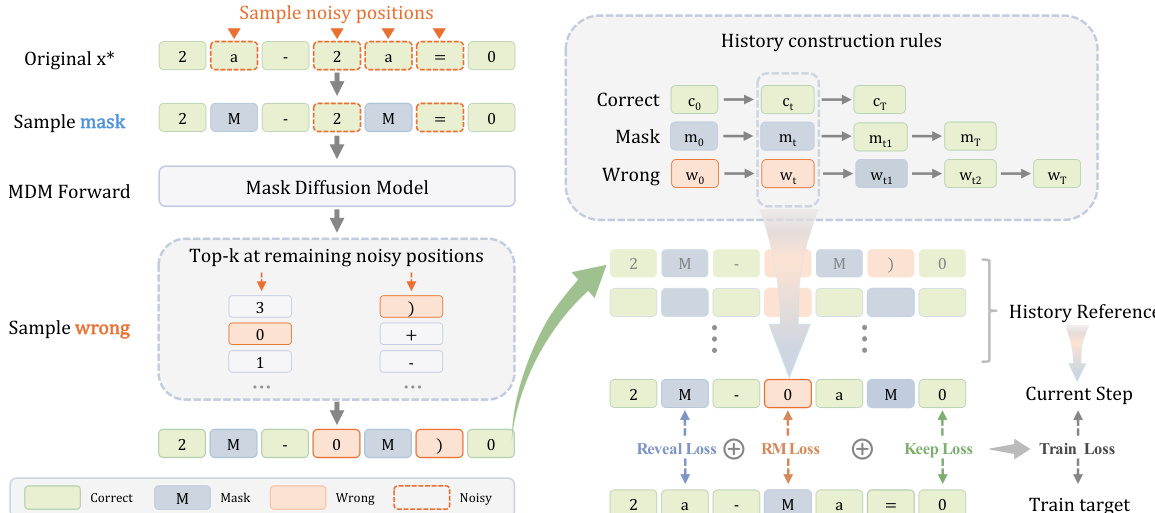
The figure details the history construction rules and the decomposition of the training loss. The transition rules dictate that wrong tokens should eventually transition to mask tokens and then to the correct target, while masked tokens transition directly to the target. The training objective minimizes the cross-entropy loss against these oracle actions, decomposing into three components: a reveal loss for masked positions, a mask loss for wrong positions, and a keep loss for correct tokens. This setup ensures the model learns to correctly identify when to revise a token versus when to preserve it, effectively enabling the reflective masking capability.
Experiment
The evaluation spans three task categories that progressively increase in reasoning complexity and decrease in external guidance: instruction-based image editing, structured Sudoku revision, and fully autonomous text reasoning and code generation. These experiments validate how Reflective Masking enables precise, localized revisions under explicit supervision, while History Reference facilitates autonomous error detection and iterative correction when guidance is minimal. Qualitatively, the model demonstrates targeted self-correction that preserves unmodified regions in images and systematically refines logic-critical tokens during multi-step reasoning. Overall, the findings confirm that integrating iterative revision with structured historical memory consistently enhances accuracy and logical consistency across diverse generation tasks.
The authors evaluate an image editing approach against Lumina and a fine-tuned baseline across three key dimensions: edit localization, background preservation, and overall editing quality. The results demonstrate that the proposed method consistently outperforms the baselines in accurately targeting specific regions while maintaining the integrity of the surrounding image. The proposed method achieves superior precision and coverage in identifying target regions for editing compared to baseline models. Background preservation is significantly improved, with the method maintaining higher similarity and lower error rates in unedited areas. The approach yields better overall editing quality, ranking highest in both automated scoring and user preference studies.

The authors evaluate Sudoku revision capabilities by testing variants of their method, including Reflective Masking and History Reference. Results indicate that incorporating History Reference significantly enhances exact accuracy and validity while reducing errors and conflicts. The complete model, which integrates all components including decay and HER, achieves the superior performance across all metrics. Integrating History Reference substantially improves exact accuracy and valid rates while minimizing replay mistakes and conflict cells compared to the baseline. The full method combining all components achieves the best overall performance, outperforming variants that lack specific mechanisms. Adding a decay factor to history reference alone offers limited benefits compared to using history reference without decay, but becomes advantageous when combined with HER.

The authors evaluate their approach on text reasoning tasks spanning mathematics, code generation, and multiple-choice questions. Results demonstrate that the proposed method consistently outperforms baseline models across all evaluated categories. Notably, the method achieves substantial improvements in code generation tasks compared to mathematical reasoning. The proposed method consistently outperforms both LLaDA and Vanilla SFT baselines across math, code, and multiple-choice benchmarks. Performance gains are particularly pronounced in code generation tasks, where the model benefits significantly from iterative revision capabilities. The approach effectively improves multi-step reasoning and structured output generation without compromising standard inference capabilities.

The authors evaluate their method on the Minerva MATH benchmark across various mathematical subjects. The results demonstrate that the proposed method consistently outperforms the Vanilla SFT baseline across all subject categories and the aggregate score. The method achieves higher accuracy than the baseline in every subject category, including Algebra, Geometry, and Number Theory. There is a consistent positive improvement in the aggregate performance metric. The approach effectively enhances performance in diverse mathematical reasoning tasks.

Evaluated against established baselines across image editing, Sudoku revision, text reasoning, and mathematical problem-solving, the experiments validate the method's precision, error reduction, and iterative reasoning capabilities. In image editing, the approach consistently achieves superior region targeting and background preservation while delivering higher overall quality. For structured tasks like Sudoku and code generation, incorporating history-based references and revision mechanisms significantly improves accuracy and minimizes conflicts without degrading standard inference. Across mathematical benchmarks, the method uniformly enhances performance in diverse reasoning categories, demonstrating robust cross-domain improvements.