Command Palette
Search for a command to run...
VideoMLA: 분 단위 자기회귀 비디오 디퓨전을 위한 저랭크 잠재 KV 캐시
VideoMLA: 분 단위 자기회귀 비디오 디퓨전을 위한 저랭크 잠재 KV 캐시
Hidir Yesiltepe Jiazhen Hu Tuna Han Salih Meral Adil Kaan Akan Kaan Oktay Hoda Eldardiry Pinar Yanardag
초록
장기간 롤아웃 인과 비디오 디퓨전은 고정 크기 슬라이딩 윈도우 KV 캐시에 수렴했으며, 최근의 진전은 윈도우를 점유하는 tokens의 선택이나 위치 인코딩 방식을 변경함으로써 해당 레이아웃 내에서 혁신을 이루고 있습니다. 스트리밍 메모리 사용량과 지연 시간에 지배적인 영향을 미치는 per-head KV 레이아웃 자체는 대부분 변경되지 않은 채로 유지되어 왔습니다. 본 논문에서는 비디오 디퓨전 분야에 Multi-Head Latent Attention (MLA)을 적용한 최초의 연구를 제시합니다. VideoMLA는 per-head keys와 values를 공유된 저랭크 콘텐츠 latent와 공유된 분리형 3D-RoPE 위치 key로 대체하여, 모든 캐시 레이어에서 per-token KV 메모리 사용량을 92.7% 절감합니다. 언어 모델에서 MLA를 도입하는 근거로 자주 제시되는 스펙트럴 가정이 성립하지 않음에도 불구하고, 비디오 디퓨전 환경에서 MLA가 성공하는 이유를 추가로 탐구합니다. 사전 학습된 비디오 어텐션은 저랭크 특성을 보이지 않으며, 99% 에너지 기준 유효 랭크는 모든 실용적인 latent 차원보다 훨씬 높습니다. VideoMLA는 직접적인 스펙트럴 근사가 큰 재구성 오류를 예측할 수준의 높은 압축 비율에서도 화질 품질을 유지합니다. 사전 학습된 스펙트럼이 아닌 MLA의 병목 구조가 유효 랭크를 결정함을 입증합니다. 스펙트럴 초기화와 무작위 초기화 모두 초기화 단계에서 거의 전체 랭크 예산을 차지하며, 학습 과정은 이 예산을 유지한 채 해당 범위 내에서 매개변수를 적응시킵니다. VBench 벤치마크에서 VideoMLA는 단기 스트리밍 비디오 디퓨전 베이스라인과 동등한 성능을 보이며, 평가된 모든 방법 중 장기 시나리오에서 가장 높은 종합 점수를 달성합니다. 또한 단일 B200 GPU 환경에서 처리량을 1.23배 향상시킵니다.
One-sentence Summary
VideoMLA integrates Multi-Head Latent Attention into autoregressive video diffusion by replacing per-head key-value caches with a shared low-rank content latent and a decoupled 3D-RoPE positional key, reducing per-token KV memory by 92.7% at every cached layer while preserving generation quality despite the pretrained attention spectrum exceeding practical latent dimensions.
Key Contributions
- The paper introduces VideoMLA, the first adaptation of Multi-Head Latent Attention to long-rollout causal video diffusion, which replaces dense per-head keys and values with a shared low-rank content latent and a decoupled 3D-RoPE positional key.
- Theoretical analysis demonstrates that the MLA bottleneck, rather than the pretrained attention spectrum, determines the effective rank and enables the model to preserve generation quality at high compression ratios despite the pretrained video attention exceeding practical latent dimensions.
- Empirical evaluations show that VideoMLA reduces per-token key-value memory by 92.7% across every cached layer while maintaining generation fidelity at compression levels where direct spectral approximation would predict significant reconstruction error.
Introduction
Autoregressive video diffusion models convert bidirectional teachers into streaming students that generate frames sequentially using a rolling key-value cache, enabling efficient long-horizon video synthesis. Prior methods improve generation stability or reduce compute by optimizing cache windows or replacing attention mechanisms, yet they either preserve dense per-head key-value layouts or skip token-level compression across cached layers. The authors leverage Multi-Head Latent Attention to bridge this gap, adapting the architecture to video diffusion where memory profiles and attention spectra differ significantly from language models. By replacing traditional caches with a shared low-rank latent representation, they substantially reduce memory overhead without sacrificing streaming generation quality.
Dataset
- Dataset composition and sources: The authors do not provide dataset composition or source information in the submitted excerpt.
- Key details for each subset: No subset sizes, origins, or filtering criteria are detailed in the text.
- How the paper uses the data: The authors do not specify training splits, mixture ratios, or how the data integrates into the model.
- Processing details: The excerpt omits any cropping strategies, metadata construction, or additional preprocessing steps.
Method
The authors present VideoMLA, a novel approach to reducing the per-token key-value (KV) cache memory in causal video diffusion models by rethinking the per-head KV layout. The framework replaces dense, per-head keys and values with a shared low-rank content latent and a head-shared decoupled 3D-RoPE positional key, significantly reducing memory footprint. The core of the design is a two-part decomposition of the attention mechanism. Each video latent token xt is first compressed into a shared content latent ctKV∈Rdc via a joint down-projection W↓KV, which is written to the compressed KV cache. This latent represents the content of the token. Positional information is decoupled and stored separately. For each head h, the per-head key kt,hnope and value vt,h are reconstructed from ctKV using head-specific up-projections W↑,hK and W↑,hV. This shared latent structure means a single cache read produces all per-head keys and values, eliminating the need to store dense per-head states for each token. The positional information is handled by a separate RoPE branch. A single, head-shared positional key ktR is computed from xt via WRK and stored in the cache. At attention time, this unrotated key is rotated by 3D-RoPE to produce ktrope, which is used in the attention score calculation. The query path follows a similar structure, with a query latent ctQ derived from xt, and a head-specific positional query qt,hR computed from ctQ and rotated. The attention score for head h combines the content-based score from the inner product of qt,hnope and kt,hnope with the positional score from qt,hrope and ktrope. This design reduces the per-token cache size from 2nhdh scalars to dc+dhrope. As shown in the figure below, this results in a significant reduction in memory and a more efficient inference process, as the cache stores a compressed content latent and a shared positional key, with the per-head components reconstructed only when needed for attention computation.

Experiment
The evaluation combines fixed-memory batch scaling tests with a human perceptual study to assess prompt adherence, temporal coherence, and motion consistency in generated videos. Ablation experiments validate that VideoMLA effectively converts cache compression into substantial serving headroom while establishing a clear quality-efficiency trade-off in latent dimension selection. The findings demonstrate that moderate compression preserves essential visual details and that balancing cached content with positional encoding channels optimally supports streaming video generation. These results confirm the method's practical deployment potential, with future work targeting extended horizons and higher resolutions.
The authors analyze the memory and computational complexity of different attention mechanisms, showing that MLA Local reduces memory and computation compared to causal full and causal linear variants by leveraging a compressed latent representation and a split attention design. Results indicate that the proposed approach achieves significant reductions in both metrics while maintaining efficiency and performance. MLA Local reduces memory and computational complexity compared to causal full and causal linear attention mechanisms. The approach achieves lower memory and computation by using a compressed latent representation and a split attention design. The design allows for efficient scaling while maintaining performance through optimized resource allocation.
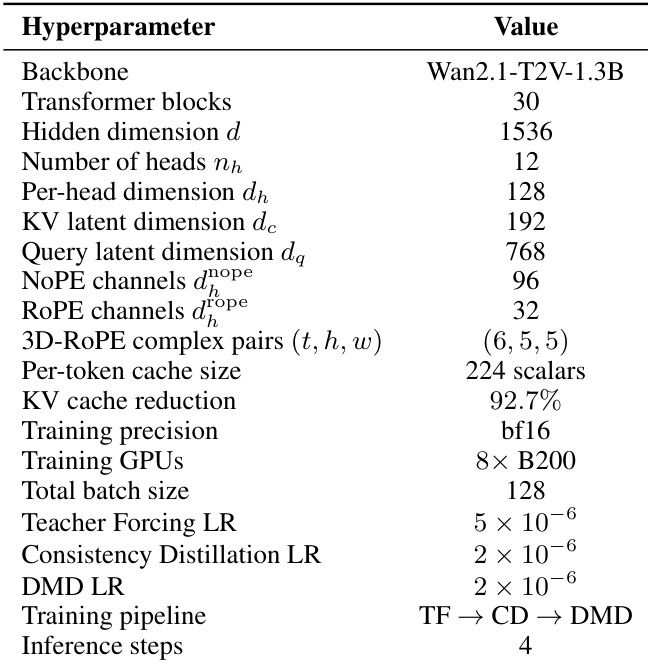
The authors conduct ablation studies to analyze the impact of key hyperparameters on VideoMLA's performance, focusing on memory efficiency and quality trade-offs. Results show that reducing the KV cache dimension significantly improves memory scalability while maintaining acceptable quality, with optimal performance achieved through a balanced allocation of channels between cached content and positional encoding. The model is trained in three stages using a combination of teacher forcing, consistency distillation, and distribution matching distillation. Reducing the KV cache dimension leads to substantial memory savings and enables larger batch sizes without exceeding memory limits. A balanced allocation of channels between cached content and positional encoding yields the best performance, with a dedicated RoPE subspace improving temporal and spatial coherence. The training pipeline involves multiple stages, including teacher forcing, consistency distillation, and distribution matching distillation, to optimize the model for efficient inference.
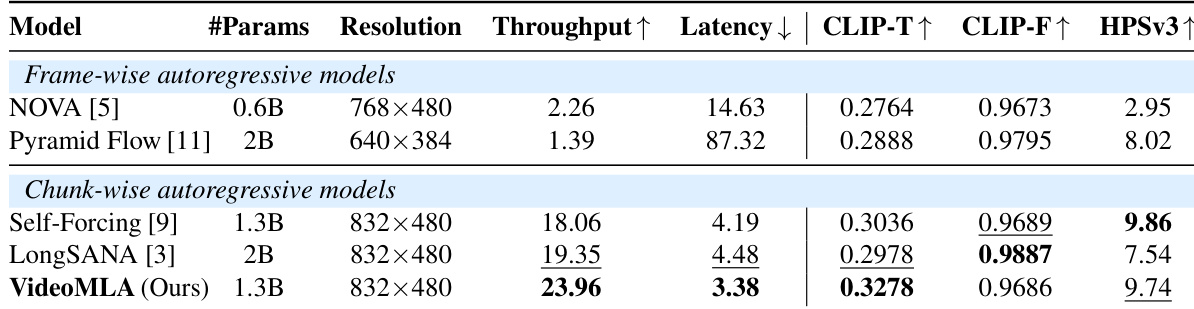
The authors compare VideoMLA against other autoregressive models in terms of parameters, resolution, throughput, latency, and performance on CLIP and HPSv3 metrics. Results show that VideoMLA achieves higher throughput and lower latency compared to frame-wise models, while maintaining competitive or superior performance on quality metrics. VideoMLA achieves higher throughput and lower latency than frame-wise autoregressive models. VideoMLA outperforms other chunk-wise autoregressive models in CLIP-T and HPSv3 scores. VideoMLA demonstrates a balance between efficiency and quality, achieving competitive performance with reduced latency.
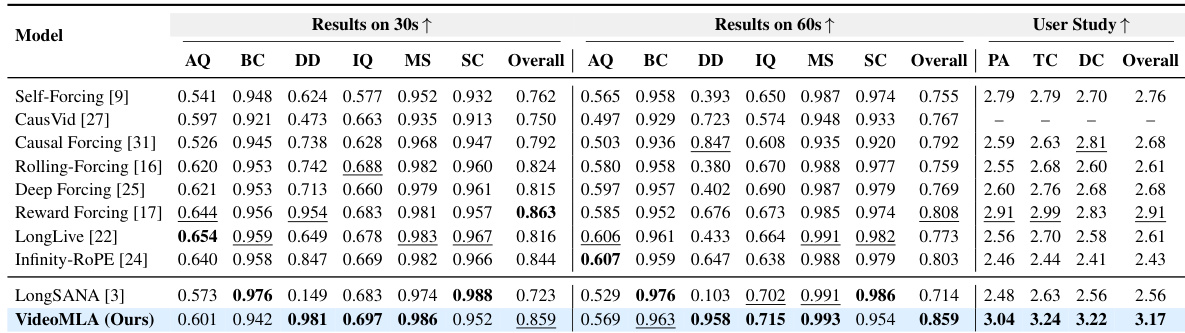
The authors conduct ablation studies to evaluate the impact of latent dimension and positional encoding configurations on model performance. Results show that increasing the latent dimension improves quality but reduces memory efficiency, while the balance between positional and content channels significantly affects both semantic fidelity and temporal coherence. The optimal configuration achieves a trade-off between memory savings and video quality. Increasing the latent dimension improves quality but reduces memory efficiency, with diminishing returns at higher values. The split between positional and content channels affects semantic fidelity and temporal coherence, with an optimal balance favoring content channels. The best-performing configuration achieves a balance between memory savings and video quality by optimizing both latent dimension and channel split.

The authors compare their VideoMLA model against several baselines across multiple metrics, including quality and consistency scores. Results show that VideoMLA achieves competitive or superior performance on most evaluation criteria, particularly in long-horizon generation and perceptual quality, while maintaining efficient memory usage through latent compression. VideoMLA outperforms or matches existing methods on key quality and consistency metrics across different generation lengths. The model achieves high perceptual quality in user studies, with strong ratings in prompt adherence and motion consistency. VideoMLA maintains strong performance while significantly reducing memory requirements through efficient latent compression.
The experimental evaluation assesses the memory efficiency, computational complexity, and generation quality of VideoMLA through ablation studies and comparative benchmarks against existing autoregressive models. Results validate that compressed latent representations and split attention designs substantially reduce resource consumption while preserving core model capabilities. Hyperparameter analyses further demonstrate that balancing cached content with positional encoding and optimizing latent dimensions achieves an ideal trade-off between memory savings and video fidelity. Ultimately, the approach delivers competitive generation quality and temporal consistency alongside significantly reduced latency compared to conventional frame-wise baselines.