Command Palette
Search for a command to run...
GrepSeek: 직접 코퍼스 상호작용을 위한 검색 Agents 학습
GrepSeek: 직접 코퍼스 상호작용을 위한 검색 Agents 학습
Alireza Salemi Chang Zeng Atharva Nijasure Jui-Hui Chung Razieh Rahimi Fernando Diaz Hamed Zamani
초록
대형 언어 모델(LLM) 검색 agents는 추론과 정보 검색의 다중 라운드를 통해 지식 집약적 언어 작업에서 강력한 가능성을 보여주고 있습니다. 대부분의 기존 시스템은 키워드 또는 자연어 쿼리를 입력받아 사전 계산된 문서 표현 인덱스를 기반으로 문서의 순위 목록을 반환하는 retriever를 활용하여 정보에 접근합니다. 본 연구에서는 검색 agent가 코퍼스 자체를 검색 환경으로 간주하고 실행 가능한 shell 명령을 실행하여 증거를 발견하는 보완적 관점을 탐구합니다. 우리는 대규모 텍스트 코퍼스에서 증거를 찾고, 필터링하며, 구성하는 경량화된 검색 agent를 학습시키는 최적화된 직접 코퍼스 상호작용(Direct Corpus Interaction, DCI) 검색 agent인 GrepSeek을 제안합니다. 대규모 코퍼스에서 강화 학습을 통해 학습 행동을 직접 수행할 때 발생하는 불안정성을 해결하기 위해, 본 연구는 두 단계 학습 파이프라인을 제안합니다. 먼저, 검증되고 인과적 근거를 갖춘 검색 궤적을 생성하기 위해 답변 인식 Tutor와 답변 무지 Planner를 활용하여 cold-start 데이터셋을 구성합니다. 둘째, Group Relative Policy Optimization (GRPO)를 통해 초기화된 정책을 정제하여, agent가 코퍼스와의 직접적인 상호작용을 통해 작업 지향적 검색 행동을 개선할 수 있도록 합니다. DCI의 대규모 실용화를 위해, 본 연구는 shell 기반 검색을 최대 7.6imes 가속화하면서도 shell 명령의 순차적 실행과 바이트 단위 정확히 동일한 결과를 유지하는 의미 보존 샤드 병렬 실행 엔진을 추가로 활용합니다. 7개 오픈 도메인 질문 답변 벤치마크에 대한 실험 결과, GrepSeek이 전체 token-level F1 및 Exact Match 지표에서 가장 우수한 성능을 달성함을 확인했습니다. 또한 본 분석은 표면 형태 변이가 큰 쿼리에 대한 순수 어휘 기반 상호작용의 한계를 부각시키며, DCI가 현실 세계에서 기존 검색 패러다임을 보완할 수 있는 실용적이고 경쟁력 있는 검색 agents 방법임을 시사합니다.
One-sentence Summary
GrepSeek is a direct corpus interaction search agent that replaces traditional index-based retrieval with executable shell commands, employing a two-stage training pipeline that first generates verified trajectories using an answer-aware Tutor and answer-blind Planner and then refines the policy via Group Relative Policy Optimization, all accelerated by a semantics-preserving sharded-parallel execution engine for scalable evidence retrieval.
Key Contributions
- This work introduces GrepSeek, a direct corpus interaction search agent that replaces conventional embedding-based retrievers with executable shell commands to locate, filter, and synthesize evidence from raw text corpora.
- A two-stage training pipeline stabilizes reinforcement learning on large corpora by generating verified search trajectories via an answer-aware Tutor and answer-blind Planner, followed by policy refinement through Group Relative Policy Optimization.
- A semantics-preserving sharded-parallel execution engine accelerates shell-based retrieval by up to sevenfold, and empirical evaluations on single-hop and multi-hop question-answering benchmarks demonstrate enhanced task-oriented reasoning and evidence composition.
Introduction
Large language model search agents are increasingly deployed for complex, knowledge-intensive tasks that require multi-step reasoning and evidence synthesis across vast text collections. Traditional retrieval-augmented systems rely on pre-computed document indices, which frequently introduce semantic conflation and rigid chunking boundaries that undermine exact entity matching and fine-grained lexical filtering. Although recent Direct Corpus Interaction approaches bypass these indices by executing shell commands on raw data, they depend heavily on prompting large proprietary models at inference time, leading to prohibitive computational costs, slow response times, and unstable reinforcement learning trajectories for compact agents. To overcome these barriers, the authors introduce GrepSeek, a trained open-weight search agent that learns to interact directly with unstructured corpora through deterministic shell operations. They stabilize policy development using a backward-chaining Tutor and forward-Planner framework, refine search behavior with Group Relative Policy Optimization, and implement a semantics-preserving sharded-parallel execution engine that cuts retrieval latency by up to 7.6 times. This integrated approach transforms direct corpus interaction into a scalable, low-latency alternative to index-based retrieval, delivering statistically significant gains on multi-hop reasoning benchmarks while maintaining byte-exact lexical precision.
Dataset

-
Dataset composition and sources: The authors evaluate their approach on a standardized suite of seven knowledge-intensive question answering benchmarks sourced from the FlashRAG repository. The collection is divided into single-hop tasks for targeted fact retrieval and multi-hop tasks for iterative corpus exploration. All evaluations operate on a 2018 Wikipedia dump containing 21 million documents formatted as a single JSONL file.
-
Key details for each subset:
- Natural Questions (NQ): Open-domain split featuring real user queries that require matching Wikipedia passages to answer questions without prior context.
- TriviaQA: Curated trivia questions where answers are typically contained within a single retrieved document.
- PopQA: Entity-centric dataset built from Wikidata triples, specifically targeting rare entities to test long-tail knowledge retrieval.
- HotpotQA: Multi-hop questions designed to force reasoning across at least two distinct Wikipedia articles.
- 2WikiMultihopQA: Constructed using Wikidata properties to enforce explicit logical chains and strict reasoning steps across multiple documents.
- MuSiQue: Rigorously filtered multi-hop dataset that chains single-hop questions to eliminate shortcut reasoning and lexical overlap.
- Bamboogle: Manually crafted questions engineered to defeat standard search engines, demanding deep multi-step evidence gathering. Exact dataset sizes for training and evaluation splits are documented in the appendix table.
-
How the paper uses the data: The authors restrict training to the official training sets of NQ and HotpotQA while treating the remaining five datasets as out-of-distribution evaluation sets. For supervised fine-tuning, they construct a 10,000-sample cold-start dataset using a balanced mixture of HotpotQA and NQ examples, trained for one epoch. This policy is subsequently optimized via GRPO reinforcement learning for 200 steps across the full HotpotQA and NQ training splits. During evaluation, they report token-level F1 scores on official test splits, falling back to development sets only when test labels are unavailable, and provide exact match scores in the appendix.
-
Processing details: Rather than traditional cropping or metadata extraction, the pipeline treats the entire Wikipedia corpus as a flat text file where each line represents one passage. The system prompt enforces a shell-based interaction strategy, instructing the model to pipe search results through commands like
head -n 3orhead -n 8to cap output volume and prevent context overflow. The authors generate synthetic multi-turn trajectories during data construction to teach the model how to alternate between plain-text reasoning steps and single-pipeline shell commands. All benchmarks are standardized through FlashRAG to ensure consistent formatting and evaluation protocols.
Method
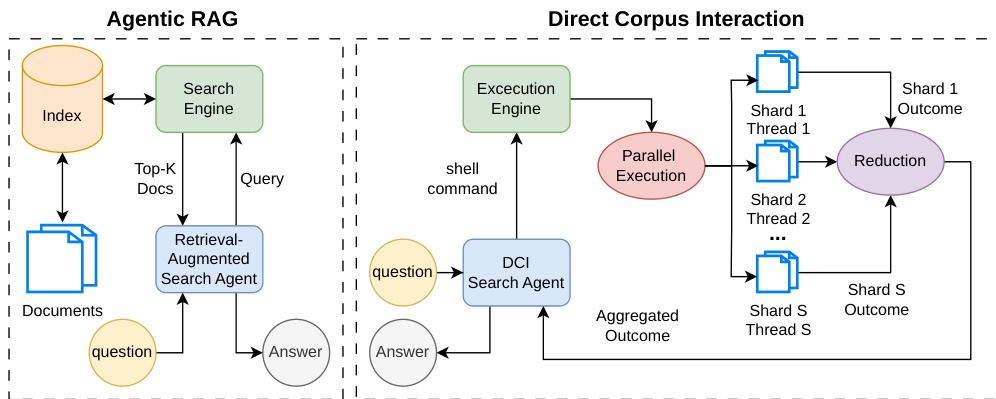
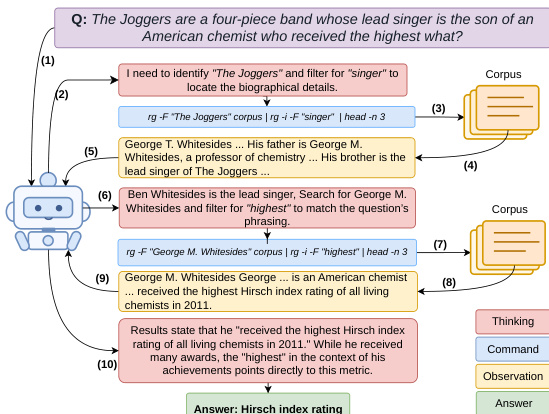
The authors leverage a two-stage training framework to develop GrepSeek, a direct corpus interaction (DCI) search agent that operates within the ReAct framework, enabling it to perform multi-hop reasoning and information retrieval by issuing executable shell commands directly against a raw text corpus. The overall architecture, illustrated in the framework diagram, contrasts with traditional Retrieval-Augmented Generation (RAG) systems that rely on pre-computed indices. Instead, the DCI agent interacts with the corpus through a series of shell commands, such as grep and rg, to find, filter, and compose evidence. The agent's policy, denoted as πθ, generates a trajectory consisting of reasoning traces and actions based on the question and the history of previous interactions. Actions are either shell commands or a termination that outputs the final answer, with the execution engine returning observations that inform subsequent steps.
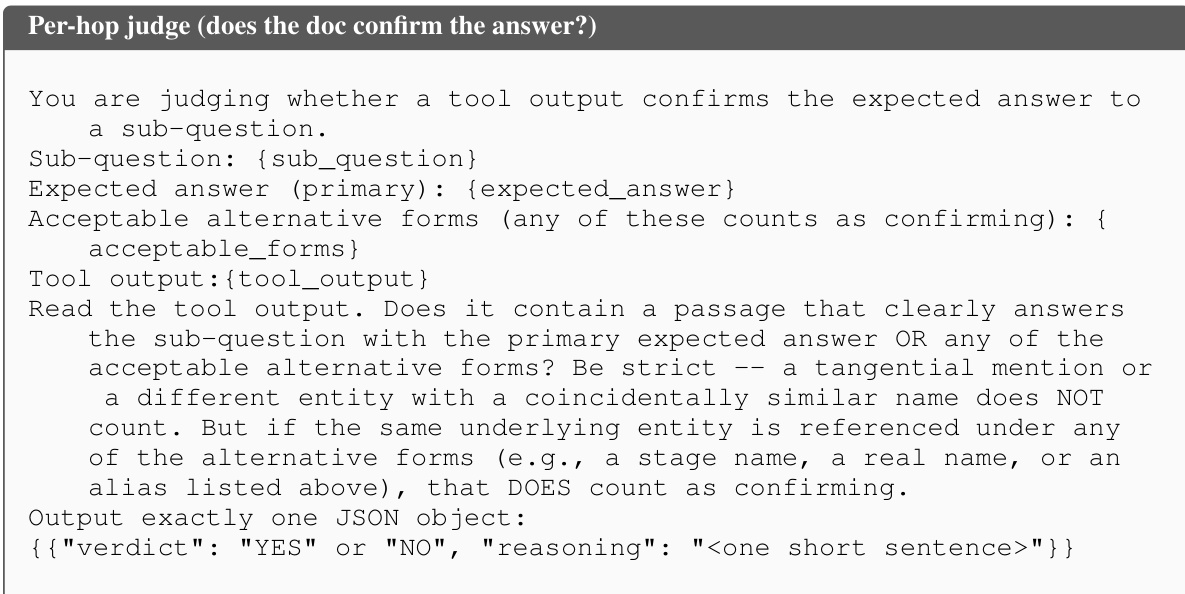
The training process begins with the construction of a high-quality, cold-start dataset to stabilize the initial policy. This is achieved through a two-phase pipeline that uses an answer-aware Tutor LLM and an answer-blind Planner LLM to generate verified, causally grounded search trajectories. In the backward phase, the Tutor decomposes the query and gold answer into a sequence of sub-queries and then works backward to generate a shell command for each sub-query, ensuring the command does not leak the answer by masking it and its aliases. The Tutor iteratively refines the command and verifies the retrieved document supports the target answer, constructing a multi-hop evidence chain. This chain is then reversed into chronological order for the forward phase. In the forward phase, the answer-blind Planner generates a reasoning trace and action proposal based solely on the causal history, which the Tutor then aligns with the verified command, ensuring the reasoning is grounded in observable evidence. This process produces trajectories that are both realistic and reliable.
After generating the cold-start data, the policy is first supervised fine-tuned (SFT) on these synthetic trajectories to initialize it with stable and causally grounded retrieval behavior. The SFT stage teaches the agent to produce concise commands and avoid excessive context retrieval. Following SFT, the policy is further optimized using Group Relative Policy Optimization (GRPO). For each query, the policy samples a group of five trajectories, and each trajectory receives a reward based on the token-level F1 score between the predicted answer and the gold answer, combined with a binary format indicator that verifies the structural validity of the trajectory. The GRPO algorithm computes a relative advantage within each group, which encourages trajectories that outperform others for the same query while reducing sensitivity to reward scale. This two-stage approach, combining synthetic data generation with GRPO, addresses the instability of learning directly with reinforcement learning on large corpora.
To make DCI practical at scale, the system employs a sharded-parallel execution engine that accelerates shell-based retrieval by up to 7.6× while preserving byte-exact equivalence with sequential execution. This engine performs a one-time, line-aligned sharding of the corpus into S disjoint partitions. At inference time, compatible shell pipelines are executed in parallel across the S shards using a thread pool. The engine dynamically classifies each pipeline to determine if it can be safely parallelized. Pipelines composed entirely of stateless transformations (e.g., cut, tr, line-wise sed) are evaluated independently on each shard. The final output is reconstructed using a strategy-specific reduction rule, such as deterministic concatenation for purely stateless pipelines or a k-way merge for top-K retrieval pipelines. This approach substantially improves retrieval throughput while ensuring behavioral equivalence to sequential execution. The system further reduces latency by using a persistent search daemon that keeps the corpus in memory and avoids repeated process startup and corpus loading across successive tool calls.
Experiment
Evaluated across seven open-domain question-answering benchmarks using a strict in-distribution and out-of-distribution split, the experiments assess GrepSeek against dense and sparse retrieval baselines through performance comparisons, efficiency analyses, ablation studies, and qualitative case reviews. These evaluations validate that direct corpus interaction via shell commands excels at precise lexical matching and iterative evidence filtering, substantially improving multi-hop reasoning and entity disambiguation while drastically reducing memory and indexing overhead. However, the approach inherently lacks semantic ranking and remains vulnerable to surface-form variations, which occasionally limits its effectiveness on broadly paraphrased queries. Ultimately, the findings confirm that structured, interpretable shell-based retrieval serves as a highly precise and resource-efficient alternative to embedding-driven systems for complex reasoning tasks.
The ablation study evaluates the impact of different training stages on GrepSeek's performance across single-hop and multi-hop benchmarks. Results show that both the supervised fine-tuning (SFT) and reinforcement learning (GRPO) stages are crucial, as removing either leads to significant performance drops. The model without GRPO performs worse than the full model on all datasets, while the variant without SFT shows the most severe degradation, particularly on multi-hop tasks. The full model achieves the highest average score, demonstrating the importance of both stages for effective retrieval and reasoning. Removing either the supervised fine-tuning or reinforcement learning stage leads to significant performance drops across all benchmarks. The model without reinforcement learning performs worse than the full model on every dataset, indicating the importance of policy optimization. The variant without supervised fine-tuning shows the largest overall performance drop, highlighting the necessity of structured trajectory initialization before reinforcement learning.

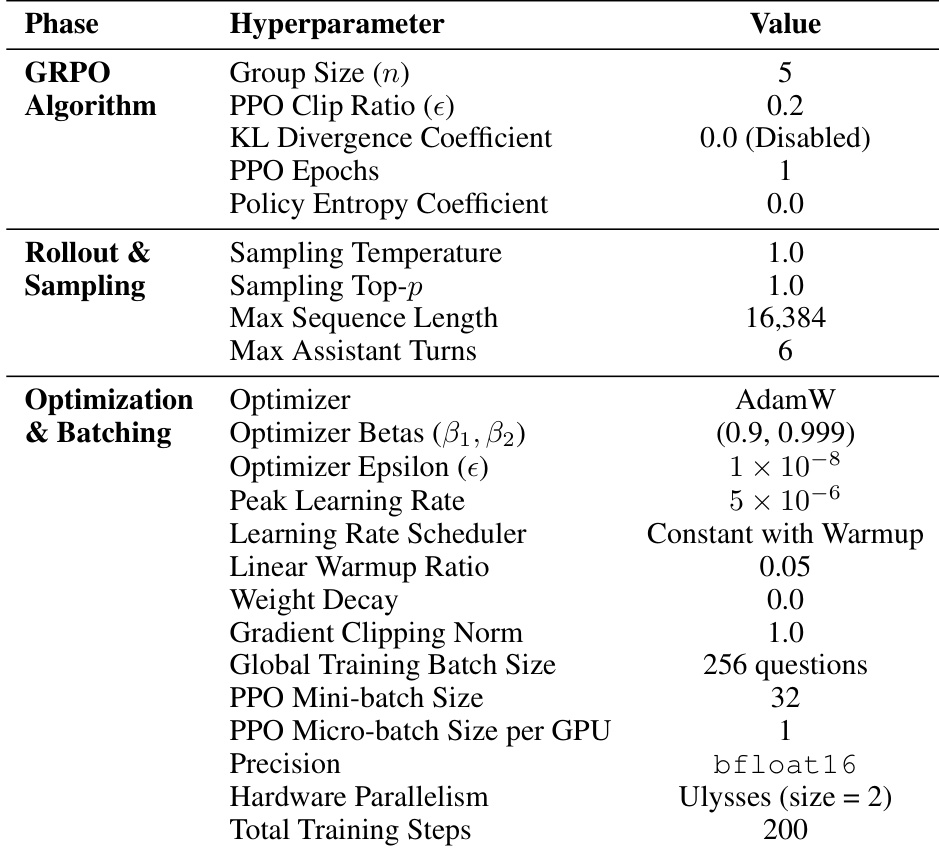
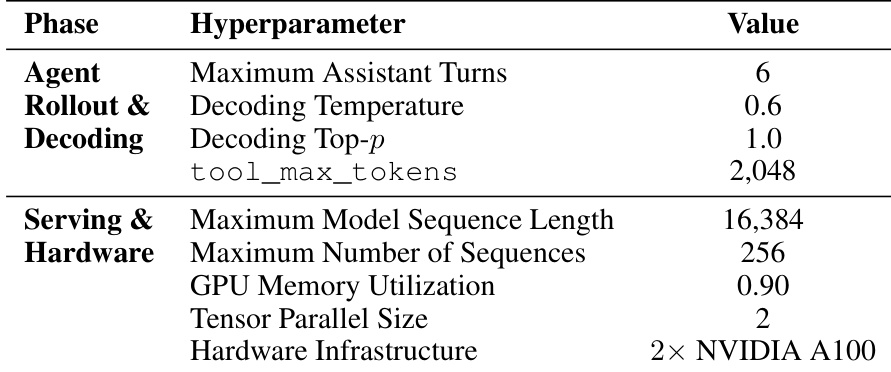
The authors analyze the reinforcement learning configuration for GrepSeek, focusing on the GRPO training phase. The setup uses a group size of five trajectories per query, a PPO clip ratio of 0.2, and disables KL divergence and policy entropy penalties. During rollout, the system employs a sampling temperature of 1.0 and a top-p of 1.0, with a maximum sequence length of 16,384 tokens and up to six assistant turns. Training is conducted using AdamW with a peak learning rate of 5e-6, a linear warmup, and a constant schedule over 200 steps, utilizing bfloat16 precision and Ulysses sequence parallelism. GRPO uses a group size of five trajectories and a PPO clip ratio of 0.2, with no KL divergence or policy entropy penalties. Rollout settings include a sampling temperature of 1.0 and a top-p of 1.0, with a maximum sequence length of 16,384 tokens and six assistant turns. Training uses AdamW with a peak learning rate of 5e-6, a constant schedule after linear warmup, and runs for 200 steps with bfloat16 precision and Ulysses parallelism.
{"summary": "The ablation study compares GrepSeek with variants lacking reinforcement learning optimization or supervised fine-tuning, showing that both training stages are critical for performance. Removing either component leads to significant drops across all datasets, with the absence of supervised fine-tuning causing the most severe degradation. GrepSeek consistently outperforms both ablated variants on multi-hop benchmarks, indicating that structured trajectory initialization and policy optimization are essential for effective retrieval and reasoning.", "highlights": ["GrepSeek significantly outperforms variants without reinforcement learning or supervised fine-tuning across all datasets.", "The absence of supervised fine-tuning causes the largest performance drop, highlighting its importance for stable policy training.", "GrepSeek maintains a clear advantage over ablated variants on multi-hop benchmarks, indicating the value of both training stages for complex reasoning tasks."]

The authors evaluate GrepSeek, a system that uses direct corpus interaction through shell commands for retrieval-augmented reasoning. Results show that GrepSeek achieves superior performance on multi-hop reasoning tasks compared to dense and sparse retrieval baselines, particularly due to its precise lexical filtering and iterative evidence aggregation. However, it exhibits limitations in handling semantic variations and surface-form differences, where dense retrieval methods perform better. The system's efficiency is characterized by low memory footprint and no offline indexing cost, though it incurs higher inference latency due to longer reasoning trajectories. GrepSeek outperforms retrieval baselines on multi-hop reasoning tasks by leveraging precise lexical filtering and iterative evidence aggregation. The system's reliance on exact string matching makes it sensitive to surface-form variations, leading to performance drops on datasets with semantic ambiguity. GrepSeek achieves high efficiency with minimal memory usage and no offline indexing cost, but has higher inference latency due to extended reasoning processes.
The authors compare GrepSeek against various retrieval-augmented baselines, showing that GrepSeek outperforms non-agenetic and trained agentic methods across multiple benchmarks, particularly on multi-hop reasoning tasks. While GrepSeek achieves the highest overall average performance, it shows mixed results on specific datasets, with notable improvements on some and slight declines on others, especially where lexical variations or semantic ambiguity are present. The results indicate that direct corpus interaction through shell-based retrieval provides high precision for complex reasoning but can be brittle under surface-form variations. GrepSeek achieves the best performance on multiple benchmarks, especially in multi-hop reasoning tasks, outperforming both non-agenetic and trained agentic baselines. GrepSeek shows significant improvements on datasets requiring precise lexical matching and iterative evidence aggregation, but experiences performance trade-offs on datasets with semantic ambiguity or surface-form variations. The method's reliance on exact string matching makes it sensitive to spelling differences and diacritics, leading to failures where dense retrievers can generalize through semantic similarity.
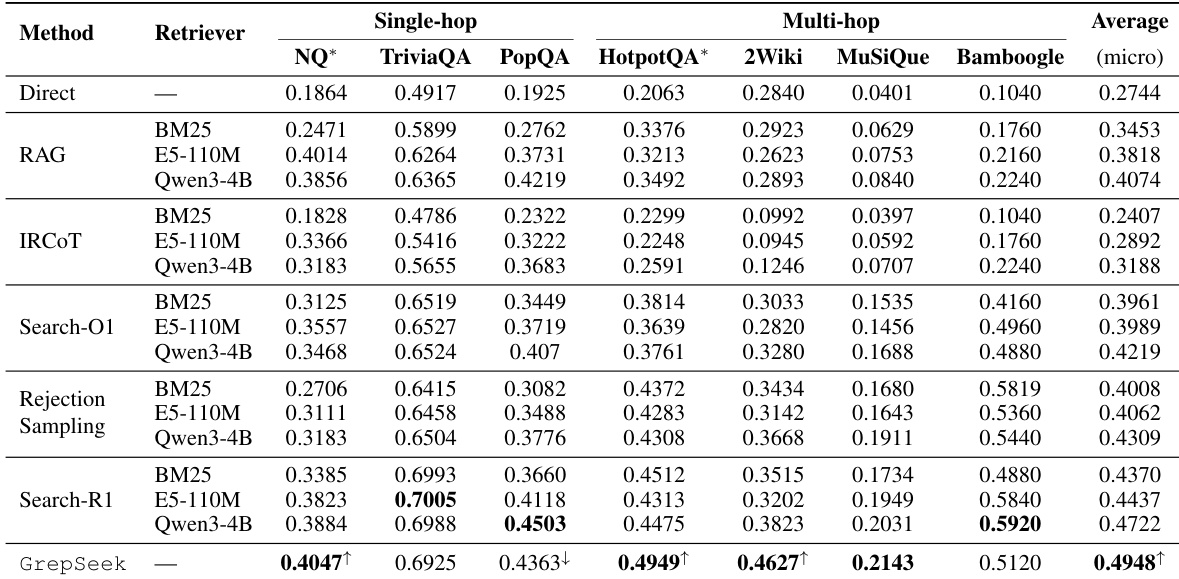
The evaluation setup comprises an ablation study on training stages and a comparative benchmark against retrieval baselines to validate GrepSeek's direct shell-based corpus interaction approach. The ablation confirms that both supervised fine-tuning and reinforcement learning are essential, as removing either causes significant performance degradation, particularly on multi-hop reasoning tasks. Comparative results show that GrepSeek excels in complex multi-hop scenarios by leveraging precise lexical filtering and iterative evidence aggregation, though its reliance on exact string matching makes it sensitive to semantic variations and surface-form differences. Overall, the experiments demonstrate that direct corpus interaction enables high-precision reasoning but requires structured initialization and policy optimization to maintain robustness across diverse linguistic contexts.