Command Palette
Search for a command to run...
학습된 밀도 제어를 갖춘 생성형 3D 가우시안
학습된 밀도 제어를 갖춘 생성형 3D 가우시안
Runjie Yan Yan-Pei Cao Peng Wang Ding Liang Yuan-Chen Guo
초록
우리는 적응형 렌더링 프리미티브와 확장 가능한 생성 모델링 간의 간극을 메우기 위해 설계된 새로운 3차원 표현법인 Density-Sampled Gaussians(DeG)를 제안합니다. 기존의 접근 방식들이 3D Gaussians를 고정된 보그리드(voxel grids) 또는 배열로 제약하는 것과 달리, DeG는 오크트리(octree) 위에서 정의된 학습 가능한 확률 밀도 함수로부터 표본 추출된 형태로 Gaussian 중심을 모델링합니다. 이러한 수식화(수학적 형식화)는 적응형 밀도 제어를 위한 엄격한 수학적 프레임워크를 제공합니다. 렌더링 감독하에 공간적 밀도와 Gaussian 속성을Jointly 최적화함으로써, 본 모델은 기하학적 복잡도가 높은 영역에 자연스럽게 프리미티브(primitives)를 집중시킵니다. 이는 표준 Gaussian Splatting에서 사용되는 이산적 densification 및 pruning 휴리스틱에 해당하는 완전히 미분 가능한 유사 물량인 새로운 렌더 손실 기여도 그래디언트(render loss contribution gradient)를 통해 달성됩니다.resultant(결과물) 표현은 매우 유연하여, 단순히 샘플링 예산(sampling budget)을 조정함으로써 단일 latent code로부터 가변 해상도 디코딩을 지원합니다. 생성적 합성을 가능하게 하기 위해, 우리는 DeG 상에서 latent diffusion model을 학습합니다. 우리는 순서가 없는 집합(set) 구조를 가진 latents에 확산(d diffusion)을 적용할 때 수렴 속도가 현저히 저하될 수 있는 중요한 과제를 식별하고, latent tokens를 결정론적인 3D Sobol 시퀀스에 고정함으로써 latent 생성의 모호한 집합 문제(retion)를 견고한 시퀀스 모델링 문제로 전환하는 canonical 재인덱싱 메커니즘인 VecSeq를 제안합니다. 광범위한 실험을 통해, 우리의 파이프라인이 구조적 적응성을 가진 비구조화 프리미티브와 그리드 기반 방법론의 훈련 안정성을 결합하여 단일 이미지에서 3D로 생성하는 작업(state-of-the-art)에서 최상위 성능을 달성함을 입증합니다.
One-sentence Summary
The authors propose Density-Sampled Gaussians (DeG), a 3D representation that models Gaussian centers as samples from a learnable probability density over an octree and employs a differentiable render loss contribution gradient for adaptive density control, and combine it with VecSeq, a deterministic Sobol-sequence re-indexing that stabilizes latent diffusion on unordered sets, achieving state-of-the-art single-image-to-3D generation.
Key Contributions
- Density-Sampled Gaussians (DeG) models Gaussian centers as samples from a learnable probability density function defined over an octree. A fully differentiable render loss contribution gradient replaces non-differentiable densification and pruning, enabling adaptive allocation of primitives to geometrically complex regions and variable-resolution decoding from a single latent code.
- A paired autoencoder compresses 3D assets into compact latent tokens and decodes them into DeG with end-to-end density optimization under rendering supervision. This yields substantially improved reconstruction quality under a comparable Gaussian budget and smooth scaling with increased anchor counts or token lengths.
- VecSeq addresses slow convergence caused by permutation ambiguity in unordered set-structured latents by anchoring latent tokens to a deterministic 3D Sobol sequence via optimal transport. This converts the set-generation problem into a robust sequence modeling task, leading to faster convergence and state-of-the-art single-image-to-3D generation quality.
Introduction
3D Gaussian Splatting has become a leading representation for real-time novel view synthesis, but existing generative pipelines struggle to preserve the core flexibility that makes Gaussians attractive: they typically tie output to a fixed structure (voxel grids, per-pixel or per-patch counts) and thus cannot adaptively allocate more primitives to complex regions. Methods that try to loosen these constraints either require costly per-object optimization to create ground-truth targets or sample primitives uniformly, failing to learn a global density that directs detail where it is needed most. The authors address this with Density-Sampled Gaussians (DeG), a generative representation that defines a rendering-optimized density over an octree and samples Gaussian centers from it, enabling variable-sized outputs and smart, adaptive capacity allocation under a learnable budget. They further build a paired autoencoding and diffusion pipeline with a VecSeq formulation that resolves permutation ambiguity in latent tokens, yielding high-quality single-image conditional generation with consistent gains in low-budget regimes.
Method
The authors present a generative framework comprising two core components: a Density-sampled Gaussian VAE (DeG-VAE) and a VecSeq diffusion transformer. The DeG-VAE encodes 3D assets into a compact latent space and decodes them via a learned spatial probability density, allowing for dynamic allocation of Gaussian primitives. The diffusion model then learns the distribution of these latents conditioned on a single input image. As shown in the framework diagram, the pipeline integrates encoding, density decoding, and attribute decoding to support variable-resolution outputs.
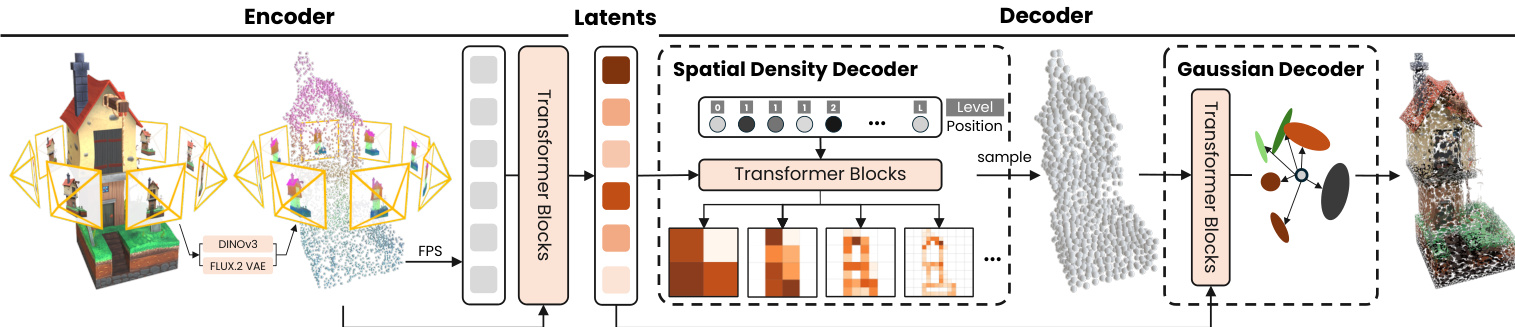
The DeG-VAE begins with a Set Encoder. For a 3D asset, the authors represent geometry and appearance as a set of latent tokens Z. They aggregate information from multi-view RGB renderings and explicit surface geometry. Feature maps are extracted using DINOv3 for semantic consistency and a FLUX.2 VAE for high-frequency texture details. Surface points are projected onto these feature maps. A transformer-based set encoder compresses these variable-length point features into a fixed-size latent set Z using Farthest Point Sampling (FPS).
To enable adaptive allocation, the authors formulate Gaussian center prediction as a sampling process from a learned conditional probability density qθ(x∣Z) over R3. This density is parameterized using an L-level octree factorization to maintain sparse computation. The joint probability is factorized as a product of conditional distributions over children cells. At inference, anchor points are drawn from this density, and the number of anchors P is adjustable to trade off speed for fidelity. As shown in the figure below, the network iteratively predicts density values for occupied voxels to allocate points from the coarsest to the finest level.

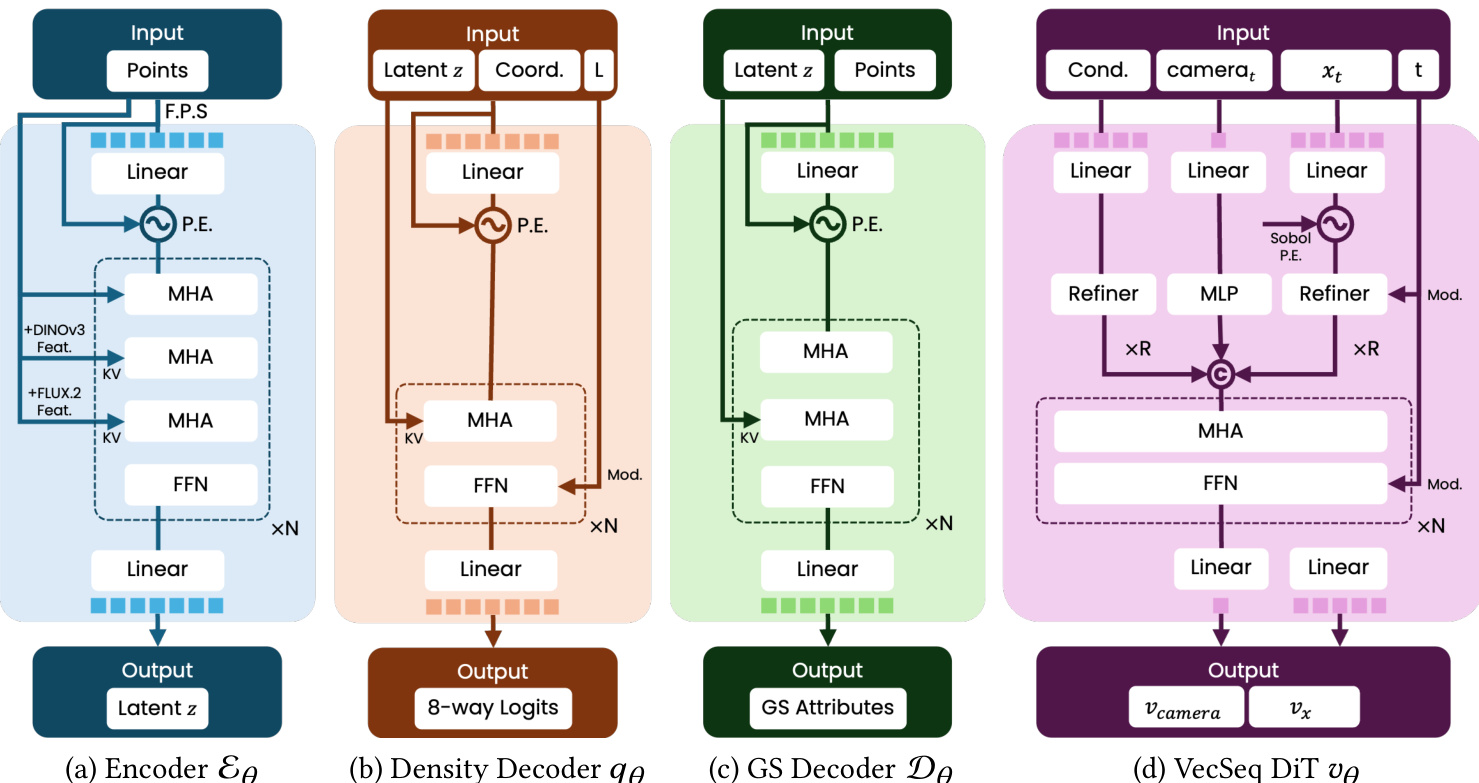
With the sampled anchors establishing spatial support, a transformer-based attribute decoder predicts the parameters of the Gaussian primitives, including opacity, scaling, rotation, and spherical harmonic coefficients. To capture local surface details, a local expansion mechanism allows each anchor to spawn K individual Gaussians with learned local offsets. This hierarchical approach yields N=P⋅K total splats. Refer to the detailed architecture diagram for the specific neural architectures of the encoder, density decoder, attribute decoder, and the diffusion transformer.
A key challenge in this pipeline is optimizing the spatial density qθ end-to-end, as the sampling operation is non-differentiable. The authors address this by deriving the render loss contribution gradient. They seek to minimize the expected rendering loss over the density distribution. The gradient computation involves a difference reward term: ΔLrender=Lrender({xi}i=1P)−Lrender({xi}i=jP). This term measures the marginal contribution of each anchor xj to reducing the rendering error, effectively performing differentiable densification and pruning. The authors implement an efficient version of this gradient by accumulating primitive-level contributions inside the standard 3DGS backward rasterization pass. The VAE is trained with a combination of structural supervision and rendering supervision via a three-stage curriculum: Structural Initialization, Appearance training, and Joint Refinement.
For the generative modeling task, the authors model the distribution of latent codes Z using a diffusion transformer based on the Flow Matching framework. A fundamental challenge here is permutation ambiguity; unordered set tokens lack intrinsic ordering, leading to slow convergence. To resolve this, the authors propose VecSeq, a canonical re-indexing strategy. They align the unordered latent tokens to a fixed, deterministic 3D Sobol sequence using optimal transport. This transforms the ambiguous set-generation problem into a robust sequence modeling task. As shown in the figure below, latent tokens are associated with 3D positions and canonically ordered by matching them to deterministic anchors, enabling the use of positional encoding in the diffusion transformer.
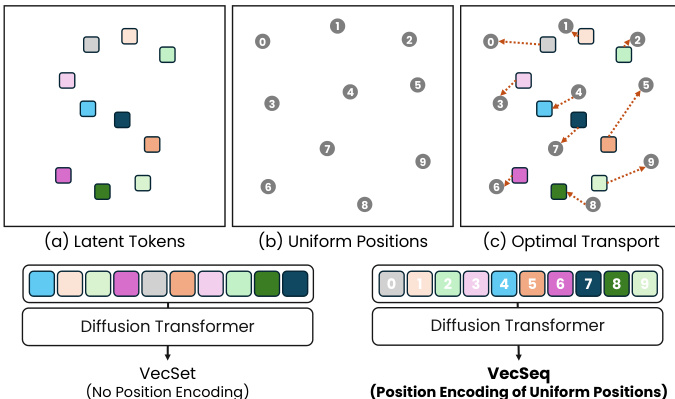
By injecting sinusoidal positional embeddings of the Sobol anchors into the diffusion model, the model learns to predict a sequence where the j-th output corresponds to a specific spatial location, significantly improving convergence and generation quality.
Experiment
The evaluation uses the Toys4K dataset for quantitative reconstruction and generation tests, with self-collected high-quality images for qualitative generation comparisons. Reconstruction experiments show that DeG‑VAE outperforms baselines by learning efficient, variable-sized Gaussian allocations that improve visual fidelity, especially under limited capacity, and that learned density control further enhances low-budget reconstruction. The generation pipeline achieves state-of-the-art image‑condition alignment and perceptual quality, with token reordering proving crucial for semantic consistency, while user studies confirm strong preference for its richer details and natural colors over competing mesh and Gaussian models. Occasional failure cases arise in novel views due to challenging conditioning inputs or limited generative capacity.
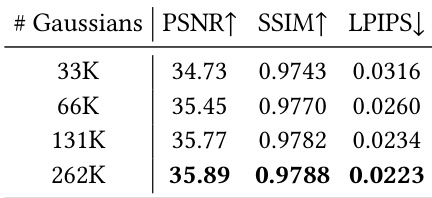
The authors evaluate the impact of the Gaussian budget on reconstruction quality by varying the number of decoded Gaussians while keeping the token length fixed. Results show that increasing the number of Gaussians consistently improves visual fidelity across all evaluated metrics. Reconstruction quality improves steadily as the number of decoded Gaussians increases. Higher Gaussian budgets yield better PSNR and SSIM scores while reducing LPIPS. The model demonstrates favorable scaling behavior with respect to the available Gaussian capacity.
The authors conducted a user study to evaluate the perceptual quality of their method against several baselines using complex prompts. Participants performed pairwise comparisons of rendered videos to assess overall quality and condition alignment. The proposed method achieved the highest preference rating, significantly outperforming competing mesh and Gaussian generation models. The proposed method secures the top rank in user preference, demonstrating superior visual quality and alignment with input images. All competing baselines receive lower preference ratings, with the proposed method showing a significant margin over the second-best approach. The study validates that the generated 3D assets are preferred over both mesh-based and Gaussian-based alternatives.

The authors evaluate the impact of token reordering during diffusion training by comparing their approach against a baseline that uses unordered latents. The results demonstrate that reordering tokens to establish consistent spatial correspondence significantly improves both prompt alignment and the overall distributional quality of the generated assets. Token reordering leads to better image-condition alignment compared to the unordered baseline. The proposed method achieves superior distributional quality with lower distance metrics. Establishing consistent spatial meaning for token indices makes positional embeddings more effective during training.

The authors evaluate their reconstruction method against representative baselines on a standard dataset. Results show that their approach substantially outperforms competing methods across all reported reconstruction quality metrics while using a comparable number of Gaussians, demonstrating more effective allocation of rendering capacity. The proposed method achieves the highest reconstruction quality among the compared approaches across all evaluated metrics. The method utilizes a similar Gaussian budget as the baselines but delivers superior visual fidelity through adaptive density allocation. Decoding time for the proposed method is slightly higher than the baselines, reflecting a minor trade-off for significantly improved reconstruction performance.

The authors ablate key hyperparameters of the DeG-VAE model, including the local expansion factor, octree depth, and regularization loss. The experiments demonstrate that moderate hyperparameter settings offer the best balance between reconstruction fidelity and computational efficiency. Incorporating the regularization loss is also shown to slightly enhance the overall reconstruction quality. Increasing the local expansion factor beyond a moderate value yields only marginal gains in reconstruction quality while increasing computational cost. Setting the octree depth to a moderate level achieves the best reconstruction performance, whereas deeper octrees incur higher training times with comparable quality. Omitting the regularization loss leads to a slight reduction in reconstruction fidelity compared to the full model configuration.
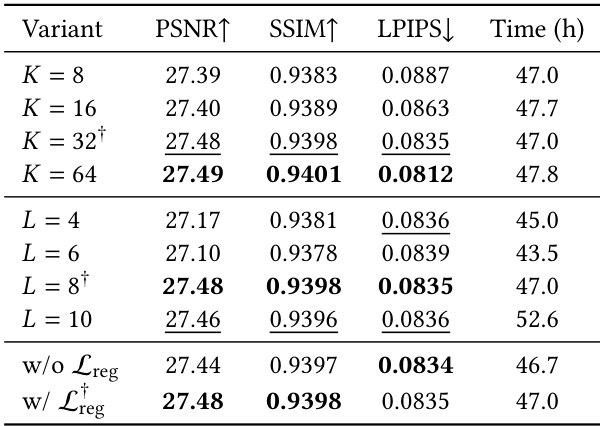
Experiments assess reconstruction quality scaling with Gaussian budget, user preference against baselines, token reordering benefits, and hyperparameter choices. Increasing the number of decoded Gaussians steadily improves visual fidelity, and moderate hyperparameter settings best balance quality and cost. A user study reveals the proposed method significantly outperforms mesh and Gaussian baselines in perceived quality and condition alignment. Token reordering to establish spatial correspondence consistently boosts prompt alignment and distributional quality, and the reconstruction method achieves superior results with similar Gaussian counts through more effective capacity allocation.