Command Palette
Search for a command to run...
Canonical LST: Tezos를 위한 프로토콜 네이티브 유동적 스테이킹 솔루션
Canonical LST: Tezos를 위한 프로토콜 네이티브 유동적 스테이킹 솔루션
Mathias Bourgoin Arthur Breitman Pierrick Couderc Zaynah Dargaye Diane Gallois-Wong Marina Polubelova Lucas Randazzo Julien Tesson
초록
Canonical LST(sTEZ)는 리퀴드 스테이킹 중개자에 의해 초래될 수 있는 중앙화 리스크를 완화하기 위해 설계된, 엔슈드(enshrined) 프로토콜 네이티브 메커니즘입니다. 이는 직접 스테이킹을 대체하기보다 보완하는 것을 목적으로 하며, 테조스 프로토콜이 직접 관리하는 중립적이고 공개적인 대안을 제공합니다. 이를 통해 모든 tez 보유자는 제3자 운영자에 의존하지 않고 집계된 스테이킹에 참여할 수 있습니다. sTEZ는 accrua(누적) 기반 디자인을 따르며, 모든 슬래싱 사건과 보상은 토큰의 tez 대비 환율에 반영됩니다. 이는 잔고를 대체 가능하게 유지하면서 보유자에게 스테이킹의 정확한 경제구조를 노출시킵니다. 이러한 접근 방식은 리퀴드 스테이킹이 재량껏 운영되는 상용 상품이 아니라, 결정론적인 라이프사이클 규칙, 투명하게 공개되는 온체인 데이터, 수정 프로세스에 기반한 거버넌스를 갖춘 근본적인 네트워크 인프라로서 기능함을 보장합니다. 이 백서에서는 Canonical LST를 엔슈드하는 동기, 핵심 메커니즘, 환율 모델, 규제적 고려사항, 리스크 포지션, 그리고 향후 로드맵을 요약하고 있습니다.
One-sentence Summary
The authors propose Canonical LST (sTEZ), a protocol-native liquid staking mechanism for Tezos that eliminates third-party intermediaries by employing an accrual-based exchange-rate model to dynamically adjust token valuations according to staking rewards and slashing events, thereby preserving fungibility while establishing liquid staking as transparent, governance-anchored infrastructure that mitigates centralization risks for tez holders.
Key Contributions
- Canonical LST (sTEZ) introduces a protocol-enshrined liquid staking mechanism that eliminates reliance on discretionary third-party operators by providing a neutral, public alternative managed directly by the Tezos protocol.
- The system utilizes an accrual-based exchange-rate model where all staking rewards and slashing events adjust the sTEZ to tez ratio, maintaining fungibility while transparently reflecting precise network economics.
- Protocol-level governance and transparency measures, including amendment-anchored oversight and public validator dashboards, replace discretionary intermediaries to prevent consensus capture and enforce deterministic lifecycle rules.
Introduction
Liquid staking has become essential for proof-of-stake networks, enabling users to participate in consensus while retaining asset liquidity for decentralized finance applications. Prior implementations, however, rely heavily on third-party operators that concentrate validation power, create winner-take-all liquidity dynamics, and introduce governance capture risks that threaten network decentralization. The authors leverage this gap to propose Canonical LST (sTEZ), a protocol-enshrined liquid staking mechanism for Tezos that removes operator discretion from core issuance and lifecycle management. By implementing an accrual-based exchange rate model that transparently reflects staking rewards and slashing events, the authors anchor governance directly to the protocol amendment process and reframe liquid staking as neutral, auditable network infrastructure.
Dataset
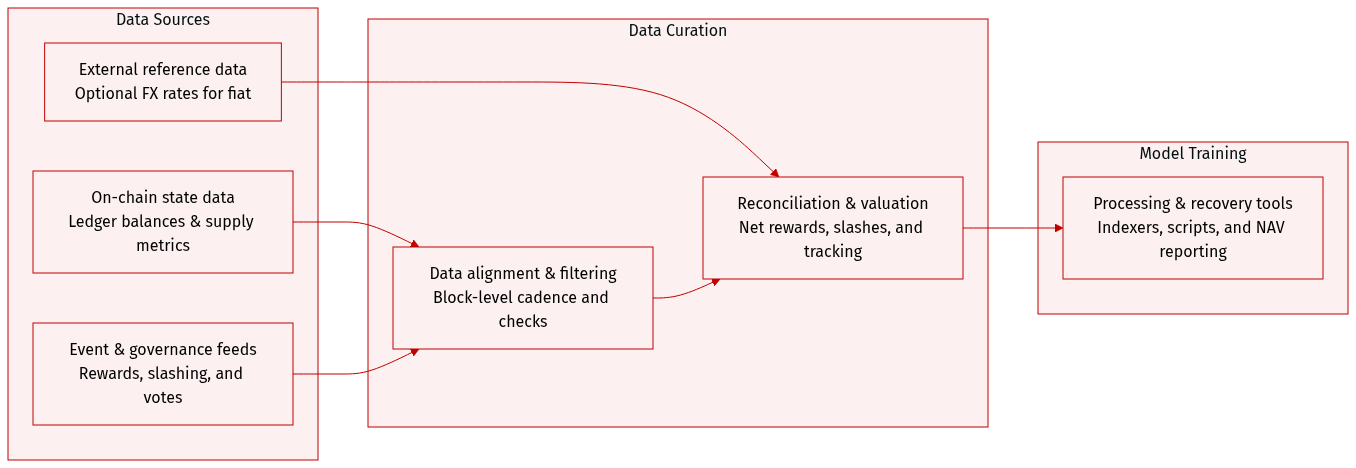
- Dataset Composition and Sources: The authors assemble a minimal on-chain and off-chain dataset centered on Tezos blockchain state. Core inputs include ledger balances queried from contract storage or RPC views, token supply metrics pulled from the interface contract fungible token ledger, and structured event deltas tracking reward accrual and slashing amounts. An optional external feed provides reference currency foreign exchange rates when non-tez reporting is required. The system also ingests governance amendment records and leverages full archive node state data for complete historical reconstruction.
- Subset Details: Ledger and supply metrics are captured directly from on-chain contract storage. Event deltas are filtered to isolate reward and slashing events for precise attribution. Foreign exchange feeds are included only when necessary for fiat-denominated valuations. Governance data encompasses proposal hashes, validator ballots, quorum participation rates, and super-majority thresholds across five fixed amendment periods.
- Data Usage and Processing: The authors use this dataset to compute valuations, calculate net asset values, and reconcile operator positions. The data is not partitioned for model training or combined in mixture ratios. Instead, all on-chain variables are recomputed at block, intra-day, or cycle cadences to align with native protocol mechanics. Reconciliation windows attribute returns to net rewards, slashing losses, and straddling deposits or redemptions. A tolerance band of five basis points is applied to flag valuation anomalies. Open-source indexers and monitoring scripts are provided to guide custodians and NAV agents through state reconstruction and disaster recovery workflows.
- Additional Processing and Metadata: The pipeline mirrors Tezos scheduling mechanics, recording immediate deposits and redemption burns, block-level reward accruals, and cycle-scheduled deferred rewards. Slashing penalties are tracked within bounded windows before cycle-end execution. Because the entire system state is bootstrappable from genesis via archive nodes, the authors treat the dataset as a fully reconstructible historical ledger. Governance metadata tracks participation via an exponential moving average to dynamically adjust voting quorums.
Method
The Canonical Liquid Staking Token (sTEZ) system is designed as a protocol-native mechanism within the Tezos blockchain, enabling users to participate in staking through a fungible token without relying on third-party custodians or smart contracts. At the heart of the system is the sTEZ Interface, a single enshrined contract that mediates all user interactions. This interface manages deposits, redemptions, and the minting and burning of sTEZ tokens, operating as a core component of the Tezos protocol. The system's architecture is built around a transparent and deterministic lifecycle, with all state transitions governed by on-chain rules and events. The primary data structures include the staking ledger Lt, representing the total tez staked, and the sTEZ token supply St, which tracks the circulating tokens. The exchange rate Rt=Lt/St dynamically reflects the value of each sTEZ unit in tez and evolves as rewards accrue or slashing occurs, without altering token balances.
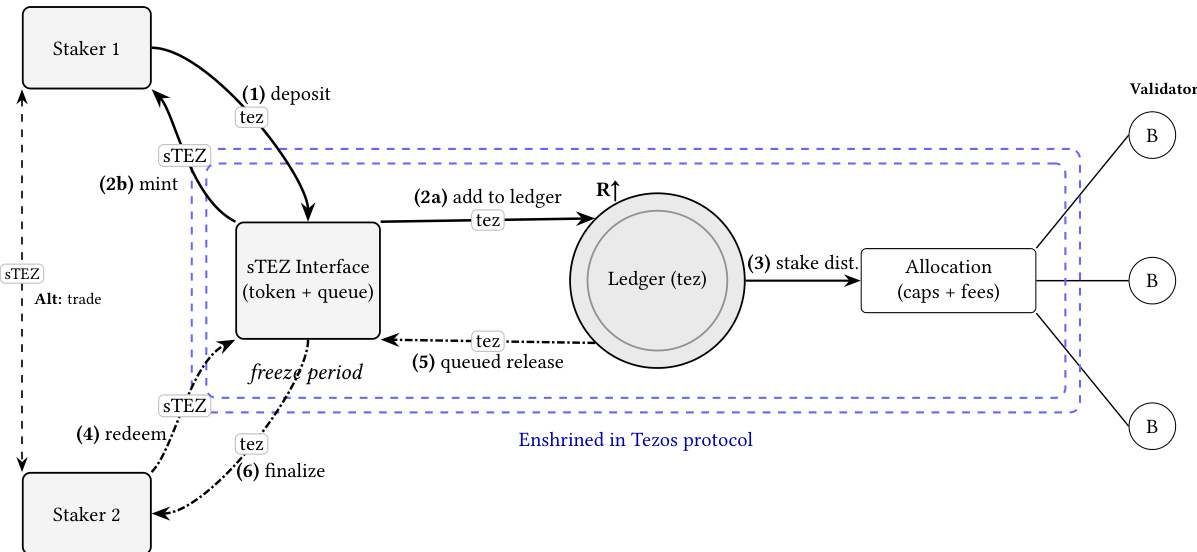
Refer to the framework diagram for an overview of the system's lifecycle. The process begins with a staker depositing tez into the sTEZ Interface, which increases the staking ledger Lt and mints new sTEZ tokens proportional to the current exchange rate Rt. These tokens are immediately transferable and represent a share of the total staked amount. The deposited tez is then added to the staking ledger, where it becomes eligible for allocation to validators. At the cycle boundary, the protocol performs stake allocation based on validator eligibility, fees, and capacity caps. This allocation process is deterministic and ensures that stake is distributed fairly, promoting decentralization. Validator eligibility is defined by protocol-level criteria, including a clean recent slashing history and declared capacity, with automatic exclusion upon any slashing event.
The sTEZ Interface also manages the redemption process. When a user wishes to exit, they submit a redemption request, burning their sTEZ tokens and initiating a claim on the underlying tez. The corresponding tez value is immediately calculated using the current exchange rate Rt and moved from the staking ledger to a frozen ledger, which tracks funds awaiting the completion of the unbonding period. During this period, the funds are not eligible for rewards and remain subject to slashing. Once the unbonding period expires, the funds are finalized and moved to the finalizable ledger, from which users can withdraw their tez. This mechanism ensures that redemption is secure and that slashing risks are properly managed. The entire system is designed for transparency and auditability, with all key events—deposits, redemptions, allocations, and slashing—recorded as on-chain events, providing a complete and verifiable audit trail. The absence of privileged administrator keys and the requirement for all parameter changes to go through the formal Tezos amendment process ensure the system's neutrality and security.
Experiment
The evaluation combines comprehensive software testing with a multi-layered risk assessment framework to validate the security and operational integrity of the Canonical LST protocol. Unit, integration, and property-based tests verify core implementation logic and system invariants, while public testnet simulations assess economic incentives and real-world validator behavior under diverse conditions. Together with shared technical and organizational controls among developers, validators, and custodians, these experiments demonstrate a resilient architecture that effectively mitigates risks related to market dynamics, governance, and regulatory compliance.