Command Palette
Search for a command to run...
PlayCoder: LLM 생성 GUI Code의 실행 가능성 확보
PlayCoder: LLM 생성 GUI Code의 실행 가능성 확보
Zhiyuan Peng Wei Tao Xin Yin Chenhao Ying Yuan Luo Yiwen Guo
초록
거대 언어 모델(LLMs)은 코드 생성 분야에서 뛰어난 성과를 거두었으나, GUI 애플리케이션, 특히 게임을 생성하는 능력에 대한 연구는 여전히 부족한 실정입니다. 기존의 벤치마크는 주로 테스트 케이스를 통해 정답 여부를 평가하지만, 이는 GUI 애플리케이션의 특성을 반영하기에 불충분합니다. GUI 시스템은 상호작용 중심적이며 이벤트 기반(event-driven)으로 작동할 뿐만 아니라, 일련의 사용자 동작에 따른 정확한 상태 전이(state transitions)를 필요로 하기 때문입니다. 따라서 GUI 평가에는 단순한 통과/실패(pass/fail) 결과뿐만 아니라 상호작용 흐름과 UI 로직을 반드시 고려해야 합니다.본 연구에서는 이러한 문제를 탐구하기 위해 Python, TypeScript, JavaScript로 작성된 43개의 다국어 GUI 애플리케이션을 기반으로 구축된 저장소 인식형(repository-aware) 벤치마크인 PlayEval을 소개합니다. 데스크톱 환경에 적용하기 어려웠던 기존의 GUI 벤치마크와 달리, PlayEval은 6가지 주요 GUI 애플리케이션 카테고리를 포괄하며 코드 생성 평가를 직접적으로 지원합니다. 나아가, 우리는 k개의 생성된 후보 중 적어도 하나가 논리적 오류 없이 엔드 투 엔드(end-to-end)로 플레이 가능한지를 측정하는 지표인 Play@k를 제안합니다. 신뢰할 수 있는 평가를 지원하기 위해, 우리는 작업 지향적 GUI 플레이스루(playthrough)를 수행하고 논리 위반을 자동으로 감지하는 LLM 기반 agent인 PlayTester를 개발했습니다.10개의 최첨단 코드 LLMs를 대상으로 진행한 실험 결과, 높은 컴파일 성공률에도 불구하고 Play@3 수치는 거의 0에 가까운 것으로 나타났으며, 이는 논리적으로 올바른 GUI 애플리케이션을 생성하는 데 있어 심각한 약점이 있음을 시사합니다. 이러한 한계를 극복하기 위해, 우리는 GUI 애플리케이션 코드를 폐쇄 루프(closed loop) 내에서 생성, 평가 및 반복적으로 수정하는 multi-agent 기반의 저장소 인식형 프레임워크인 PlayCoder를 제시합니다. PlayCoder는 오픈 소스 및 클로즈드 소스 모델 모두에서 기능적 정확성과 의미적 정렬(semantic alignment)을 실질적으로 향상시켜, 최대 38.1%의 Exec@3와 20.3%의 Play@3를 달성했습니다. 사례 연구를 통해 PlayCoder가 기존 지표들이 놓치기 쉬운 잠재적인 논리 버그(silent logic bugs)를 찾아내고, 타겟팅된 편집을 통해 이를 수정할 수 있음을 입증했습니다.
One-sentence Summary
To improve the generation of playable GUI applications, the authors propose PlayCoder, a multi-agent, repository-aware framework that utilizes closed-loop control and the PlayTester agent to perform interactive, task-oriented evaluations that detect and repair silent logic flaws missed by traditional unit tests.
Key Contributions
- The paper introduces PlayEval, a repository-aware evaluation dataset comprising 43 multilingual GUI applications across six major categories to facilitate code generation tasks on desktop platforms.
- A new evaluation metric called Play@k is proposed to measure end-to-end logical correctness by determining if at least one of k generated candidates allows for error-free application gameplay, supported by an LLM-based agent named PlayTester that automates interactive playthroughs.
- The study presents PlayCoder, a multi-agent, repository-aware framework that utilizes closed-loop control to write, evaluate, and refine GUI code, which achieves significant improvements in functional correctness and semantic alignment by reaching up to 20.3% Play@3 scores.
Introduction
Large language models have made significant strides in code generation, yet their ability to develop functional graphical user interfaces (GUIs) remains limited. While traditional benchmarks focus on compilation success and unit test passage, these metrics fail to capture the stateful, event-driven logic required for interactive applications like games. Consequently, models often produce code that runs without errors but contains critical behavioral flaws, such as broken collision detection or failed event handling, which pass standard functional tests.
The authors address these gaps by introducing PlayEval, a repository-aware benchmark designed to evaluate GUI applications through hierarchical behavioral testing. They propose a novel Play@k metric that measures whether generated code can be played end-to-end without logical errors. To automate this process, the authors develop PlayCoder, a multi-agent framework that utilizes a specialized LLM-based agent called PlayTester to drive interactive playthroughs and detect semantic violations. By feeding these behavioral diagnostics back into a refinement loop, PlayCoder enables targeted automated program repair, significantly improving the functional correctness and semantic alignment of generated GUI applications.
Dataset
-
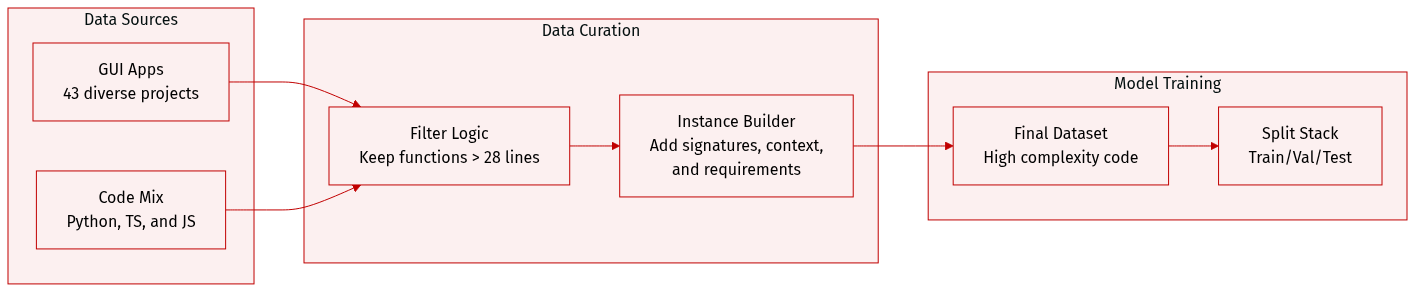
Dataset Composition and Sources: The authors introduce PlayEval, a repository-aware benchmark consisting of 43 diverse GUI applications. The dataset spans three programming languages: Python, TypeScript, and JavaScript. The applications are organized into six categories: Game Emulation, Classic Games, MMORPG Games, Game Engines, Standalone Applications (such as productivity tools and multimedia apps), and Desktop Widgets.
-
Selection and Filtering Criteria: Repositories were selected based on active development history (at least 6 months of maintenance), community validation (primarily projects with over 100 GitHub stars), and functional completeness. To ensure the benchmark focuses on behavior-rich code rather than simple utility helpers, the authors applied a filtering rule where functions must have a minimum of 28 lines after excluding docstrings and decorators.
-
Data Processing and Metadata Construction: Each evaluation instance is constructed using a three part structure:
- Function Signature: The exact method declaration including parameter types and return specifications.
- Requirements: Natural language descriptions of the function's purpose and behavior, generated using GPT-4o-mini and manually verified by experts to ensure high quality.
- Repository Context: Relevant imports, class definitions, and related functions extracted from the codebase. To maintain realistic development environments, the authors used git checkout to revert repositories to specific states.
-
Complexity and Evaluation: The dataset is designed to stress models with high structural complexity, featuring an average cyclomatic complexity of 10.2 per file and an average nesting depth of 11.0 levels. For ground truth, the authors utilize the original repository's unit tests, though they note that real-world projects often have limited test coverage.
Method
The authors propose PlayCoder, a multi-agent framework designed for repository-aware GUI application code generation, which operates through a structured test-and-repair cycle involving two specialized agents: PlayDeveloper and PlayRefiner. The overall workflow begins with a requirement description, repository context, and function signature, which are combined to generate candidate code. This code undergoes behavioral testing, and based on the results, PlayRefiner performs automated program repair (APR) to refine the application. The process iterates until the generated code satisfies both syntactic and behavioral criteria.
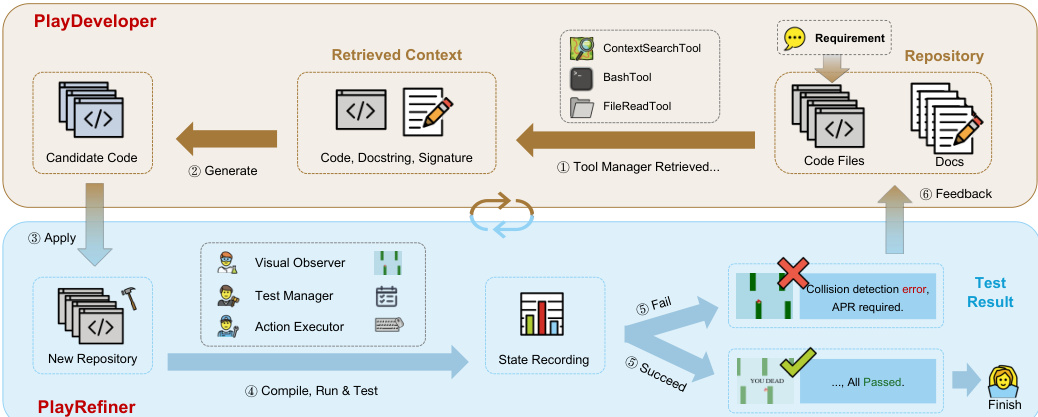
The framework's architecture is illustrated in the diagram above, showing the interaction between the two agents. PlayDeveloper, the code generation agent, operates in a context-aware manner by retrieving relevant code patterns and module structures from the repository. It leverages a modular tool ecosystem, including a ContextSearchTool for retrieving code examples and import patterns, a FileReadTool for accessing files, a BashTool for executing shell commands, and a ConversationTool to maintain dialogue sessions. This agent uses few-shot prompting with standard requirement-code examples to generate repository-aware code.
PlayRefiner, the automated program repair agent, is responsible for diagnosing and fixing behavioral issues identified during testing. It coordinates a set of core tools: a ContextSearcher for retrieving repository-aware APIs and import patterns during repair, a Validator for syntax and AST checks, and an Executor for running the program in a sandbox to capture runtime and behavioral signals. The repair process follows a five-phase loop: Diagnosis aggregates compiler output, runtime logs, and testing reports into actionable failure summaries; Patch Generation proposes minimal edits guided by retrieved context; Patch Application writes changes atomically; Build & Runtime Validation compiles and executes the application; and Iterative Refinement repeats this cycle up to a fixed budget or until the behavioral criteria are met.
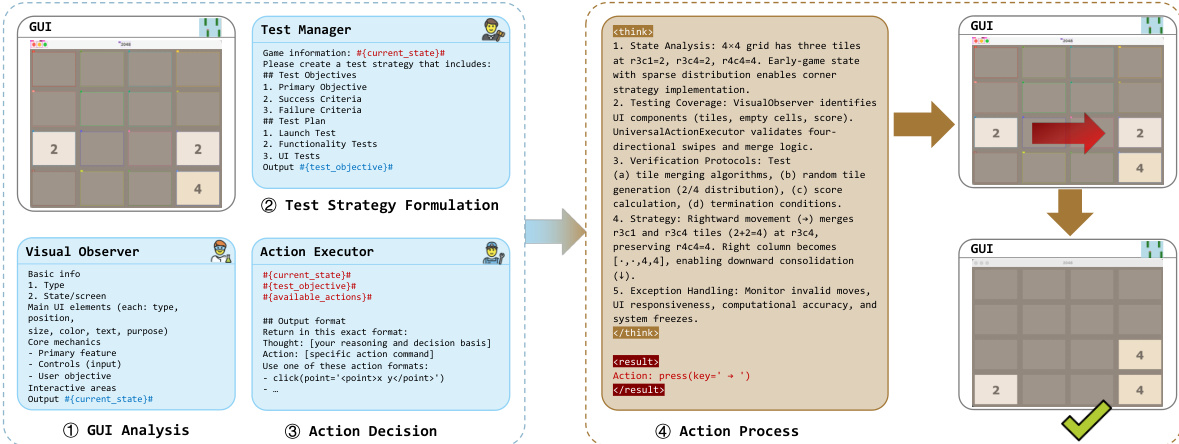
The behavioral testing phase is conducted using the PlayTester framework, which integrates three specialized components. The Visual Observer captures application state via screenshots using platform-specific APIs and caches recent frames to detect state changes. The Action Executor translates test strategies into specific GUI operations, such as clicks, typing, and scrolling, and includes safety mechanisms. The Test Manager, which uses vision-language models, plans tests by processing screenshots and textual context to generate strategies, with distinct prompt templates for goal-driven (e.g., games) and coverage-driven (e.g., non-game applications) testing regimes. The entire process is supported by comprehensive logging through the AgentTrajectory tool, which records LLM interactions, tool usage, and execution traces, enabling diagnosis and reproducibility. Applications execute in sandboxed environments with deterministic seeding to ensure fair and reproducible evaluations.
Experiment
The researchers evaluate the effectiveness of PlayCoder, a multi-agent framework designed for GUI-based code generation, against various state-of-the-art LLMs and agentic baselines using the PlayEval benchmark. The experiments validate the necessity of combining automated program repair with visual-based behavioral testing to detect silent logical failures that traditional unit tests cannot capture. Results demonstrate that PlayCoder significantly outperforms existing methods across multiple programming languages and provides superior cost-effectiveness by achieving higher behavioral correctness per token consumed.
The the the table presents a breakdown of the PlayEval benchmark, which consists of 43 projects across six categories including game emulation, classic games, and MMORPG games. The projects vary significantly in size and complexity, with metrics such as lines of code, number of functions, and classes showing substantial differences between categories, while the benchmark includes a total of 2,104 test cases. The benchmark spans six categories with varying project complexity, including game emulation, classic games, and MMORPG games. There is significant variation in project size across categories, with some having over 120,000 lines of code and others under 3,000. The benchmark includes a total of 2,104 test cases across all projects, with test case counts per project ranging from 24 to 1,539.

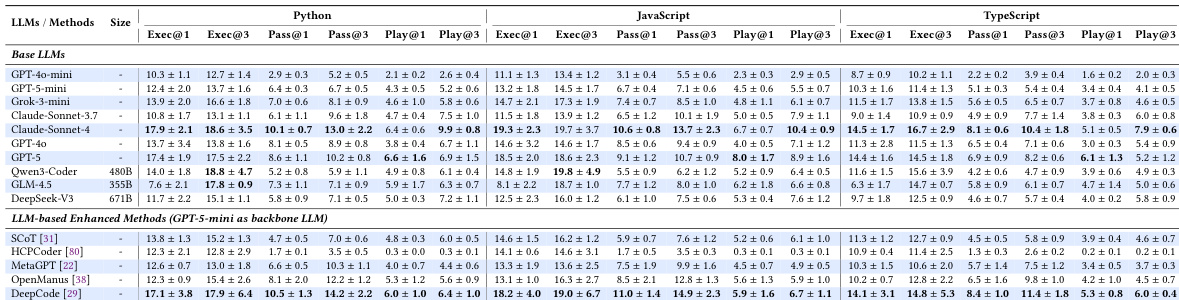
The authors evaluate various language models and enhanced methods on a benchmark for GUI application code generation, focusing on execution, pass, and behavioral validation metrics. Results show that even top-performing models achieve low behavioral correctness rates, and existing enhancement strategies provide limited improvements, highlighting the challenges in generating semantically correct GUI applications. The proposed PlayCoder framework, which integrates automated program repair with dynamic GUI testing, outperforms all baselines across different models and languages, demonstrating superior effectiveness and cost-effectiveness. Top-performing models achieve low behavioral correctness rates, with significant performance drops from execution to behavioral validation across all languages. Existing enhancement methods provide limited and inconsistent improvements over base models, failing to bridge the performance gap for GUI applications. PlayCoder outperforms all baselines across models and languages, achieving the highest effectiveness and cost-effectiveness in behavioral validation.
{"summary": "The authors evaluate the performance of various LLMs and code generation methods on a benchmark for GUI application development, focusing on behavioral correctness through interactive testing. Results show that existing methods struggle with behavioral validation, particularly in TypeScript, and that the proposed PlayCoder framework significantly outperforms baselines by combining automated program repair with visual feedback and dynamic interaction. The framework demonstrates consistent effectiveness across different LLMs and achieves higher efficiency compared to other agentic approaches.", "highlights": ["PlayCoder outperforms all baseline methods across different LLMs and programming languages, achieving superior behavioral validation through iterative repair and visual feedback.", "Existing methods show limited improvements over base models, with significant performance gaps in behavioral validation, especially in statically-typed languages like TypeScript.", "PlayCoder demonstrates strong cost-effectiveness and consistent performance across diverse LLM architectures, highlighting the importance of both automated repair and GUI feedback components."]
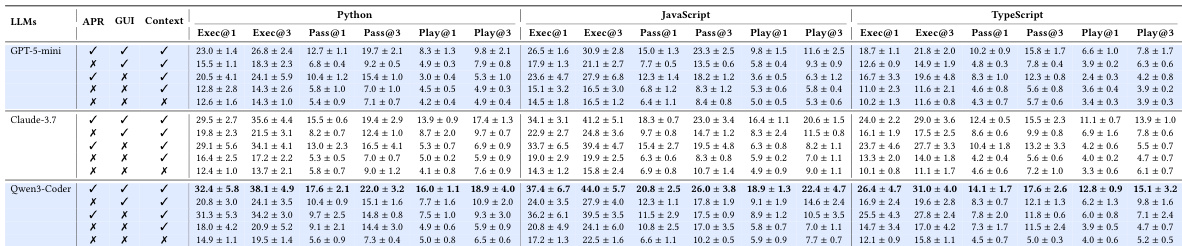
The authors evaluate various large language models and code generation methods on a benchmark for interactive GUI applications, focusing on behavioral correctness through automated testing. Results show that even top-performing models achieve low behavioral validation rates, with significant performance drops from basic execution to interactive testing, and that existing enhancement strategies provide limited improvements. The proposed PlayCoder framework, which integrates iterative repair with visual feedback, outperforms all baselines across multiple languages and models, demonstrating superior effectiveness and cost-efficiency. PlayCoder significantly outperforms all baseline methods in both execution and behavioral validation across multiple programming languages and models. Existing enhancement strategies provide limited improvements in behavioral correctness, with performance degrading substantially from execution to interactive testing. PlayCoder achieves better performance per token consumed, demonstrating high cost-effectiveness compared to other methods.

The authors evaluate the performance of various code generation methods on a benchmark for interactive GUI applications, focusing on execution, pass, and behavioral validation metrics. Results show that existing methods, including advanced LLM-based approaches, struggle with behavioral correctness, particularly in TypeScript, while the proposed PlayCoder framework demonstrates significant improvements across all metrics and maintains consistent effectiveness across different models. Existing code generation methods show limited behavioral validation performance, especially in TypeScript, with most failing to achieve high Play@k scores. PlayCoder outperforms all baseline methods across different models and programming languages, achieving superior execution and behavioral validation metrics. The framework's effectiveness is consistent across diverse LLM architectures, with ablation studies confirming the critical role of automated program repair and visual feedback components.
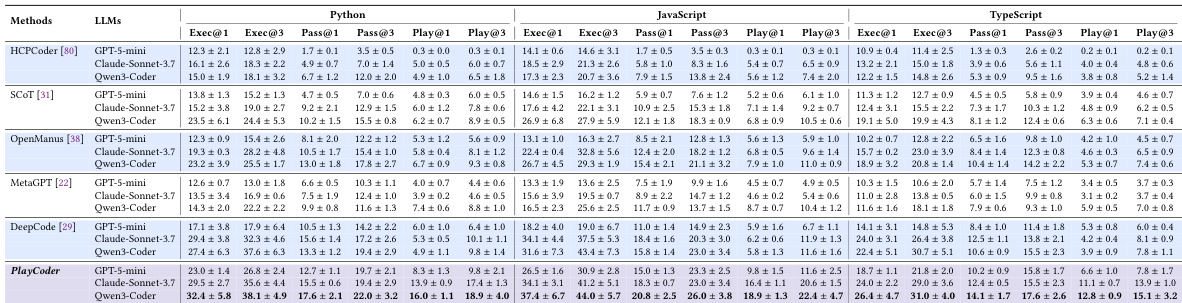
The authors evaluate various large language models and enhancement strategies on the PlayEval benchmark, which consists of diverse GUI application projects ranging from game emulation to MMORPGs. The experiments reveal that existing methods struggle to achieve behavioral correctness, showing significant performance declines when moving from basic execution to interactive testing. In contrast, the proposed PlayCoder framework outperforms all baselines by integrating automated program repair with visual feedback, demonstrating superior effectiveness and cost-efficiency across multiple programming languages and model architectures.