Command Palette
Search for a command to run...
BERT-as-a-Judge: 효율적인 Reference-based LLM 평가를 위한 Lexical Methods의 강건한 대안
BERT-as-a-Judge: 효율적인 Reference-based LLM 평가를 위한 Lexical Methods의 강건한 대안
Hippolyte Gisserot-Boukhlef Nicolas Boizard Emmanuel Malherbe Céline Hudelot Pierre Colombo
초록
정확한 평가는 대규모 언어 모델(LLM) 생태계의 핵심이며, 다양한 유즈케이스(use cases)에 걸친 모델 선택과 다운스트림 채택을 가이드하는 역할을 합니다. 그러나 실제 환경에서 생성된 출력물을 평가할 때는 일반적으로 답변을 추출하고 평가하기 위해 경직된 어휘적 방법(lexical methods)에 의존하는데, 이는 모델의 진정한 문제 해결 능력과 사전 정의된 형식 가이드라인에 대한 준수 여부를 혼동할 수 있습니다. 최근 등장한 LLM-as-a-Judge 방식은 엄격한 구조적 일치성보다는 의미론적 정확성을 평가함으로써 이러한 문제를 완화하고 있지만, 상당한 계산 오버헤드를 발생시켜 평가 비용을 높인다는 단점이 있습니다.본 연구에서는 먼저 36개의 모델과 15개의 다운스트림 태스크를 아우르는 대규모 실증적 연구를 통해 어휘적 평가의 한계를 체계적으로 조사하였으며, 이러한 방법론이 인간의 판단과 상관관계가 낮음을 입증하였습니다. 이러한 한계를 해결하기 위해, 본 논문에서는 레퍼런스 기반(reference-based) 생성 환경에서 답변의 정확성을 평가하는 인코더 구동형 접근 방식인 BERT-as-a-Judge를 제안합니다. 이 방식은 출력 문구의 변화에 강건하며(robust), 합성된 주석이 달린 '질문-후보 답변-레퍼런스(question-candidate-reference)' 트리플릿(triplets)에 대한 경량 학습(lightweight training)만으로도 충분합니다.연구 결과, BERT-as-a-Judge는 어휘적 베이스라인(lexical baseline)을 지속적으로 능가하는 동시에 훨씬 더 큰 규모의 LLM judge 성능에 필적하는 성능을 보여주었으며, 두 방식 사이에서 설득력 있는 트레이드오프(tradeoff)를 제공하여 신뢰할 수 있고 확장 가능한 평가를 가능하게 합니다. 마지막으로, 광범위한 실험을 통해 BERT-as-a-Judge의 성능에 대한 상세한 통찰을 제공하여 실무자들에게 실질적인 가이드를 제시하며, 다운스트림 채택을 촉진하기 위해 모든 프로젝트 아티팩트(artifacts)를 공개합니다.
One-sentence Summary
To address the poor human correlation of rigid lexical methods and the high computational costs of LLM-as-a-Judge approaches, the authors propose BERT-as-a-Judge, an encoder-driven framework that uses lightweight training on synthetic question-candidate-reference triplets to provide reliable, scalable, and semantically accurate reference-based evaluation for generative models.
Key Contributions
- This work presents a large-scale empirical study involving 36 models and 15 downstream tasks that demonstrates how lexical evaluation methods correlate poorly with human judgments by conflating problem-solving ability with formatting compliance.
- The paper introduces BERT-as-a-Judge, an encoder-driven framework that assesses answer correctness in reference-based generative settings through lightweight training on synthetically annotated question-candidate-reference triplets.
- Experimental results show that the proposed method consistently outperforms lexical baselines and matches the performance of much larger LLM judges while providing a more efficient and scalable computational tradeoff.
Introduction
Accurate evaluation is essential for selecting and deploying large language models (LLMs) across diverse tasks. Current zero-shot evaluation methods often rely on lexical matching or regex-based parsing to compare model outputs against reference answers. However, these approaches frequently conflate a model's core reasoning abilities with its ability to follow strict formatting constraints, leading to underestimated performance. While LLM-as-a-Judge frameworks offer a more semantic alternative, they introduce significant computational overhead and sensitivity to prompt design. The authors introduce BERT-as-a-Judge, an encoder-driven approach that leverages bidirectional attention to assess semantic correctness. This lightweight framework provides a more efficient and reliable alternative that aligns closely with human judgment without the high inference costs of generative judges.
Dataset
-
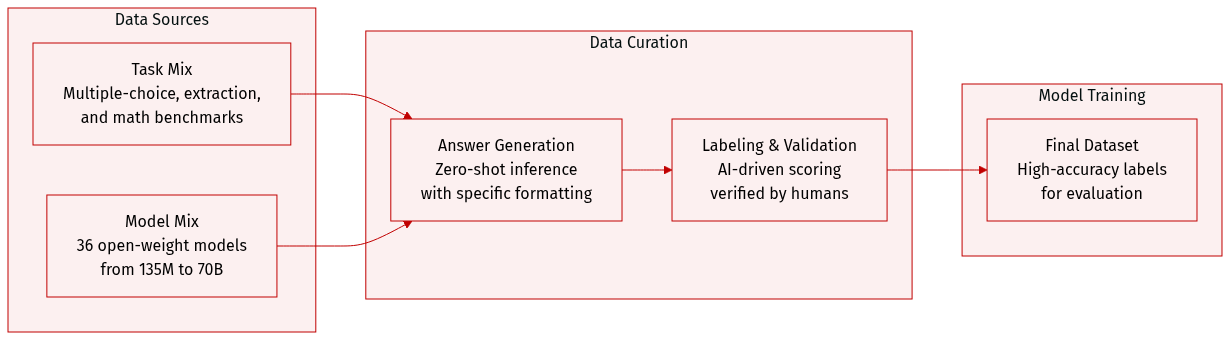
Dataset Composition and Sources: The authors construct an evaluation dataset composed of three distinct task families designed for objective assessment:
- Multiple-choice: Includes MMLU, MMLU-Pro, TruthfulQA, ARC-Easy/Challenge, and GPQA.
- Context extraction: Includes SQuAD-v2, HotpotQA, DROP, and CoQA.
- Open-form mathematics: Includes GSM8K, MATH, AsDiv, AIME 24, and AIME 25.
-
Data Processing and Generation:
- The authors perform zero-shot inference across 36 different open-weight instruction-tuned models, ranging in size from 135M to 70B parameters.
- Responses are generated using greedy decoding with a maximum length of 2048 tokens.
- To enable consistent parsing via regular expressions, models are prompted to conclude their outputs using a specific "Final answer: [answer]" format.
-
Labeling and Validation Strategy:
- Synthetic Labeling: The authors use Nemotron-Super-v1.5 as an automated evaluator. This model receives the question, the candidate response, and the reference answer to determine correctness via greedy decoding in non-reasoning mode.
- Human Validation: To ensure the reliability of the synthetic labels, a subset of the data was independently annotated by 11 human evaluators. This resulted in 3,212 annotations with a 97.5% average agreement rate compared to the synthetic labels.
Method
The authors leverage a BERT-like encoder model, referred to as BERT-as-a-Judge, to evaluate model-generated answers by treating the task as a structured text classification problem. The model is trained on labeled question-candidate-reference triplets constructed from multiple benchmark datasets, including MMLU, ARC-Easy, ARC-Challenge, SQuAD-v2, HotpotQA, GSM8K, and Math. These datasets are selected for their availability of explicit training splits, and the training mixture is carefully balanced to ensure approximately one million synthetically labeled samples across task categories and models. The encoder is initialized from EuroBERT 210M and fine-tuned for a single epoch using binary cross-entropy loss. Training employs a learning rate of 2×10⁻⁵, with a 5% warmup ratio and a linear decay schedule, conducted on 8 MI250x GPUs, achieving an effective batch size of 32 and requiring approximately 20 GPU hours per run.
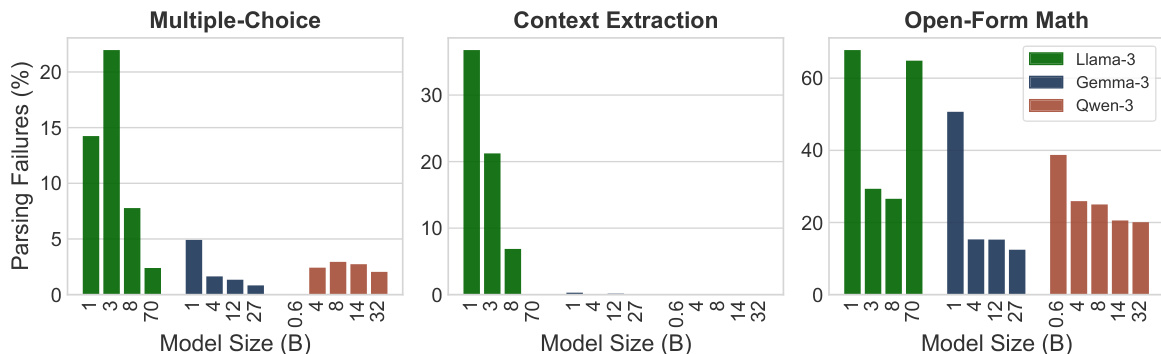
The evaluation framework integrates two distinct modules: a regex-based evaluation system and the BERT-as-a-Judge model. In the regex-based approach, model outputs are processed through a parsing step that extracts answers using a regular expression pattern "Final answer:\s*(.)", which enables flexible and general answer extraction. This method relies on a lexical match between the extracted answer and the reference, resulting in binary scores. In contrast, the BERT-as-a-Judge framework employs a fine-tuned encoder that directly assesses the generated answer against the reference. The model processes the question, candidate answer, and reference as structured input, leveraging its bidirectional attention mechanism to produce a confidence score. This approach allows for a more nuanced evaluation by capturing semantic alignment between the answer and the reference. As shown in the figure below, both evaluation paths converge into a true ranking mechanism that compares the performance of different models across tasks.
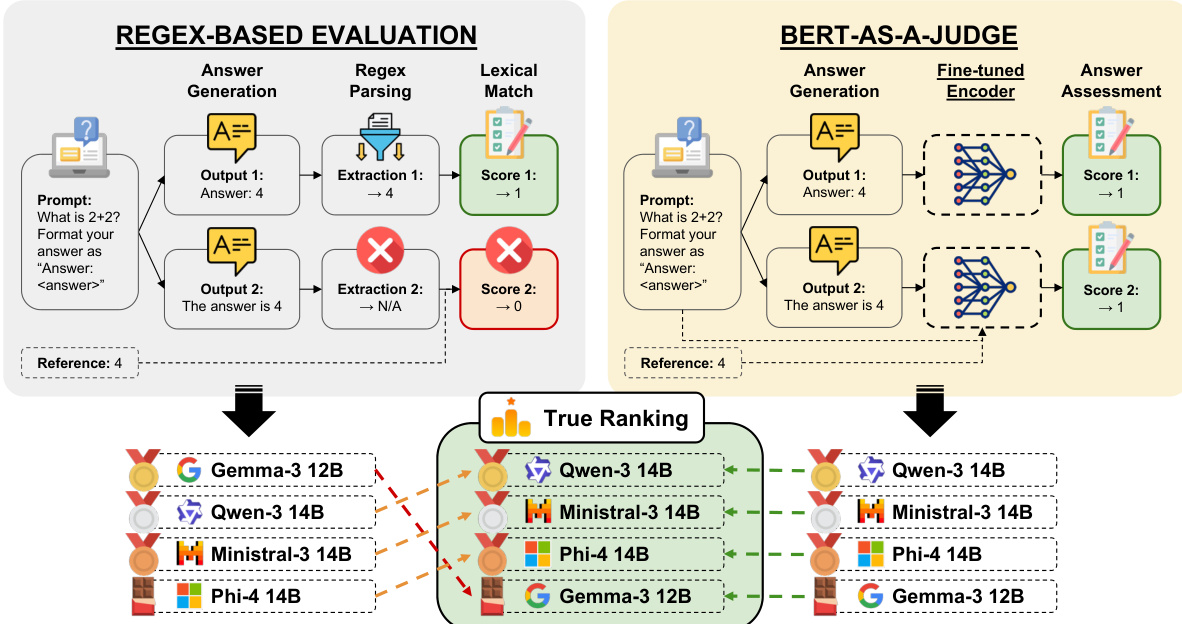
The overall architecture is designed to support both direct and indirect evaluation of model outputs, with the BERT-as-a-Judge model providing a scalable and automated solution for answer assessment that does not rely on manual annotations.
Experiment
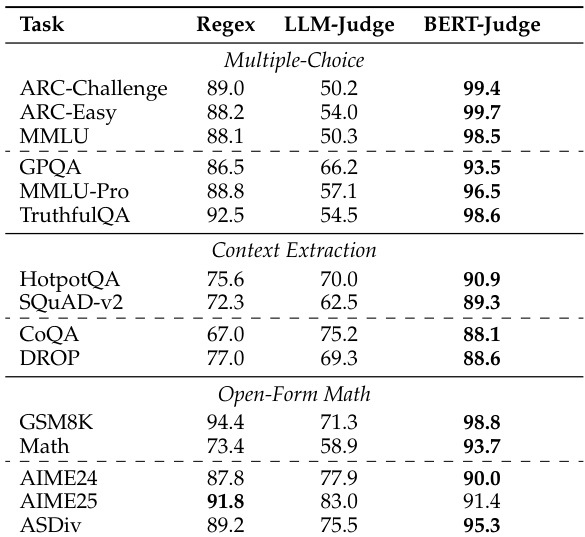
The researchers evaluated several assessment methods, including regex-based parsing, LLM-as-a-Judge, and their proposed BERT-as-a-Judge encoder, against synthetic ground-truth labels across multiple task categories. The results demonstrate that regex-based evaluation significantly distorts model rankings and underestimates performance due to rigid lexical matching and formatting failures. In contrast, the BERT-as-a-Judge encoder provides superior accuracy, strong generalization to out-of-domain models, and high robustness to varying answer formats while remaining computationally efficient.
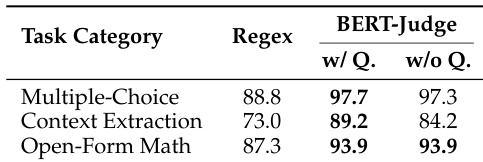
The authors compare regex-based evaluation with BERT-as-a-Judge across multiple task categories. Results show that BERT-as-a-Judge achieves higher accuracy than regex, with minimal performance difference when the question is excluded from the input. The method demonstrates consistent effectiveness across different task types. BERT-as-a-Judge outperforms regex-based evaluation across all task categories Excluding the question from the input has minimal impact on BERT-as-a-Judge performance BERT-as-a-Judge maintains high accuracy on multiple-choice, context extraction, and open-form math tasks
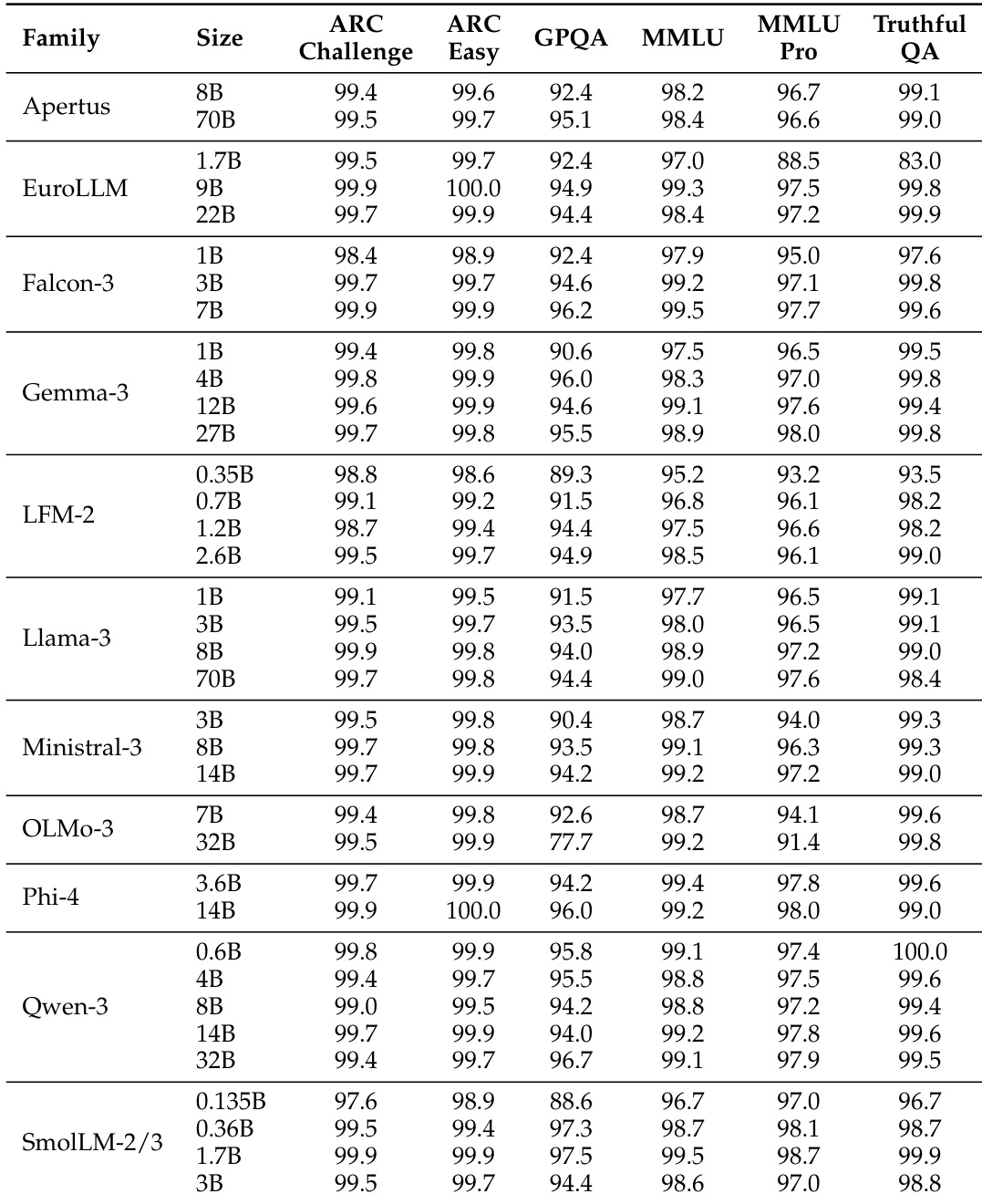
The the the table presents accuracy scores for various model families across multiple benchmarks, showing significant performance differences between models. BERT-as-a-Judge achieves high accuracy across tasks, outperforming regex-based methods, with strong alignment to ground-truth labels. BERT-as-a-Judge consistently outperforms regex-based evaluation across all model families and benchmarks. Larger models generally achieve higher accuracy, with some exceptions in specific tasks. Performance varies widely across tasks, with multiple-choice and open-form math showing higher accuracy compared to context extraction.
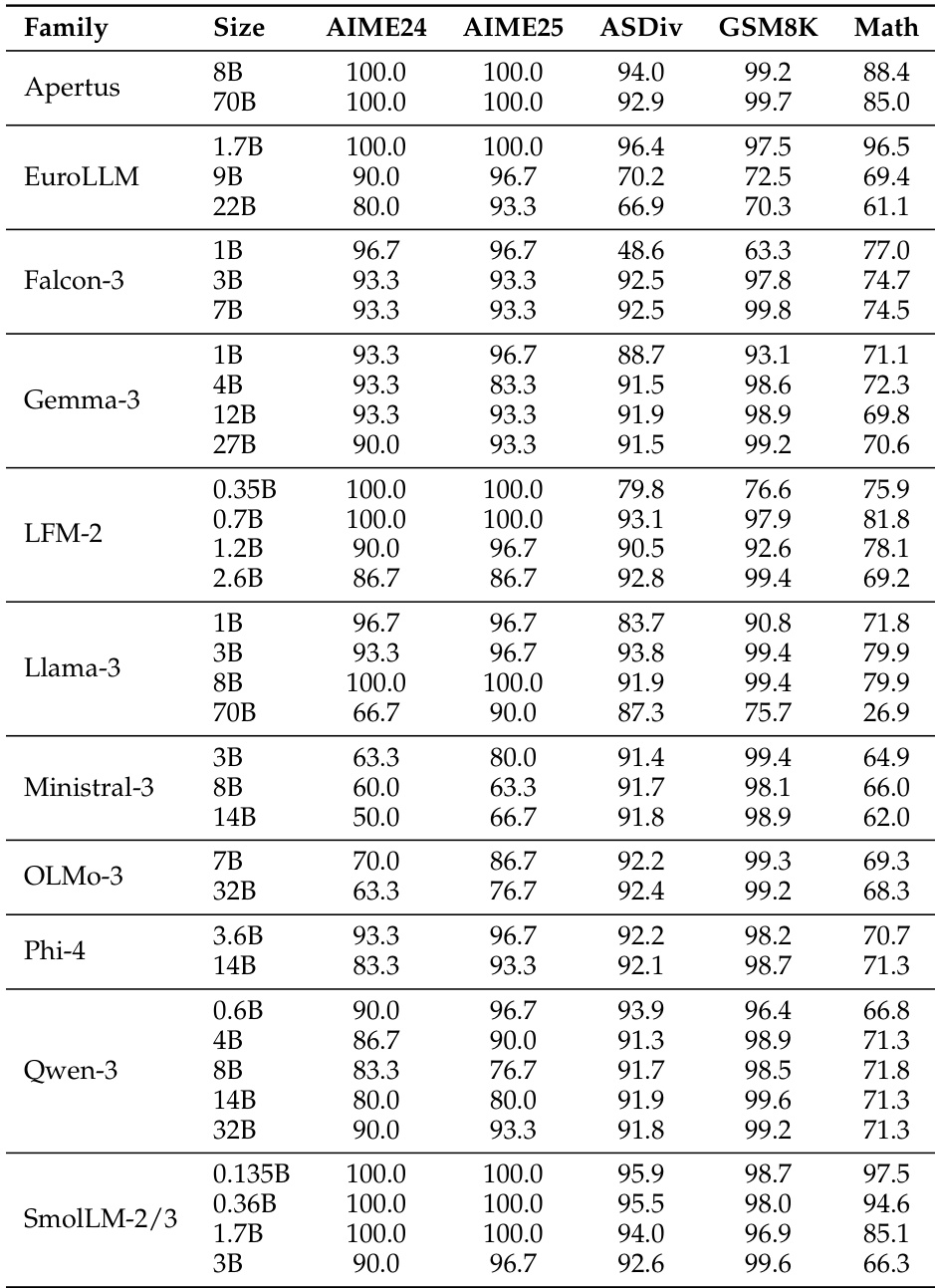
The the the table presents accuracy scores for various language model families across multiple benchmarks, showing significant variation in performance based on model size and family. Results indicate that larger models generally achieve higher accuracy, with some families demonstrating consistent performance across tasks while others show more variability. Performance varies significantly across model families and sizes, with larger models generally outperforming smaller ones Different model families exhibit distinct performance patterns across benchmarks, indicating task-specific strengths Some models achieve high accuracy on specific tasks while showing low scores on others, highlighting task-dependent performance variation
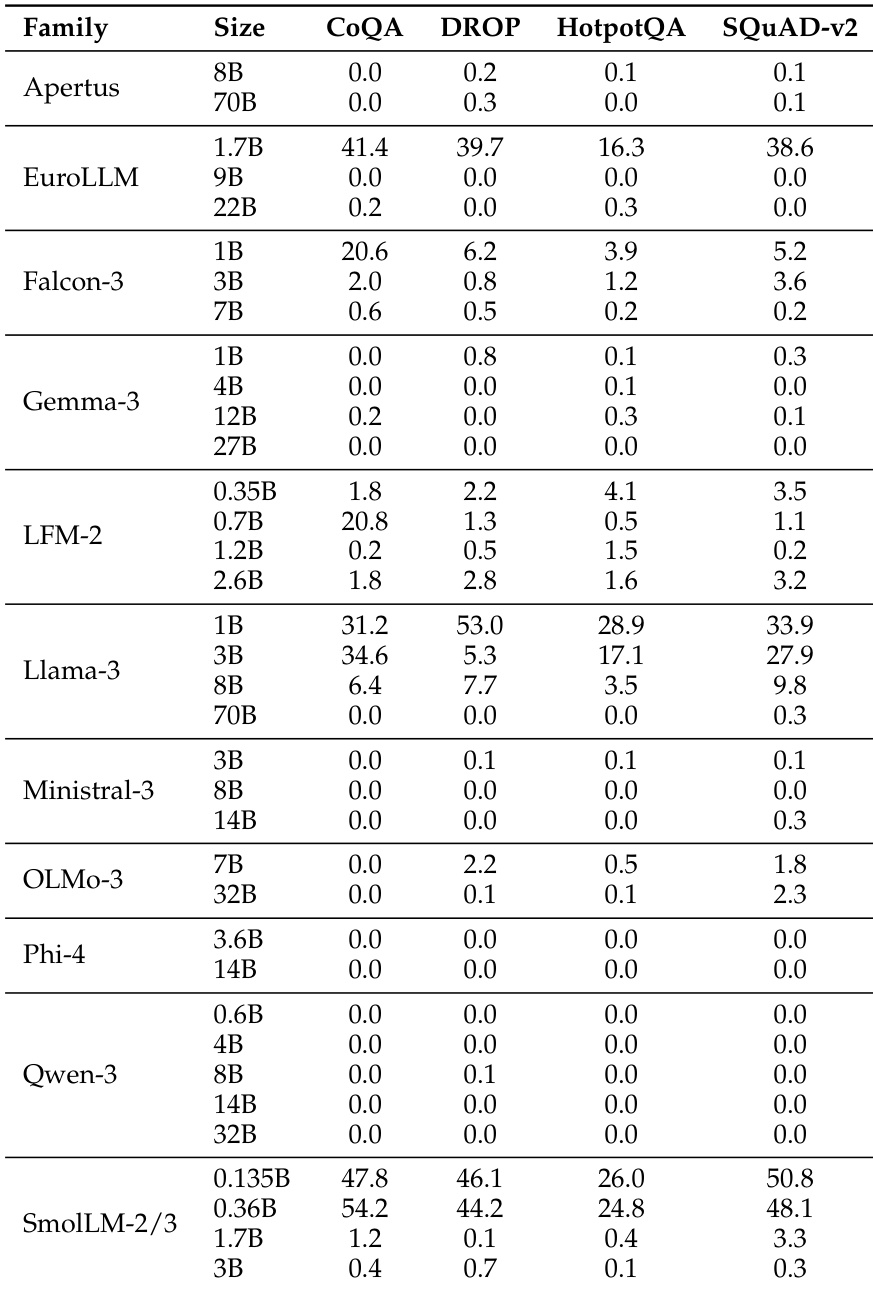
The the the table presents a comparison of model performance across multiple benchmarks for various model families and sizes. It highlights differences in accuracy across tasks, with some models achieving higher scores on certain benchmarks while others perform better on different ones, reflecting varying strengths across model architectures and sizes. Performance varies significantly across models and benchmarks, with no single model excelling in all tasks. Model size influences performance, with larger models generally showing higher accuracy on most benchmarks. Different model families exhibit distinct strengths, with some performing better on specific tasks like CoQA or DROP.
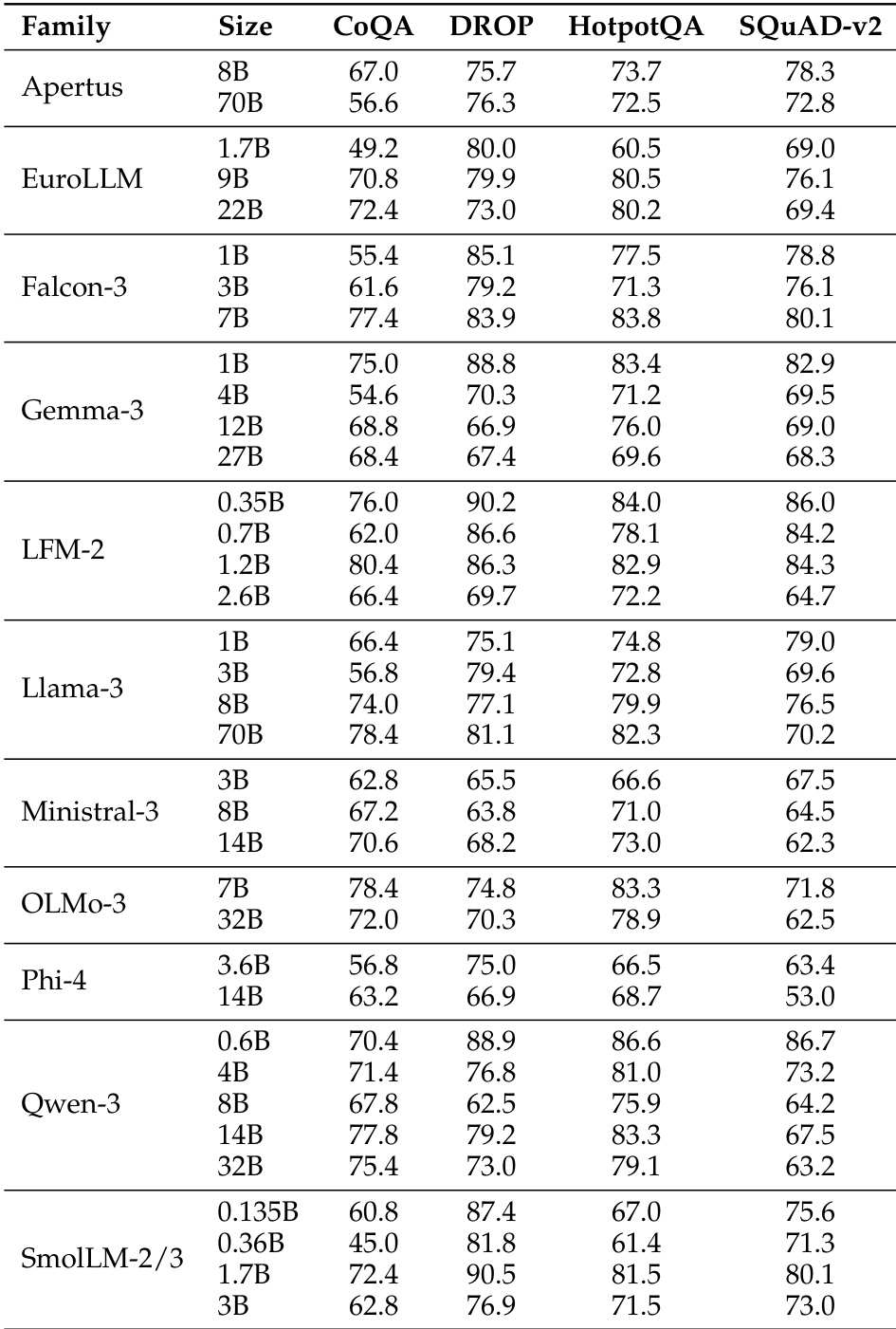
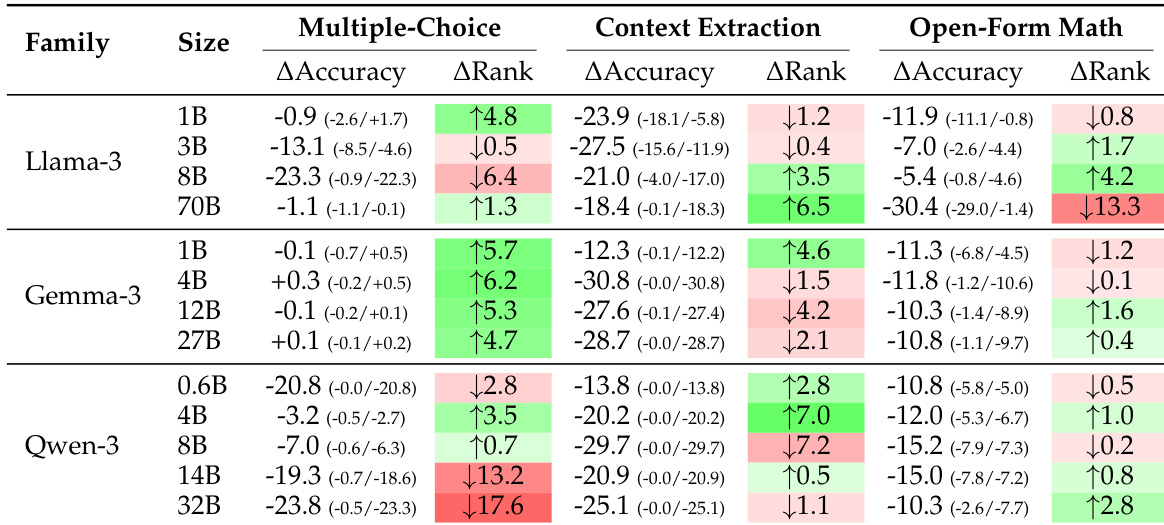
The authors compare BERT-as-a-Judge to regex-based and LLM-as-a-Judge methods, finding that the encoder-based approach achieves higher accuracy across various benchmarks. Results show that regex-based evaluation leads to significant performance distortions, while BERT-as-a-Judge demonstrates robustness and strong alignment with ground-truth labels. BERT-as-a-Judge achieves higher accuracy than regex-based evaluation across all benchmarks Regex-based evaluation causes substantial performance distortions and misranking BERT-as-a-Judge is robust to variations in answer formatting and generalizes well to out-of-domain tasks
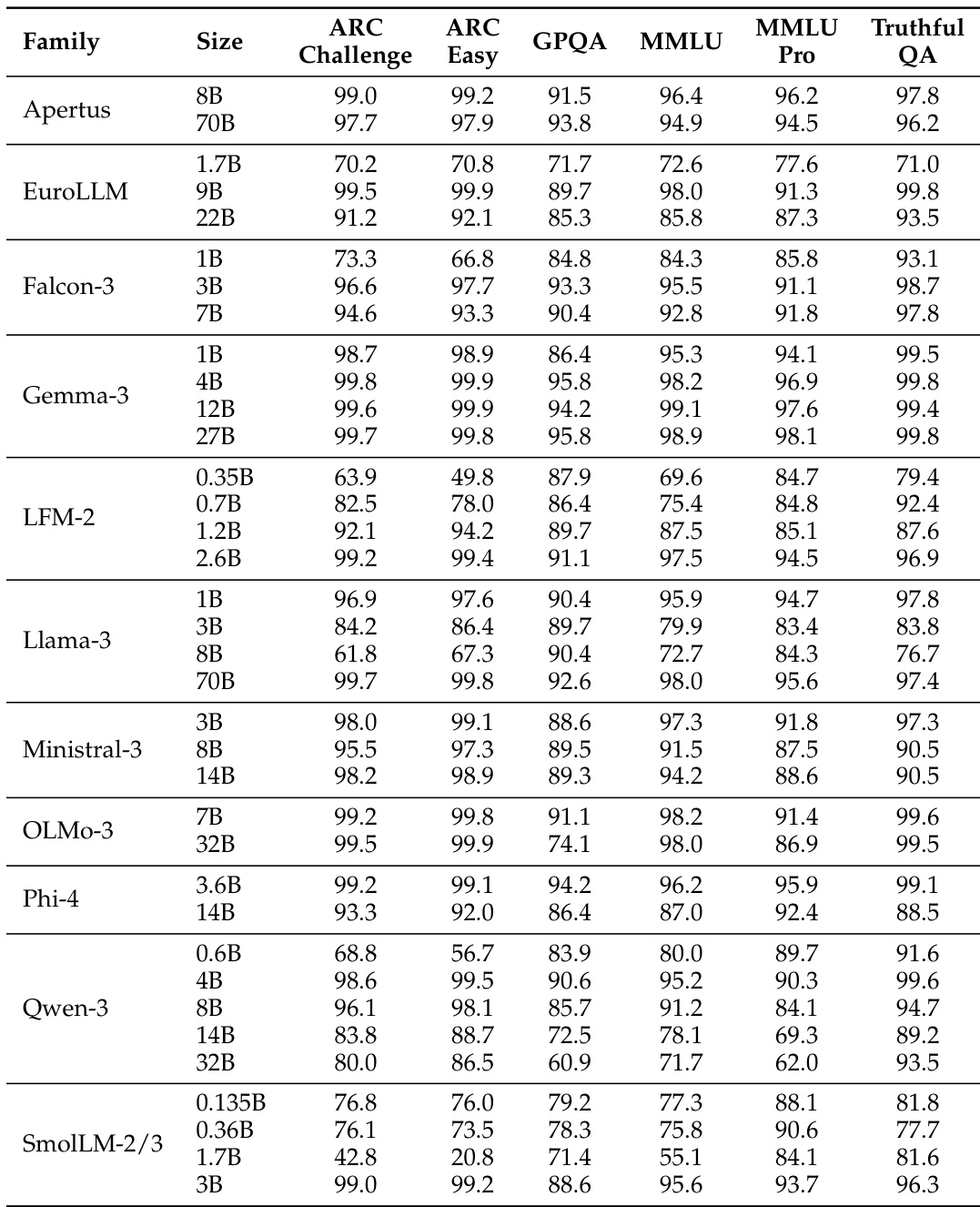
The authors evaluate the effectiveness of BERT-as-a-Judge by comparing it against regex-based and LLM-as-a-Judge methods across various task categories and model families. The results demonstrate that BERT-as-a-Judge provides superior accuracy and robustness, avoiding the performance distortions and misranking common in regex-based evaluation. While model performance varies based on architecture, size, and specific task requirements, the BERT-based approach maintains consistent alignment with ground-truth labels across diverse benchmarks.