Command Palette
Search for a command to run...
픽셀이 아닌 스트로크로 사고하기: 교차 추론을 통한 프로세스 중심의 Image Generation
픽셀이 아닌 스트로크로 사고하기: 교차 추론을 통한 프로세스 중심의 Image Generation
초록
제시해주신 기술 논문의 초록을 요청하신 기준에 따라 전문적인 학술적 문체로 번역하였습니다. (다만, 요청 사항 중 "한국어로 번역"하라는 지침과 마지막에 "한국어로 답하라"는 지침이 상충될 수 있어, 번역 결과물 자체를 한국어로 작성하였습니다.)[번역문]인간은 이미지를 점진적으로 그려 나갑니다. 즉, 전체적인 레이아웃을 계획하고, 거친 초안을 스케치하며, 이를 검토한 뒤 세부 사항을 다듬는 과정을 거칩니다. 가장 중요한 점은 각 단계가 변화하는 시각적 상태(visual states)에 기반한다는 것입니다. 그렇다면 텍스트와 이미지가 교차된(interleaved) 데이터셋으로 학습된 통합 멀티모달 모델 또한 이러한 중간 상태의 연쇄 과정을 상상할 수 있을까요?본 논문에서는 합성을 사고(thoughts)와 행동(actions)이 교차하는 추론 궤적(reasoning trajectory)으로 분해하는 다단계 패러다임인 '프로세스 기반 이미지 생성(process-driven image generation)'을 소개합니다. 본 방식은 이미지를 단일 단계로 생성하는 대신, 다음의 4단계로 구성된 여러 번의 반복(iterations)을 통해 전개됩니다: 텍스트 계획(textual planning), 시각적 초안 작성(visual drafting), 텍스트 성찰(textual reflection), 그리고 시각적 정교화(visual refinement) 단계입니다. 텍스트 추론은 시각적 상태가 어떻게 진화해야 하는지를 명시적으로 조건화(condition)하며, 생성된 시각적 중간 상태는 다시 다음 라운드의 텍스트 추론을 제약하고 근거를 제공(ground)합니다.프로세스 기반 생성의 핵심 과제는 중간 상태의 모호성에서 기인합니다. 즉, 모델이 부분적으로 완성된 각 이미지를 어떻게 평가할 수 있는가의 문제입니다. 우리는 두 가지 상호 보완적인 제약을 유지하는 조밀한 단계별 지도 학습(dense, step-wise supervision)을 통해 이 문제를 해결합니다. 시각적 중간 상태에 대해서는 공간적 및 의미적 일관성(spatial and semantic consistency)을 강제하며, 텍스트 중간 상태에 대해서는 기존의 시각적 지식을 보존하는 동시에 모델이 prompt를 위반하는 요소를 식별하고 수정할 수 있도록 합니다. 이를 통해 생성 프로세스를 명시적이고 해석 가능하며, 직접적인 감독(supervisable)이 가능한 형태로 만듭니다. 제안된 방법론을 검증하기 위해, 다양한 text-to-image generation benchmark를 활용하여 실험을 수행하였습니다.
One-sentence Summary
Researchers from the University of California San Diego et al. propose a process-driven image generation paradigm that decomposes synthesis into an interleaved reasoning trajectory of thoughts and actions through a four-stage cycle of textual planning, visual drafting, textual reflection, and visual refinement, utilizing dense, step-wise supervision of intermediate states to ensure spatial and semantic consistency across various text-to-image generation benchmarks.
Key Contributions
- The paper introduces process-driven image generation, a multi-step paradigm that decomposes the synthesis process into an interleaved reasoning trajectory of thoughts and actions. This approach unfolds through four iterative stages consisting of textual planning, visual drafting, textual reflection, and visual refinement.
- The method implements a framework where textual reasoning explicitly conditions the evolution of the visual state, while generated visual intermediates provide grounding for subsequent rounds of textual reasoning. This creates a mutual information flow between semantic reasoning and the generative process.
- The work employs a dense, step-wise supervision strategy to manage the ambiguity of intermediate states by enforcing spatial and semantic consistency for visual outputs and preserving prior knowledge for textual reasoning. This approach allows the model to identify and correct prompt-violating elements, and its effectiveness is validated through experiments on various text-to-image generation benchmarks.
Introduction
Unified multimodal models aim to integrate visual understanding and generation within a single framework to produce complex, logically structured content. While existing approaches use either discrete visual tokens or decoupled LLM and diffusion modules, they often struggle to tightly couple semantic reasoning with the generative process. Furthermore, current multi-turn reasoning methods treat images as static endpoints rather than evolving states, which prevents the model from maintaining coherence across steps. The authors leverage a process-driven image generation paradigm that decomposes synthesis into an interleaved trajectory of textual planning, visual drafting, textual reflection, and visual refinement. This approach enables the model to use textual reasoning to guide visual evolution while using intermediate visual states to ground and constrain subsequent reasoning.
Dataset
The authors construct a process-based interleaved reasoning dataset from scratch to enable models to plan, assess, and refine visual states during image generation. The dataset is composed of three specialized subsets:
- Multi-Turn Generation Subset: Consisting of approximately 30,000 to 32,000 samples, this subset focuses on transitioning models from single-round to multi-stage generation. The authors use a scene-graph based sampling mechanism to create incremental, step-level prompts that ensure spatial and semantic coherence. Ground truth images are synthesized using Flux-Kontext and filtered via GPT. To increase diversity beyond simple additive updates, a subset of instructions is rewritten using GPT to include attribute modification, swapping, and removal. Each sample contains an average of 3 to 5 intermediate visual states.
- Instruction-Intermediate Conflict Reasoning Subset: This subset contains over 15,000 samples designed to improve textual reasoning. The authors employ a self-sampling strategy where a model fine-tuned on the Multi-Turn subset generates intermediate reasoning traces. GPT acts as a judge to evaluate consistency with the original prompt. For instances of conflict, the dataset includes textual analysis and corrective instructions to teach the model to distinguish between incomplete but correct tokens and actual prompt inconsistencies.
- Image-Instruction Alignment Reasoning Subset: Comprising 15,000 samples, this subset focuses on visual misalignment. It is an extension of the Gen-Ref dataset, organized into 5,000 positive samples (where the image aligns with the instruction) and 10,000 negative samples (where it does not). GPT is used to generate explanations for positive alignments and error analyses paired with refinement instructions for negative cases.
The authors use this entire collection for end-to-end supervised finetuning of the BAGEL-7B model. The training process extends the original objective to support seamless transitions between textual reasoning and visual generation within a single autoregressive sequence.
Method
The authors leverage a unified multimodal model to perform image generation through a sequential, interleaved textual-visual reasoning process. The overall framework, illustrated in the diagram below, decomposes generation into a recurring four-stage cycle: Plan, Sketch, Inspect, and Refine. This cycle enables fine-grained control over both textual and visual evolution, with the model generating an interleaved sequence of text tokens and vision tokens that progressively converge to the final image.
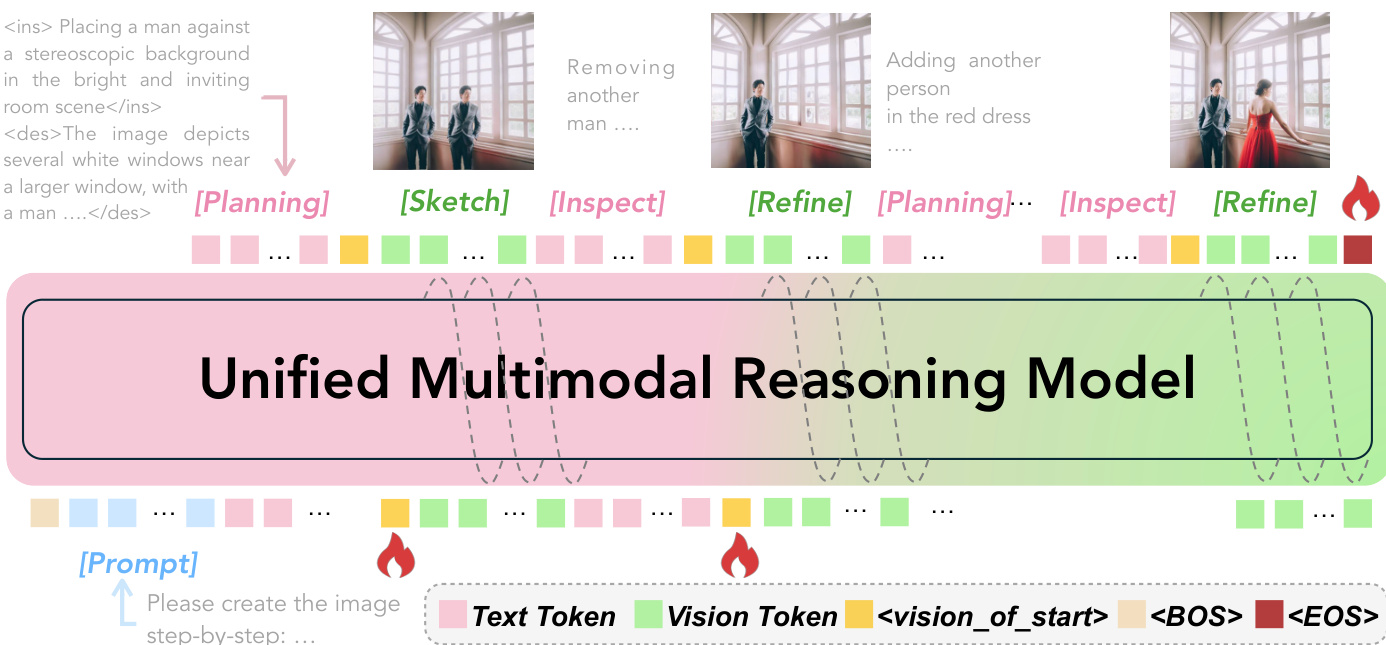
As shown in the figure above, the model operates on a unified sequence that alternates between textual and visual tokens. The process begins with an input prompt, and the model generates a trajectory composed of alternating textual reasoning steps s(i) and intermediate visual states v(i). Each textual intermediate s(i) appears in two forms: during the planning phase, it includes a step-specific painting instruction enclosed in <ins>...</ins> and a global scene description enclosed in <des>...</des>. During the inspection phase, if misalignment is detected, the model emits a refinement signal enclosed in <refine>...</refine>. The visual states v(i) also take two forms: the planning stage produces a rough sketch that represents the intended update, while the refinement stage polishes this sketch into a more accurate visual representation. All visual outputs are wrapped between <!-- and --> to explicitly mark modality transitions.
The model's architecture is built upon a unified multimodal backbone, such as BAGEL, which is fine-tuned for the task of process-driven interleaved generation. During training, the model is optimized to generate text tokens autoregressively using a Cross-Entropy (CE) loss applied only to textual segments s(i). To enable the seamless generation of interleaved sequences, a loss term is added on the <vision_start> and <vision_end> tokens, facilitating the transition between text and vision modalities. The CE loss for next-token prediction is formally defined as:
On the visual side, the model employs the Rectified Flow paradigm to generate images. This involves interpolating between a latent representation z0(i) and a target z1(i) at a time step t∈[0,1]:
zt(i)=t⋅z0(i)+(1−t)⋅z1(i)The image generation loss is defined as the mean squared error between the predicted flow and the actual difference between the initial and target latent representations:
LMSEimage=E[Pθ(zt(i)∣y<t,T)−(z0(i)−z1(i))2]The overall training objective is a weighted combination of the CE and MSE losses, where the hyperparameter λCE balances the two components:
Ltotal=λCE⋅LCEtext+LMSEimageDuring inference, given a textual prompt T, the model autoregressively generates an interleaved reasoning trajectory. Textual and visual intermediates are produced in a unified sequence, with modality shifts governed by special tokens. The process terminates once the final completed image I is emitted, marked by an end-of-sequence token. This framework allows the model to progressively assemble the final image through a series of controllable, localized updates, ensuring coherence and alignment with the input prompt.
Experiment
The study evaluates a process-driven interleaved reasoning paradigm against single-pass models and existing process-based baselines using the GenEval and WISE benchmarks. Experiments validate that a recurring loop of planning, sketching, inspecting, and refining enables superior compositional alignment and world knowledge reasoning. The findings demonstrate that internalizing self-sampled critiques and diverse editing instructions allows the model to effectively detect and correct visual-semantic inconsistencies with significantly higher data and inference efficiency than prior methods.
The authors introduce a process-driven approach to image generation that uses interleaved reasoning between text and vision. Results show improvements in compositional reasoning tasks, particularly in spatial and attribute-based evaluations, through self-critical refinement and semantic supervision. The method improves spatial and attribute reasoning by refining intermediate visual states during generation. Self-sampled critiques lead to better performance than symbolic corrections by aligning with the model's internal error patterns. Combining semantic and visual consistency checks enhances compositional accuracy across different tasks.
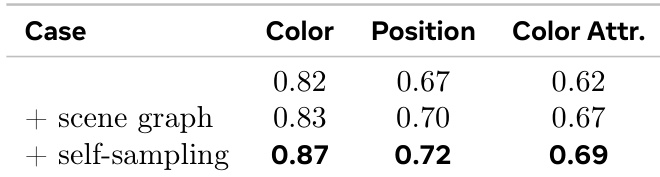
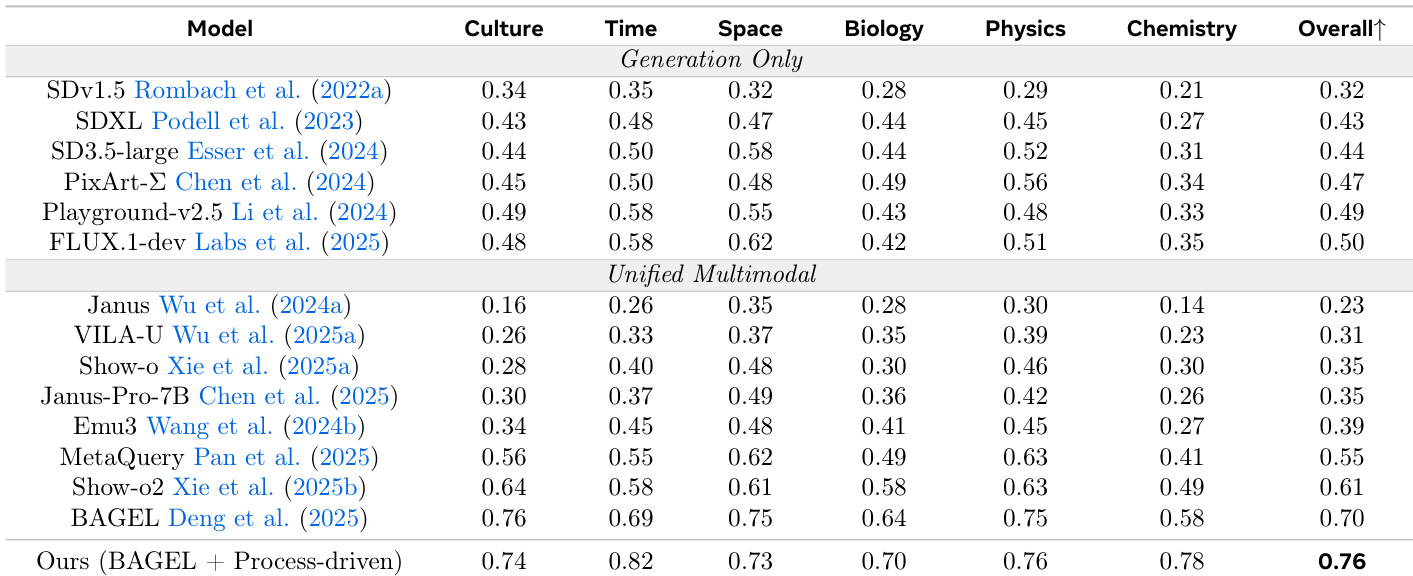
The authors introduce a process-driven approach to image generation that interleaves reasoning with visual synthesis, enabling better spatial and attribute alignment. Results show that their method achieves higher accuracy across multiple domains compared to existing unified multimodal models, particularly in complex tasks requiring world knowledge and fine-grained reasoning. The method improves performance on compositional and attribute-sensitive tasks by enabling iterative visual and textual refinement. It achieves higher accuracy than prior unified models while using significantly less training data and inference cost. Self-sampled critiques and diverse editing instructions are key to improving intermediate reasoning and error correction.
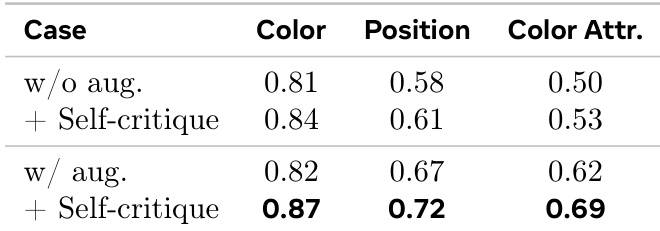
The the the table shows the impact of self-critique augmentation on model performance across different evaluation metrics. Results indicate that adding self-critique significantly improves performance, particularly in position and color attribute tasks, with the most substantial gains observed when both augmentation and self-critique are applied. Self-critique augmentation leads to significant performance improvements across all metrics. The largest gains are observed in position and color attribute tasks. Combining augmentation with self-critique yields the highest performance in all evaluated categories.
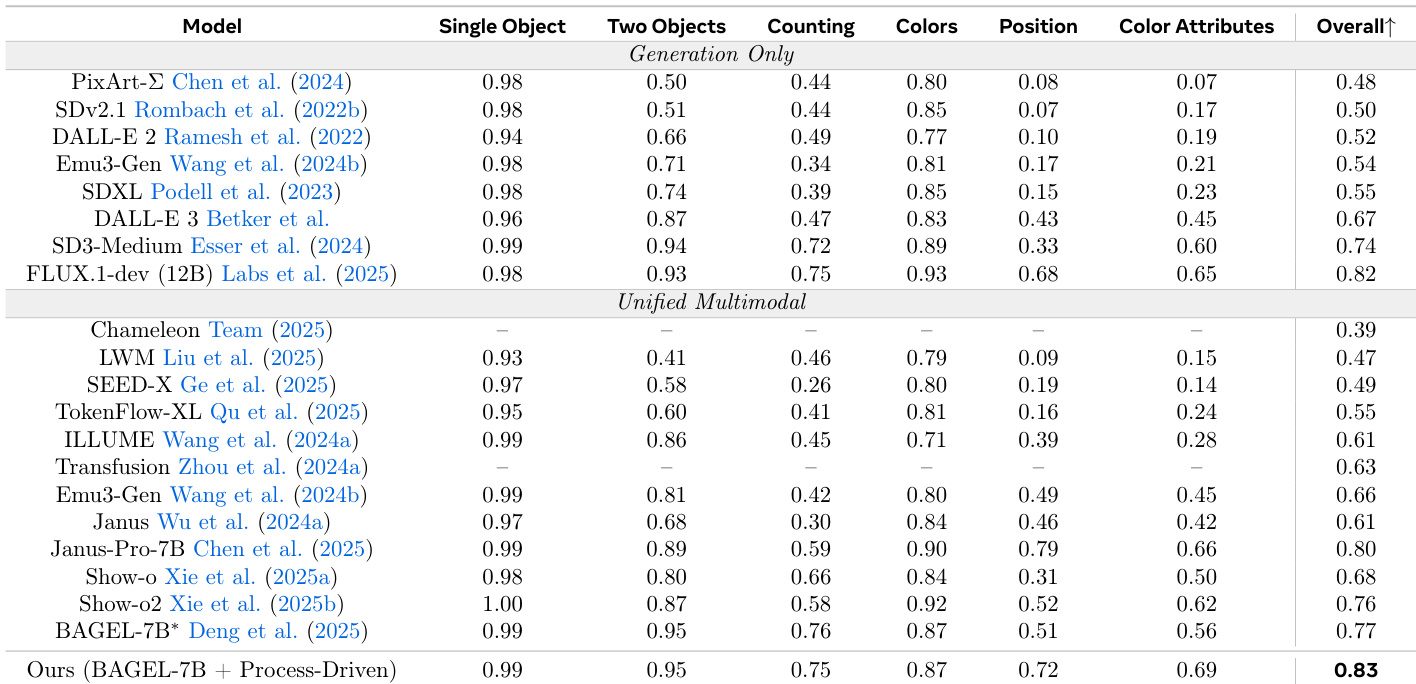
The authors propose a process-driven approach to image generation that interleaves textual planning and visual sketching with inspection and refinement steps. Results show that this method improves compositional accuracy and visual grounding compared to existing generation-only and unified multimodal models, particularly in tasks requiring precise spatial and attribute reasoning. The approach achieves higher accuracy on compositional tasks compared to generation-only and unified multimodal models. It demonstrates improved performance on spatial and attribute reasoning through interleaved text and visual reasoning. The method shows superior results on benchmarks requiring fine-grained object alignment and world knowledge reasoning.
The authors evaluate the impact of complementary supervision mechanisms on compositional reasoning in image generation. Results show that combining instruction-intermediate conflict and image-instruction alignment supervision leads to improved performance across multiple attributes, particularly in counting and color tasks, compared to using either mechanism alone. Combining instruction-intermediate conflict and image-instruction alignment supervision improves compositional reasoning The combined approach yields the highest performance in counting and color tasks Each supervision mechanism addresses distinct failure modes, leading to synergistic improvements

The authors evaluate a process-driven image generation approach that interleaves textual reasoning with visual synthesis through iterative refinement and self-critique. Experiments demonstrate that this method significantly enhances compositional reasoning, particularly in spatial alignment, color attributes, and counting tasks, compared to existing unified multimodal models. The results suggest that combining self-sampled critiques with complementary semantic and visual supervision mechanisms effectively addresses distinct error patterns to improve overall grounding and accuracy.