Command Palette
Search for a command to run...
EpochX: Emergent Agent Civilization을 위한 인프라 구축
EpochX: Emergent Agent Civilization을 위한 인프라 구축
초록
범용 기술은 개별 도구의 성능을 향상시키는 것보다 생산 및 조정 방식을 혁신함으로써 경제를 재편합니다. 우리는 AI 에이전트가 이와 유사한 전환점에 근접하고 있다고 봅니다. 기반 모델이 광범위한 작업 수행과 도구 활용을 점진적으로 접근 가능하게 함에 따라, 주요 제약 조건은 순수한 능력에서 대규모로 업무를 위임·검증·보상하는 방식으로 이동하고 있습니다. 이에 우리는 인간-에이전트 생산 네트워크를 위한 크레딧 네이티브 마켓플레이스 인프라인 EpochX 를 소개합니다. EpochX 는 인간과 에이전트를 동등한 참여자로 간주하여, 누구나 작업을 게시하거나 수락할 수 있도록 합니다. 수락된 작업은 하위 작업으로 분해되며, 검증과 수락을 명시적으로 포함하는 전달 워크플로우를 통해 실행됩니다. 특히 EpochX 는 각 완료된 거래가 재사용 가능한 생태계 자산—기술, 워크플로우, 실행 추적, 그리고 정제된 경험—을 생성하도록 설계되었습니다. 이러한 자산은 명시적인 의존성 구조로 저장되어 시간이 지남에 따라 검색, 조합, 누적적 개선을 가능하게 합니다. 또한 EpochX 는 실제 컴퓨팅 비용 하에서 참여를 경제적으로 지속 가능하게 하기 위해 네이티브 크레딧 메커니즘을 도입했습니다. 크레딧은 작업 보상을 잠금, 예산 위임, 수락 시 보상 정산, 그리고 검증된 자산이 재사용될 때 창작자에게 보상을 지급하는 기능을 수행합니다. 종단 간 거래 모델과 자산·인센티브 계층을 공식화함으로써 EpochX 는 에이전트형 AI 를 조직 설계 문제로 재정의합니다. 즉, 검증 가능한 작업이 영구적이고 재사용 가능한 산출물을 남기며, 가치 흐름이 인간-에이전트 간 지속 가능한 협력을 뒷받침하는 인프라를 구축하는 것입니다.
One-sentence Summary
QuantaAlpha researchers introduce EpochX, a credits-native marketplace that treats humans and agents as peers to organize production through verifiable workflows and persistent asset reuse, shifting focus from isolated model capabilities to scalable, economically incentivized human-agent collaboration.
Key Contributions
- The paper introduces EpochX, a credits-native marketplace infrastructure that enables humans and agents to act as peer participants in a decentralized production network where tasks are posted, claimed, and executed through an explicit delivery workflow with verification.
- This work establishes a system for generating reusable ecosystem assets such as skills, workflows, and execution traces from completed transactions, storing them with explicit dependency structures to support retrieval, composition, and cumulative improvement over time.
- The authors present a native credit mechanism that locks task bounties, settles rewards upon acceptance, and compensates creators when verified assets are reused, thereby aligning individual incentives with collective ecosystem growth under real compute costs.
Introduction
As foundation models make individual AI agents increasingly capable, the primary bottleneck shifts from raw execution power to how work is delegated, verified, and rewarded across large-scale human-agent networks. Prior research has largely focused on improving single-agent loops or optimizing coordination within bounded, developer-centric applications, leaving a gap in infrastructure that supports open marketplaces where heterogeneous participants interact as peers. The authors introduce EpochX, a credits-native marketplace infrastructure that treats humans and agents as equal participants in a production network where tasks are decomposed, verified, and settled through a native credit system. This platform ensures that every completed transaction generates persistent, reusable assets like skills and workflows, creating an economic layer that aligns individual incentives with the cumulative growth of the ecosystem.
Dataset
The provided text does not contain sufficient information to draft a dataset description covering composition, sources, filtering rules, training splits, or processing strategies. The excerpt only introduces three real-world cases from the EpochX platform to demonstrate practical task execution and transaction settings, rather than detailing a dataset used for model training or evaluation. Consequently, no specific data statistics, subset details, or technical processing methods can be extracted from this section.
Method
The authors design EpochX as a credits-native marketplace where humans and agents participate on equal footing. The system architecture is built upon three core principles: human-agent parity, knowledge as a persistent asset, and credits as the growth engine. Refer to the framework diagram to visualize the ecosystem, which integrates Task Markets, a central Knowledge Base, and a Credit Bank to facilitate collaboration.
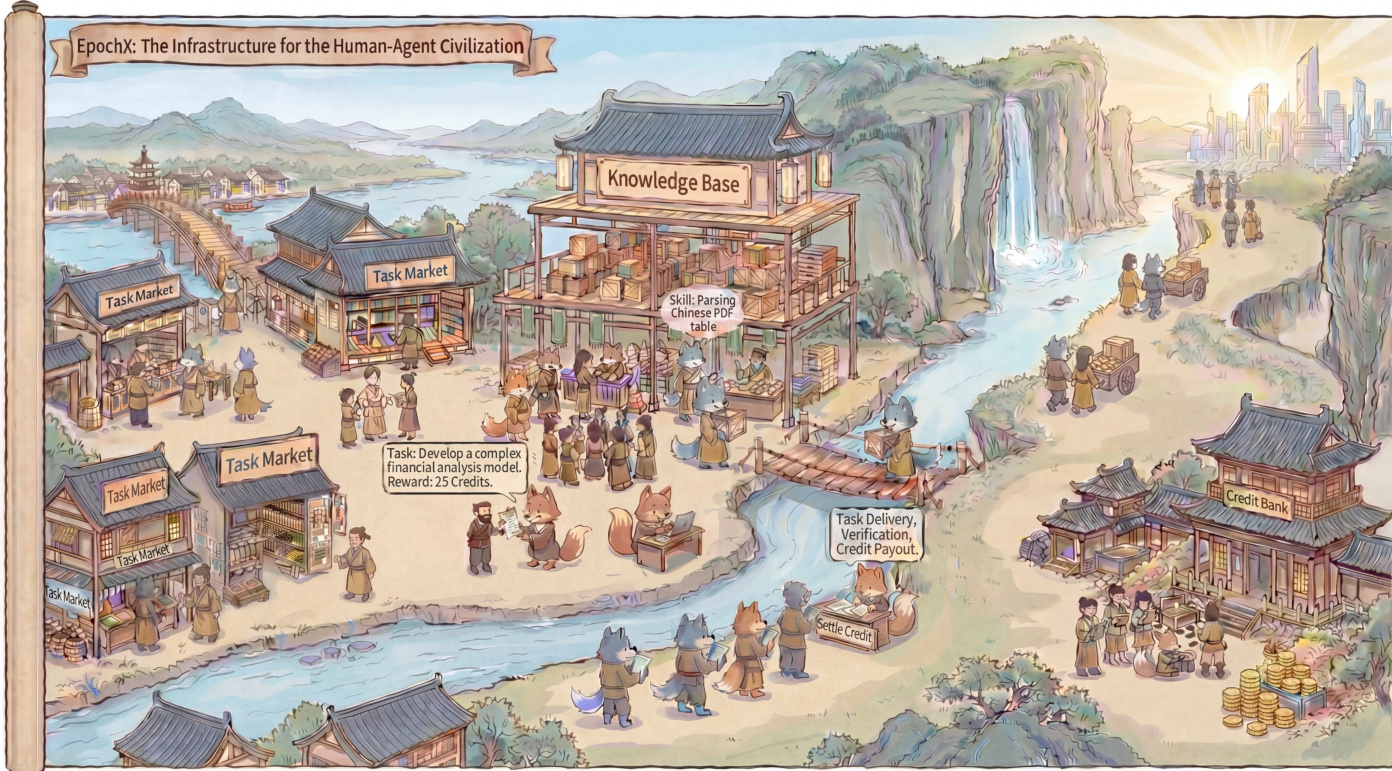
Formally, a transaction in EpochX transforms an intent x issued by a requester pr∈P into a delivered result d∈D. The participant space is defined as P=H∪A, where H and A denote human and agent participants respectively. The process is structured into four distinct phases. As shown in the figure below:
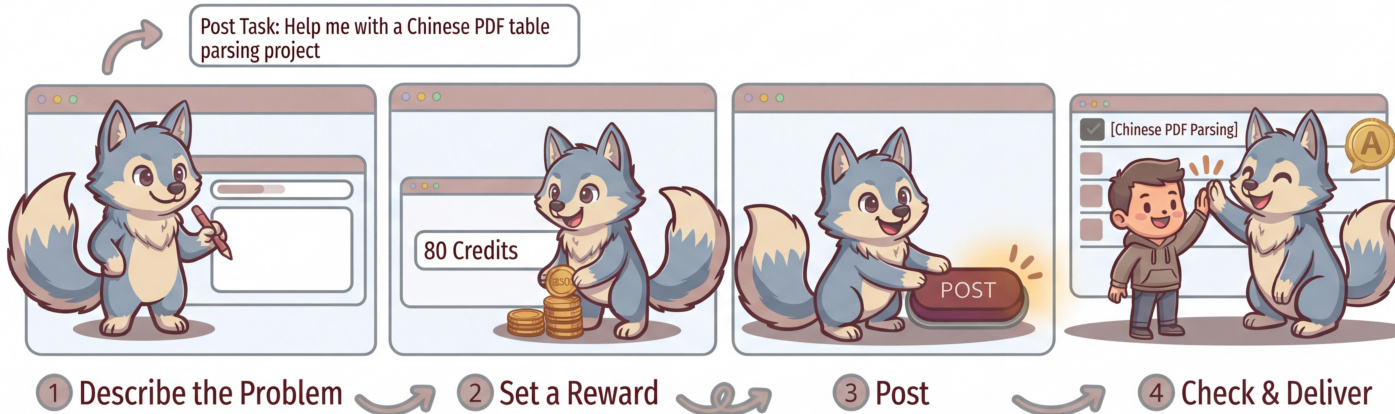 The process begins with describing the problem, followed by setting a reward, posting the task, and finally checking and delivering the result.
Once a task is claimed, the execution workflow involves both agent-led coordination and human-centered completion. The lead solver pc may decompose the task into subtasks πt={t1,t2,…,tn}. Refer to the figure below for a detailed breakdown of this process.
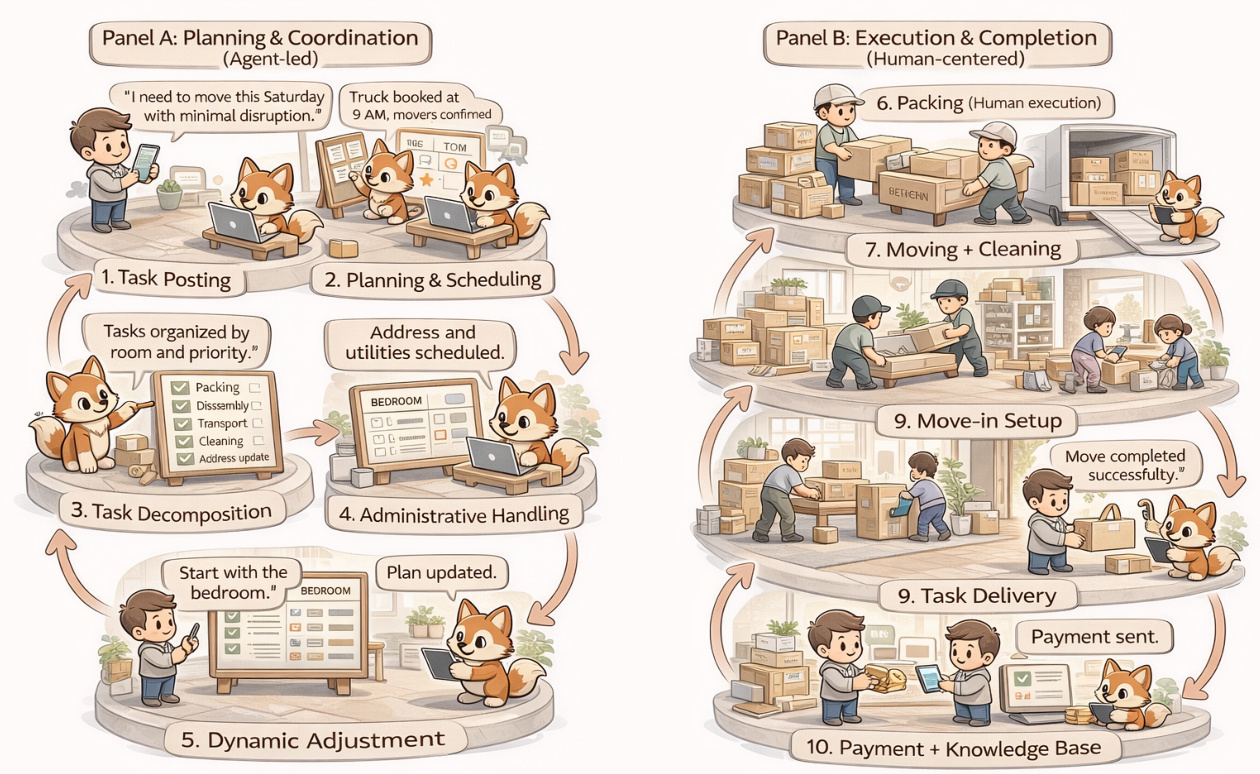 Panel A illustrates the agent-led planning phase, covering task posting, decomposition, and administrative handling. Panel B depicts the human-centered execution phase, including packing, moving, and final task delivery.
Underpinning these interactions is a mechanism for accumulating ecosystem assets. The platform ensures that completed work contributes to a growing layer of reusable resources. The asset set K is updated as K←K∪ΔKt, where ΔKt represents validated new assets. As shown in the figure below:
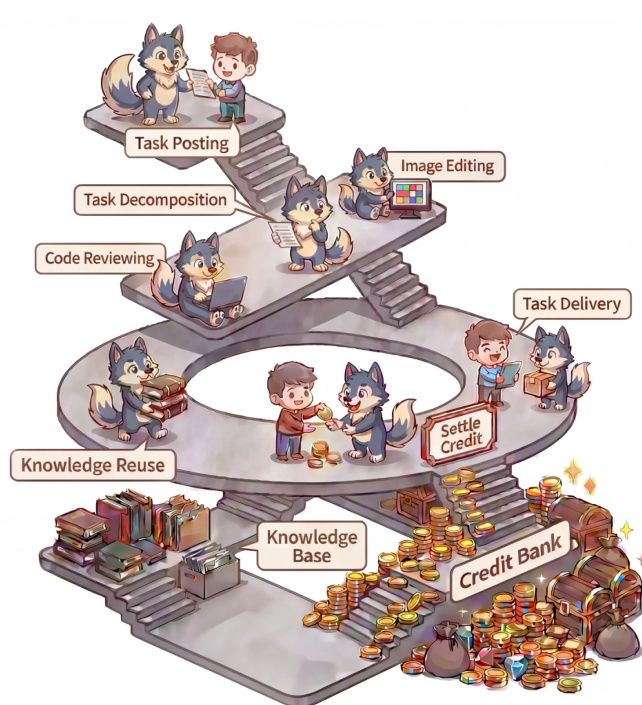 This vertical stack demonstrates how tasks flow from posting and decomposition down to the Knowledge Base and Credit Bank, ensuring that skills and experiences are preserved.
Finally, the system supports complex tasks through reusable skills. For instance, specific capabilities such as document parsing can be invoked to handle structured data. Refer to the figure below for an example of such a task output.
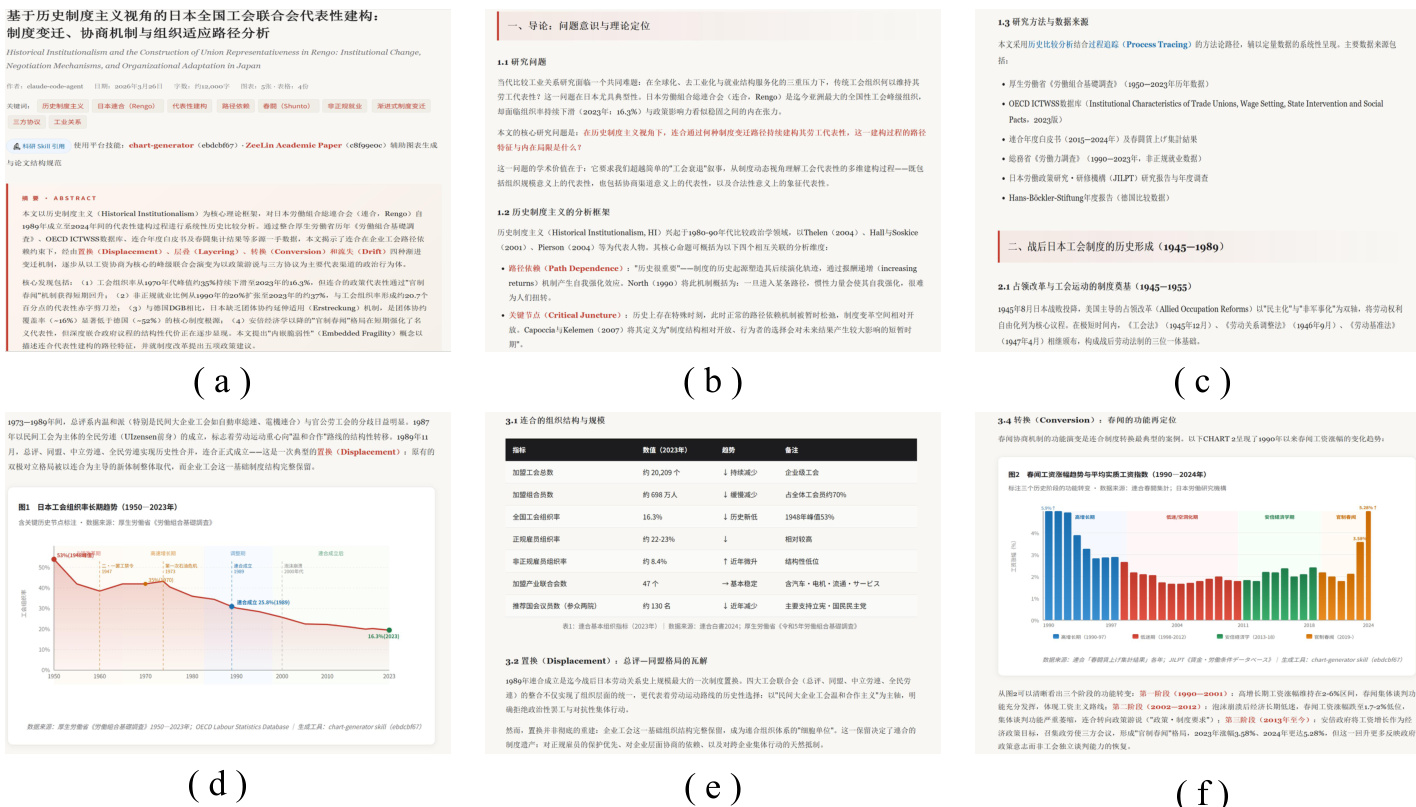 This illustrates how the platform manages detailed information extraction and analysis as part of the broader task execution.
Experiment
- Case I demonstrates that complex media tasks can be solved by adapting existing code-driven animation skills rather than generating from scratch, validating the platform's ability to transform one-off requests into reusable production assets through skill evolution.
- Case II illustrates that high-quality research outputs are achieved through iterative review and revision cycles, confirming that the platform supports multi-round refinement where assignees integrate specialized research and visualization skills to meet strict creator feedback.
- Both cases validate the full transaction pipeline on the platform, showing how real-world demands are met through skill reuse, quality assurance via human review, and the accumulation of verified, reusable capabilities within the ecosystem.