Command Palette
Search for a command to run...
텍스트 데이터 통합
텍스트 데이터 통합
Md Ataur Rahman Dimitris Sacharidis Oscar Romero Sergi Nadal
초록
데이터는 다양한 형태로 존재합니다. 표면적으로 볼 때 데이터는 구조화된 (예: 관계형, 키 - 값 쌍) 또는 비구조화된 (예: 텍스트, 이미지) 형식으로 분류될 수 있습니다. 지금까지 기계는 엄격한 스키마를 따르는 구조화된 데이터를 처리하고 추론하는 데 상당히 능숙해 왔습니다. 그러나 데이터의 이질성은 다양한 범주의 데이터를 의미 있게 저장하고 처리하는 방식에 중대한 과제를 제기합니다. 데이터 엔지니어링 파이프라인의 핵심 요소인 데이터 통합 (Data Integration) 은 서로 다른 데이터 소스를 결합하여 최종 사용자에게 통합된 데이터 접근을 제공함으로써 이러한 문제를 해결합니다. 지금까지 대부분의 데이터 통합 시스템은 구조화된 데이터 소스만을 결합하는 데 의존해 왔습니다. 그러나 비구조화된 데이터 (즉, 자유 텍스트) 역시 활용되지 않은 방대한 지식을 내포하고 있습니다. 따라서 본 장에서는 먼저 텍스트 데이터 통합의 필요성을 논증한 후, 이와 관련된 과제, 최신 연구 동향 (state of the art), 그리고 해결되지 않은 문제들을 제시하고자 합니다.
One-sentence Summary
The authors propose a comprehensive framework for integrating textual data with structured sources using Knowledge Graphs and LLMs to overcome heterogeneity, enabling data discovery, sparsity mitigation, and augmentation across diverse enterprise scenarios.
Key Contributions
- The chapter presents a case for integrating textual data with structured sources to address data heterogeneity, leveraging Knowledge Graphs as a unified representation model that captures semantic relationships and contextual information.
- The work outlines three specific benefits of this integration approach, demonstrating how textual data can mitigate data sparsity, enable data discovery, and enhance integration through data augmentation with concrete motivating examples.
- The text identifies the need for a scalable and automated framework that combines techniques from Natural Language Processing, Machine Learning, and the Semantic Web to overcome the limitations of current systems that rely on manual extraction of structured information from text.
Introduction
Data integration is essential for unifying disparate sources, yet traditional systems struggle to incorporate the vast amounts of unstructured text that hold critical contextual knowledge. Prior approaches often rely on fixed schemas or require extensive manual annotation, making them ill-suited for handling the semantic ambiguity, heterogeneity, and dynamic nature of real-world textual data. The authors address these gaps by advocating for a framework that leverages Knowledge Graphs and advanced NLP techniques, including LLMs and RAG, to automatically conceptualize text and enrich structured datasets. This approach aims to mitigate data sparsity, enable discovery of implicit relationships, and support scalable schema evolution without the heavy resource costs of retraining models for every new integration scenario.
Dataset
- The dataset integrates disjoint structured medical records with unstructured clinical text to bridge schema gaps and discover new relationships.
- Structured sources include a Disease Dataset containing diagnoses and surgeries, a Complication Dataset tracking adverse events and drugs, a Patients Table with demographics, and a Medications Table listing prescriptions.
- Unstructured data consists of clinical book excerpts and patient notes that provide context for linking entities like anatomy, organs, and specific medical conditions.
- The authors use textual data to perform data augmentation by extracting inferred concepts and join-paths, such as connecting diseases to complications via anatomical entities.
- Processing involves identifying relationships in text to create new associative tables, such as a Prescription Table that links patients to medications without shared primary keys.
- This approach enables schema evolution and instance enrichment, allowing the system to adapt to previously unknown information and produce a unified view for complex queries.
Method
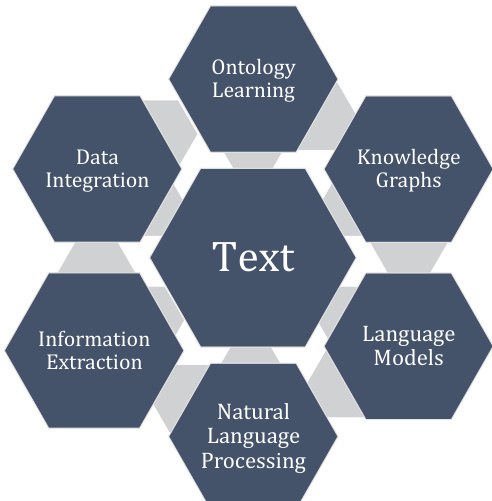
The authors propose a comprehensive framework for text data integration, positioning Ontology Learning (OL) as the central mechanism to transform unstructured text into structured Knowledge Graphs (KGs). As illustrated in the central framework diagram, this approach integrates various NLP components, including Information Extraction, Language Models, and Data Integration, to facilitate robust reasoning and data management.
The construction of the ontology follows a hierarchical progression, moving from basic linguistic units to complex logical rules. Refer to the hierarchical structure diagram which outlines these levels, starting from Terms and Synonyms, advancing to Concepts and Concept Hierarchies, then Relations, and finally culminating in Concept and Relation Representation and Axioms.
The initial phase involves concept extraction, where entities are identified from text using techniques such as Named Entity Recognition (NER), co-reference resolution, or syntactic parsing. More recent practices utilize neural Language Models (LMs) based on transformer architectures, such as BERT or T5, to extract concepts in a supervised manner. These concepts are then organized into taxonomic relationships (hypernym/hyponym) using lexico-syntactic patterns or distributional semantics.
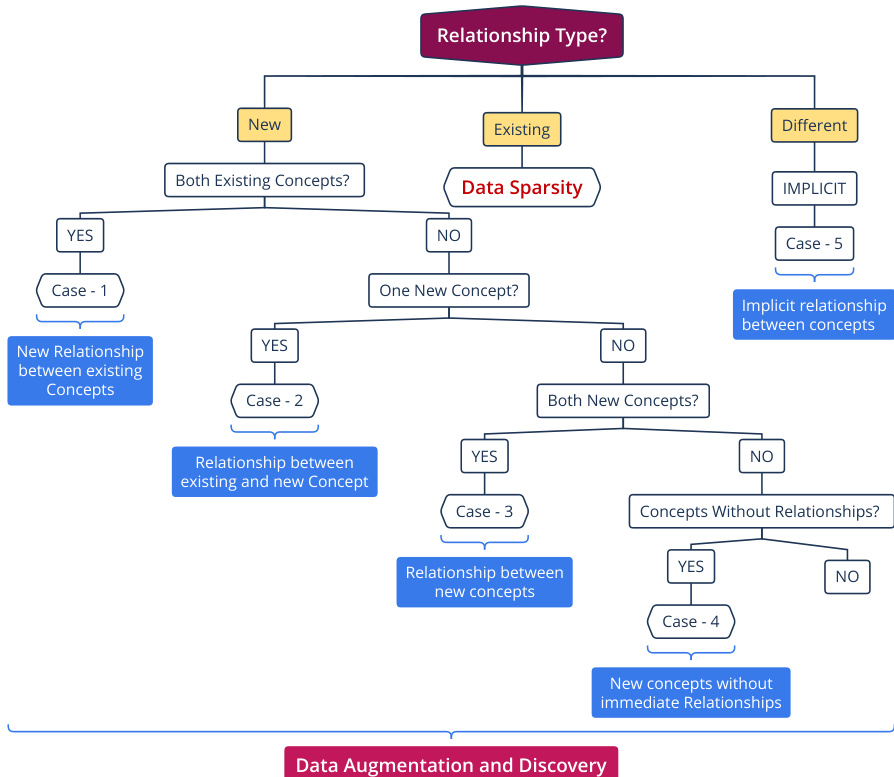
Following concept identification, the method focuses on extracting non-taxonomic relations, such as attributes, thematic roles, meronymy, and causality. The system categorizes relationship types based on the status of the underlying concepts (existing vs. new) to handle data sparsity and facilitate discovery. The decision process for relationship types is detailed in the flowchart, which branches into cases for new relationships between existing concepts, relationships involving new concepts, and implicit relationships.
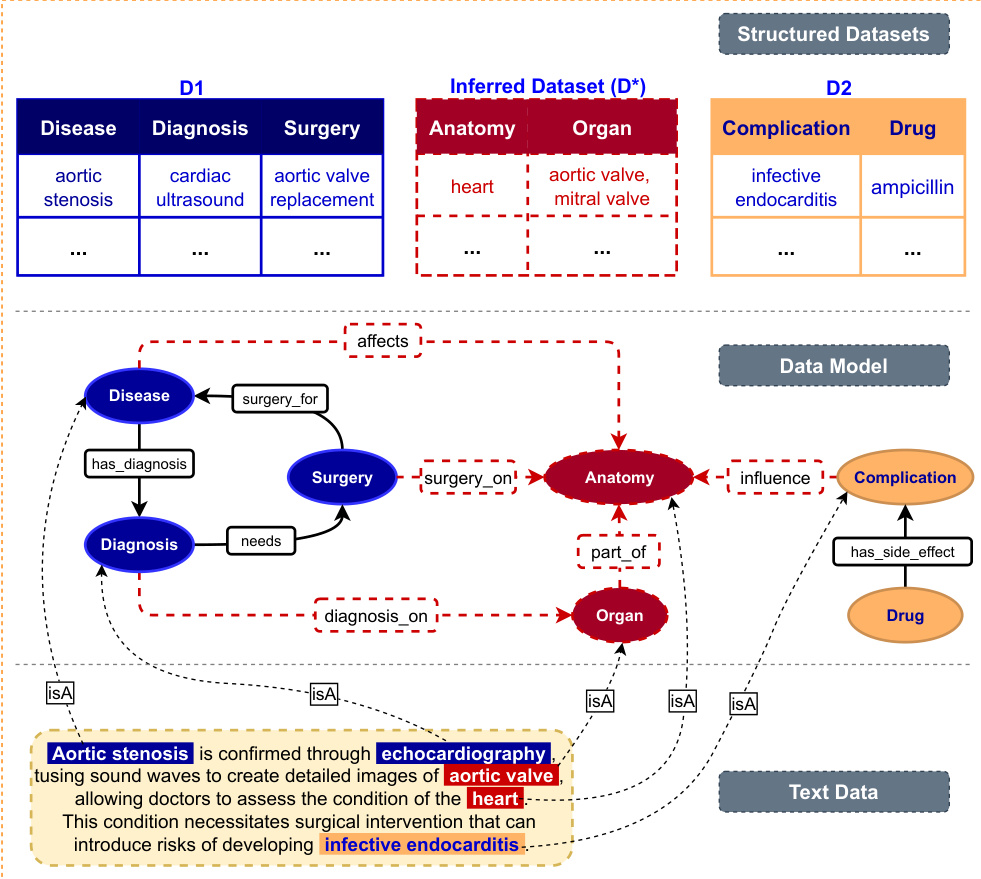
To represent this data, the authors advocate for modeling the information as a Knowledge Graph with a dynamic schema, utilizing representation languages like RDF, RDFS, and OWL. This allows for high-level abstraction and reasoning capabilities that simple data graphs lack. The final Data Model integrates structured datasets with inferred data derived from text, linking entities such as Disease, Surgery, and Anatomy through defined relationships like surgery_for or affects.
The process concludes with the definition of Axioms, which are rules and constraints that govern the interaction between concepts and relations. These axioms, often expressed in first-order logic or description logics, add expressivity to the ontology and are crucial for automatic reasoning and knowledge discovery within the domain.