Command Palette
Search for a command to run...
보이지 않지만 잊히지 않는다: 동적 비디오 월드 모델을 위한 하이브리드 메모리
보이지 않지만 잊히지 않는다: 동적 비디오 월드 모델을 위한 하이브리드 메모리
Kaijin Chen Dingkang Liang Xin Zhou Yikang Ding Xiaoqiang Liu Pengfei Wan Xiang Bai
초록
비디오 월드 모델은 물리적 세계를 시뮬레이션하는 데 있어 막대한 잠재력을 입증해 왔으나, 기존 메모리 메커니즘은 주로 환경을 정적인 캔버스로 간주합니다. 동적 주체가 시야에서 사라졌다가 다시 나타나는 상황에서 현재 방법론들은 종종 어려움을 겪어 주체가 고정되거나 왜곡되기도 하고 소멸하기도 합니다. 이러한 한계를 극복하기 위해 우리는 '하이브리드 메모리(Hybrid Memory)'라는 새로운 패러다임을 제시합니다. 이는 모델이 정적 배경에 대해서는 정밀한 기록 보관자로서, 동적 주체에 대해서는 경계 태세를 갖춘 추적자로서 동시에 작동하도록 하여 시야 밖 구간에서도 운동 연속성을 보장합니다. 본 연구 방향의 발전을 촉진하기 위해 우리는 하이브리드 메모리에 전념한 최초의 대규모 비디오 데이터셋인 HM-World 를 구축했습니다. HM-World 는 카메라와 주체의 궤적이 분리된 59,000 개의 고정밀 클립으로 구성되며, 17 가지 다양한 장면, 49 개의 고유한 주체, 그리고 하이브리드 일관성을 엄격하게 평가하기 위해 정교하게 설계된 진입 - 퇴장 이벤트를 포함하고 있습니다. 또한, 우리는 메모리를 토큰으로 압축하고 시공간적 관련성 기반 검색 메커니즘을 활용하는 전용 메모리 아키텍처인 HyDRA 를 제안합니다. HyDRA 는 관련 운동 단서에 선택적으로 주의를 기울여 숨겨진 주체의 정체성과 운동을 효과적으로 유지합니다. HM-World 를 통한 광범위한 실험 결과, 제안된 방법은 동적 주체 일관성과 전반적인 생성 품질 측면에서 기존 최첨단 방법론들을 압도적으로 능가하는 것을 확인했습니다.
One-sentence Summary
Researchers from Huazhong University of Science and Technology and Kling Team propose Hybrid Memory, a paradigm for video world models that maintains static backgrounds while tracking dynamic subjects. Their HyDRA architecture uses spatiotemporal retrieval to preserve motion consistency during out-of-view intervals, validated on the new HM-World dataset.
Key Contributions
- The paper introduces Hybrid Memory, a novel paradigm that requires models to simultaneously maintain spatial consistency for static backgrounds and motion continuity for dynamic subjects during out-of-view intervals.
- This work presents HM-World, the first large-scale video dataset dedicated to hybrid memory research, featuring 59K high-fidelity clips with decoupled camera and subject trajectories to rigorously evaluate spatiotemporal coherence.
- A specialized memory architecture named HyDRA is proposed, which compresses memory into tokens and employs a spatiotemporal relevance-driven retrieval mechanism to effectively rediscover hidden subjects and preserve their identity and motion.
Introduction
Video world models are critical for applications like autonomous driving and embodied intelligence, yet current memory mechanisms treat environments as static canvases that fail when dynamic subjects move out of view. Existing approaches often cause hidden characters to vanish, freeze, or distort upon re-emergence because they lack the ability to track independent motion logic during occlusion. The authors introduce Hybrid Memory, a new paradigm that requires models to simultaneously archive static backgrounds and predict the unseen trajectories of dynamic subjects. To support this, they release HM-World, the first large-scale dataset featuring decoupled camera and subject movements, and propose HyDRA, a specialized architecture that uses spatiotemporal relevance-driven retrieval to preserve identity and motion continuity for hidden entities.
Dataset
-
Dataset Composition and Sources: The authors introduce HM-World, a large-scale synthetic dataset built to address the scarcity of natural videos featuring exit-entry events. It is generated entirely within Unreal Engine 5 by procedurally combining four core dimensions: 17 diverse 3D scenes, 49 distinct subjects (humans and animals), 10 predefined subject trajectories, and 28 designed camera trajectories.
-
Key Details for Each Subset: The final collection consists of 59,225 high-fidelity video clips. Each clip features 1 to 3 subjects moving along random paths while the camera executes deliberate back-and-forth motions to force subjects to leave and re-enter the frame. The dataset is unique in its inclusion of specific in-and-out-of-frame dynamics, unlike existing datasets that either lack dynamic subjects, keep subjects always visible, or use static cameras.
-
Usage in the Model: This dataset serves as a dedicated testing ground and training resource for Hybrid Memory in Video World Models. It enables the model to learn spatiotemporal decoupling by simultaneously anchoring static backgrounds and tracking dynamic subjects that disappear and reappear, a capability essential for maintaining visual identity and consistent motion states during out-of-view extrapolation.
-
Processing and Metadata Construction: The rendering pipeline filters out any clips that fail to produce exit-entry events. Every retained sample is comprehensively annotated with the rendered video, a descriptive caption generated by MiniCPM-V, precise camera poses, per-frame 3D positions for all subjects, and exact timestamps marking when each subject exits and enters the frame.
Method
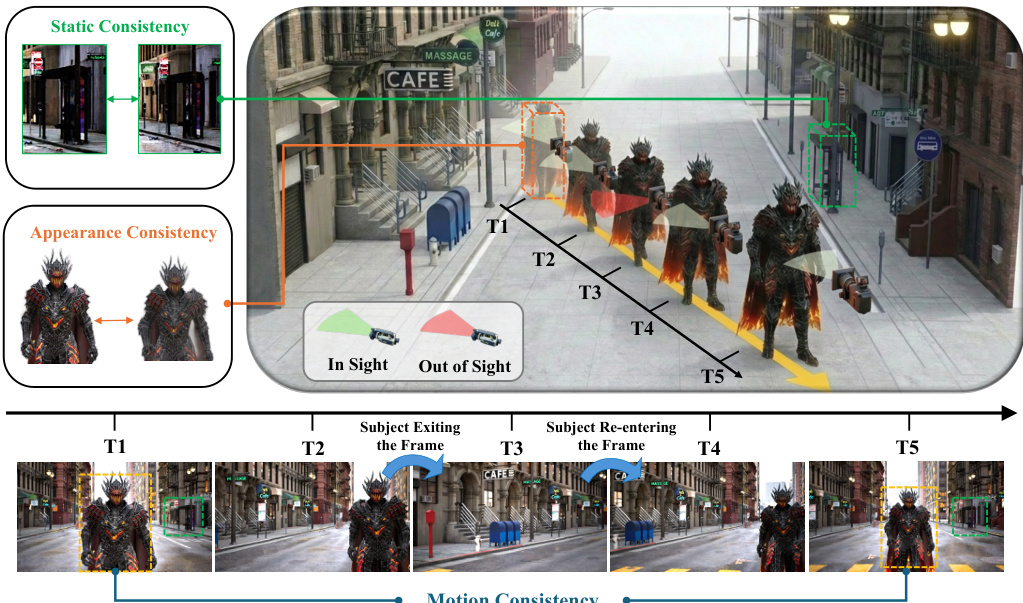
The authors address the challenge of generating consistent video sequences where dynamic subjects frequently exit and re-enter the camera's field of view. As illustrated in the conceptual diagram, maintaining static, appearance, and motion consistency across time steps (T1 to T5) is critical when subjects are occluded or out of sight. To achieve high-fidelity future frame prediction, the model must preserve the static background while actively seeking moving subjects to maintain their appearance and motion consistency.
The overall framework is built upon a full-sequence video diffusion model. Refer to the framework diagram for the complete pipeline structure. The architecture comprises a causal 3D VAE for spatiotemporal compression and a Diffusion Transformer (DiT) for generation. The model follows Flow Matching, where the diffusion timestep is encoded via an MLP to modulate the DiT blocks. During training, the model learns to predict the ground-truth velocity vt=z0−z1 at timestep t∈[0,1], minimizing the loss function:
Lθ=Ez0,z1,t∣∣u(zt,t;θ)−vt∣∣2To enable precise spatial control, camera trajectories are injected as an explicit condition. The camera pose sequence is flattened and encoded via a camera encoder, then added element-wise to the latent features fed into the DiT blocks.
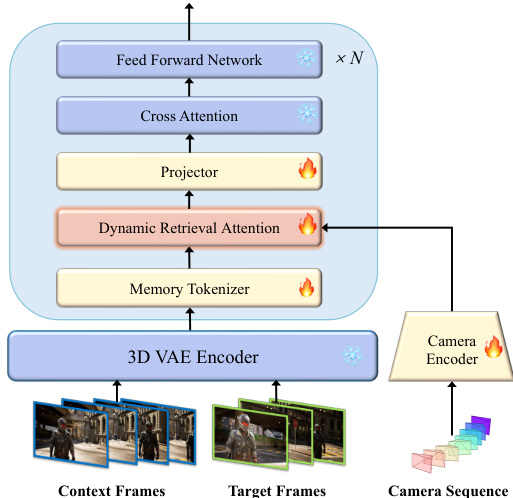
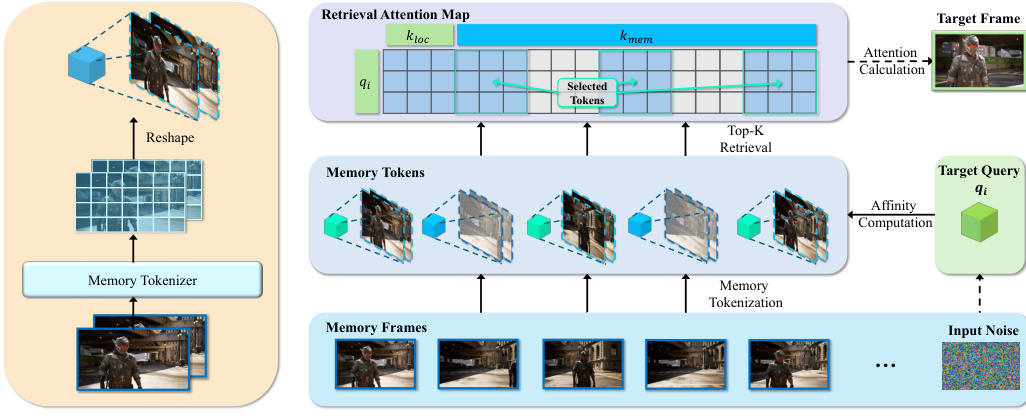
To handle dynamic subjects efficiently without flooding the model with irrelevant noise, the authors introduce HyDRA (Hybrid Dynamic Retrieval Attention). This module replaces standard self-attention layers and consists of two key components: Memory Tokenization and Dynamic Retrieval Attention.
First, a Memory Tokenizer processes the encoded memory latents Zmem. Instead of using raw latents, a 3D-convolution-based tokenizer expands the spatiotemporal receptive field to capture long-duration motion information, producing compact memory tokens M. This transformation is defined as M=Tmem(Zmem).
Second, the Dynamic Retrieval Attention mechanism computes a spatiotemporal affinity metric between the target query and the memory tokens. As shown in the detailed module breakdown, the system performs a Top-K selection to retrieve the most relevant memory tokens based on affinity scores Si,j. To preserve local denoising stability, the retrieved memory features are concatenated with keys and values from a local temporal window. The final attention is computed using the standard formulation:
Attention(qi,Ki′,Vi′)=Softmax(dqi(Ki′)T)Vi′By iterating this process, the model selectively attends to pertinent motion and appearance cues of out-of-sight subjects, ensuring spatiotemporal consistency while reducing computational burden.
Experiment
- Main experiments compare the proposed HyDRA method against baselines and state-of-the-art models, validating its superior ability to maintain subject identity and motion coherence during complex exit-and-re-entry events.
- Qualitative results demonstrate that while competing methods suffer from subject distortion, vanishing, or stuttering, HyDRA successfully preserves hybrid consistency by effectively anchoring static backgrounds and tracking dynamic subjects.
- Ablation studies confirm that temporal interaction within the memory tokenizer is critical for capturing long-term dynamics, as removing it causes significant consistency failures.
- Experiments on token retrieval show that dynamic affinity-based selection outperforms static Field of View filtering by adaptively retrieving keyframes with rich subject details rather than relying on fixed geometric overlap.
- Analysis of retrieved token counts indicates that a moderate number of tokens is sufficient to provide necessary spatiotemporal context, whereas overly restricted counts lead to information loss and generation artifacts.
- Open-domain evaluations verify that the model generalizes well to unseen scenes and camera movements, maintaining robust memory capabilities without specific fine-tuning.