Command Palette
Search for a command to run...
Generative Priors를 활용한 결정론적 비디오 깊이 추정을 위한 방법
Generative Priors를 활용한 결정론적 비디오 깊이 추정을 위한 방법
원클릭 DVD 배포: 생성 사전 기반의 결정론적 비디오 깊이 추정
초록
기존 비디오 심도 추정(Video Depth Estimation) 방식은 근본적인 상충 관계(trade-off)에 직면해 있습니다. 생성 모델은 확률적 기하학적 환각과 스케일 드리프트(scale drift)의 취약성이 있는 반면, 판별 모델은 의미적 불명확성을 해결하기 위해 방대한 양의 레이블링된 데이터셋을 필요로 합니다. 이러한 정체 상태를 돌파하기 위해, 본 논문은 사전 학습된 비디오 디퓨전 모델을 단번에 심도 회귀기로 결정론적으로 적응시키는 첫 번째 프레임워크인 'DVD'를 제시합니다. 구체적으로 DVD는 세 가지 핵심 설계 요소를 갖추고 있습니다: (i) 구조적 척도로 디퓨전 시간 단계(timestep)를 재활용하여 전반적인 안정성과 고주파 세부 사항을 균형 있게 조절함, (ii) 잠재 매니폴드 정정(Latent Manifold Rectification, LMR)을 통해 회귀로 인한 과도한 평활화(over-smoothing)를 완화하고, 차등 제약 조건을 통해 선명한 경계와 일관된 운동을 복원함, (iii) 인터-윈도우(divergence between windows) 발산을 제한하는 고유한 속성인 전역 아핀 일관성(Global Affine Coherence)을 통해 복잡한 시간 정렬 없이도 긴 영상 추론을 원활하게 수행하도록 함. 광범위한 실험을 통해 DVD가 벤치마크 전반에서最先进的(SOTA) 제로샷(zero-shot) 성능을 달성함을 입증했습니다. 또한 DVD는 기존 최상위 기준선(Baseline) 대비 163배 적은 작업 전용 데이터만으로 비디오 파운데이션 모델에 내재된 깊은 기하학적 사전 지식(Geometric Priors)을 성공적으로 활용했습니다. 주목할 점은, 본 연구에서 SOTA 비디오 심도 추정을 위한 전체 학습 스위트(Training Suite)를 포함한 파이프라인을 온전히 오픈소스하여 오픈소스 커뮤니티에 기여했다는 것입니다.
One-sentence Summary
The authors propose DVD, a framework that deterministically adapts pre-trained video diffusion models into single-pass depth regressors to address stochastic geometric hallucinations and massive labeled dataset requirements through latent manifold rectification and global affine coherence, achieving state-of-the-art zero-shot performance with 163× less task-specific data than leading baselines while unlocking profound geometric priors.
Key Contributions
- DVD is the first framework to deterministically adapt pre-trained video diffusion models into single-pass depth regressors. This approach bypasses stochastic sampling to resolve the ambiguity-hallucination dilemma while uniting semantic richness with structural stability.
- Three core designs include repurposing the diffusion timestep as a structural anchor and employing latent manifold rectification to enforce differential constraints on motion. Global affine coherence enables seamless long-video inference without requiring complex temporal alignment.
- Extensive experiments demonstrate state-of-the-art zero-shot performance across benchmarks using 163× less task-specific data than leading baselines. The complete training pipeline is fully released to benefit the open-source community.
Introduction
Video depth estimation serves as a foundational component for 3D scene understanding in fields ranging from autonomous driving to robotic manipulation. Current approaches face a fundamental trade-off where generative models suffer from stochastic geometric hallucinations and discriminative models demand massive labeled datasets to resolve semantic ambiguities. The authors introduce DVD, the first framework to deterministically adapt pre-trained video diffusion models into single-pass depth regressors. This approach leverages a timestep structural anchor and latent manifold rectification to balance global stability with high-frequency details, enabling state-of-the-art zero-shot performance with 163 times less task-specific data than leading baselines.
Method
The authors propose a novel framework for video depth estimation that bridges the gap between generative priors and deterministic stability. The method operates within a compressed latent manifold to leverage the rich semantic knowledge of large-scale pre-trained models while ensuring geometric consistency.
The overall pipeline begins by formalizing video depth estimation as a mapping from an input RGB sequence x∈RF×3×H×W to a depth sequence d∈RF×H×W. To exploit pre-trained capabilities, a frozen variational autoencoder (VAE) encoder E projects both RGB and depth data into a unified latent space, defined as zx=E(x) and zd=E(d). The core objective is to learn a deterministic mapping Φ:zx↦zd that recovers geometric structure directly in this latent space, with the final depth reconstructed via a frozen VAE decoder.
Refer to the framework diagram for a visualization of the complete architecture, which encompasses both the training adaptation and the long-video inference stages.
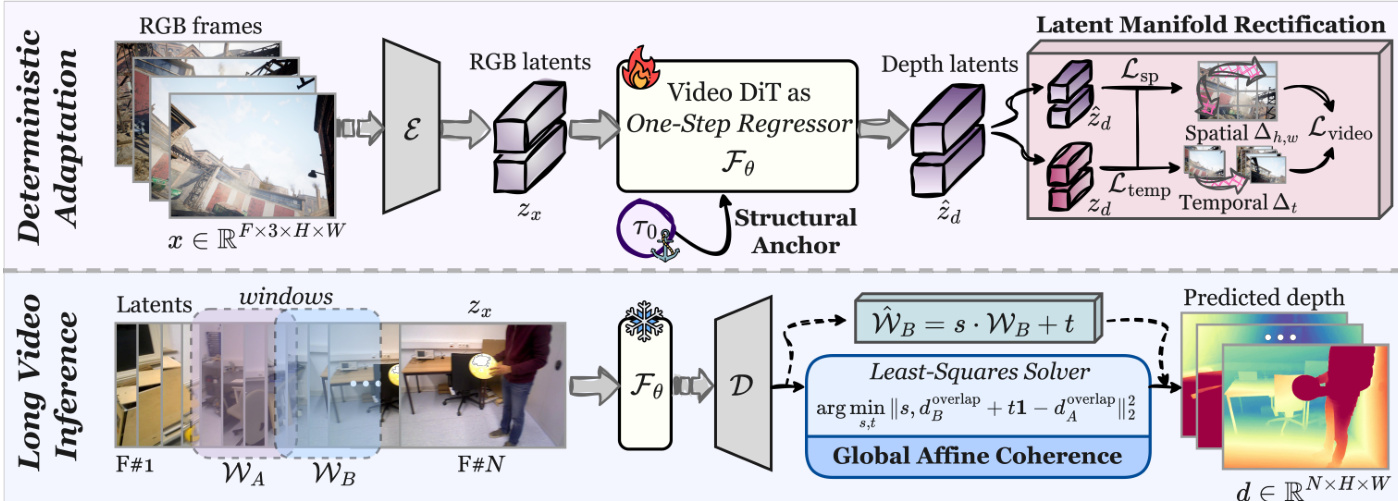
In the deterministic adaptation phase, the authors repurpose a pre-trained Video Diffusion Transformer (Video DiT) as a one-step regressor rather than performing iterative stochastic denoising. Instead of solving an ordinary differential equation over a noise trajectory, the network Fθ performs a direct functional mapping z^d=Fθ(zx,τ) in a single forward pass. A critical design choice involves the conditioning timestep τ. Unlike standard diffusion models where t parameterizes noise levels during generation, the authors leverage τ as a structural anchor. By fixing the timestep to an optimal state τ0 via a sinusoidal embedding, the model is calibrated to a specific geometric operating regime. This frequency-parameterized conditioning balances low-frequency global stability with high-frequency local detail recovery, preventing the over-smoothing often observed when adapting diffusion backbones to deterministic tasks.
To address the issue of mean collapse inherent in regression-based training, the framework introduces Latent Manifold Rectification (LMR). Standard point-wise losses tend to drive predictions toward the conditional expectation, washing out high-frequency structural details and causing temporal flickering. LMR counteracts this by enforcing differential consistency in the latent space without requiring auxiliary modules. The supervision strategy aligns the spatial gradients and temporal flows of the predicted latents with the ground truth. The spatial rectification loss Lsp penalizes low-frequency collapse to preserve sharp boundaries, while the temporal rectification loss Ltemp synchronizes inter-frame dynamics to ensure coherent motion. These terms are combined with a global L2 loss to form the total video objective, effectively preserving latent high-frequency structures against the smoothing effects of deterministic regression.
For long-duration video inference, memory constraints necessitate a sliding-window approach. While the deterministic backbone eliminates stochastic scale drift, the VAE decoder's context-dependent normalization can still induce fluctuations in depth values across windows. To resolve this, the authors exploit an inherent property of global affine coherence, observing that inter-window discrepancies can be approximated by linear scale-shift transformations. During inference, the system employs a Least-Squares Solver to estimate a global scale s and shift t based on the overlap between adjacent windows. This affine calibration is broadcast to the entire current window, allowing for seamless blending of overlapping frames. This strategy enables robust, flicker-free depth estimation for long videos without requiring complex feature matching or recurrent temporal modules. Finally, the model is optimized via an image-video joint training strategy, where static images act as high-frequency spatial anchors while video sequences enforce temporal coherence, ensuring both spatial sharpness and temporal stability.
Experiment
The evaluation utilizes standard video and image depth benchmarks to compare the proposed DVD method against state-of-the-art generative and discriminative baselines across tasks involving temporal consistency, boundary accuracy, and single-image generalization. Results indicate that DVD achieves superior geometric fidelity and long-term temporal coherence while maintaining competitive inference speeds and requiring significantly less training data than comparable generative models. Further analysis confirms that deterministic adaptation and joint image-video training are critical for preventing geometric hallucinations and ensuring robust scalability across diverse open-world scenes.
The authors compare their DVD method against ChronoDepth, DepthCrafter, and VDA across KITTI, DIODE, and NYUv2 datasets. Results indicate that DVD achieves the best performance on KITTI and DIODE, outperforming both discriminative and generative baselines. On the NYUv2 dataset, the method demonstrates competitive accuracy, closely trailing the top-performing VDA while significantly surpassing other approaches. DVD achieves the highest accuracy on KITTI and DIODE benchmarks compared to all listed baselines. The proposed method significantly outperforms generative models like DepthCrafter across all evaluated datasets. DVD demonstrates robust single-image generalization, performing competitively against the strong VDA baseline on NYUv2.

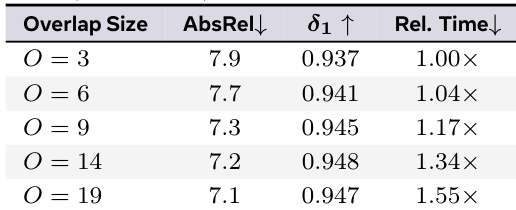
The authors analyze the impact of overlap size on model performance and efficiency. Results indicate that increasing the overlap size consistently improves geometric accuracy and threshold metrics. However, this enhancement in quality is accompanied by a significant increase in relative inference time. Absolute relative error decreases as overlap size increases. Threshold accuracy improves with larger overlap configurations. Relative inference time rises steadily with larger overlap settings.
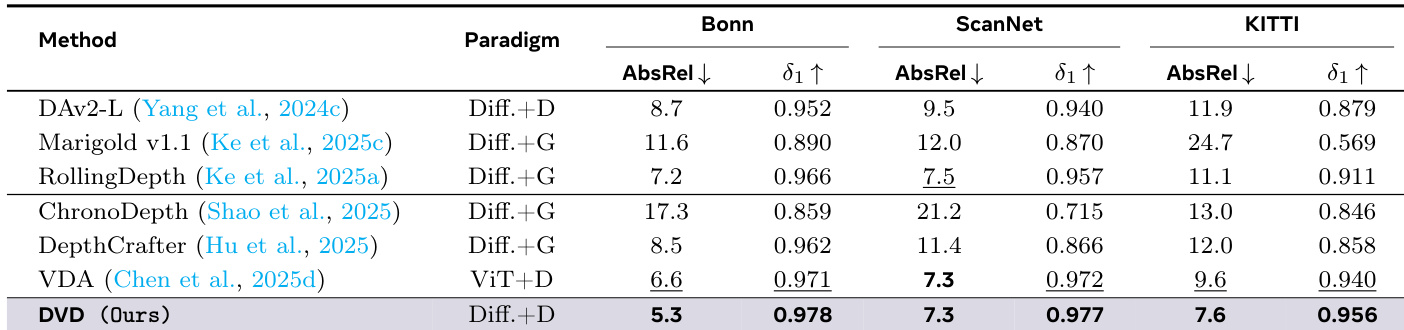
The authors evaluate DVD against state-of-the-art video depth estimation methods across standard benchmarks including Bonn, ScanNet, and KITTI. Results show that DVD consistently achieves superior geometric fidelity and temporal coherence compared to both generative and discriminative baselines. The method demonstrates significant efficiency gains by utilizing deterministic adaptation instead of iterative sampling. DVD achieves top-tier accuracy across all tested datasets, outperforming methods like DepthCrafter and VDA. The deterministic adaptation approach bypasses the computational bottlenecks associated with iterative generative sampling. Joint image-video training ensures the model retains high spatial precision while maintaining temporal consistency.
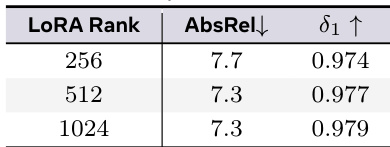
The the the table presents an ablation study evaluating the impact of LoRA rank on model performance. Results show that increasing the rank from the lowest setting significantly reduces error and improves accuracy metrics. However, moving from the medium to the highest rank yields diminishing returns, suggesting a moderate rank is sufficient for optimal performance. Increasing the LoRA rank leads to consistent improvements in error reduction and accuracy. Performance stabilizes at the medium rank, with the highest rank offering negligible additional benefits. The lowest rank setting demonstrates the weakest performance across all measured metrics.
The authors evaluate their DVD method against state-of-the-art video and image depth estimation baselines across multiple standard benchmarks. The results demonstrate that DVD achieves superior geometric fidelity and temporal coherence, consistently outperforming both generative and discriminative approaches on most metrics. Notably, the model attains these leading results while utilizing a significantly smaller training dataset compared to massive-scale competitors. DVD achieves the lowest absolute relative error on KITTI, ScanNet, and Bonn datasets. The method achieves the highest threshold accuracy across all four evaluated datasets. DVD demonstrates high data efficiency, achieving top results with a training set size much smaller than that of the VDA baseline.
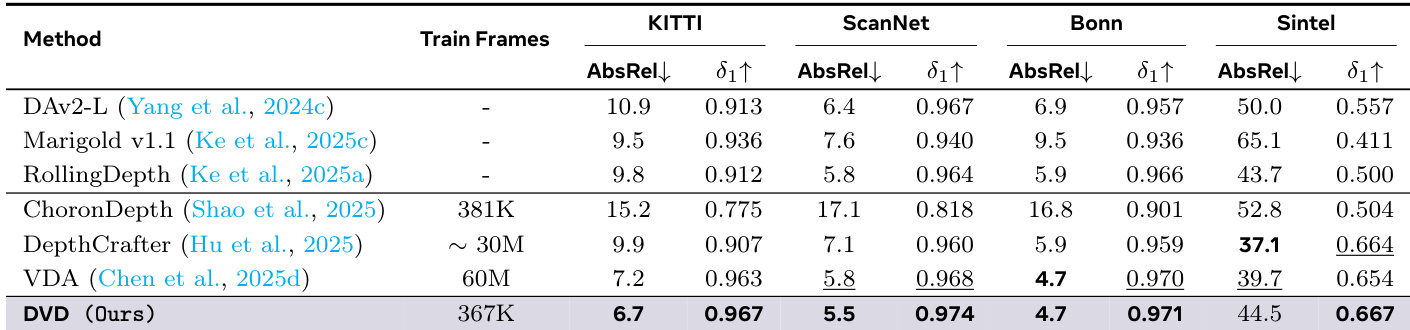
The DVD method is evaluated against state-of-the-art discriminative and generative baselines across multiple standard datasets to assess geometric fidelity and temporal coherence. Results indicate that DVD consistently outperforms competitors in accuracy and efficiency, achieving top-tier performance even with a significantly smaller training dataset. Additional experiments validate that increasing overlap size enhances accuracy at the cost of inference time, while a moderate LoRA rank provides optimal performance without diminishing returns.