Command Palette
Search for a command to run...
밀도 가이드 응답 최적화: 암묵적 수용 신호를 통한 커뮤니티 기반 정렬
밀도 가이드 응답 최적화: 암묵적 수용 신호를 통한 커뮤니티 기반 정렬
Patrick Gerard Svitlana Volkova
초록
온라인 커뮤니티에 배포된 언어 모델은 사회적, 문화적, 그리고 도메인별 맥락에 따라 상이한 규범에 적응해야 합니다. 기존의 정렬 (alignment) 접근법은 명시적 선호 (preference) 감시 (supervision) 나 사전 정의된 원칙에 의존하며, 이는 자원이 풍부한 환경에서는 효과적이지만, 대부분의 온라인 커뮤니티 — 특히 제도적 후원을 받지 않거나, 주석 (annotation) 인프라가 없으며, 민감한 주제를 중심으로 조직된 커뮤니티 — 을 배제합니다. 이러한 환경에서는 선호를 유도하는 비용이 많이 들고, 윤리적으로 문제가 많거나, 문화적 정합성 (cultural alignment) 이 깨질 수 있습니다.우리는 커뮤니티가 이미 어떤 콘텐츠를 수용하고, 참여하며, 지속시키는지라는 행위를 통해 선호를 암묵적으로 표현하고 있음을 관찰했습니다. 우리는 이러한 수용 행동이 표현 공간 (representation space) 에서 측정 가능한 기하학적 구조를 형성함을 보여주었습니다: 수용된 응답은 커뮤니티별 규범을 반영하는 응집력 있고 밀도가 높은 영역에 위치하는 반면, 거절된 콘텐츠는 희박하거나 정렬되지 않은 영역에 분포합니다. 우리는 이러한 구조를 정렬을 위한 암묵적 선호 신호로 활용하여, 명시적 선호 라벨이 필요 없는 언어 모델 정렬 방법인 '밀도 기반 응답 최적화 (Density-Guided Response Optimization, DGRO)'를 제안합니다.라벨링된 선호 데이터를 사용하여, 지역적 밀도 (local density) 가 커뮤니티의 쌍별 (pairwise) 판단을 복원함을 입증했습니다. 이는 기하학적 구조가 의미 있는 선호 신호를 인코딩하고 있음을 시사합니다. 이후 다양한 플랫폼, 주제, 언어에 걸친 주석이 부족한 환경에서 DGRO 를 적용했습니다. 그 결과, DGRO 로 정렬된 모델은 주어진 기반 (baselines) 인 감독형 (supervised) 및 프롬프트 기반 방법 대비, 인간 주석자, 도메인 전문가, 그리고 모델 기반 평가자 모두로부터 선호도를 더 높은 점수를 받았습니다.우리는 DGRO 를 명시적 선호 감시가 불가능하거나 현장 관행 (situated practices) 과 정렬되지 않은 커뮤니티를 위한 실용적인 정렬 대안으로 제안하며, 새롭게 발생하는 수용 행위를 학습함으로써 도출되는 함의와 위험에 대해 논의합니다.
One-sentence Summary
Patrick Gerard (USC) and Svitlana Volkova (Aptima) propose DGRO, a method that aligns language models to community norms using implicit acceptance signals—modeling locally dense regions in representation space where accepted content clusters—enabling alignment without explicit preference labels, particularly useful for sensitive or annotation-scarce online communities.
Key Contributions
- We demonstrate that community acceptance behavior—such as content persistence and engagement—induces measurable, high-density regions in embedding space that encode implicit preference signals, enabling alignment without explicit annotations.
- We introduce Density-Guided Response Optimization (DGRO), a method that leverages local density in representation space to align language models to community norms, validated across diverse, annotation-scarce settings including sensitive and non-English forums.
- DGRO-aligned models outperform supervised and prompt-based baselines in human and model-based evaluations, while we explicitly frame the approach as descriptive and caution against uncritical deployment due to risks of bias amplification and exclusion.
Introduction
The authors leverage community behavior—what content gets accepted, engaged with, or allowed to persist—as an implicit signal for aligning language models to context-specific norms, bypassing the need for costly or ethically fraught preference annotations. Prior methods like RLHF and DPO rely on explicit human feedback, which excludes many online communities lacking institutional support or facing cultural sensitivities. DGRO instead models accepted responses as forming high-density regions in embedding space, treating local density as a proxy for preference. Their key contribution is a practical, annotation-free alignment method that matches or outperforms supervised baselines across diverse, annotation-scarce communities, while explicitly framing the approach as descriptive—not normative—to avoid amplifying harmful or exclusionary norms.
Dataset

-
The authors use the Stanford Human Preferences (SHP) benchmark, which provides pairwise preference judgments from five distinct Reddit communities: changemyview, askkulinary, askhistorians, legaladvice, and explainlikeimfive. These communities were selected for their divergent moderation styles, interaction norms, and response evaluation criteria, enabling tests of whether preference structure generalizes across heterogeneous settings.
-
Each data instance includes a conversation history (prompt), a preferred response, and a non-preferred response, as determined by community voting. Metadata includes the normalized upvote ratio between responses, serving as a proxy for preference strength. Dataset sizes per community are detailed in Appendix Table 4.
-
For testing the manifold hypothesis, the authors embed all training responses using a fixed sentence encoder to build an unlabeled reference pool. Preference labels are not used during embedding or density estimation. Test prompts are evaluated by ranking candidate responses based on their estimated local density under the community distribution, using the 150 nearest training histories for conditioning.
-
The model, called “acceptance density,” computes pairwise margins between preferred and non-preferred responses and reports accuracy as the probability that the margin is positive. Performance is compared against baselines: random assignment, kNN with majority vote, global density estimation, and the original supervised SHP reward model (used as an upper bound).
-
All data is publicly available, handled in compliance with platform terms and CSS research norms. No individual identification was attempted; analysis focused on aggregate community patterns. The authors emphasize that DGRO models descriptive norms, not prescriptive values, and caution against deployment without oversight, transparency, and domain-specific safeguards.
Method
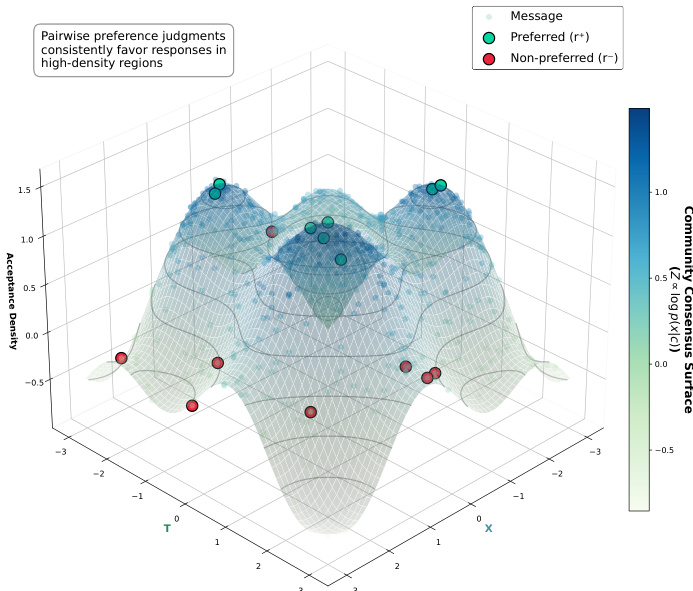
The authors leverage a novel approach called Density-Guided Response Optimization (DGRO) to derive implicit preference signals from community-accepted responses without relying on explicit human annotations. Rather than using pairwise preference labels as in traditional alignment methods like RLHF or DPO, DGRO interprets the distribution of accepted responses in embedding space as a proxy for community norms. Specifically, responses embedded in higher-density regions of this space are treated as more aligned with community expectations, enabling the construction of synthetic preferred/dispreferred pairs for training.
To operationalize this concept, the authors adopt a context-conditioned local density estimation strategy. For a given query context h, they first identify its k nearest neighbors in the embedding space using a kNN search over historical contexts. The corresponding accepted responses from these neighbors form a context-specific reference set B(h). Acceptance density for a candidate response x is then estimated via a kernel density estimator:
logp(x∣h,c)∝log∣B(h)∣1j∈B(h)∑Kσ(x,xj),where Kσ denotes an RBF kernel with bandwidth determined by the median heuristic. This formulation ensures that preference signals are locally calibrated—responses are evaluated relative to what the community accepts in semantically similar contexts, rather than against a global, potentially misleading aggregate distribution.
As shown in the figure below, this local density estimation enables DGRO to adaptively model community norms across diverse topics and intents, preserving fine-grained preference structure that global density estimation would otherwise obscure.
Experiment
- Validated the manifold hypothesis: local acceptance density in representation space reliably recovers human preference signals, especially where community consensus is strong, outperforming global density and kNN baselines.
- Demonstrated that acceptance density can substitute explicit preference labels in standard optimization objectives, achieving performance close to supervised reward models without labeled data.
- Successfully applied density-guided response optimization (DGRO) in annotation-scarce, high-stakes communities (e.g., eating disorder support, conflict documentation), where it consistently outperformed baselines like SFT and ICL in producing authentic, contextually appropriate responses.
- Confirmed that LLM-based evaluation aligns with human expert judgments in sensitive domains, enabling scalable validation without compromising reliability.
- Showed DGRO’s robustness across model architectures and embedding choices, with performance largely independent of base model or embedding type.
- Identified a key limitation: when candidate responses fall entirely outside the local acceptance manifold, density-based rankings become arbitrary and uninformative.
The authors use local acceptance density to recover human preference signals from community discourse without explicit annotations, finding it consistently outperforms unsupervised baselines and approaches supervised model performance. Results show that preference recovery improves with stronger human agreement, indicating that local geometric structure in representation space encodes meaningful community norms. This supports the use of density-guided optimization as a viable alternative to labeled preference data in alignment tasks.

The authors use local acceptance density to recover human preference signals from community discourse without explicit annotations, achieving performance close to supervised models in high-agreement contexts. Results show that preference alignment improves with stronger community consensus, indicating that local geometric structure in representation space encodes meaningful normative distinctions. In annotation-scarce domains like eating disorder and conflict documentation communities, density-guided optimization consistently outperforms standard fine-tuning and in-context learning, producing responses that better match authentic community norms in both relevance and tone.
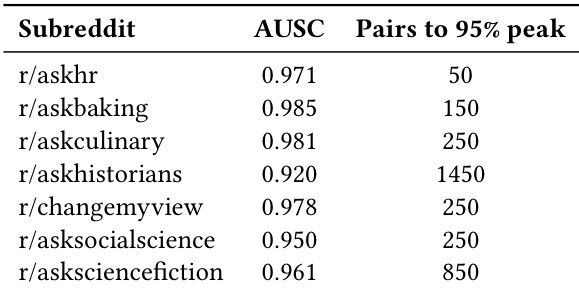
The authors evaluate how different embedding models affect the performance of local acceptance density in recovering community preferences across multiple subreddits. Results show that while performance varies slightly by subreddit, the choice of embedding model has minimal impact on overall accuracy, with all tested models achieving comparable results within narrow confidence intervals. This suggests the method’s robustness to embedding architecture under the evaluated conditions.

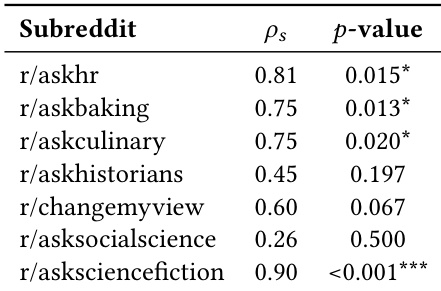
The authors find that local acceptance density reliably recovers human preference signals in community discourse, with performance strongly tied to the strength of human agreement within each subreddit. Communities exhibiting higher consensus, such as r/asksciencefiction and r/askhr, show the strongest correlations between density-based rankings and human judgments, suggesting that preference structure becomes more recoverable as norms solidify. This pattern supports the hypothesis that local geometric structure in representation space encodes meaningful preference information, particularly where community norms are well-defined.
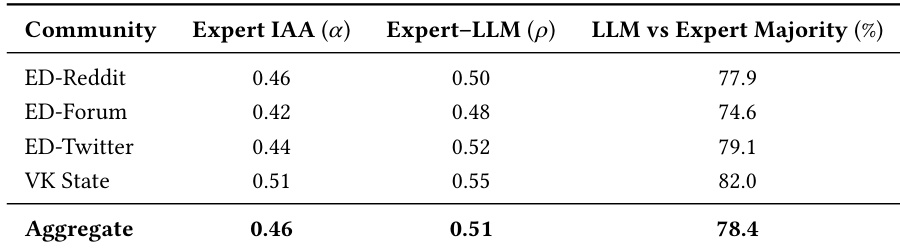
The authors use expert evaluations to validate that LLM-based judgments align with human preferences in annotation-scarce domains, showing moderate inter-annotator agreement and strong rank correlation between experts and LLMs. Aggregate LLM judgments match expert majority decisions in 78.4% of cases, supporting their use as a scalable proxy for human evaluation. This reliability enables large-scale assessment of model alignment where explicit preference labels are unavailable.