Command Palette
Search for a command to run...
World Action Models는 제로샷 정책이다
World Action Models는 제로샷 정책이다
초록
최첨단 Vision-Language-Action(VLA) 모델은 의미적 일반화(semantic generalization)에 탁월한 성능을 보이지만, 새로운 환경에서의 미시적 물리 동작(unseen physical motions) 일반화에는 한계가 있습니다. 본 논문은 사전 학습된 비디오 Diffusion 기반 백본(backbone)을 기반으로 구축된 World Action Model(WAM)인 DREAM ZERO를 제안합니다. 기존 VLA와 달리, WAM은 세계의 진화 과정을 밀도 있는 표현(dense representation)으로 사용하는 비디오를 활용하여 미래의 세계 상태와 행동을 예측함으로써 물리 역학(physical dynamics)을 학습합니다. DREAM ZERO는 비디오와 행동을 결합하여 모델링함으로써, 반복적인 데모(demonstration)에 의존하지 않고도 이종(heterogeneous) 로봇 데이터로부터 다양한 기술을 효과적으로 학습합니다. 그 결과, 실시간 로봇 실험에서 최첨단 VLA 대비 새로운 작업 및 환경에 대한 일반화 성능이 2배 이상 향상되었습니다. 특히 모델 및 시스템 최적화를 통해, 14B 파라미터 규모의 자가회귀(auto-regressive) 비디오 Diffusion 모델이 7Hz의 실시간 폐루프 제어(real-time closed-loop control)를 수행할 수 있게 되었습니다. 마지막으로, 교차 몸체(cross-embodiment) 이전의 두 가지 형태를 입증했습니다. 다른 로봇이나 인간의 비디오만으로는 구성된 데모를 활용할 때, 불과 10~20분간의 데이터로 미시적 작업(unseen task) 성능이 42% 이상 상대적으로 향상되었습니다. 더욱 놀라운 점은 DREAM ZERO가 퓨샷(few-shot) 몸체 적응을 가능하게 하여,わずか 30분의 플레이 데이터만으로 새로운 몸체(embodiment)로 이전하면서도 제로샷(zero-shot) 일반화 성능을 유지할 수 있다는 것입니다.
One-sentence Summary
DREAM ZERO is a World Action Model built upon a pretrained 14B autoregressive video diffusion backbone that learns physical dynamics by predicting future world states and actions, enabling diverse skill learning from heterogeneous robot data without repetitive demonstrations while achieving over 2x improvement in generalization compared to state-of-the-art Vision-Language-Action models, real-time closed-loop control at 7Hz, and over 42% relative improvement on unseen tasks through video-only cross-embodiment transfer.
Key Contributions
- DREAM ZERO is introduced as a World Action Model built on a pretrained video diffusion backbone that jointly predicts future world states and actions using video as a dense representation of physical dynamics. This approach achieves over 2x improvement in generalization to new tasks and environments compared to state-of-the-art VLAs in real robot experiments.
- Model and system optimizations enable a 14B autoregressive video diffusion model to perform real-time closed-loop control at 7Hz. This capability avoids the need for test-time optimization or search procedures typically required by alternative world model architectures.
- Cross-embodiment transfer is demonstrated where video-only demonstrations from other robots or humans yield over 42% relative improvement on unseen task performance with just 10 to 20 minutes of data. The method further supports few-shot embodiment adaptation by transferring to a new embodiment with only 30 minutes of play data while retaining zero-shot generalization.
Introduction
State-of-the-art Vision-Language-Action models excel at semantic generalization but struggle to adapt to unseen physical motions or novel environments due to a lack of spatiotemporal priors. These models often rely on repetitive demonstrations and fail to transfer skills across different robot embodiments without extensive task-specific data. The authors introduce DREAM ZERO, a 14B World Action Model built upon a pretrained video diffusion backbone that jointly predicts future world states and actions. This architecture allows the system to learn diverse skills from heterogeneous robot data while inheriting rich physical dynamics from web-scale video pretraining. Consequently, the model achieves over 2x improvement in zero-shot generalization compared to existing VLAs and supports cross-embodiment transfer using minimal video-only demonstrations. System optimizations further enable real-time closed-loop control at 7Hz.
Dataset
-
Dataset Composition and Sources
- The authors utilize two primary sources for pretraining: proprietary AgiBot G1 teleoperation data and the public DROID dataset.
- AgiBot data spans 22 real-world environments including homes, restaurants, and offices, totaling approximately 500 hours across 7.2K episodes.
- DROID serves as a heterogeneous validation set collected on a Franka single-arm robot to ensure reproducibility.
- Post-training relies on three specific downstream tasks collected on the AgiBot robot.
-
Key Details for Each Subset
- AgiBot Pretraining episodes average 4.4 minutes and contain roughly 42 subtasks per episode.
- Post-training subsets include Shirt folding (33 hours), Fruit packing (12 hours), and Table bussing (40 hours).
- The DROID subset is used to evaluate performance on open-source heterogeneous data.
-
Model Usage and Training Configuration
- The authors train using a Wan2.1-I2V-14B-480P image-to-video diffusion backbone.
- Pretraining runs for 100K steps with a global batch size of 128 for both AgiBot and DROID datasets.
- Post-training consists of 50K steps per specific task.
- The text encoder, image encoder, and VAE remain frozen while DiT blocks and action encoders are updated.
- Idle actions are filtered out during data preparation.
-
Processing and Collection Strategy
- Data collection prioritizes diversity over repetition by collecting across varied real-world settings rather than controlled labs.
- Each episode combines three distinct tasks to maximize diversity and encourage learning smooth task transitions.
- Tasks are deprecated from the collection sheet after 50 episodes to force the expansion of the task distribution.
- Relative joint positions serve as the default action representation.
- Evaluation protocols include applying an image overlay to the initial scene to reduce variance during post-training assessment.
Method
The authors propose DreamZero, a framework designed to convert pretrained video diffusion models into effective World Action Models (WAMs). As illustrated in the overview, the system leverages diverse, non-repetitive pretraining data to achieve zero-shot generalization to unseen tasks and environments, as well as few-shot adaptation to new embodiments.
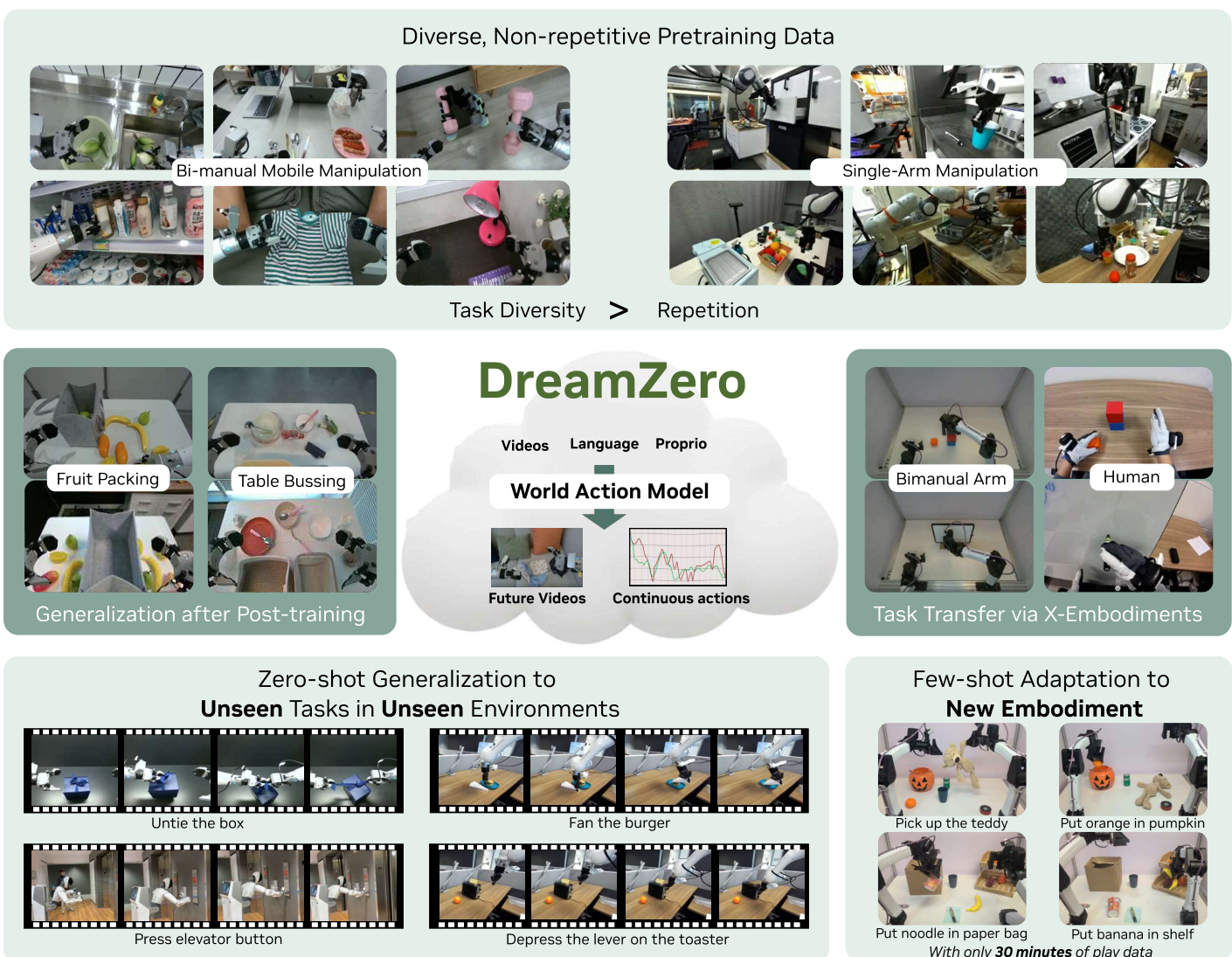
The core architecture is a Joint Video-Action Diffusion Transformer (DiT). Refer to the framework diagram which details the training and inference pipeline. The model takes video, action, proprioception, and language as inputs. Video frames are encoded into latents via a VAE Encoder, while actions are processed by an Action Encoder. Proprioception and language are handled by a State/Text Encoder. These modalities are fused and passed into Causal DiT Blocks. The model is trained to jointly denoise video latents and action chunks.
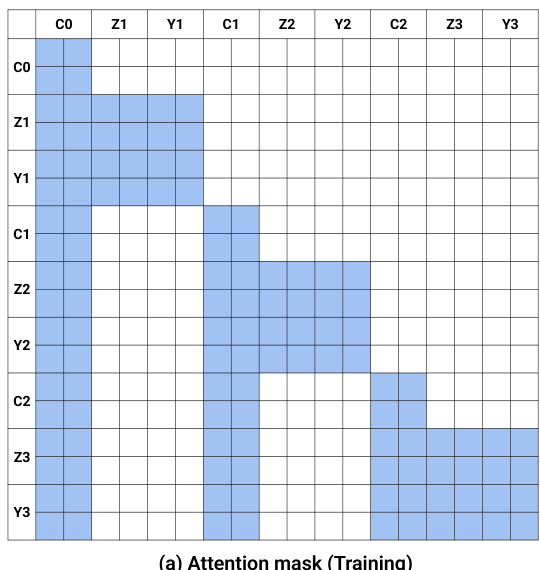
During training, the authors employ a flow-matching objective. The model predicts the velocity field for both video and action modalities. To handle variable-length trajectories, the model operates in an autoregressive, chunk-wise manner. Each chunk contains a fixed number of latent frames matching the action horizon. The attention mask, shown in the grid diagram, ensures that the current noisy chunk can attend to the clean context of previous chunks while preventing information leakage from future tokens. This design facilitates teacher forcing, where the model is trained to denoise the current chunk conditioned on clean previous chunks.
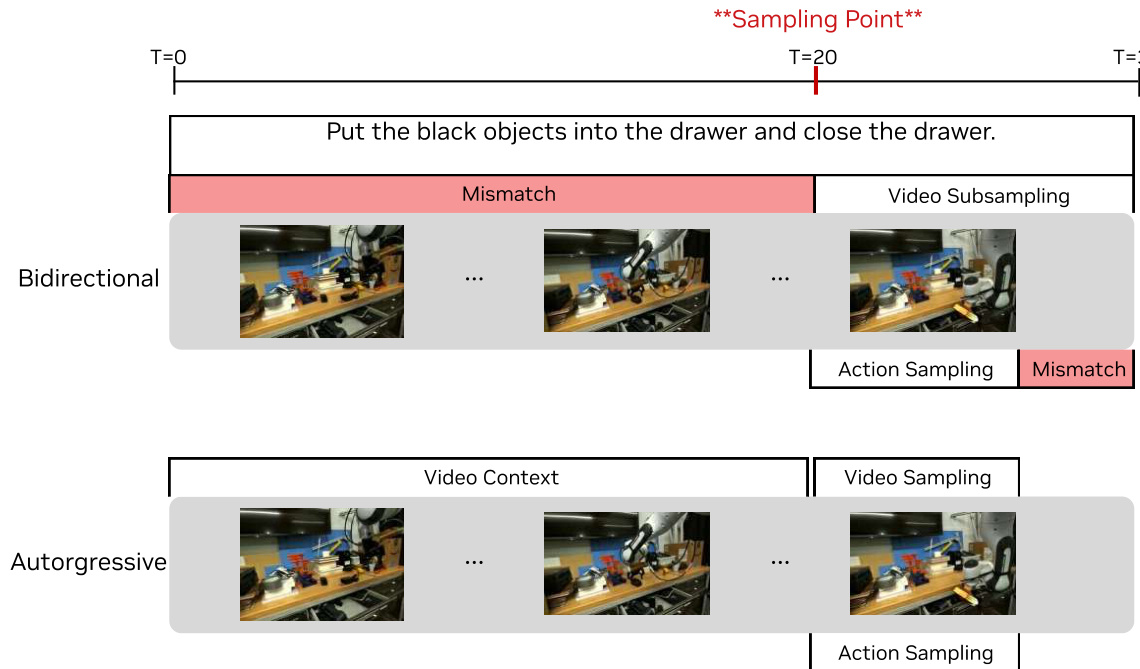
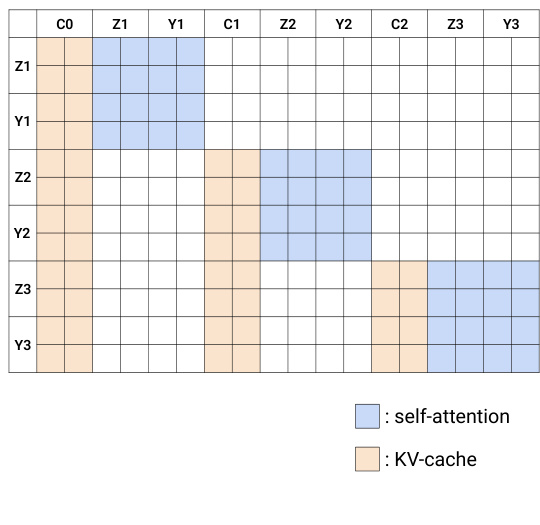
For inference, the system utilizes a closed-loop real-world execution strategy. Unlike bidirectional models that may suffer from modality misalignment or require video subsampling, the autoregressive design allows for precise alignment between video frames and robot actions. As shown in the timeline comparison, bidirectional approaches often introduce mismatches between video and action sampling points. In contrast, the autoregressive approach maintains a consistent video context. Furthermore, the system exploits the closed-loop nature of robotics: after an action chunk is executed, the predicted future frames are replaced with ground-truth observations in the KV cache. This eliminates compounding errors and enables efficient inference via KV caching.
To address the latency bottleneck of diffusion models, the authors introduce DREAMZero-Flash. This optimization decouples the noise schedules for video and action. Refer to the noise schedule graph which visualizes this decoupling. While standard training uses a shared uniform timestep, Flash biases video timesteps toward high-noise states using a Beta distribution while keeping action timesteps uniform. This trains the model to predict clean actions from noisy visual contexts, allowing for fewer diffusion steps during inference without degrading action quality. This results in significant speedups for real-time control.
Experiment
Experiments conducted on AgiBot and Franka robots validate that DREAMZero achieves superior zero-shot generalization to unseen tasks and environments compared to baseline vision-language-action models, especially when utilizing diverse training data. The joint video-action formulation enables robust cross-embodiment transfer and few-shot adaptation using only visual information, whereas baseline models often overfit to repetitive demonstrations. Furthermore, ablation studies indicate that autoregressive architectures and system optimizations preserve performance quality while enhancing temporal consistency and inference efficiency.
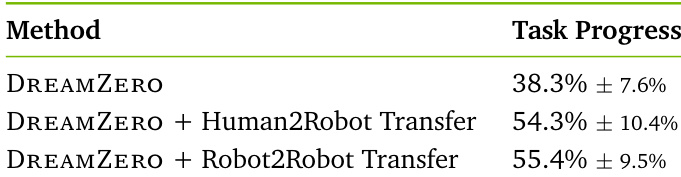
The the the table evaluates the impact of cross-embodiment transfer learning on task progress for unseen tasks using the DREAMZERO framework. It compares the baseline model against versions augmented with video data from human demonstrations and another robot embodiment, showing that both transfer methods significantly enhance performance. Both Human2Robot and Robot2Robot transfer strategies result in higher task progress compared to the baseline DREAMZERO model. Robot2Robot transfer achieves the highest performance, yielding the largest improvement over the baseline. Human2Robot transfer also demonstrates a substantial gain in task progress, validating the utility of human visual data despite the morphological differences.
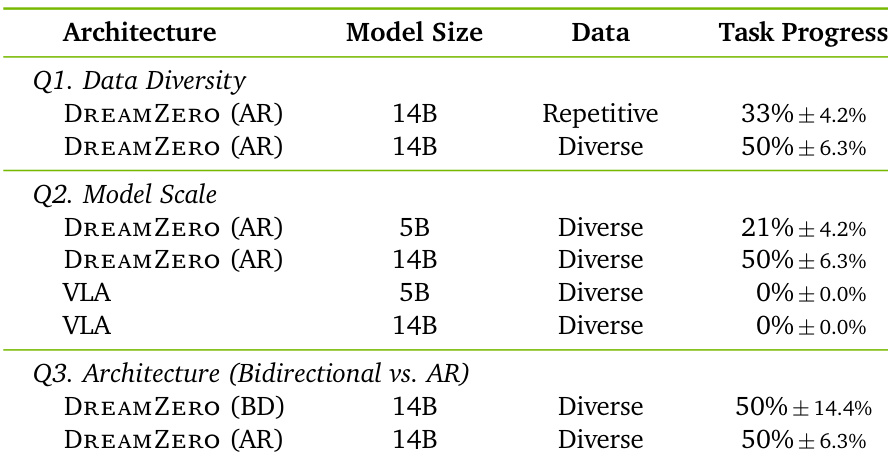
The authors evaluate the effects of data diversity, model scale, and architecture on task progress using DREAMZERO and VLA baselines. The results show that diverse data and larger model sizes significantly boost DREAMZERO performance, whereas VLAs fail to learn from diverse data regardless of scale. Additionally, bidirectional and autoregressive architectures yield comparable task progress scores. DREAMZERO achieves higher task progress when trained on diverse data compared to repetitive data. Larger DREAMZERO models outperform smaller ones, while VLAs show negligible progress across all sizes. Autoregressive and bidirectional architectures achieve similar task progress levels.
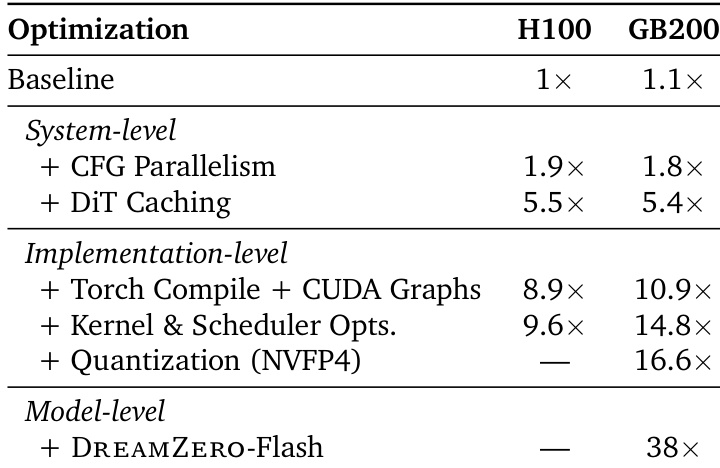
The the the table presents cumulative inference speedups achieved by stacking system, implementation, and model-level optimizations on H100 and GB200 hardware. Results indicate that system and implementation optimizations yield substantial gains, with the final model-level optimization providing a dramatic performance boost specifically on the GB200 architecture. Quantization and model-level techniques are shown to be applicable only to the GB200 hardware. System and implementation optimizations yield a cumulative speedup of approximately 9x on H100 and roughly 16x on GB200. The addition of DREAMZERO-Flash at the model level results in a 38x speedup on GB200 hardware. Quantization and the final model-level optimization are exclusive to the GB200 architecture in this evaluation.
The authors evaluate the trade-off between inference speed and task performance by reducing denoising steps. While the standard model suffers a significant accuracy drop with single-step inference, the DREAMZERO-Flash variant recovers most performance levels while maintaining the speed benefits. This indicates that the Flash variant offers a superior balance for real-time deployment scenarios. Reducing the standard model to a single denoising step causes a substantial decline in task progress. The Flash variant achieves significantly higher task progress at a single step compared to the standard single-step configuration. Single-step inference configurations provide a substantial speedup over the multi-step baseline.

The evaluation assesses the DREAMZERO framework across cross-embodiment transfer learning, data diversity, and inference efficiency to validate its generalization and speed capabilities. Experiments show that transfer strategies and diverse training data significantly improve task progress compared to VLA baselines, while larger scales further enhance performance across different architectures. Finally, cumulative optimizations achieve substantial inference speedups, where the DREAMZERO-Flash variant maintains high accuracy at single-step inference suitable for real-time applications.