Command Palette
Search for a command to run...
iFSQ: 1줄의 코드로 이미지 생성을 위한 FSQ 개선
iFSQ: 1줄의 코드로 이미지 생성을 위한 FSQ 개선
초록
이미지 생성 분야는 현재 이산 토큰을 기반으로 작동하는 자기회귀(autoregressive, AR) 모델과 연속 잠재 변수(continuous latents)를 활용하는 확산 모델(diffusion models)로 양분되어 있다. 이 분열은 VQ-VAE와 VAE 간의 본질적 차이에 뿌리를 두며, 통합적인 모델링과 공정한 벤치마킹을 방해하고 있다. 유한 스칼라 양자화(Finite Scalar Quantization, FSQ)는 이론적으로 이 격차를 메울 수 있는 다리를 제공하지만, 기존의 FSQ는 중요한 결함을 안고 있다. 즉, 등간격 양자화 방식은 활성화 값의 붕괴(activation collapse)를 유발할 수 있으며, 이로 인해 재구성 정밀도와 정보 효율성 사이에 상충 관계가 생긴다. 본 연구에서는 기존 FSQ의 활성화 함수를 분포 일치 매핑(distribution-matching mapping)으로 단순히 교체함으로써 이 딜레마를 해결한다. 이를 iFSQ라고 명명하며, 단 한 줄의 코드 수정만으로도 수학적으로 최적의 박스 활용률과 재구성 정밀도를 보장한다. iFSQ를 통제된 벤치마크로 활용하여 두 가지 핵심 통찰을 도출한다. 첫째, 이산 표현과 연속 표현 사이의 최적 균형은 차원당 약 4비트에서 도달된다. 둘째, 동일한 재구성 제약 조건 하에서 AR 모델은 초기에 빠른 수렴을 보이지만, 확산 모델은 더 높은 성능 한계를 달성함을 확인하였으며, 이는 엄격한 순차적 순서가 생성 품질의 상한선을 제한할 수 있음을 시사한다. 마지막으로, 본 연구는 AR 모델에 Representation Alignment(REPA)를 적응시켜 LlamaGen-REPA를 제안한다. 코드는 https://github.com/Tencent-Hunyuan/iFSQ 에서 공개되어 있다.
One-sentence Summary
Researchers from Peking University and Tencent Hunyuan propose iFSQ, a refined scalar quantization that fixes activation collapse via distribution-matching, enabling fair AR-diffusion benchmarking; they reveal 4 bits/dim as optimal and show diffusion models surpass AR in ceiling performance, extending insights to LlamaGen-REPA.
Key Contributions
- We introduce iFSQ, a one-line-code enhancement to Finite Scalar Quantization that replaces the tanh activation with a distribution-matching function, ensuring uniform bin utilization and optimal reconstruction fidelity by mapping Gaussian latents to a uniform prior.
- Using iFSQ as a unified tokenizer, we establish a controlled benchmark revealing that 4 bits per dimension strikes the optimal balance between discrete and continuous representations, and that diffusion models outperform autoregressive models in final quality despite slower convergence.
- We adapt Representation Alignment (REPA) to autoregressive image generation, creating LlamaGen-REPA with stronger regularization (λ=2.0), demonstrating improved performance while confirming the benefit of feature alignment across generative paradigms.
Introduction
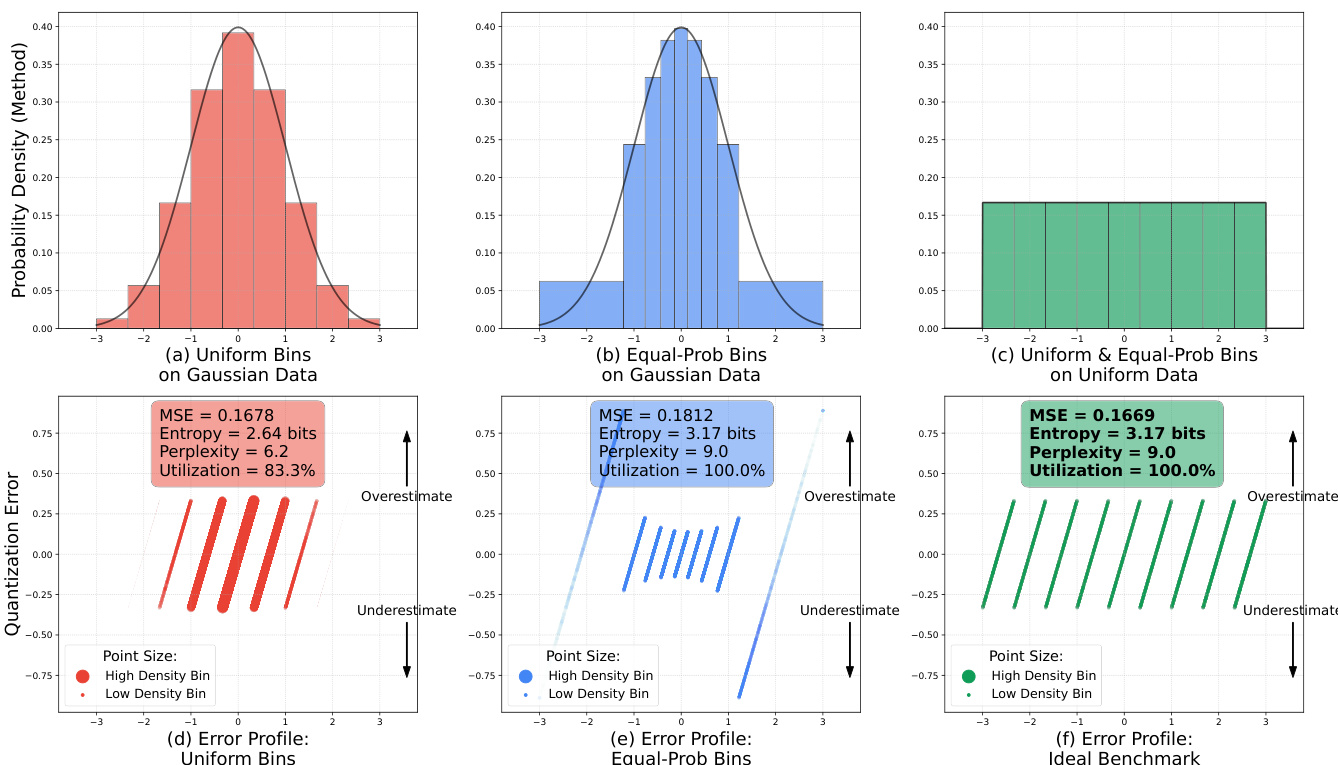
The authors leverage Finite Scalar Quantization (FSQ) to unify autoregressive and diffusion image generation under a single tokenizer, addressing the long-standing fragmentation caused by VQ-VAEs and VAEs. Vanilla FSQ suffers from activation collapse due to equal-interval quantization mismatching the Gaussian-like distribution of neural activations, forcing a trade-off between reconstruction fidelity and bin utilization. Their main contribution is iFSQ — a one-line code modification replacing tanh with a distribution-matching activation — which enforces uniform prior while preserving equal intervals, achieving optimal fidelity and efficiency simultaneously. This enables fair benchmarking, revealing that 4 bits per dimension is the sweet spot and that diffusion models outperform AR models in peak quality despite slower convergence. They further extend this by adapting Representation Alignment to AR models, creating LlamaGen-REPA.
Method
The authors leverage a quantization-based framework for visual tokenization that bridges the gap between continuous and discrete representation paradigms in generative models. The core of this approach is built upon Finite Scalar Quantization (FSQ), which enables a discrete tokenization process without the need for an explicit, learnable codebook. This design allows for efficient and stable tokenization suitable for both autoregressive and diffusion-based generation tasks. The tokenizer architecture consists of an encoder that compresses input images x∈RH×W×3 into a lower-resolution latent representation z∈Rh×w×d, typically through an 8× or 16× downsampling process. The decoder then reconstructs the image from the latent space, forming a complete compression-decompression pipeline.
For diffusion models, the quantized latent zquant is used directly as input to the diffusion process. The quantization is performed by first applying a bounding function f:R→[−1,1], commonly the hyperbolic tangent function, to constrain the latent values. The quantization resolution is defined by L=2K+1 levels per channel, where K determines the number of quantization levels. The continuous latent z is mapped to discrete integer indices q∈{0,…,L−1}d via element-wise rounding, as defined by the equation:
qj=round(2L−1⋅(f(zj)+1))This operation maps the range [−1,1] to the integer set {0,…,L−1}. The quantized indices are then mapped back to the continuous space for diffusion models using:
zquant,j=(qj−2L−1)⋅L−12This step introduces a lossy compression, where zquant≈z, preserving the structural properties of the continuous latent space while enabling discrete tokenization.
For autoregressive models, the quantized indices q are converted into a single scalar token index I through a bijective base-L expansion:
I=j=1∑dqj⋅Ld−jThis transformation ensures a unique mapping from the d-dimensional quantized vector to a scalar index, enabling the use of autoregressive models that predict tokens sequentially. The implicit codebook size is ∣C∣=Ld, which grows exponentially with the dimensionality d, but avoids the memory and stability issues associated with learnable codebooks in VQ-VAE.
The authors introduce a modification to the standard FSQ pipeline by replacing the tanh activation with a scaled sigmoid function to achieve a more uniform distribution of quantized values. Specifically, the bounding function is replaced as follows:
z=2⋅sigmoid(1.6⋅z)−1This change improves the uniformity of the transformed distribution, which is critical for maintaining the quality of the quantized representation. The quantization process is further refined using a straight-through estimator to handle gradient flow during training. The rounded latent zrounded is computed as:
zrounded=round(zscaled)where zscaled=z⋅halfWidth, and halfWidth=(L−1)/2. The estimator is then applied as:
z^=zrounded−zscaled.detach+zscaledThis allows gradients to pass through the rounding operation during backpropagation. Finally, for diffusion models, the quantized latent is normalized by dividing by the half-width:
zq=z^/halfWidthThis normalization ensures that the quantized latent remains within the [−1,1] range, consistent with the input distribution.
Experiment
- Optimized iFSQ via α=1.6 in sigmoid-based activation achieves near-uniform output distribution, minimizing RMSE and KS metrics vs. tanh (α=2.0), improving reconstruction fidelity and entropy utilization.
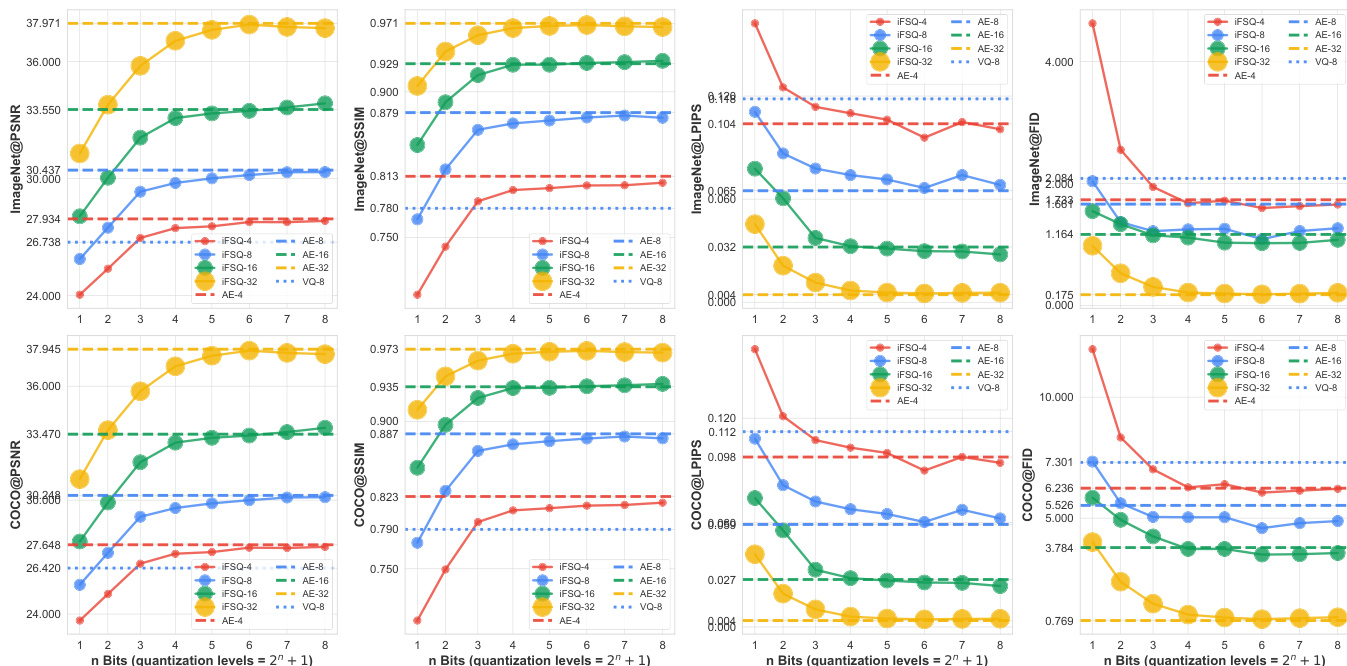
- On ImageNet, iFSQ (α=1.6) outperforms FSQ in PSNR, SSIM, and LPIPS; trends replicate on COCO, confirming scalability.
- For diffusion generation (DiT), iFSQ at 4 bits achieves gFID 12.76 (vs. AE’s 13.78) with 3× higher compression (96 vs. 24); performance plateaus beyond 4 bits.
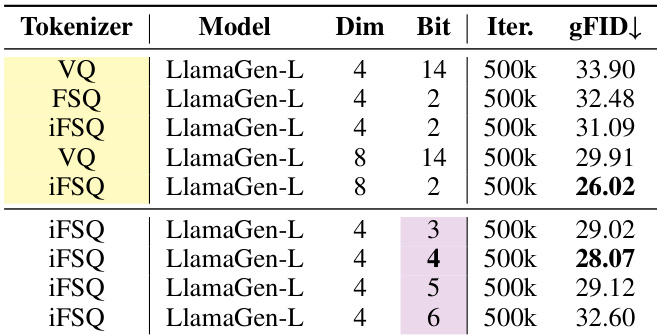
- For autoregressive generation (LlamaGen), iFSQ outperforms VQ at same latent dimension and lower bit rate; 4-bit iFSQ matches AE, with performance peaking at 4 bits.
- iFSQ enables fair comparison of diffusion vs. AR models: diffusion converges slower but surpasses AR in FID at higher compute; AR models exhibit strong sequential constraint limitations.
- iFSQ scales favorably: at 2 bits, double latent dim surpasses AE; at 7–8 bits, matches or exceeds AE; outperforms VQ across quantization levels and dimensions.
- REPA alignment at 1/3 network depth (e.g., layer 8/24) optimizes semantic acquisition in LlamaGen; λ=2.0 yields best FID, differing from DiT’s optimal λ.
- Compression ratio scaling (fig. 10) shows linear performance trend with optimal knee at ~48× compression (4 bits); VQ aligns closely with iFSQ trend, validating its hybrid discrete-continuous nature.
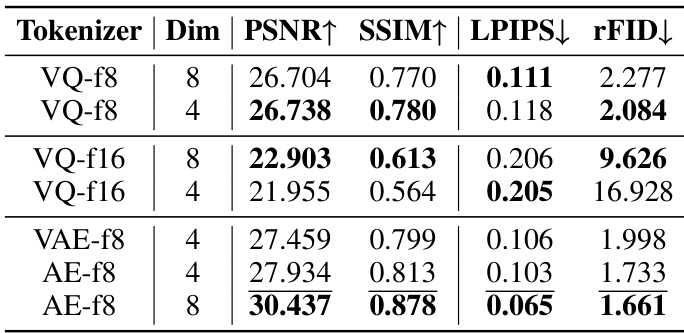
The authors compare various tokenizers, including VQ and AE variants, and find that AE-f8 achieves the highest PSNR and SSIM while also yielding the lowest LPIPS and rFID scores, indicating superior reconstruction quality. Among the VQ-based tokenizers, VQ-f8 outperforms VQ-f16 in all metrics, suggesting that higher quantization levels improve reconstruction performance.
Results show that iFSQ at 2 bits achieves the lowest gFID of 26.02, outperforming VQ-VAE and FSQ under the same settings. The performance degrades as the bit rate increases beyond 2 bits, with iFSQ at 4 bits achieving a gFID of 28.07, indicating that lower quantization levels are optimal for this configuration.
Results show that iFSQ with α = 1.6 achieves the best performance across PSNR, SSIM, and LPIPS, outperforming the original FSQ (α = 2.0), while also minimizing RMSE and KS statistics, indicating a near-uniform distribution. The optimal setting at α = 1.6 balances fidelity and distributional alignment, leading to superior image reconstruction quality compared to both continuous and discrete baselines.
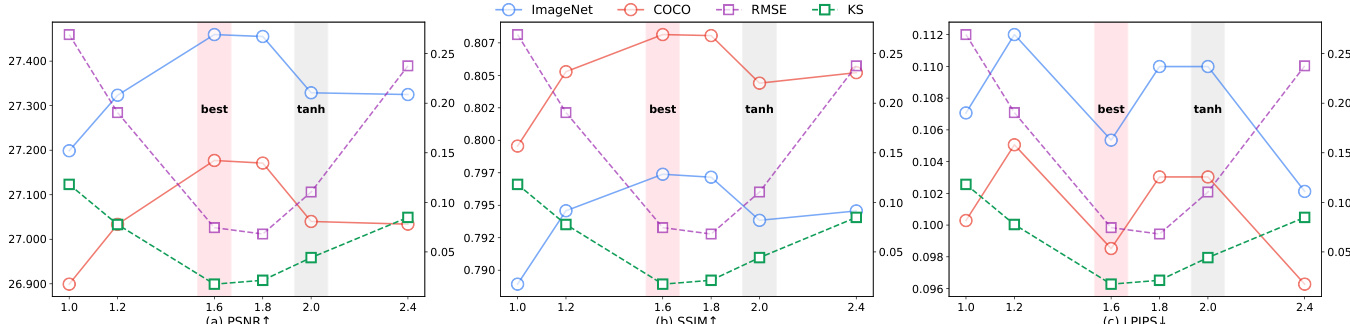
The authors use iFSQ to optimize the distribution of latent features in image generation models, showing that setting the activation parameter α to 1.6 achieves a near-uniform distribution, which improves reconstruction quality and generation performance. Results show that iFSQ at 4 bits matches or exceeds the performance of continuous AE and VQ-VAE across metrics like PSNR, SSIM, and FID, while maintaining a higher compression ratio and better training efficiency.
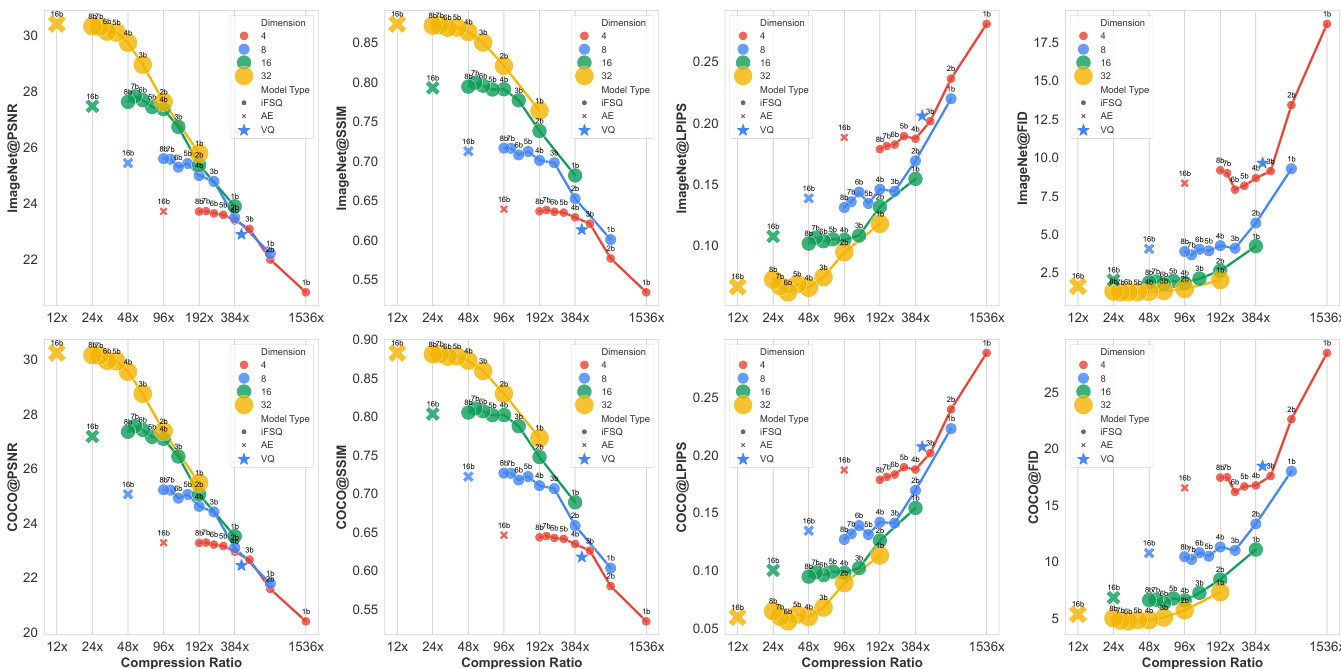
Results show that iFSQ with 4 bits achieves the best balance between reconstruction and generation performance, outperforming both AE and VQ-VAE across PSNR, SSIM, and LPIPS metrics while maintaining a significantly higher compression rate. The optimal performance at 4 bits aligns with the theoretical analysis, where the distribution of iFSQ's activations most closely approximates a uniform distribution, maximizing information entropy and minimizing activation collapse.