Command Palette
Search for a command to run...
후기 훈련에서 감독형 미세조정과 강화 학습의 비분리성에 관한 연구
후기 훈련에서 감독형 미세조정과 강화 학습의 비분리성에 관한 연구
Xueyan Niu Bo Bai Wei Han Weixi Zhang
초록
대규모 언어 모델의 사후 훈련은 일반적으로 지도형 미세조정(Supervised Fine-Tuning, SFT)과 강화학습(Reinforcement Learning, RL)을 주기적으로 번갈아 적용한다. 이 두 가지 방법은 각각 다른 목적을 가진다. SFT는 모델 출력과 전문가 응답 간의 교차 엔트로피 손실을 최소화하는 데 초점을 맞추며, 반면 RL은 인간의 선호도나 규칙 기반 검증기로부터 유도된 보상 신호를 최대화하는 데 목적이 있다. 현대의 추론 모델은 SFT와 RL 훈련을 번갈아 적용하는 방식을 널리 채택하고 있다. 그러나 이러한 두 훈련 방식이 분리될 수 있는지에 대한 이론적 분석은 여전히 부족하다. 본 연구에서는 두 방식이 어떤 순서로든 분리될 수 없다는 것을 증명한다. 구체적으로, (1) SFT-then-RL 순서에서는 SFT 최적화 상태 하에서 RL 훈련이 SFT 손실을 증가시키며, (2) RL-then-SFT 순서에서는 SFT 훈련이 RL이 달성한 보상 수준을 낮춘다. Qwen3-0.6B에 대한 실험 결과는 이론적 예측과 일치하는 성능 저하를 확인하였으며, 사후 훈련 과정에서 SFT와 RL이 성능 훼손 없이 분리될 수 없음을 입증한다.
One-sentence Summary
The authors from Huawei's Central Research Institute propose that supervised fine-tuning (SFT) and reinforcement learning (RL) in post-training of large language models cannot be decoupled without performance degradation, as SFT undermines RL rewards and RL worsens SFT loss, with experiments on Qwen3-0.6B confirming this fundamental trade-off in alternating training pipelines.
Key Contributions
-
Post-training of large language models typically alternates supervised fine-tuning (SFT) and reinforcement learning (RL), but this work proves theoretically that these stages cannot be decoupled: SFT minimizes cross-entropy loss on expert responses, while RL maximizes reward signals, leading to conflicting objectives that prevent independent optimization.
-
Theoretical analysis shows that in the SFT-then-RL pipeline, RL training increases the SFT loss even when SFT is optimal, and in the RL-then-SFT pipeline, subsequent SFT reduces the reward achieved by the previously optimized RL model, demonstrating a fundamental incompatibility between the two stages.
-
Experiments on Qwen3-0.6B confirm both theoretical predictions: RL degrades SFT performance (increased cross-entropy loss), and SFT following RL leads to reward degradation, validating that SFT and RL must be treated as an integrated optimization process rather than separate steps.
Introduction
The authors investigate the interplay between supervised fine-tuning (SFT) and reinforcement learning (RL) in post-training large language models, a common practice in modern reasoning models like DeepSeek-R1 and Qwen3. While SFT aligns model outputs with expert responses by minimizing cross-entropy loss, RL optimizes for human preferences or rule-based rewards, often leading to conflicting objectives. Prior work has shown inconsistent empirical results, with some observing performance gains from alternating SFT and RL, while others report catastrophic forgetting or limited synergy. The key limitation is the lack of theoretical understanding of whether these stages can be decoupled without performance degradation. The authors prove that decoupling is fundamentally impossible: performing SFT after RL increases the SFT loss, and performing RL after SFT reduces the reward achieved. Experiments on Qwen3-0.6B validate these findings, showing that interleaving SFT and RL is necessary to preserve prior performance, highlighting a critical constraint in current LLM post-training pipelines.
Method
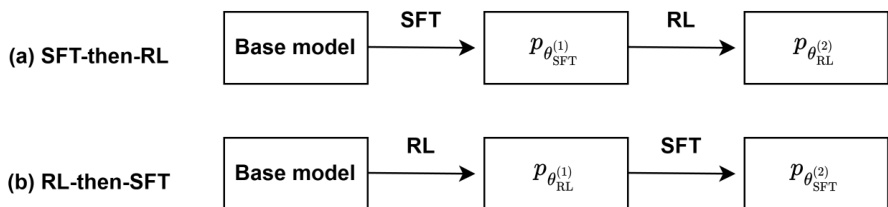
The authors investigate the interaction between supervised fine-tuning (SFT) and reinforcement learning (RL) in post-training pipelines for language models, focusing on the non-decoupling of these stages. The overall framework begins with a pretrained base model, which undergoes either SFT or RL as a post-training step, followed by the other, before reaching test-time computation. The two primary sequential strategies are SFT-then-RL and RL-then-SFT, which are analyzed to determine if the stages can be treated as independent optimizations.
In the SFT stage, the pretrained model pθ is adapted to task-specific knowledge using labeled data DSFT. The objective is to minimize the negative log-likelihood, which is equivalent to the cross-entropy loss for next-token prediction. This is formalized as LSFT(pθ)=−∑(x,y)∈DSFT∑j=1∣y∣logpθ(yj∣x,y<j). The resulting model pθSFT is optimized to generate outputs y given a prompt x, and this process is effective for in-distribution tasks.
The RL stage, typically used for aligning models with human preferences, treats the language model as a policy pθ. It aims to maximize the expected reward rG(x,y) over the output distribution. When the ground truth reward is not available, a proxy reward model r(⋅,⋅) is trained on preference data DRL, which consists of prompt-response pairs with positive and negative responses. The policy is updated using a policy gradient objective, such as PPO, which maximizes the expected reward while regularizing against drift from a reference model πref. The objective is IRL(θ)=Ex∼pDRL,y∼pθ(⋅∣x)[r(x,y)]−βEx∼pDRL[DKL(pθ(⋅∣x)∥πref(⋅∣x))]. The closed-form solution for the updated policy is pθRL(2)(y∣x)=Zβ(x)1πref(y∣x)exp(r(x,y)/β).
The analysis reveals that the two stages are fundamentally coupled. In the SFT-then-RL pipeline, even if the SFT stage has converged, the subsequent RL phase inevitably degrades the SFT loss. This is because the RL update, which maximizes reward, shifts the model's output distribution away from the SFT-optimized distribution, leading to a non-trivial increase in the SFT loss. Conversely, in the RL-then-SFT pipeline, the SFT stage, which aims to fit the SFT data, can create a persistent performance gap that decreases the reward achieved by the RL stage. This is shown by the fact that any SFT update from an RL policy cannot increase the expected reward by more than a constant controlled by the distribution shift, and under stronger assumptions, it can lead to a measurable reward deficit. Therefore, the authors conclude that SFT and RL cannot be decoupled and should be treated as a single joint optimization problem.
Experiment
- SFT-then-RL experiment: Fine-tuning the Qwen3-0.6B model on a CoLA-style SFT dataset followed by GRPO-based RL leads to a sharp increase in cross-entropy loss, exceeding the base model’s loss, validating Theorem 3.1 on non-decoupling.
- RL-then-SFT experiment: Applying SFT after RL on the same dataset causes a significant drop in mean@1 reward from 0.385 (≈69.5% accuracy) to 0.343 (≈67.2% accuracy) under robust evaluation, confirming Theorem 4.1 and demonstrating performance degradation due to objective mismatch.
- Both pipelines show performance deterioration in the second stage, empirically validating the inherent coupling between SFT and RL, with results consistent across both orders of training.