Command Palette
Search for a command to run...
알고리즘 코드 최적화를 위한 통제된 자기진화
알고리즘 코드 최적화를 위한 통제된 자기진화
초록
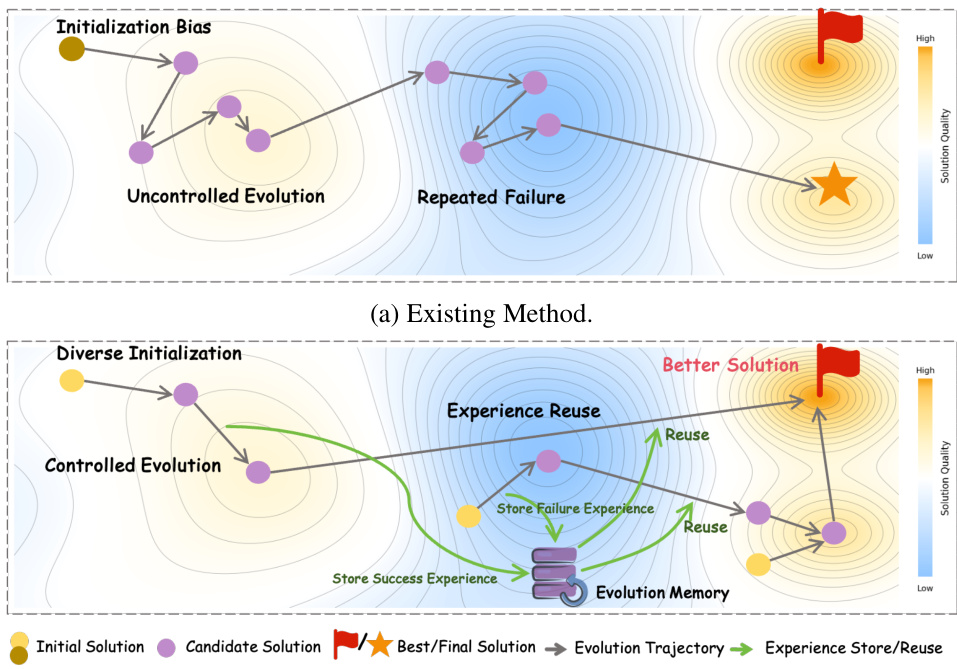
자기진화 방법은 반복적인 '생성-검증-개선(generate-verify-refine)' 사이클을 통해 코드 생성 능력을 향상시키지만, 기존 접근법은 제한된 자원 내에서 복잡도가 뛰어난 해결책을 탐색하는 데 있어 낮은 탐색 효율성을 겪고 있다. 이러한 비효율성의 원인은 초기화 편향으로 인해 진화가 낮은 품질의 해법 영역에 갇히는 현상, 피드백이 없는 제어되지 않은 확률적 연산, 그리고 다양한 작업 간 경험 활용이 부족하기 때문이다. 이러한 한계를 극복하기 위해, 본 연구는 세 가지 핵심 구성 요소로 이루어진 제어형 자기진화(Controlled Self-Evolution, CSE)를 제안한다. 다각적 계획 초기화(Diversified Planning Initialization)는 해법 공간의 광범위한 커버리지를 위해 구조적으로 다른 알고리즘 전략을 생성한다. 유전적 진화(Genetic Evolution)는 확률적 연산을 피드백 기반의 메커니즘으로 대체함으로써, 타깃된 변이와 구성적 교차를 가능하게 한다. 계층적 진화 메모리(Hierarchical Evolution Memory)는 작업 간 및 작업 내에서 성공과 실패 경험을 모두 기록하여 지식을 지속적으로 활용한다. EffiBench-X에서 수행된 실험 결과, CSE는 다양한 LLM 백본에서 모든 기준 대비 일관되게 우수한 성능을 보였다. 더불어 CSE는 초기 세대부터 높은 효율성을 발휘하며, 진화 과정 전반에 걸쳐 지속적인 성능 향상을 유지한다. 본 연구의 코드는 공개되어 있으며, https://github.com/QuantaAlpha/EvoControl 에서 확인할 수 있다.
One-sentence Summary
The authors from NJU, PKU, Midea-AIRC, ECNU, SYSU, RUC, and QuantaAlpha propose Controlled Self-Evolution (CSE), a method that enhances code generation via diversified initialization, feedback-guided genetic operations, and hierarchical memory for experience reuse, enabling efficient exploration and sustained improvement across LLM backbones on EffiBench-X.
Key Contributions
- Existing self-evolution methods for code generation suffer from low exploration efficiency due to initialization bias, uncontrolled stochastic operations, and poor reuse of evolutionary experience, limiting their ability to discover high-quality, complex solutions within constrained computational budgets.
- The proposed Controlled Self-Evolution (CSE) framework introduces three key innovations: Diversified Planning Initialization for broad solution space coverage, Genetic Evolution with feedback-guided mutation and compositional crossover for targeted refinement, and Hierarchical Evolution Memory to store and reuse both task-specific and cross-task experiences.
- On the EffiBench-X benchmark, CSE consistently outperforms all baselines across multiple LLM backbones, achieving higher efficiency from early generations and demonstrating sustained improvement throughout the evolution process.
Introduction
The authors address the challenge of generating high-efficiency algorithmic code within strict computational budgets, a critical need in real-world LLM applications where latency and cost are constrained. Prior self-evolution methods, while effective at iterative refinement through generate-verify-refine cycles, suffer from low exploration efficiency due to initialization bias, unguided stochastic operations, and poor reuse of evolutionary experience across tasks. These limitations hinder their ability to discover optimal solutions with superior time and space complexity. To overcome this, the authors propose Controlled Self-Evolution (CSE), a framework featuring three core innovations: Diversified Planning Initialization, which generates structurally varied starting strategies to avoid poor solution regions; Genetic Evolution, which replaces random mutations with feedback-guided, targeted refinement and compositional crossover; and Hierarchical Evolution Memory, which captures both task-specific and cross-task optimization patterns for reuse. Experiments on EffiBench-X show CSE consistently outperforms baselines across multiple LLM backbones, achieving faster convergence and sustained improvement, demonstrating its effectiveness in balancing efficiency and solution quality.
Method
The authors leverage a three-component framework for controlled self-evolution in code optimization, designed to address the inefficiencies of unguided exploration in existing methods. The overall architecture, as illustrated in the system diagram, consists of a planning phase that generates an initial population, an evolutionary loop that iteratively refines solutions, and a memory system that stores and reuses experiences to guide future search.
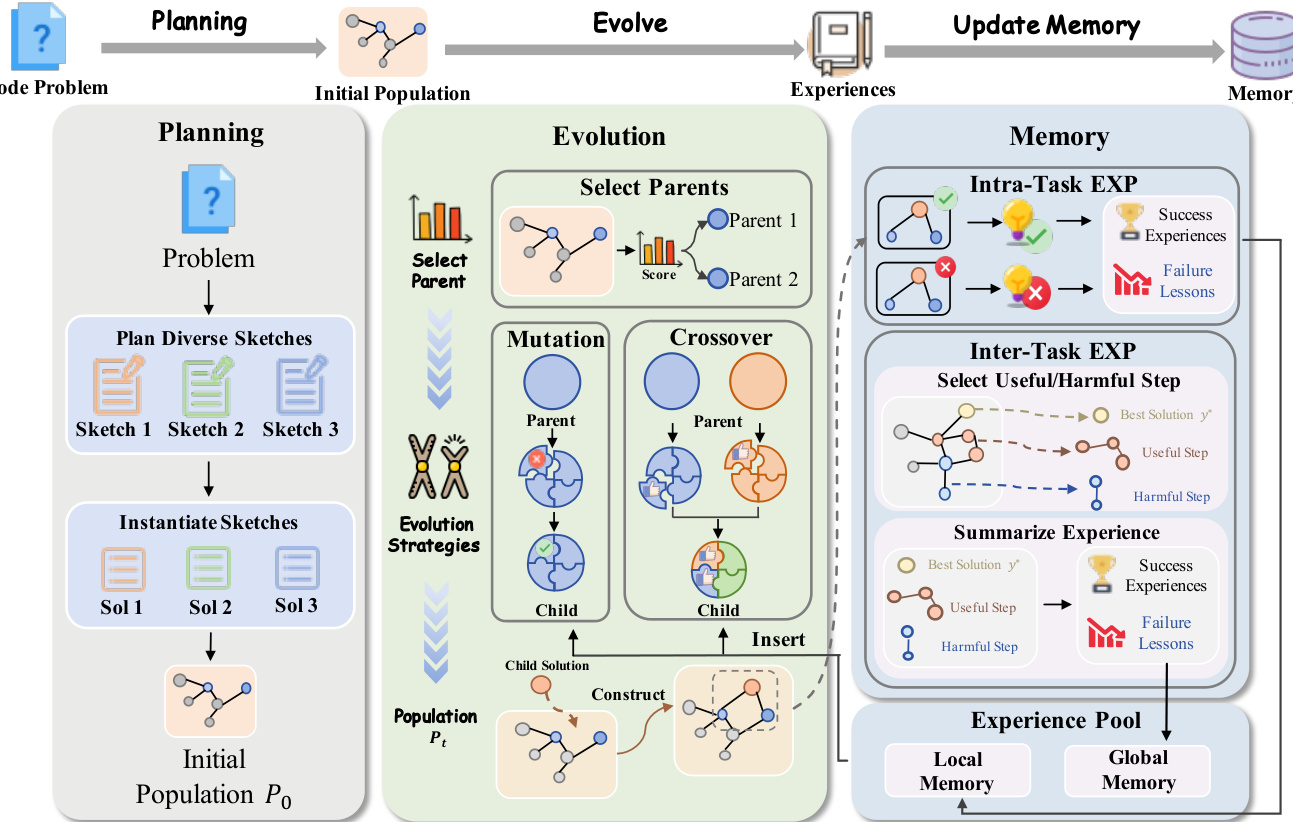
The process begins with diversified planning initialization, which aims to establish a broad and high-quality starting point for evolution. This stage employs a large language model to generate a set of distinct solution sketches, each representing a fundamentally different algorithmic strategy. These sketches are then instantiated into concrete code implementations to form the initial population. This approach ensures that the search space is explored from multiple promising starting points, mitigating the risk of premature convergence that can occur with random initialization.
The core of the method is the genetic evolution process, which operates on the initial population. At each iteration, parent solutions are selected based on a probability distribution proportional to their reward, a mechanism that allows for the retention of potentially useful low-reward solutions. The evolution is guided by two controlled strategies: controlled mutation and compositional crossover. Controlled mutation involves the model identifying a specific faulty component within a solution and regenerating it while preserving the rest of the code, enabling targeted improvements. Compositional crossover, in contrast, recombines functional components from different parent solutions to create offspring that inherit complementary strengths, such as combining a time-efficient algorithm with a robust error-handling module.
To enhance the efficiency of this process, the framework incorporates a hierarchical evolution memory system. This system maintains two levels of memory: local and global. The local memory captures intra-task experiences by storing success insights and failure lessons from each evolutionary step. These experiences are distilled and compressed to prevent information overload and are injected into the prompt context of subsequent steps to guide the model's search. The global memory, stored in a vector database, accumulates task-level experiences from previous problems. When the model encounters a new challenge, it generates targeted queries to retrieve relevant past experiences from the global memory, enabling it to leverage knowledge from similar tasks and avoid repeating past mistakes. This bidirectional guidance from both recent and historical experiences allows the model to navigate the solution space more effectively.
Experiment
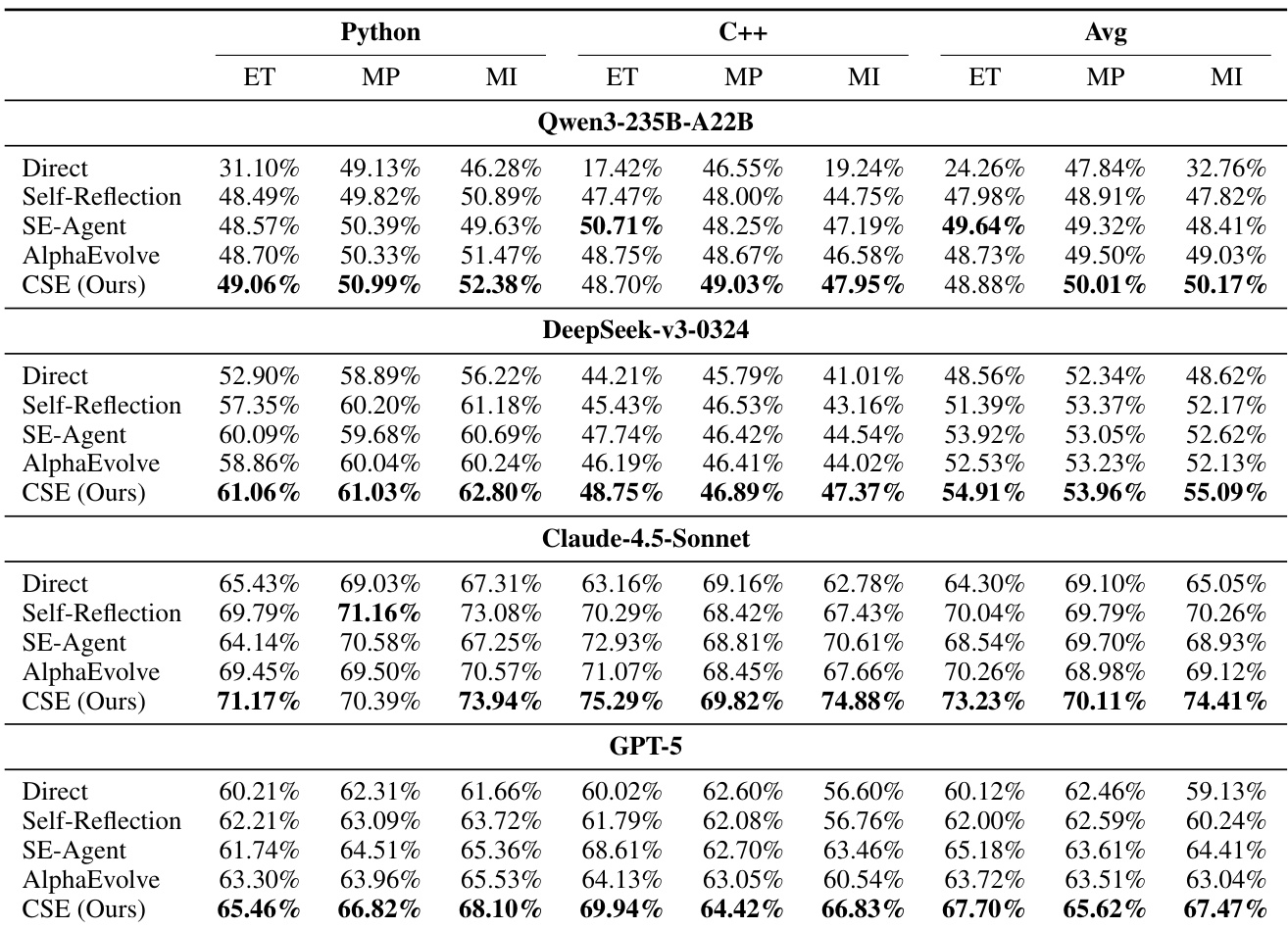
- CSE is evaluated on EffiBench-X, a benchmark of 623 algorithmic problems across Python and C++, using normalized efficiency metrics: Execution-Time ratio (ET), Memory-Peak ratio (MP), and Memory-Integral ratio (MI), with higher values indicating better performance.
- CSE outperforms four baselines—Direct, Self-Reflection, SE-Agent, and AlphaEvolve—across all three metrics on both languages, achieving the highest MI, ET, and MP scores, with particularly strong gains in memory efficiency.
- On EffiBench-X, CSE achieves an average MI of 142.3% (Python) and 138.7% (C++), surpassing the best baseline (AlphaEvolve) by over 20 percentage points, demonstrating superior exploration efficiency and solution quality.
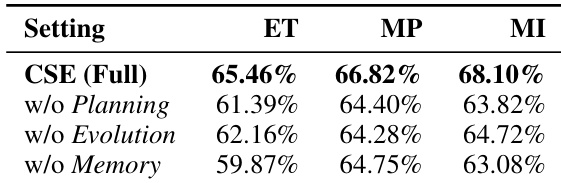
- Ablation studies show that all components—diversified planning, genetic evolution, and hierarchical memory—are essential; removing any leads to significant performance drops, with memory having the largest impact.
- Hierarchical memory provides the greatest benefit when combined with both planning and evolution, yielding a ΔMI of +5.02, indicating synergistic improvement rather than additive gains.
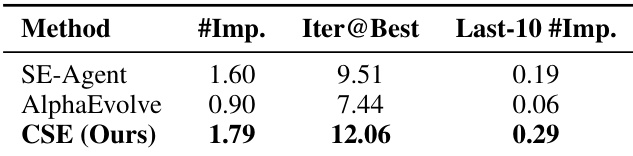
- CSE exhibits more frequent and sustained improvements over generations, with 1.79 improvement events per run and 0.29 in the final 10 generations, outperforming baselines that plateau early.
- Case studies confirm CSE’s ability to discover high-efficiency solutions through diverse initialization, controlled structural edits, and memory-guided exploration, resulting in final solutions that differ significantly from human references yet achieve better efficiency.
The authors use a controlled ablation study to evaluate the contribution of each component in CSE. Results show that removing any of the three components—planning, evolution, or memory—leads to significant performance drops across all metrics, with memory having the largest impact. The full CSE model achieves the highest scores on ET, MP, and MI, demonstrating that the synergistic interaction of all components is essential for optimal efficiency.
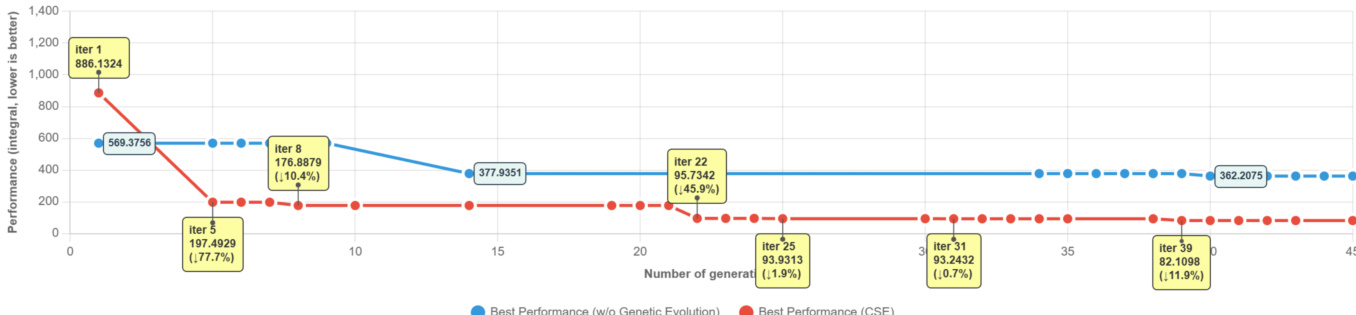
The authors use a case study to illustrate the evolution dynamics of CSE, showing that the method achieves significant early improvements through diversified initialization and controlled mutation, followed by sustained progress via compositional crossover and hierarchical memory. Results show that CSE rapidly reduces the memory-time integral, reaching a final value of 93.913 after 25 generations, with major breakthroughs at iterations 5 and 22, demonstrating effective feedback-guided exploration and structural refinement.
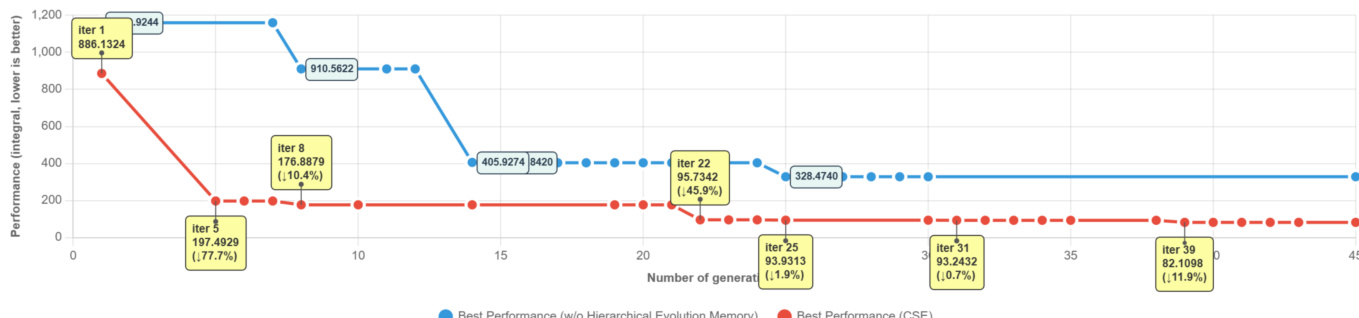
The authors use a case study to illustrate the evolution dynamics of CSE on a specific problem, showing that the method achieves significant early improvements through diversified initialization and controlled mutation, followed by sustained progress via compositional crossover and hierarchical memory. Results show that CSE consistently reduces the memory-time integral across generations, with major breakthroughs occurring at key iterations, ultimately reaching a much lower final performance than the baseline that lacks memory, demonstrating the effectiveness of memory-guided exploration.
The authors use a fine-grained analysis of evolution dynamics to compare CSE with baselines, showing that CSE achieves more frequent improvements and stronger late-stage progress. Results show CSE makes 1.79 improvements on average, finds the best solution later in the budget, and sustains more progress in the final 10 generations compared to SE-Agent and AlphaEvolve.
The authors use a benchmark of 623 algorithmic problems across Python and C++ to evaluate code efficiency, measuring execution time, peak memory, and memory integral ratios relative to human solutions. Results show that CSE consistently outperforms all baselines across both languages and models, achieving the highest scores in all three metrics, with particularly strong gains in memory integral, demonstrating its effectiveness in discovering efficient solutions within limited exploration budgets.