Command Palette
Search for a command to run...
베비비전: 언어를 초월한 시각적 추론
베비비전: 언어를 초월한 시각적 추론
초록
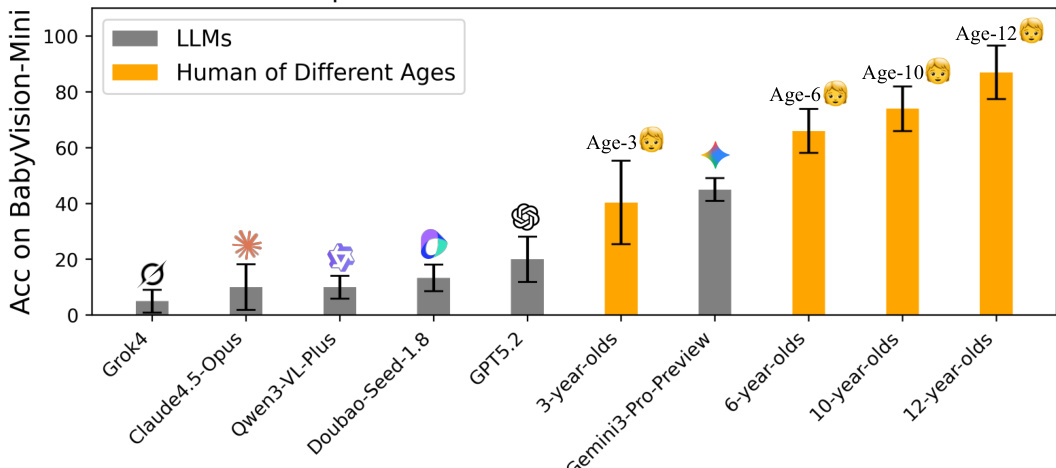
인간은 언어를 습득하기 훨씬 전에 핵심 시각 능력을 발달시킨다. 그러나 현행 다모달 대규모 언어모델(Multimodal LLM, MLLM)은 여전히 취약한 시각 이해 능력을 보완하기 위해 언어적 사전 지식에 크게 의존하고 있다. 우리는 중요한 사실을 발견했다. 최첨단 MLLM들은 인간, 심지어 3세 어린이도 쉽게 해결할 수 있는 기초적인 시각 작업에서 일관되게 실패하고 있다는 점이다. 이러한 격차를 체계적으로 탐구하기 위해, 언어적 지식 없이도 핵심 시각 능력을 평가할 수 있도록 설계된 벤치마크인 BabyVision을 제안한다. BabyVision은 넓은 범위의 작업을 포함하며, 총 388개 항목이 네 가지 핵심 범주에 걸쳐 22개 하위 분류로 구성되어 있다. 실증 결과 및 인간 평가를 통해 선도적인 MLLM들이 인간 기준보다 훨씬 낮은 성능을 보이고 있음을 확인했다. Gemini 3-Pro-Preview의 점수는 49.7에 불과하며, 이는 6세 어린이의 성능에도 미치지 못하고, 평균 성인의 점수인 94.1보다 크게 뒤떨어진다. 이러한 결과는 현재 MLLM들이 지식 중심 평가에서는 뛰어난 성과를 내고 있음에도 불구하고 여전히 기본적인 시각 원천 능력이 부족하다는 것을 보여준다. BabyVision에서의 성과 향상은 인간 수준의 시각 인식 및 추론 능력에 한 걸음 다가가는 계기가 될 것이다. 또한, 생성 모델을 활용한 시각 추론 해결 방안을 탐색하기 위해 BabyVision-Gen과 자동 평가 툴킷을 제안한다. 본 연구의 코드 및 벤치마크 데이터는 https://github.com/UniPat-AI/BabyVision 에 공개되어 재현이 가능하다.
One-sentence Summary
The authors from UniPat AI, Peking University, Tsinghua University, and collaborating institutions propose BABYVISION, a benchmark assessing core visual abilities in multimodal LLMs independent of language, revealing that even top models like Gemini3-Pro-Preview lag behind 6-year-old humans; the work introduces BABYVISION-GEN and an automatic evaluation toolkit to advance visual reasoning in generation models, marking a step toward human-level visual perception.
Key Contributions
-
The paper introduces BABYVISION, a benchmark comprising 388 items across 22 subclasses in four domains—Fine-grained Discrimination, Visual Tracking, Spatial Perception, and Visual Pattern Recognition—designed to evaluate core visual abilities in multimodal LLMs independent of linguistic knowledge, revealing a significant performance gap between current models and human infants and children.
-
The study demonstrates that state-of-the-art MLLMs, including Gemini3-Pro-Preview, achieve only 49.7% accuracy on BABYVISION, far below human benchmarks (6-year-olds: ~70%, adults: 94.1%), exposing a critical deficiency in foundational visual primitives despite strong performance on language-heavy multimodal tasks.
-
To address the visual reasoning gap, the authors propose BABYVISION-GEN, a generative evaluation framework that assesses visual reasoning through image and video generation, paired with an automatic evaluation toolkit achieving 96% agreement with human judgments, and show that generative models can outperform MLLMs on certain visual tasks.
Introduction
Contemporary Multimodal Large Language Models (MLLMs) excel at high-level, knowledge-intensive tasks such as mathematical reasoning and expert-level question answering, yet they consistently fail on basic visual reasoning tasks that even 3-year-old children can solve without language. This gap highlights a critical limitation: current models lack foundational visual primitives—such as object tracking, spatial perception, and fine-grained discrimination—that emerge early in human development and are independent of linguistic knowledge. Prior benchmarks have largely focused on semantic or expert-level reasoning, failing to systematically evaluate these pre-linguistic visual abilities, which leads to an overestimation of model robustness in real-world perception.
The authors introduce BABYVISION, a rigorous benchmark designed to assess core visual reasoning in MLLMs without relying on language. It comprises 388 tasks across four domains—Fine-grained Discrimination, Visual Tracking, Spatial Perception, and Visual Pattern Recognition—structured to mirror early human visual development. Evaluation reveals a stark performance gap: the best MLLM, Gemini3-Pro-Preview, scores only 49.7% compared to 94.1% for adult humans, with significant failures in tracking and spatial reasoning due to a "verbalization bottleneck" that discards non-verbalizable visual information.
To address this, the authors propose BABYVISION-GEN, a generative extension that evaluates visual reasoning through image or video output rather than text, enabling models to express solutions via visual means like tracing paths or completing patterns. They also develop an automatic evaluation toolkit with 96% agreement to human judgments. Experiments show that frontier generation models like Sora-2 and Nano-Banana-Pro demonstrate human-like visual thinking, suggesting that native multimodal architectures—those that reason directly in visual space—may be key to achieving truly grounded visual intelligence.
Dataset

- The BABYVISION benchmark consists of 388 carefully curated visual reasoning questions designed to evaluate foundational early-vision skills in Multimodal Large Language Models (MLLMs), grounded in developmental psychology and organized into four core categories: Fine-grained Discrimination (8 subtypes), Visual Tracking (5 subtypes), Spatial Perception (5 subtypes), and Visual Pattern Recognition (4 subtypes), totaling 22 subtypes.
- The dataset was constructed through a three-stage curation pipeline: (1) Taxonomy definition and seed selection, where 100 high-quality seed images were manually chosen to represent each subtype; (2) Data collection and filtering, using reverse image search and keyword-based retrieval to gather ~4,000 candidate images, with strict filtering for text, cultural knowledge, and inappropriate content; and (3) Annotation and quality assurance, where trained annotators created questions and detailed solution processes, followed by double-blind expert review to ensure answers are visually grounded and unambiguous.
- Final dataset composition includes 135 multiple-choice questions (34.8%) and 253 fill-in-the-blank questions (65.2%), with an average length of 25.9 words, balanced answer distributions, and strong visual grounding to prevent language-based shortcuts.
- A supplementary training set of 1,400 examples was created using the same pipeline but with broader data sourcing to study the impact of training on model performance on BABYVISION.
- BABYVISION-GEN, a generation-focused adaptation, includes 280 questions across 21 subtypes from the same four categories, excluding one subtype incompatible with visual generation. Each instance includes an original image, a generation prompt (avg. 22.9 words), and a reference solution image based on consensus from three human annotators.
- Questions are evaluated using strict criteria: for example, in "Find the Same," all marked elements must exactly match the ground truth; in "Maze," the path must follow the exact same route; in "Count Same Patterns," the count must match precisely.
- The authors use the BABYVISION dataset for evaluation, with a focus on testing visual reasoning capabilities, while BABYVISION-GEN is used to assess visual generation models’ ability to produce solutions through image synthesis rather than verbal answers.
Method
The authors leverage a structured three-phase framework for constructing the BABYVISION-GEN dataset, which emphasizes systematic taxonomy development, scalable data collection, and rigorous quality control. The process begins with taxonomy and seed collection, where the scope of early vision tasks is defined using textbooks and visual tests. This phase establishes four top-level categories and 22 subtypes, culminating in the manual selection of approximately 50 seed images that serve as foundational examples for subsequent data generation.
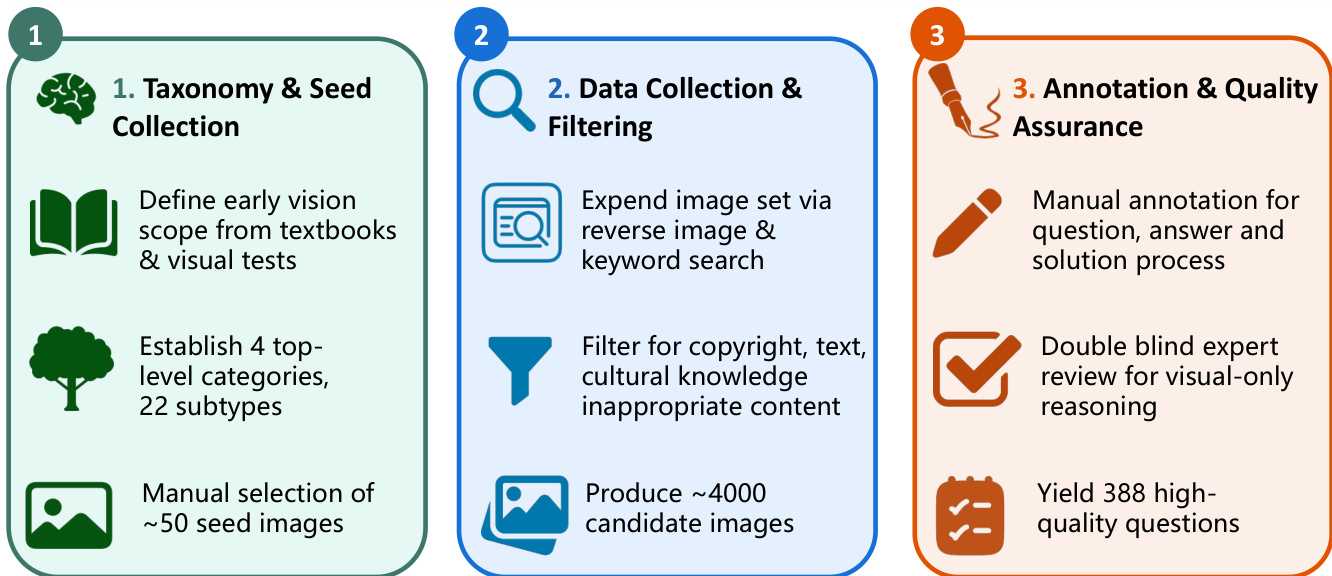
As shown in the figure below, the second phase focuses on data collection and filtering. The image set is expanded through reverse image search and keyword-based queries to generate a large pool of candidate images. This raw collection undergoes filtering to remove content that violates copyright, contains inappropriate text, or involves culturally sensitive material. The result is a curated set of approximately 4,000 candidate images suitable for downstream annotation.
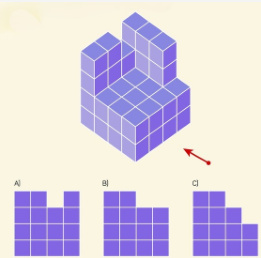
The final phase, annotation and quality assurance, ensures the reliability and clarity of the dataset. Each question, answer, and solution process is manually annotated to preserve the original image context while adding only the necessary visual marks—such as circles, lines, arrows, or text labels—to indicate the solution. A double-blind expert review process is applied specifically to assess visual-only reasoning tasks, ensuring that annotations are accurate and minimal. This phase yields 388 high-quality questions, each accompanied by a precise visual solution.
Experiment
- Evaluated 11 frontier models (5 proprietary, 6 open-source) on BabyVision and BabyVision-GEN using standardized prompts and LLM-as-judge evaluation with Qwen3-Max and Gemini-3-Flash, achieving 100% consistency with human evaluators on BabyVision and 96.1% agreement on BabyVision-GEN.
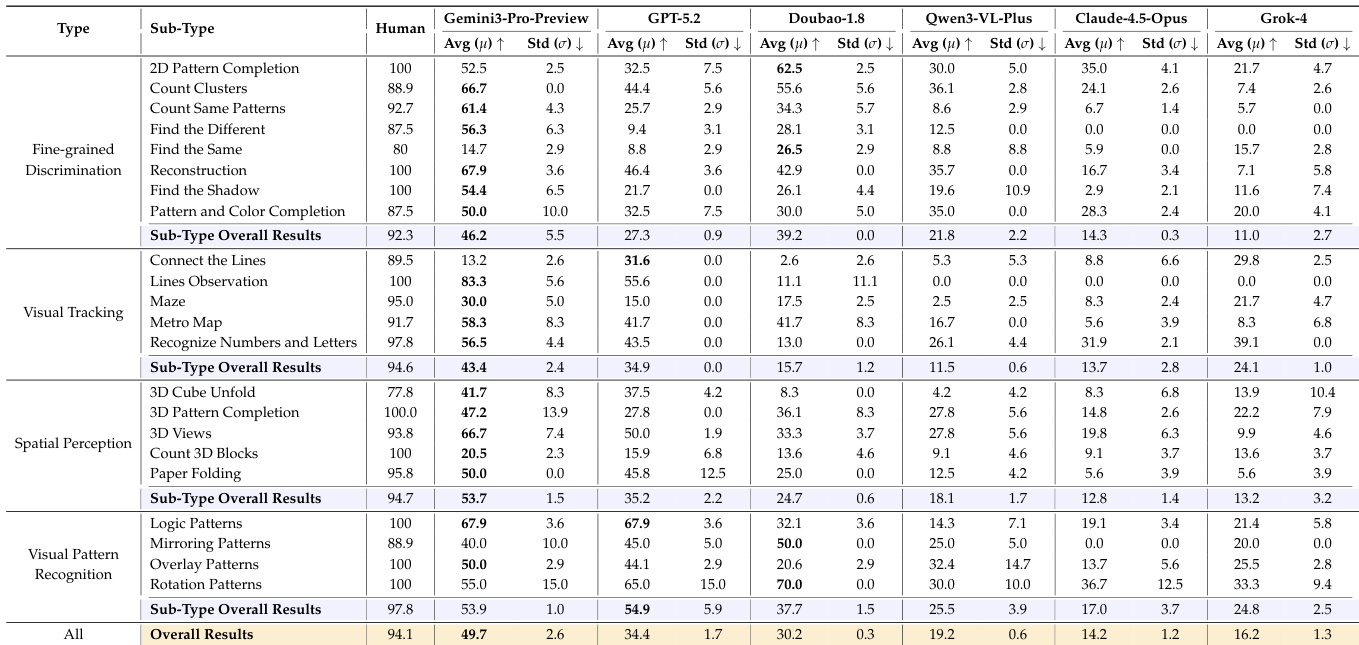
- On BabyVision, proprietary models achieved up to 49.7% Avg@3 (Gemini3-Pro-Preview), far below human baseline (94.1%), with persistent failures in fine-grained discrimination (best: 26.5% on Find the Same), visual tracking (near-zero on Lines Observation), and 3D spatial perception (best: 20.5% on Count 3D Blocks).
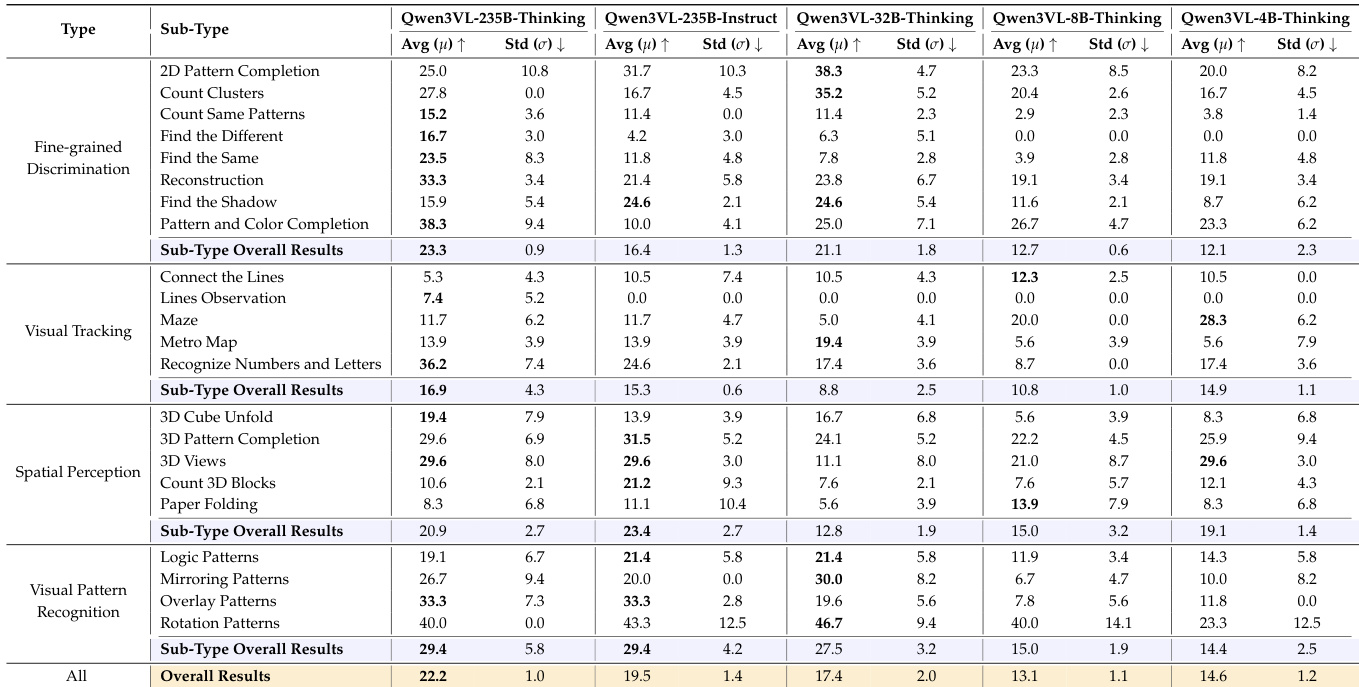
- Open-source models showed lower performance (best: 22.2% for Qwen3VL-235B-Thinking), with test-time thinking providing measurable gains over Instruct variants, but still significantly behind proprietary models.
- Model scaling improved performance in the Qwen3VL family (235B-Thinking: 22.2% vs. 4B-Thinking: 14.6%), though gains were non-monotonic, indicating limitations of scaling alone for early-vision tasks.
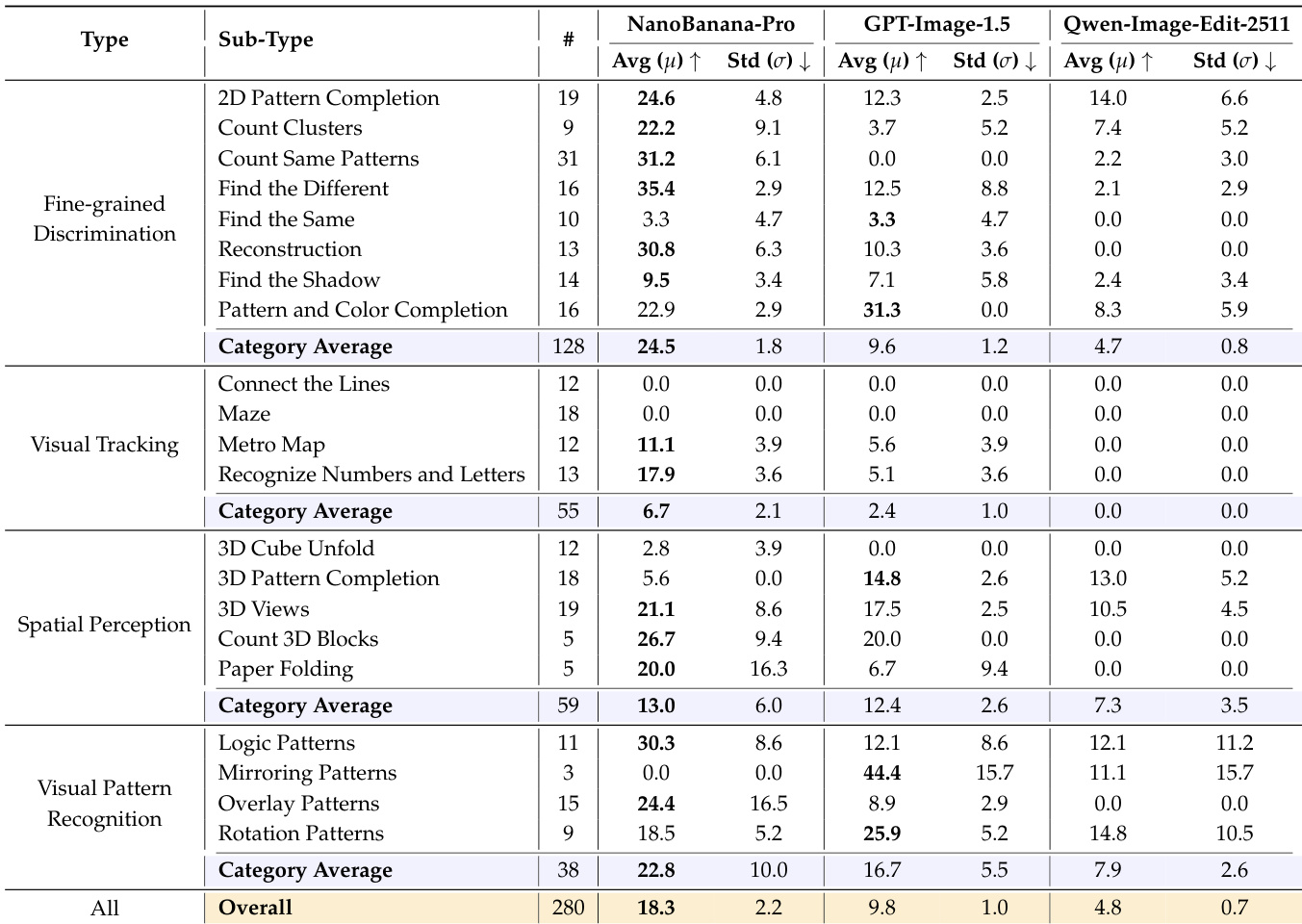
- On BabyVision-GEN, NanoBanana-Pro achieved 18.3% accuracy, outperforming GPT-Image-1.5 (9.8%) and Qwen-Image-Edit (4.8%), with strong results in Fine-grained Discrimination (24.5%) and Visual Pattern Recognition (22.8%), but near-zero accuracy on visual tracking tasks (Maze, Connect the Lines).
- RLVR fine-tuning of Qwen3-VL-8B-Thinking improved BabyVision accuracy by +4.8 points overall, with gains across most subtypes, though visual tracking showed little improvement, highlighting the challenge of continuous perceptual tracking in language-based reasoning.
- Qualitative analysis revealed a "verbalization bottleneck" where MLLMs fail on tasks requiring non-verbal, fine-grained visual perception, manifold identity tracking, 3D spatial imagination, and visual pattern induction due to lossy compression of visual information into language.
The authors evaluate three visual generation models on the BABYVISION-GEN benchmark, with NanoBanana-Pro achieving the highest overall accuracy at 18.3%, significantly outperforming GPT-Image-1.5 (9.8%) and Qwen-Image-Edit (4.8%). Results show that all models struggle with tasks requiring continuous spatial tracking, such as maze navigation and line tracing, where accuracy drops to 0%, while performance is stronger in fine-grained discrimination and visual pattern recognition subtypes.
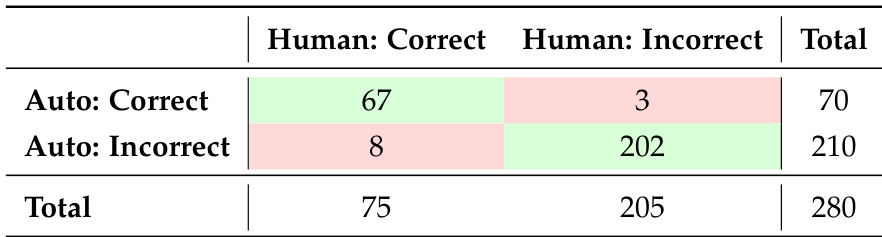
The authors evaluate the reliability of their automatic evaluation method for BABYVISION-GEN by comparing it against human judgments. The results show that the automatic judge agrees with human evaluators on 96.1% of instances, with a high F1 score of 0.924, indicating strong consistency between the two evaluation approaches.
The authors use a unified prompt template and LLM-as-judge evaluation to assess model performance on the BabyVision benchmark, with results showing that proprietary models like Gemini3-Pro-Preview achieve the highest scores but still fall significantly below human performance. The table reveals that no model consistently outperforms humans across all subtypes, with the largest gaps observed in fine-grained discrimination and visual tracking tasks, indicating persistent challenges in foundational visual reasoning.
The authors use the table to compare the performance of different Qwen3VL models across various visual reasoning tasks, focusing on the impact of model size and reasoning mode. Results show that the Thinking variant consistently outperforms the Instruct variant at the same scale, and performance generally improves with model size, though the 4B-Thinking model slightly exceeds the 8B-Thinking model, indicating non-monotonic scaling effects.
The authors use a benchmark called BabyVision to evaluate visual reasoning capabilities of large language models (LLMs) and compare them to human performance across different age groups. Results show that even the best-performing LLM, Gemini3-Pro-Preview, achieves an accuracy of 44.1%, which is significantly below the performance of 6-year-old children and far from the 94.1% accuracy of 12-year-olds.