Command Palette
Search for a command to run...
MMFormalizer: 월드와이드에서의 다중모달 자동공식화
MMFormalizer: 월드와이드에서의 다중모달 자동공식화
초록
자연어 수학을 형식적 진술로 번역하여 기계적 추론을 가능하게 하는 자동형식화(autoformalization)는 현실 세계의 다중 모달성이라는 본질적인 도전 과제에 직면해 있다. 특히 물리학에서는 시각적 요소로부터 숨겨진 제약 조건(예: 질량 또는 에너지)을 추론해야 하기 때문이다. 이를 해결하기 위해 우리는 실세계 수학 및 물리 도메인의 실체들과 적응형 지향성(adaptive grounding)을 통합함으로써 자동형식화의 범위를 텍스트를 넘어서 확장하는 MMFormalizer를 제안한다. MMFormalizer는 적응형 재귀 종결(adaptive recursive termination)을 통해 시각적 증거에 기반하고 차원적 또는 공리적 지향성에 고정된 상태에서, 감각적으로 지향된 기본 구성 요소로부터 재귀적으로 형식적 명제를 구성하며, 재귀적 지향과 공리 조합을 통해 이를 수행한다. 우리는 MathVerse, PhyX, 합성 기하학(Synthetic Geometry), 해석 기하학(Analytic Geometry)에서 수집한 총 115개의 정밀하게 구성된 샘플을 포함하는 새로운 벤치마크인 PhyX-AF에서 MMFormalizer를 평가하였다. 결과적으로 GPT-5 및 Gemini-3-Pro와 같은 최첨단 모델들이 가장 높은 컴파일 정확도와 의미적 정확도를 기록하였으며, 특히 GPT-5는 물리적 추론에서 뛰어난 성능을 보였다. 반면 기하학은 여전히 가장 도전적인 영역으로 남아 있다. 종합적으로 MMFormalizer는 인지와 형식적 추론을 연결하는 확장 가능한 통합 다중 모달 자동형식화 프레임워크를 제공한다. 우리 지식에 따르면, 이는 해밀토니안에서 유도된 고전역학을 비롯해 상대성 이론, 양자역학, 열역학까지 다룰 수 있는 최초의 다중 모달 자동형식화 방법이다. 보다 자세한 내용은 프로젝트 페이지(MMFormalizer.github.io)에서 확인할 수 있다.
One-sentence Summary
The authors, from The University of Hong Kong, University of Michigan, University of Edinburgh, University of California, Santa Barbara, Ohio State University, and University of California, Los Angeles, propose MMFORMALIZER—a novel multimodal autoformalization framework that integrates adaptive grounding with perceptual primitives to recursively construct formally grounded mathematical and physical propositions, enabling machine reasoning across domains including classical mechanics, relativity, quantum mechanics, and thermodynamics, with demonstrated scalability on the PHYX-AF benchmark.
Key Contributions
-
We introduce MMFORMALIZER, a multimodal autoformalization framework that recursively grounds visual and textual inputs in physical and mathematical axioms, using dimensional analysis and adaptive termination to ensure every formal proposition is anchored in measurable reality and supported by perceptual evidence.
-
The framework enables the formalization of complex physical theories—including classical mechanics (via Hamiltonian derivation), relativity, quantum mechanics, and thermodynamics—making it the first method capable of unified multimodal reasoning across these domains.
-
We present PHYX-AF, a new benchmark with 115 diverse samples from MathVerse, PhyX, Synthetic Geometry, and Analytic Geometry, designed to enforce genuine multimodal reasoning by minimizing redundancy between modalities, and demonstrate that frontier models like GPT-5 and Gemini-3-Pro achieve state-of-the-art compile and semantic accuracy.
Introduction
The authors address the challenge of translating real-world, multimodal inputs—such as diagrams, text, and physical scenes—into formally verifiable mathematical and physical statements, a critical step for enabling machine reasoning in complex domains. Prior work in autoformalization has largely focused on symbolic or textual inputs within geometry, relying on fixed formal languages that struggle to capture dimensional and physical constraints inherent in real-world phenomena. These systems often fail to ground abstract reasoning in measurable reality, especially when dealing with physics where quantities like mass, energy, and time require empirical and dimensional consistency. To overcome this, the authors introduce MMFORMALIZER, a recursive framework that integrates perceptual grounding with dimensional and axiomatic reasoning within the Lean theorem prover. It uses adaptive recursive termination to ensure each formal step is anchored in visual evidence and dimensionally consistent, enabling formalization of classical mechanics, relativity, quantum mechanics, and thermodynamics—domains previously inaccessible to multimodal autoformalization. The method is evaluated on PHYX-AF, a new benchmark designed to enforce genuine multimodal reasoning by minimizing redundancy between modalities, demonstrating that while large models like GPT-5 show strong performance, geometry and physical reasoning remain challenging.
Dataset

-
The PHYX-AF benchmark consists of 115 curated samples drawn from multiple sources: MATHVERSE (Zhang et al., 2024a), PHYX (Shen et al., 2025), SYNTHETIC GEOMETRY (Trinh et al., 2024), and an extended ANALYTIC GEOMETRY dataset. Additional synthetic data is generated using a rule-based computation engine (Hubert et al., 2025) and a symbolic deduction framework inspired by AlphaGeometry and GenesisGeo (Zhu et al., 2025).
-
The dataset is divided into distinct subsets:
- Multimodal Mathematical Setup: Primarily sourced from MATHVERSE, covering Plane Geometry, Solid Geometry, and Function categories. These problems are drawn from real-exam contexts and emphasize proof-based reasoning and solving multivariate/higher-order equations from function graphs.
- Analytic Geometry: Includes problems from GEOMETRY3K (Lu et al., 2021) and GEOINT (Wei et al., 2025), augmented with procedurally generated 2D and 3D figures composed of points, lines, planes, and polyhedra. This subset tests understanding of coordinate-based geometric and numerical relationships.
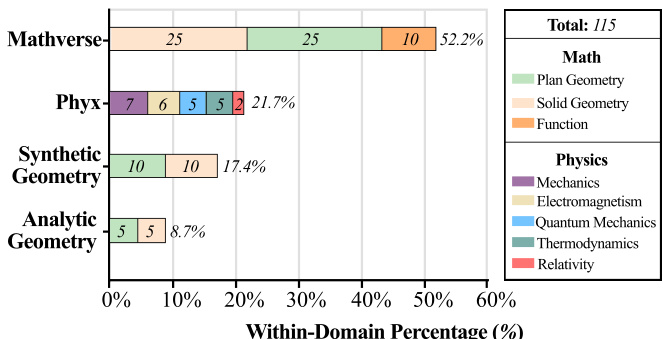
- Multimodal Physical Setup: Derived from the PHYX subset (21.7% of the dataset), featuring visual scenes from mechanics, electromagnetism, thermodynamics, and relativity. Each problem pairs an image with a textual constraint, assessing visual-physical grounding under perceptual noise.
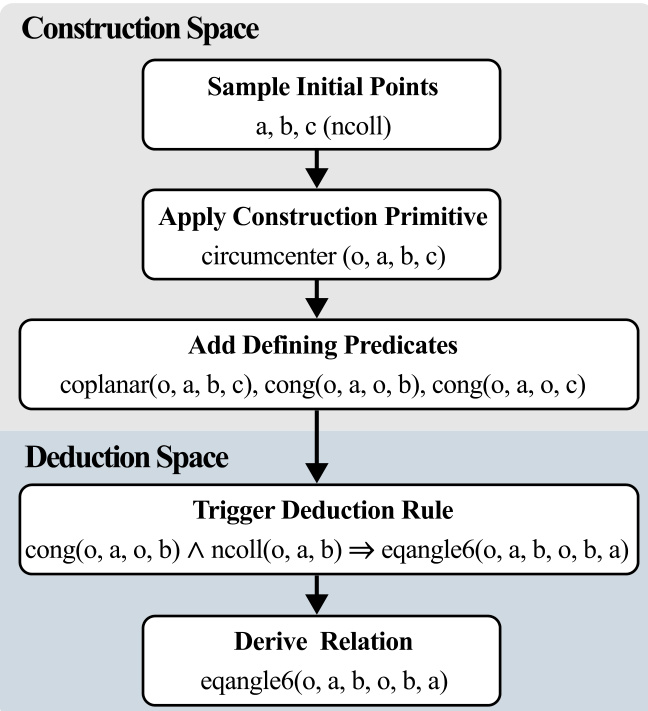
- Synthetic Geometry Setup: Entirely generated via a symbolic pipeline that constructs geometric configurations using a bounded sequence of declarative operators (e.g., point, line, circle, incidence, perpendicularity). These configurations are validated through symbolic deduction closure and numerical verification.
-
Data filtering ensures only problems where diagrams are essential for solution are retained—text-only solvable problems are excluded to enforce genuine multimodal reasoning.
-
The synthetic geometry pipeline follows a four-stage process:
- Synthetic Construction: Geometric configurations are built using a finite sequence of construction operators, bounded in length and object count to ensure well-defined, non-degenerate setups. Invalid constructions (e.g., intersecting parallel lines) are discarded.
- Symbolic Deduction Closure: Forward chaining deduces all derivable geometric statements from the construction, producing a full derivation graph that records dependency relations.
- Minimal Dependency Extraction: A derived statement is selected as the goal, and a minimal premise set is extracted by traversing the derivation graph backward. This ensures only necessary facts are included, preserving derivational sufficiency.
- Numerical Verification: Each instance is instantiated with concrete real-number coordinates. Geometric predicates (equality, incidence, perpendicularity, etc.) are checked under a fixed numerical tolerance. Failed or unstable instances are discarded.
-
The final dataset is used for training and evaluation with a mixture of in-distribution (MATHVERSE, PHYX) and out-of-distribution (synthetic, analytic geometry) samples. The model is trained to perform autoformalization across these domains, with synthetic data specifically designed to test the model’s ability to synthesize new dependent types and constructors at test time.
-
Metadata is constructed through structured symbolic representations, including derivation graphs and premise-goal dependencies, enabling precise evaluation of logical correctness and semantic fidelity. All synthetic instances are reproducible given a fixed random seed.
Method
The authors leverage a multimodal autoformalization framework, implemented through the MMFORMALIZER model, to synthesize formal, type-theoretic representations from perceptual inputs such as images and text. The overall architecture operates in three primary inductive stages: recursive grounding, recursive termination, and axiom composition, forming a hierarchical pipeline that maps visual and textual data into a formally consistent propositional chain. The process begins with the decomposition of an input image into a scene graph, which encodes primitive visual entities and their spatial relations. This scene graph serves as the foundation for recursively constructing a dependent hierarchy of formal propositions, referred to as a PropChain, where each proposition is grounded in perceptual data.
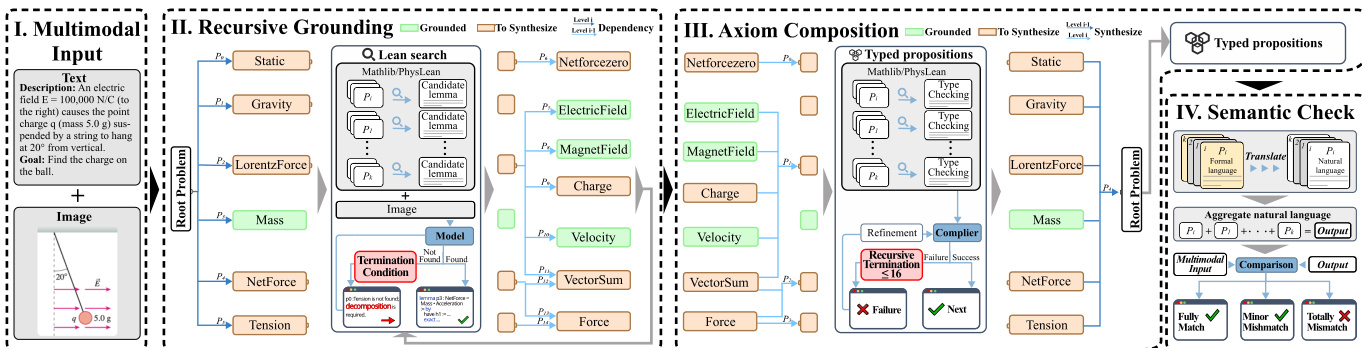
As shown in the figure below, the pipeline overview consists of three stages: Recursive Grounding, identifying physical primitives (the red parts in the figure, e.g., the Hamiltonian or dimensional quantities) for Termination, and Axiom Composition. The blue parts in the figure indicate the compiler checking process. The green part indicates the formal statements we retrieved from the dependency library.
The recursive grounding process, denoted as RG, incrementally constructs a PropChain by mapping perceptual scene structures to formal propositions. This is achieved through a recursive decomposition of the scene graph into a hierarchy of lemmas, where each lemma is a dependent pair of a formal proposition and its proof term. The grounding process is initiated by parsing the input image into a base-level scene graph, G0, which consists of a list of visual primitives—such as points, lines, or regions—and their spatial relations. Each primitive is assigned an initial semantic hypothesis, forming the base layer of the propositional structure. The grounding is inductively extended by mapping each visual element to a formal statement, using a combination of semantic search and large language model (LLM) prompting to retrieve and select the most relevant theorems from a formal library.

The recursive termination phase ensures that the formal abstraction is both supported by perceptual grounding and capable of constraining subsequent parsing. The recursion terminates when a proposition is grounded either in a primitive dimensional quantity or a fundamental axiom. This termination condition is determined by a mapping function that evaluates whether the current proposition corresponds to a physical dimension or an axiom within the formal system. The process is implemented through two major phases: grounding, where intermediate lemma statements are used to search for relevant theorems in a formal library, and termination, where the recursion stops upon reaching a primitive or axiom.
The final stage, axiom composition, constructs the AxiomChain, which represents the formal closure of the propositional hierarchy. This is achieved by recursively combining child nodes into non-leaf nodes using a composition operator, which captures the transition from perceptual substructures to hierarchically dependent propositions. The resulting formal statements are passed through a syntax checker for compilation verification, ensuring their structural and logical validity within the LEAN system. This process enables the construction of formal models that faithfully reflect the generative structure of physical and conceptual reality, where primitives combine to form law-constrained, formal systems.
Experiment
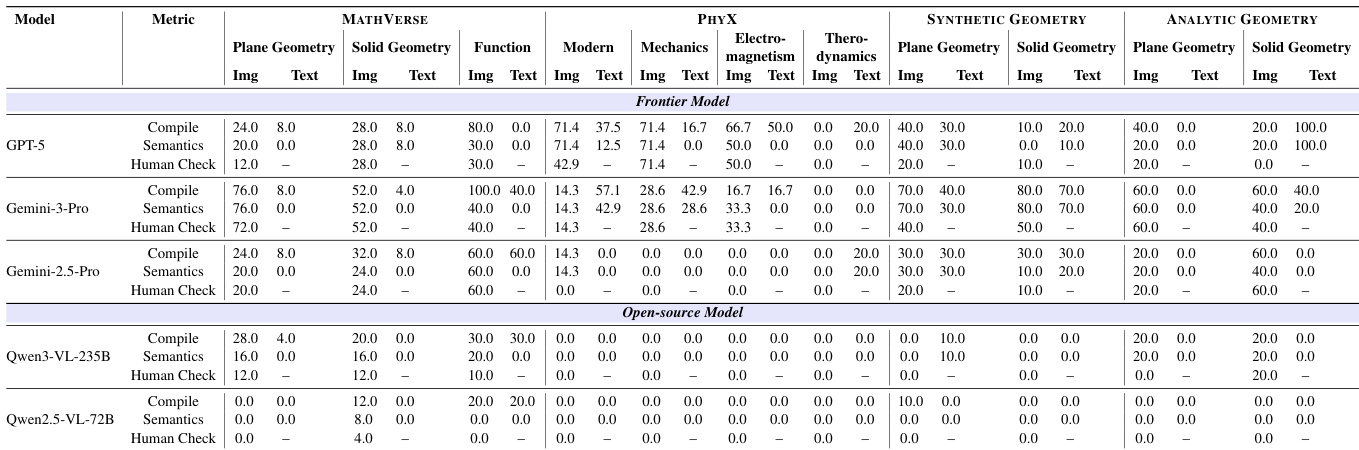
- Gemini-3-Pro achieves the highest compile and semantic accuracy on MATHVERSE and ANALYTIC GEOMETRY, while GPT-5 excels on PHYX, particularly in the MODERN category (quantum mechanics and relativity), demonstrating superior physical reasoning and grounding.
- All models show significantly lower accuracy on SYNTHETIC GEOMETRY and ANALYTIC GEOMETRY, indicating persistent challenges in visual-to-formal reasoning and generalization beyond training distributions.
- Qwen3-VL-235B, the strongest open-source model, performs poorly on physical domain problems and out-of-distribution synthetic geometry tasks, highlighting a performance gap compared to frontier models.
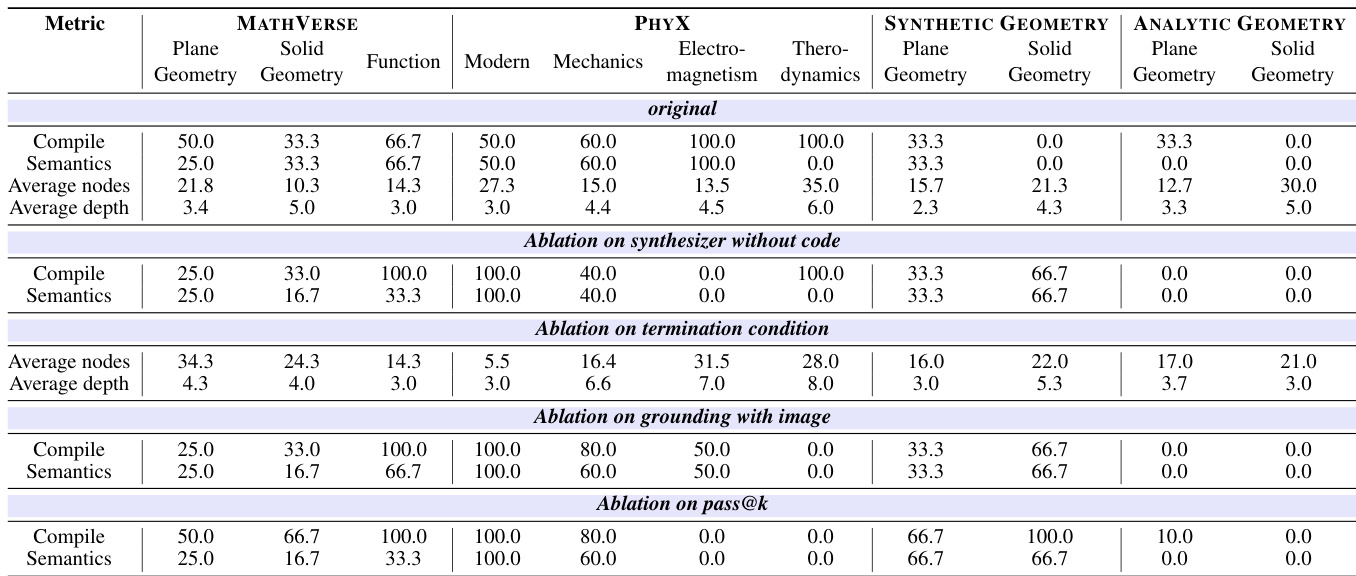
- Ablation studies show that removing retrieved reference code improves out-of-distribution generalization in synthetic geometry, explicit recursion termination prevents infinite decomposition, grounding with images boosts performance in modern physics and synthetic geometry, and increasing pass@k enhances results on difficult problems.
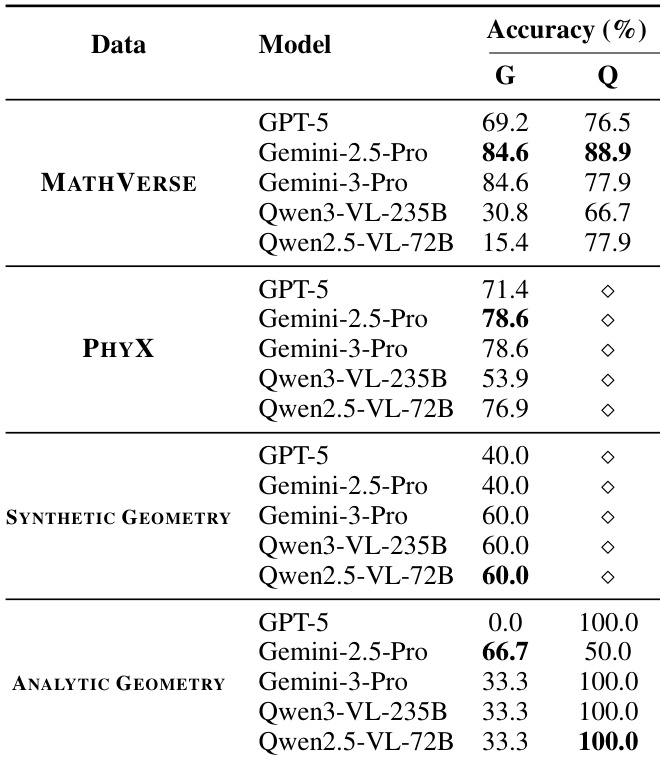
- In semantic checking, Gemini-2.5-Pro achieves the highest accuracy across MATHVERSE, PHYX, and ANALYTIC GEOMETRY; Qwen2.5-VL-72B performs on par with Gemini-3-Pro when verifying code from Qwen3-VL-235B, revealing the potential of weak models supervising strong ones.
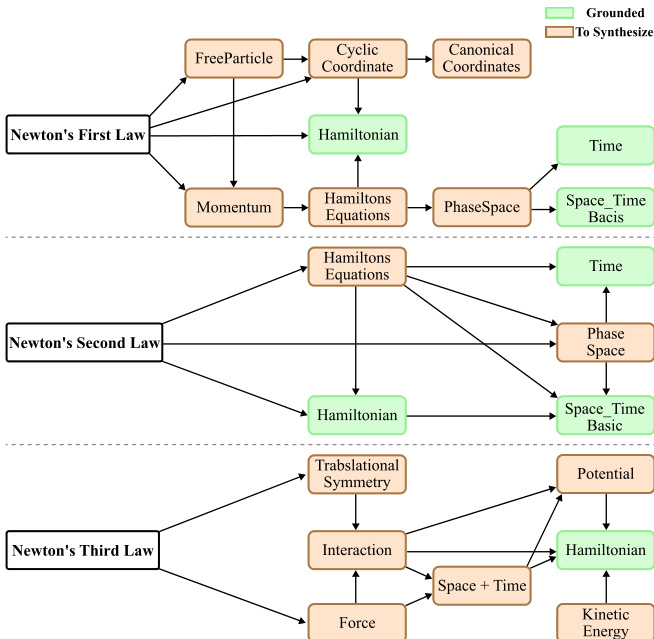
- Case studies validate the framework’s ability to construct verifiable dependency graphs and perform logical grounding in Lean for complex problems, including geometric solids, Newton’s laws, quantum tunneling, and relativistic velocity addition, with failure cases underscoring the necessity of termination conditions.
Results show that GPT-5 achieves the highest compile and semantic accuracy across most benchmarks, particularly excelling in the PHYX dataset, while Gemini-3-Pro performs best on MATHVERSE and ANALYTIC GEOMETRY. All models struggle with synthetic and analytic geometry tasks, indicating persistent challenges in visual and formal reasoning, and open-source models like Qwen3-VL-235B show significant performance gaps compared to frontier models.
The authors use the provided bar chart to illustrate the distribution of problems across different domains and subdomains within the evaluation benchmarks. Results show that MATHVERSE accounts for the majority of the dataset at 52.2%, with the largest portion being Plan Geometry. PHYX contributes 21.7% of the total, primarily composed of Mechanics and Solid Geometry. Synthetic Geometry and Analytic Geometry make up the remaining 17.4% and 8.7% respectively, with the former dominated by Plane Geometry and the latter by Plan Geometry as well.
Results show that Gemini-3-Pro achieves the highest accuracy on MATHVERSE and ANALYTIC GEOMETRY, while GPT-5 performs best on PHYX and SYNTHETIC GEOMETRY. All models exhibit significantly lower performance on synthetic geometry tasks, indicating persistent challenges in visual and formal reasoning.
Results show that the original model configuration achieves the highest compile and semantic accuracy across most benchmarks, particularly excelling in the PHYX and MATHVERSE datasets. Ablation studies reveal that removing retrieved code improves out-of-distribution generalization, while enforcing a termination condition prevents recursive over-decomposition, and grounding with images enhances performance in challenging physics and geometry tasks. Increasing pass@k improves semantic accuracy on difficult problems, indicating the effectiveness of test-time scaling.