Command Palette
Search for a command to run...
스텝딥리서치 기술 보고서
스텝딥리서치 기술 보고서
초록
자율 에이전트로 전환되는 대규모 언어 모델(LLM)의 발전에 따라, 딥 리서치(Deep Research)가 핵심 평가 지표로 부상하고 있다. 그러나 기존의 학술 기준인 BrowseComp와 같은 평가 벤치마크는 개방형 리서치에 필요한 실제 세계의 요구사항을 충족하지 못하는 경우가 많다. 이는 의도 인식, 장기적 의사결정, 그리고 다양한 출처 간의 검증 능력 등 강력한 능력이 요구되기 때문이다. 이를 해결하기 위해 우리는 계획 수립과 보고서 작성 능력을 강화하기 위한 원자적 능력 기반의 데이터 생성 전략을 제안하고, 에이전트 기반 중간 훈련에서 SFT(Supervised Fine-Tuning) 및 RL(Reinforcement Learning)으로 이어지는 점진적 훈련 경로를 도입한 비용 효율적인 엔드투엔드 에이전트인 Step-DeepResearch를 소개한다. 체크리스트 형식의 평가자(기준)를 도입함으로써 이 접근법은 훨씬 더 높은 강건성(로버스트함)을 달성한다. 더불어 중국어 환경에서의 평가 격차를 해소하기 위해 실제적인 딥 리서치 시나리오를 반영한 ADR-Bench를 구축하였다. 실험 결과, Step-DeepResearch(32B)는 Scale AI Research Rubrics에서 61.4%의 점수를 기록하였다. ADR-Bench에서는 비교 가능한 모델들을 크게 능가하며, OpenAI 및 Gemini DeepResearch와 같은 최첨단 폐쇄형 모델과도 경쟁 가능한 성능을 보였다. 이러한 결과는 정교한 훈련 전략을 통해 중간 규모 모델이 산업 최고 수준의 비용 효율성으로 전문가 수준의 능력을 달성할 수 있음을 입증한다.
One-sentence Summary
StepFun researchers propose Step-DeepResearch, a cost-effective 32B-parameter agent model for open-ended deep research tasks, introducing a novel Atomic Capabilities-based data synthesis strategy and progressive training with a checklist-style reward system. It achieves expert-level performance on RESEARCHRUBRICS (61.42) and a new Chinese-language benchmark, rivaling proprietary services like OpenAI DeepResearch while significantly reducing deployment costs.
Key Contributions
- Existing Deep Research evaluations like BrowseComp focus on academic multi-hop search with ground truth, failing to address real-world open-ended research demands requiring latent intent recognition, long-horizon decision-making, and cross-source verification. This gap limits agent usability despite industrial progress in systems like OpenAI DeepResearch.
- The authors introduce Step-DeepResearch, a 32B-parameter agent trained via a novel Data Synthesis Strategy Based on Atomic Capabilities (targeting planning, information seeking, reflection, and report writing) and a progressive pipeline from agentic mid-training to supervised fine-tuning and reinforcement learning with a Checklist-style Judger reward.
- Evaluated on the new Chinese ADR-Bench benchmark covering commercial, policy, and software engineering scenarios, Step-DeepResearch achieves a 61.42 score on RESEARCHRUBRICS and surpasses open-source models while rivaling OpenAI DeepResearch and Gemini DeepResearch in expert Elo ratings, demonstrating cost-effective expert-level performance.
Introduction
The authors recognize that real-world Deep Research—addressing open-ended, complex information-seeking tasks—demands capabilities beyond academic multi-hop question answering, including latent intent recognition, long-horizon planning, cross-source verification, and structured synthesis. Prior agent systems either over-optimized for retrieval accuracy in constrained benchmarks like BrowseComp, producing fragmented "web crawlers" rather than coherent researchers, or relied on complex multi-agent orchestration that increased deployment costs and reduced robustness in practical scenarios. To bridge this gap, the authors introduce Step-DeepResearch, a 32B-parameter model trained via a novel atomic capability data synthesis strategy that decomposes research into trainable skills (planning, reflection, verification) and a progressive training pipeline from mid-training to reinforcement learning. This end-to-end approach internalizes expert-like cognitive loops within a single agent, enabling cost-effective, high-quality research performance that rivals larger proprietary systems while addressing real-world usability gaps.
Dataset
The authors construct a synthetic training dataset through three primary methods to address gaps in existing research benchmarks:
-
Dataset composition and sources
The core training data is synthetically generated from high-quality sources including open-access technical reports, academic surveys, financial research documents, Wikidata5m, and CN-DBpedia knowledge graphs. This approach ensures coverage of real-world research complexity where public benchmarks lack depth. -
Key subset details
- Planning & Task Decomposition data: Reverse-engineered from report titles/abstracts using LLMs to create complex queries and feasible plans. Filtered via trajectory consistency checks to retain only paths aligning with preset plans.
- Reasoning data: Built via graph-based synthesis (10-40 node subgraphs from Wikidata5m/CN-DBpedia) and multi-document walks (using Wiki-doc hyperlinks). Queries undergo difficulty filtering using QwQ-32b to exclude solvable "simple problems."
- Reflection & Verification data: Generated through closed-loop pipelines for self-correction and fact-checking, incorporating structured noise (e.g., tool errors with recovery steps).
- Report data: Mid-training uses 〈Query, Report〉 pairs from screened human reports (e.g., financial analyses), with queries reverse-engineered from document content.
-
Usage in model training
- Mid-training: Focuses on atomic capabilities (planning, retrieval) using domain-style 〈Query, Report〉 pairs and reasoning subsets.
- SFT stage: Combines two trajectory types at optimized ratios:
- Deep Search: Ground-truth answer tasks prioritizing "correct and shortest" trajectories for efficiency.
- Deep Research: Open-ended tasks covering full pipelines (planning to citation-rich reporting), constituting the majority for end-to-end logic reinforcement.
Mixture ratios emphasize Deep Research data to align with real-scenario demands.
-
Processing and quality controls
- Trajectory efficiency filtering retains only minimal-step successful paths.
- Strict N-gram deduplication removes repetitive reasoning loops.
- Citation formatting (\cite{}) is enforced in reports for factual grounding.
- Controlled noise injection (e.g., 5-10% tool errors) builds robustness to real-world instability.
Evaluation uses ADR-Bench with 90 real-user queries across nine domains (20 professional-law/finance, 70 general), rigorously validated by domain experts.
Method
The authors leverage a ReAct-inspired single-agent architecture to structure the Step-DeepResearch system, enabling dynamic, iterative reasoning through alternating phases of thought generation and tool interaction. As shown in the figure below, the agent receives a user query and initiates a multi-turn loop in which it alternates between internal reasoning (enclosed in <tool_call> tags) and external tool invocation (via <toolcall>), with each tool response fed back into the next reasoning step. This cycle continues until the agent produces a final report, marked by an <answer> tag, which is then delivered as a structured document.
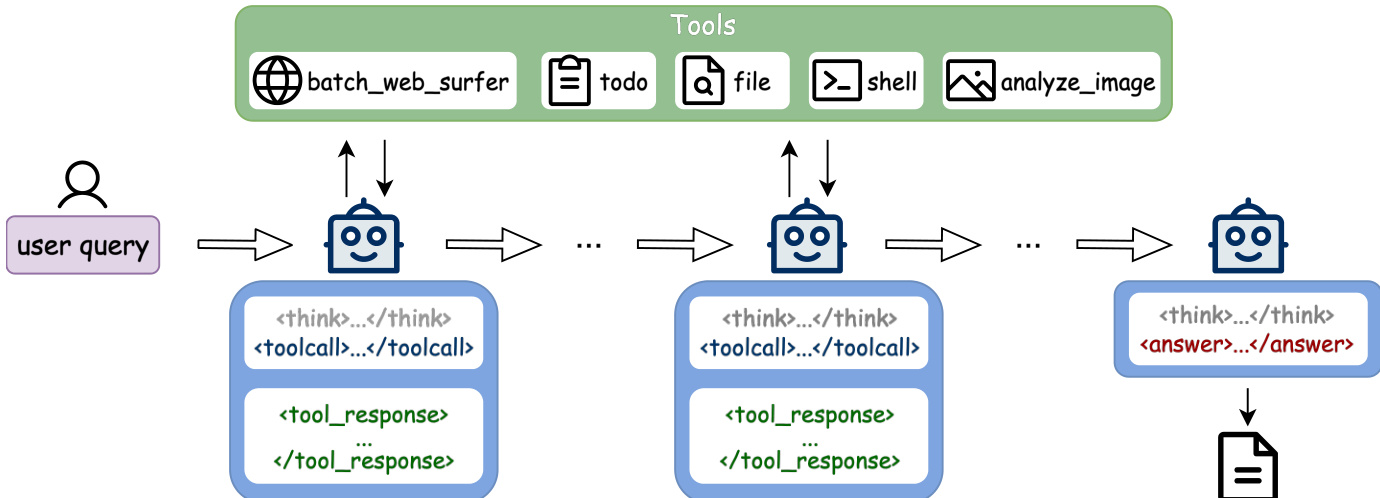
The agent’s core operational loop is supported by a unified tool system designed for capability alignment, information adaptation, and architectural simplification. Key tools include batch_web_surfer for high-precision information retrieval, todo for stateful task tracking, file for token-efficient document editing and local storage, shell for sandboxed terminal execution, and analyze_image for multimodal perception. These tools are not merely wrappers but are engineered to preserve human-like interaction logic while optimizing for token efficiency and long-context robustness.
For information acquisition, the system employs a curated authority indexing strategy, isolating over 600 authoritative domains to ensure factual grounding. Knowledge-dense retrieval operates at paragraph-level granularity to maximize information density per token, while authority-aware ranking heuristics prioritize high-trust sources when semantic relevance is comparable. During execution, the agent leverages a patch-based editing protocol to minimize token overhead during report refinement and a summary-aware local storage mechanism to offload context pressure to disk, enabling near-infinite context support.
To support long-horizon reasoning, the system integrates stateful todo management that decouples research progress from model weights, ensuring goal alignment across extended trajectories. Interactive execution is enhanced through tmux-integrated sandboxing, allowing stable operation of stateful command-line tools, and a perception-optimized browser that suppresses redundant visual feedback via perceptual hash comparison, reducing multimodal token redundancy.
The agent’s behavior is governed by a policy πθ that maps states—comprising user intent, historical tokens, and tool observations—to actions, which may include natural language generation or structured tool calls. Training proceeds through a three-stage pipeline: mid-training to instill atomic capabilities, supervised fine-tuning to enforce instruction following and formatting, and reinforcement learning to optimize for real-world task performance. In the RL stage, the agent interacts within a multi-tool environment under explicit budget constraints, and its performance is evaluated via a rubric-based reward system. The reward signal is derived from a trained Rubrics Judge model that maps fine-grained rubric judgments to binary signals—either 1 or 0—based on whether each rubric is fully satisfied, eliminating ambiguity from intermediate categories. Policy updates are performed using the clipped PPO objective, with advantage estimation via GAE (γ=1,λ=1) to simplify credit assignment in long-horizon, sparse-reward settings.
Experiment
- Stage 1 mid-training (32K context) validated gains in structured reasoning, achieving +10.88% on FRAMES benchmark after 150B tokens, with steady improvements on SimpleQA (+1.26%) and TriviaQA (+2.30%).
- Stage 2 mid-training (128K context) validated enhanced tool-augmented reasoning for real-world tasks, enabling retrieval and multi-tool collaboration under ultra-long contexts.
- Step-DeepResearch achieved 61.42 on RESEARCHRUBRICS benchmark, surpassing open-source models by +5.25 (e.g., Kimi-k2-thinking) and nearing Gemini DeepResearch (63.69), while costing under 0.50 RMB per report—less than one-tenth of Gemini (6.65 RMB).
- On ADR-Bench human evaluation, Step-DeepResearch won 30 out of 70 comparisons against its non-midtrained version and achieved 67.1% non-inferiority rate against top commercial systems, leading in AI/ML (64.8), Historical Analysis (65.8), and Technical Documentation (64.6) domains.