Command Palette
Search for a command to run...
Inferix: 월드 시뮬레이션을 위한 차세대 추론 엔진으로서 블록-디퓨전 기반의 아키텍처
Inferix: 월드 시뮬레이션을 위한 차세대 추론 엔진으로서 블록-디퓨전 기반의 아키텍처
초록
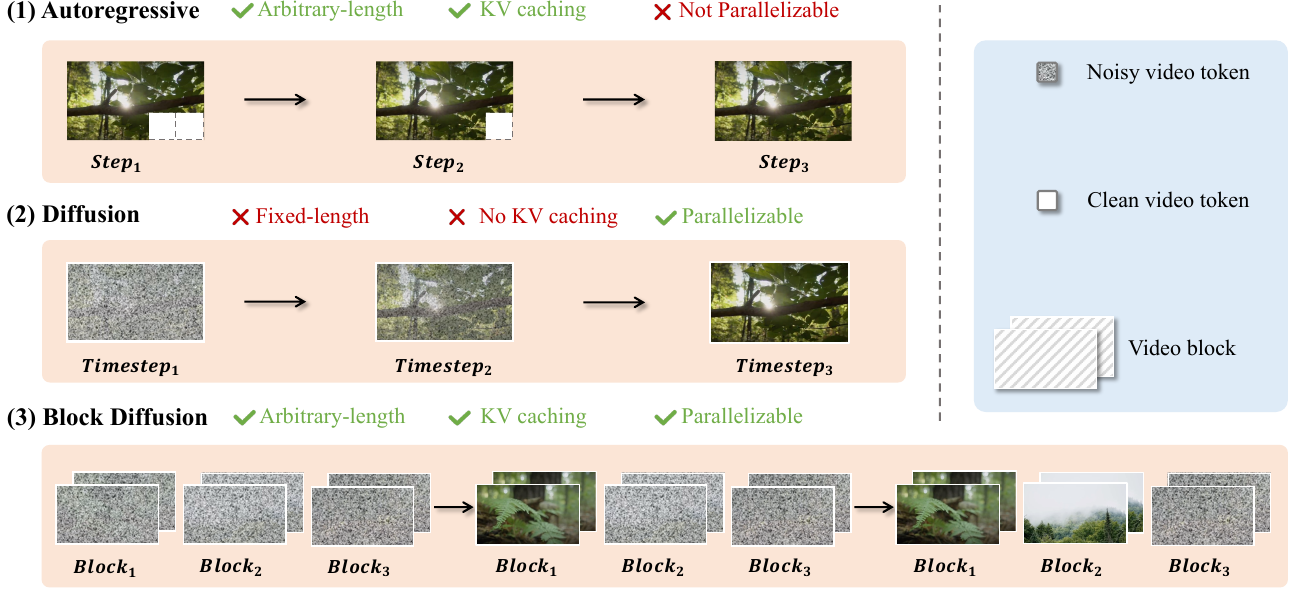
세계 모델(World models)은 에이전트형 AI, 몸체화된 AI, 게임 등 다양한 분야의 핵심 시뮬레이터로서, 긴 시간 동안 물리적으로 현실감 있게 상호작용 가능한 고품질 영상을 생성할 수 있다. 또한 이러한 모델의 규모 확장은 시각적 인지, 이해 및 추론 능력에서 새로운 능력이 부상하게 하여, 현재의 LLM 중심 시각 기반 모델에 머물러 있는 패러다임을 넘어선 새로운 접근 방식을 열어줄 수 있다. 이러한 모델의 핵심적 돌파구는 반자율적(블록-디퓨전, block-diffusion) 디코딩 파라다임이다. 이는 각 블록 내에서 디퓨전 방식으로 영상 토큰을 블록 단위로 생성하면서도 이전 블록들을 조건으로 삼아, 자율적 생성 방식과 디퓨전 방식의 장점을 결합함으로써 더 일관성 있고 안정적인 영상 시퀀스를 생성한다. 특히 기존 영상 디퓨전 방식의 한계를 극복하기 위해 LLM 방식의 KV 캐시 관리 기법을 재도입함으로써, 효율적이고 길이가 변동 가능한 고품질 생성을 가능하게 한다.이러한 특징을 바탕으로 Inferix는 최적화된 반자율적 디코딩 프로세스를 통해 몰입형 세계 생성을 가능하게 하는 차세대 추론 엔진으로 특별히 설계되었다. 세계 시뮬레이션에 집중한 이 엔진은 고병렬 처리 시나리오를 위한 시스템(예: vLLM, SGLang)이나 전통적인 영상 디퓨전 모델(예: xDiTs)과 명확히 구분된다. 더불어 Inferix는 실시간 상호작용과 현실적인 시뮬레이션을 가능하게 하는 인터랙티브 영상 스트리밍 및 프로파일링 기능을 제공하며, 분석 가능한 성능 데이터를 통해 세계 동역학을 정확히 모델링할 수 있도록 한다. 또한 LV-Bench라는 새로운 세밀한 평가 기준을 원활하게 통합함으로써, 분 단위의 영상 생성 시나리오에 특화된 효율적인 벤치마킹을 지원한다. 우리는 커뮤니티가 함께 협력하여 Inferix를 발전시키고 세계 모델 탐색을 촉진하기를 기대한다.
Summarization
The Inferix Team introduces Inferix, a next-generation inference engine for immersive world synthesis that employs optimized semi-autoregressive block-diffusion decoding and LLM-style KV Cache management to enable efficient, interactive, and long-form video generation distinct from standard high-concurrency or classic diffusion systems.
Introduction
World models are rapidly advancing toward generating long-form, interactive video sequences, creating a critical need for specialized infrastructure capable of handling the immense computational and storage demands of immersive world synthesis. Current approaches face a distinct trade-off: Diffusion Transformers (DiT) offer high-quality, parallelized generation but suffer from inefficient decoding and fixed-length constraints, while Autoregressive (AR) models support variable lengths but often lag in visual quality and lack parallelization capabilities.
To bridge this gap, the authors introduce Inferix, a dedicated inference engine designed to enable efficient, arbitrary-length video generation. By adopting a "block diffusion" framework, the system interpolates between AR and diffusion paradigms, utilizing a semi-autoregressive decoding strategy that reintroduces LLM-style memory management to maintain high generation quality over extended sequences.
Key innovations include:
- Semi-Autoregressive Block Diffusion: The engine employs a generate-and-cache loop where attention mechanisms leverage a global KV cache to maintain context across generated blocks, ensuring long-range coherence without sacrificing diffusion quality.
- Advanced Memory Management: To address the storage bottlenecks of long-context simulation, the system integrates intelligent KV cache optimization techniques similar to PageAttention to minimize GPU memory usage.
- Scalable Production Features: The framework supports distributed synthesis for large-scale environments, continuous prompting for dynamic narrative control, and built-in real-time video streaming protocols.
Dataset
The authors introduce LV-Bench, a benchmark designed to address the challenges of generating minute-long videos. The dataset construction and usage involve the following components:
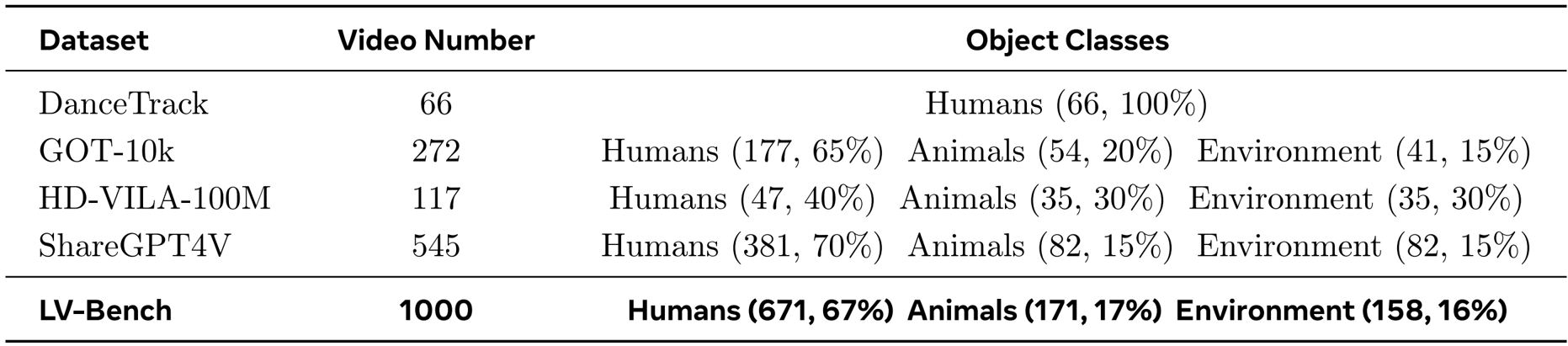
- Composition and Sources: The benchmark comprises 1,000 long-form videos collected from diverse open-source collections, specifically DanceTrack, GOT-10k, HD-VILA-100M, and ShareGPT4V.
- Selection Criteria: The team prioritized high-resolution content, strictly selecting videos that exceed 50 seconds in duration.
- Metadata Construction: To ensure linguistic diversity and temporal detail, the authors utilized GPT-4o as a data engine to generate granular captions every 2 to 3 seconds.
- Quality Assurance: A rigorous human-in-the-loop validation framework was applied across three stages: sourcing (filtering unsuitable clips), chunk segmentation (ensuring coherence and removing artifacts), and caption verification (refining AI-generated text). At least two independent reviewers validated each stage to maintain reliability.
- Model Usage: The final curated dataset is partitioned into an 80/20 split for training and evaluation purposes.
Method
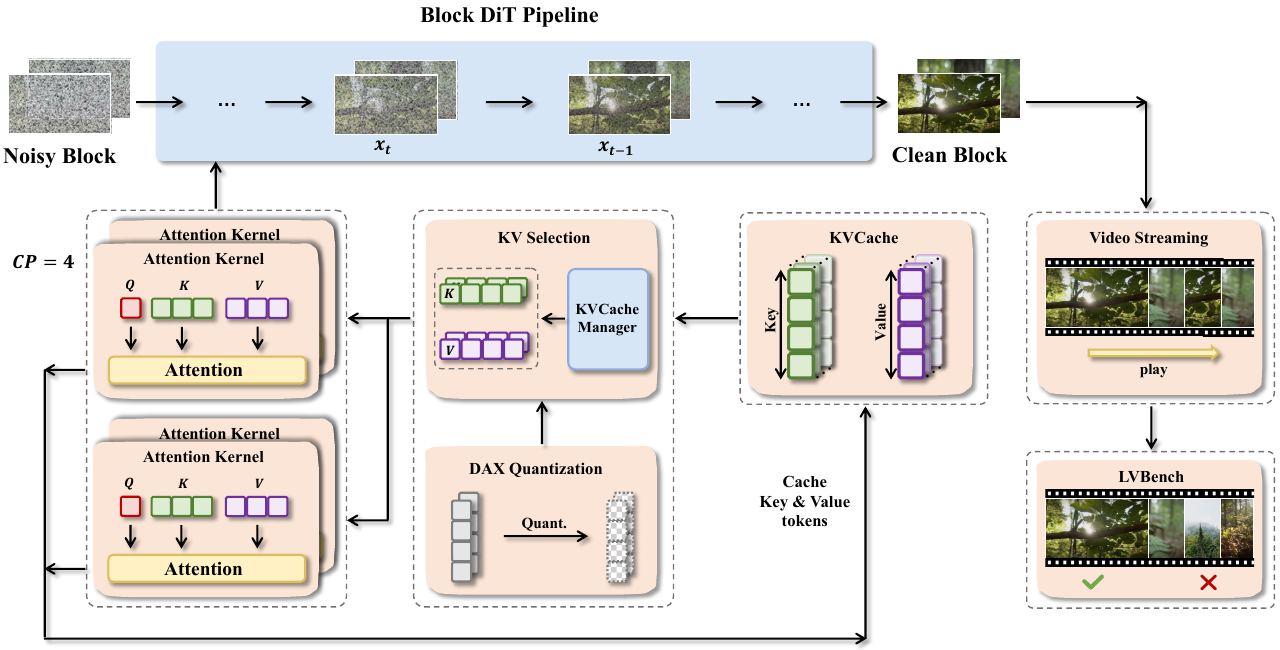
The authors leverage a modular and extensible framework designed to address the unique challenges of block diffusion models for long video generation. The core of the system, as illustrated in the framework diagram, is built around a generalized inference pipeline that abstracts common computational patterns across diverse models such as MAGI-1, CausVid, and Self Forcing. This pipeline orchestrates a sequence of interconnected components to enable efficient and scalable inference.
At the heart of the inference process is the Block DiT Pipeline, which processes video in discrete blocks. Each block undergoes a diffusion-based denoising process, where a noisy block is iteratively refined into a clean block. This process relies on attention mechanisms that require access to key-value (KV) pairs from previous steps. To manage these KV pairs efficiently, the framework employs a block-wise KV memory management system. This system supports flexible access patterns, including range-based chunked access and index-based selective fetch, ensuring scalability and extensibility for future model variants that may require sliding-window or selective global context.
To accelerate computation and reduce memory pressure, the framework integrates a suite of parallelism techniques. Ulysses-style sequence parallelism partitions independent attention heads across multiple GPUs, while Ring Attention distributes attention operations in a ring topology, enabling scalable computation over long sequences. The choice between these strategies is adaptive, based on model architecture and communication overhead, ensuring optimal resource utilization. The framework also incorporates DAX quantization, which reduces the precision of KV cache tokens to minimize memory footprint without significant loss in quality.
The system further supports real-time video streaming, allowing dynamic control over narrative generation through user-provided signals such as prompts or motion inputs. When a new prompt is introduced for a subsequent video chunk, the framework clears the cross-attention cache to prevent interference from prior contexts, ensuring coherent and prompt-aligned generation. This capability is complemented by a built-in performance profiler that provides near-zero-overhead, customizable, and easy-to-use instrumentation for monitoring resource utilization during inference.
Experiment
- Introduces Video Drift Error (VDE), a unified metric inspired by MAPE, designed to quantify relative quality changes and temporal degradation in long-form video generation.
- Establishes five specific VDE variants (Clarity, Motion, Aesthetic, Background, and Subject) to assess drift across different visual and dynamic aspects, where lower scores indicate stronger temporal consistency.
- Integrates these drift metrics with five complementary quality dimensions from VBench (Subject Consistency, Background Consistency, Motion Smoothness, Aesthetic Quality, and Image Quality) to form a comprehensive evaluation protocol.
The authors use the LV-Bench dataset, which contains 1000 videos and is composed of 671 human instances, 171 animal instances, and 158 environment instances, to evaluate long-form video generation. Results show that the dataset spans diverse object classes and video counts, providing a comprehensive benchmark for assessing temporal consistency and visual quality in long-horizon video generation.