Command Palette
Search for a command to run...
ROOT: 신경망 학습을 위한 강건한 직교화 최적화기
ROOT: 신경망 학습을 위한 강건한 직교화 최적화기
Wei He Kai Han Hang Zhou Hanting Chen Zhicheng Liu Xinghao Chen Yunhe Wang
초록
대규모 언어 모델(LLM)의 최적화는 모델 규모가 증가함에 따라 알고리즘의 부정확성과 학습 불안정성에 대한 민감도가 심화되면서 여전히 핵심적인 도전 과제로 남아 있다. 최근 최적화 알고리즘의 발전은 모멘텀 직교화를 통해 수렴 효율성을 향상시켰지만, 두 가지 주요 내구성 제약을 겪고 있다. 첫째, 직교화 정밀도에서 차원에 취약한 특성이며, 둘째, 이상치에 의해 유도되는 노이즈에 취약하다는 점이다. 이러한 내구성 문제를 해결하기 위해, 우리는 이중 내구성 메커니즘을 통해 학습 안정성을 향상시키는 ‘ROOT(Robust Orthogonalized Optimizer)’를 제안한다. 첫 번째로, 특정 행렬 크기에 맞춰 세밀하게 조정된 계수를 사용하는 적응형 뉴턴 반복법을 기반으로 한 차원 내구성 있는 직교화 방식을 개발하여, 다양한 아키텍처 구성에서도 일관된 정밀도를 보장한다. 두 번째로, 프록시 최적화 기반의 최적화 내구성 프레임워크를 도입하여 이상치 노이즈를 억제하면서도 의미 있는 기울기 방향을 유지한다. 광범위한 실험을 통해 ROOT가 Muon 및 Adam 기반 최적화 알고리즘과 비교해 더 빠른 수렴 속도와 우수한 최종 성능을 보이며, 특히 노이즈가 많거나 비볼록(non-convex)한 환경에서 뛰어난 내구성을 입증하였다. 본 연구는 현대 대규모 모델 학습의 복잡성을 효과적으로 다룰 수 있는 내구성 있고 정밀한 최적화 알고리즘 개발을 위한 새로운 패러다임을 제시한다. 코드는 https://github.com/huawei-noah/noah-research/tree/master/ROOT 에 공개될 예정이다.
Summarization
Researchers from Huawei Noah's Ark Lab introduce ROOT, a robust orthogonalized optimizer for large language models that enhances training stability and convergence speed by employing adaptive Newton iterations and proximal optimization to overcome the dimensional fragility and noise sensitivity of existing momentum orthogonalization methods.
Introduction
The escalating computational demands of pre-training Large Language Models (LLMs) require optimizers that are both efficient and stable at scale. While standard methods like AdamW and newer matrix-aware approaches like Muon have advanced the field, they often struggle with numerical instability and precision gaps. Specifically, existing orthogonalization-based optimizers rely on fixed-coefficient approximations that fail to adapt to varying matrix dimensions, and they remain sensitive to gradient noise from outlier data samples which can corrupt update directions.
The authors introduce ROOT (Robust Orthogonalized Optimizer), a novel framework designed to enhance robustness against both structural uncertainties and data-level noise. By refining how weight matrices are orthogonalized and how gradients are filtered, ROOT ensures reliable training for massive neural networks without compromising computational efficiency.
Key innovations include:
- Adaptive Orthogonalization: The method employs a Newton-Schulz iteration with dimension-specific coefficients to ensure high precision across diverse network architectures, replacing imprecise fixed-coefficient schemes.
- Noise Suppression: A proximal optimization term utilizes soft-thresholding to actively mitigate the destabilizing effects of outlier-induced gradient noise.
- Enhanced Convergence: The approach achieves faster training speeds and superior performance in noisy, non-convex scenarios compared to current state-of-the-art optimizers.
Method
The authors leverage a framework that enhances the robustness of orthogonalization-based optimization by addressing two key limitations in existing methods: sensitivity to matrix dimensions and vulnerability to outlier-induced gradient noise. The overall approach integrates adaptive coefficient learning for the Newton-Schulz iteration and outlier suppression via soft-thresholding, forming a unified optimization process.
At the core of the method is the Newton-Schulz (NS) iteration, which approximates the orthogonal transformation (MtMtT)−1/2Mt by iteratively refining an initial matrix X0=Mt/∥Mt∥F. The update rule at each iteration k is defined as:
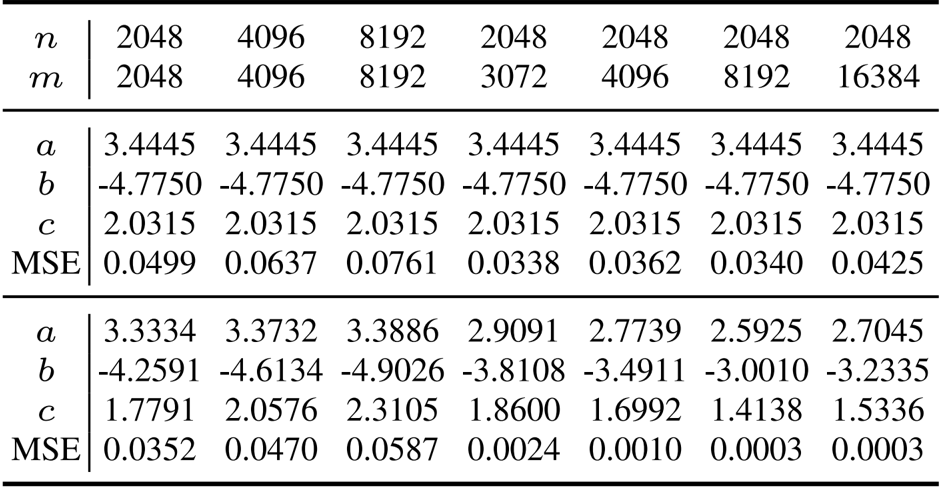
Xk=aXk−1+bXk−1(Xk−1TXk−1)+cXk−1(Xk−1TXk−1)2This recurrence operates on the singular values of the input matrix through a polynomial mapping g(x)=ax+bx3+cx5, and after T iterations, the resulting matrix XT approximates the orthogonalized momentum. The standard Muon optimizer employs fixed coefficients a=3.4445, b=−4.7750, and c=2.0315, which are optimized for average matrix shapes but exhibit poor performance on matrices with varying dimensions.
To overcome this dimensional fragility, the authors introduce an adaptive Newton-Schulz iteration (AdaNewton), where the coefficients a(m,n), b(m,n), and c(m,n) are learned specifically for each matrix size (m,n) in the network. This fine-grained adaptation ensures consistent orthogonalization quality across layers of different dimensions. The adaptive update rule is given by:
Xk=a(m,n)Xk−1+b(m,n)Xk−1(Xk−1TXk−1)+c(m,n)Xk−1(Xk−1TXk−1)2The coefficients are optimized jointly with the model parameters during training, allowing the orthogonalization process to adapt to the spectral properties of each layer. This approach shifts from a one-size-fits-all strategy to a dimension-robust design, ensuring stable and reliable gradient updates throughout the network.
[[IMG:|Framework diagram of the ROOT optimizer]]
The framework diagram illustrates the integration of adaptive orthogonalization and outlier suppression. The momentum matrix Mt is first decomposed into a base component Bt and an outlier component Ot using soft-thresholding. The outlier component is discarded, while the base component undergoes robust orthogonalization via AdaNewton. The resulting orthogonalized matrix is then used to update the model parameters.
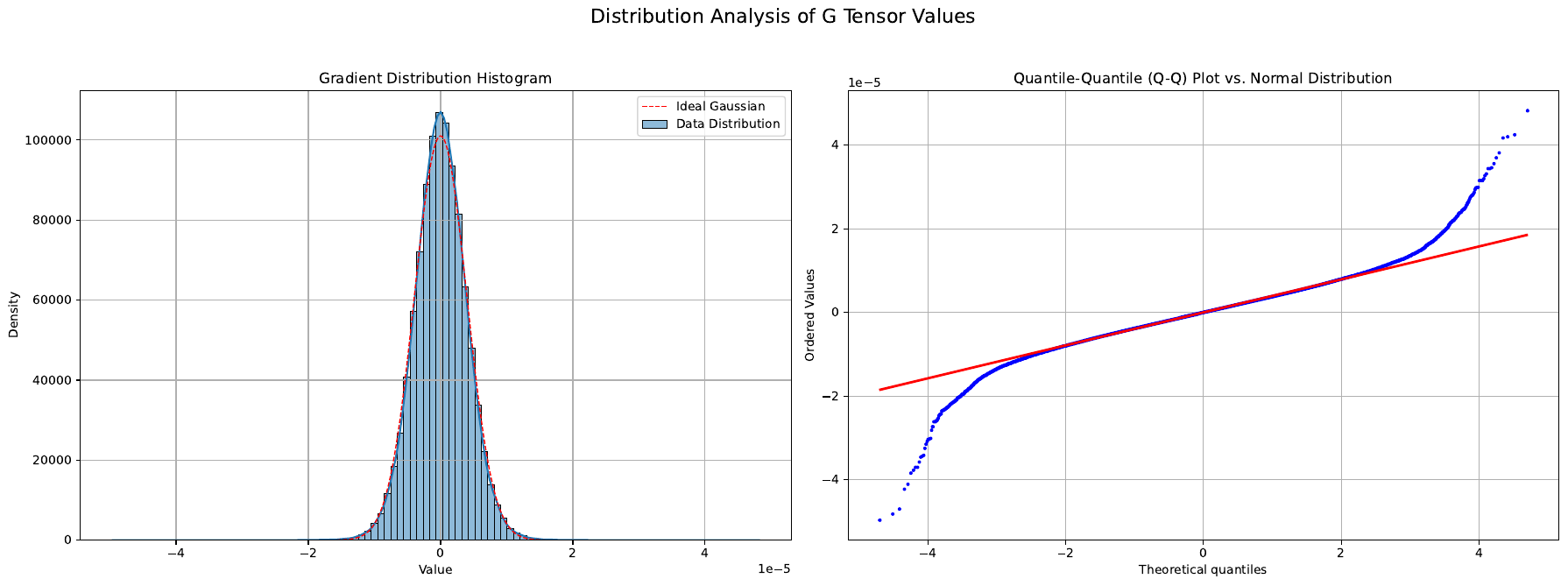
To further enhance robustness, the method incorporates soft-thresholding to suppress gradient outliers. The momentum matrix Mt is modeled as the sum of a base component Bt and an outlier component Ot, and the robust decomposition is formulated as a convex optimization problem that penalizes large-magnitude elements. The solution to this problem is given by the soft-thresholding operator:
Tε[x]i=sign(xi)⋅max(∣xi∣−ε,0)This operation smoothly shrinks gradient values beyond a threshold ε, preserving the relative ordering of magnitudes while dampening extreme values. The decomposition is applied element-wise to the momentum matrix, yielding:
Ot=Tε(Mt),Bt=Mt−OtBy applying orthogonalization only to the clipped base component Bt, the method ensures that the sensitive NS iteration operates on stable gradients, mitigating the amplification of outlier noise. This design provides a continuous, differentiable alternative to hard clipping, maintaining gradient direction while improving training stability. The complete optimization process is summarized in the ROOT optimizer algorithm, which combines momentum accumulation, outlier suppression, and adaptive orthogonalization in a single iterative loop.
Experiment
- Gradient Dynamics Validation: Compared orthogonalization strategies using gradients from the first 10k pre-training steps; ROOT maintained lower relative error than Muon and Classic Newton-Schulz, confirming that dimension-aware coefficients better approximate ground-truth SVD.
- LLM Pre-training: Trained a 1B Transformer on FineWeb-Edu subsets (10B and 100B tokens); ROOT achieved a final training loss of 2.5407, surpassing the Muon baseline by 0.01.
- Academic Benchmarks: Evaluated zero-shot performance on tasks like HellaSwag and PIQA; ROOT achieved an average score of 60.12, outperforming Muon (59.59) and AdamW (59.05).
- Ablation Studies: Identified a 0.90 percentile threshold as optimal for outlier suppression and selected a Mixed (1:3) calibration strategy to ensure stability while preventing overfitting.
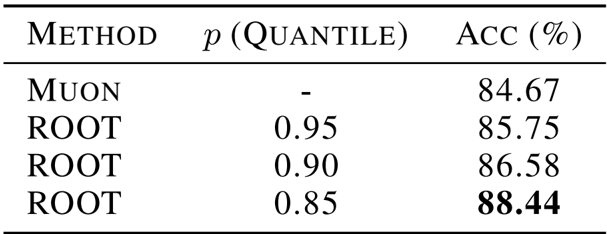
- Vision Generalization: Trained a Vision Transformer on CIFAR-10; ROOT consistently achieved higher accuracy than the Muon baseline, validating the method's effectiveness on non-language modalities.
The authors use the provided table to demonstrate that the ROOT optimizer's shape-specific coefficients achieve lower mean squared error (MSE) across various matrix dimensions compared to fixed-coefficient methods. Results show that the MSE decreases significantly as the coefficient values adapt to different matrix shapes, indicating improved approximation fidelity for diverse layer geometries during training.
The authors evaluate the ROOT optimizer against AdamW and Muon on a range of academic benchmarks, showing that ROOT achieves higher zero-shot performance across all tasks. Specifically, ROOT outperforms both baselines in HellaSwag, PIQA, OBQA, SciQ, Wino, and WSC, with an average score of 60.12, surpassing AdamW's 59.05 and Muon's 59.59.

The authors evaluate the impact of different percentile thresholds for outlier suppression in the ROOT optimizer on a Vision Transformer trained on CIFAR-10. Results show that the choice of threshold significantly affects performance, with a lower percentile of 0.85 yielding the highest accuracy of 88.44%, outperforming both the Muon baseline and other ROOT configurations. This indicates that more aggressive outlier suppression can enhance generalization in vision tasks.