Command Palette
Search for a command to run...
시각적으로 생각하고 텍스트적으로 추론하라: ARC에서의 시각-언어 융합
시각적으로 생각하고 텍스트적으로 추론하라: ARC에서의 시각-언어 융합
Beichen Zhang Yuhang Zang Xiaoyi Dong Yuhang Cao Haodong Duan Dahua Lin Jiaqi Wang
초록
최소한의 예시로부터 추상적 추론을 수행하는 것은 GPT-5, Grok 4와 같은 최전선 기반 모델이 여전히 해결하지 못한 핵심 과제이다. 이러한 모델들은 몇 개의 예시로부터 구조적 변환 규칙을 추론하는 데 실패하며, 이는 인간 지능의 핵심적 특징 중 하나이다. 인공 일반지능(AGI)을 위한 추상화 및 추론 코퍼스(ARC-AGI)는 이 능력을 엄격하게 평가할 수 있는 테스트베드를 제공하며, 새로운 과제에 대해 개념적 규칙을 유도하고 전이하는 능력을 요구한다. 기존의 대부분의 방법들은 ARC-AGI를 순수 텍스트 기반 추론 과제로 간주하여, 인간이 이러한 퍼즐을 해결할 때 시각적 추상화에 크게 의존한다는 사실을 간과하고 있다. 그러나 우리의 사전 실험 결과는 모순을 드러낸다. ARC-AGI의 격자 데이터를 단순히 이미지로 변환하는 방식은 정확한 규칙 실행이 어려워 성능을 저하시키는 결과를 초래한다. 이에 따라 우리는 다음과 같은 핵심 가설을 제시한다. 즉, 시각과 언어는 서로 다른 추론 단계에서 보완적인 강점을 지닌다. 시각은 전반적인 패턴 추상화와 검증에 유리한 반면, 언어는 기호적 규칙의 구성과 정밀한 실행에 특화되어 있다. 이 통찰을 바탕으로, 두 가지 상호보완적인 전략을 제안한다. 첫째, 시각-언어 융합 추론(Vision-Language Synergy Reasoning, VLSR)은 ARC-AGI 문제를 모달리티에 맞춘 하위 과제로 분해한다. 둘째, 모달리티 전환 자기보정(Modality-Switch Self-Correction, MSSC)은 언어 기반 추론의 오류를 시각적 검증을 통해 내재적으로 보정하는 방식이다. 광범위한 실험 결과는 제안한 방법이 다양한 주요 모델과 여러 ARC-AGI 과제에서 텍스트 기반 기준 모델 대비 최대 4.33%의 성능 향상을 달성함을 입증한다. 본 연구 결과는, 향후 기반 모델이 일반화 가능하고 인간과 유사한 지능을 달성하기 위해 시각적 추상화와 언어적 추론을 통합하는 것이 필수적임을 시사한다. 소스 코드는 곧 공개될 예정이다.
Summarization
Researchers from The Chinese University of Hong Kong and Shanghai AI Laboratory introduce Vision-Language Synergy Reasoning (VLSR) and Modality-Switch Self-Correction (MSSC) to address the ARC-AGI benchmark, effectively combining visual global abstraction with linguistic symbolic execution to outperform text-only baselines in abstract reasoning tasks.
Introduction
The Abstraction and Reasoning Corpus (ARC-AGI) serves as a critical benchmark for Artificial General Intelligence, assessing a model's ability to "learn how to learn" by identifying abstract rules from minimal examples rather than relying on memorized domain knowledge. While humans naturally rely on visual intuition to solve these 2D grid puzzles, existing state-of-the-art approaches process these tasks purely as text-based nested lists. This text-centric paradigm overlooks vital spatial relationships such as symmetry and rotation, yet naive image-based methods also fail due to a lack of pixel-perfect precision. Consequently, models struggle to balance the global perception needed to understand the rule with the discrete accuracy required to execute it.
The authors propose a novel methodology that integrates visual and textual modalities based on their respective strengths. They decompose abstract reasoning into two distinct stages, utilizing visual inputs to summarize transformation rules and textual representations to apply those rules with element-wise exactness.
Key innovations and advantages include:
- Vision-Language Synergy Reasoning (VLSR): A framework that dynamically switches modalities, employing visual grids to extract global patterns and textual coordinates to execute precise manipulations.
- Modality-Switch Self-Correction (MSSC): A verification mechanism that converts text-generated solutions back into images, allowing the model to visually detect inconsistencies that are invisible in text format.
- Versatile Performance Gains: The approach functions as both an inference strategy and a training paradigm, delivering significant accuracy improvements across flagship models like GPT-4o and Gemini without requiring external ground truth.
Dataset
Based on the provided text, the authors employ a specific processing strategy to visualize data as follows:
- Matrix-to-Image Conversion: The authors convert input-output matrices into color-coded 2D grids to preserve 2D spatial information and offer a global view of the data.
- Color Mapping: Each numerical value is mapped to a specific color to create distinct visual elements:
- 0: Black
- 1: Blue
- 2: Red
- 3: Green
- 4: Yellow
- 5: Grey
- 6: Pink
- 7: Orange
- 8: Light blue
- 9: Brown
- Structural Formatting: White dividing lines are inserted between the colored elements (small squares) to clearly indicate specific numbers and define the structure within each block.
Method
The authors leverage a two-phase framework that strategically combines visual and textual modalities to address the challenges of reasoning over structured grid-based tasks in the ARC-AGI benchmark. This approach, termed Vision-Language Synergy Reasoning (VLSR), decomposes the task into two distinct subtasks: rule summarization and rule application, each optimized for the strengths of a specific modality. The overall framework is designed to overcome the limitations of purely textual approaches, which often fail to capture the inherent 2D structural information of the input matrices.
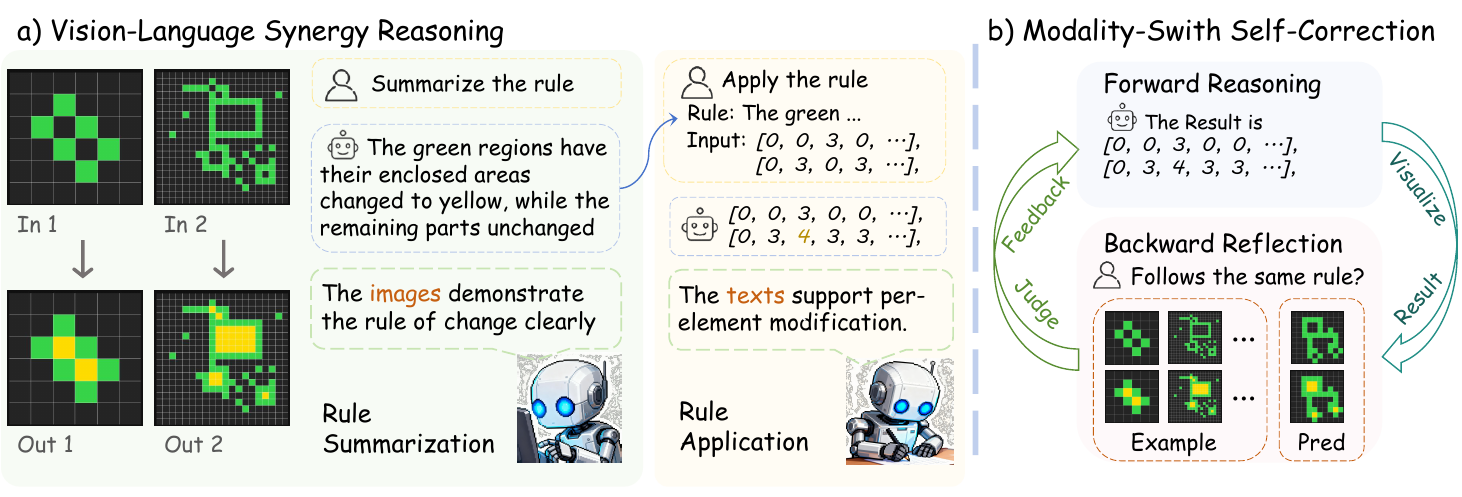 As shown in the figure below, the first phase, Vision-Language Synergy Reasoning, begins by converting all provided input-output example pairs into their visual representations. Each matrix m is transformed into an image i=V(m), where each cell value is mapped to a distinct color, creating a grid layout that preserves the spatial relationships between elements. This visual representation is then fed to a large vision-language model (LVLM) to perform rule summarization. The model analyzes the visual patterns across the examples to derive an explicit transformation rule, rpred, expressed in natural language. This phase leverages the model's ability to perform global pattern recognition and understand 2D structural relationships, which is crucial for identifying complex spatial transformations.
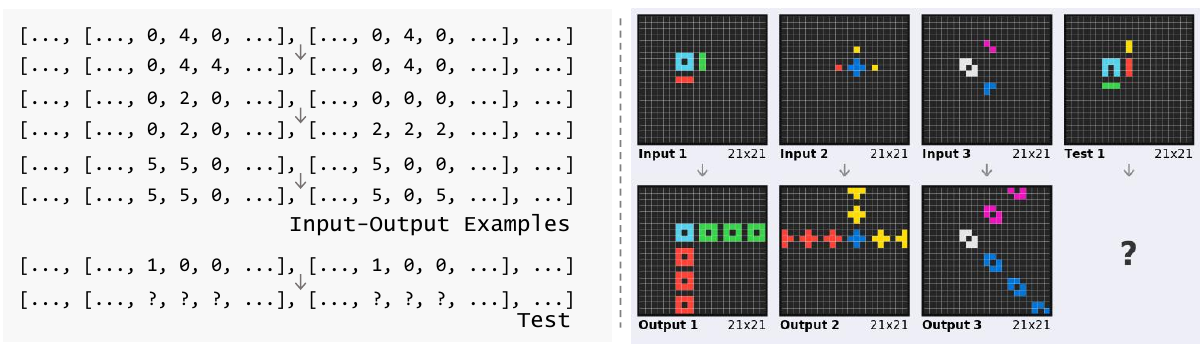 The second phase, rule application, shifts to the textual modality. The derived rule rpred is used to guide the transformation of the test input. All matrices, including the test input and the examples, are converted into their textual representations t=T(m), which are nested lists of integers. The same LVLM, now operating in text mode with a rule application prompt, performs element-wise reasoning to generate the predicted output matrix tpred. This phase exploits the precision of textual representation for manipulating individual elements according to the summarized rule. The authors emphasize that the same base model is used for both phases, with the only difference being the input modality and the specific prompting strategy, ensuring a consistent reasoning process.
To further enhance the reliability of the output, the authors introduce a Modality-Switch Self-Correction (MSSC) mechanism. This strategy addresses the challenge of intrinsic self-correction by using different modalities for reasoning and verification. After the initial textual rule application produces a candidate output tpred, the model first converts this textual output back into a visual representation ipred. This visualized output is then presented to the LVLM, which acts as a critic to assess the consistency of the predicted transformation with the provided examples. The model evaluates whether the test input-output pair (itestinput,ipred) follows the same pattern as the training examples. If the model determines the output is inconsistent, it receives feedback and performs an iterative refinement step, using the previous attempt's information to generate a new candidate output. This process repeats until the output is deemed consistent or a maximum number of iterations is reached. This modality switch provides a fresh perspective, breaking the model's confirmation bias and enabling it to identify errors that are imperceptible when using the same modality for both reasoning and verification.
Experiment
- Modality isolation experiments validated that visual representations excel at rule summarization (yielding a 3.2% average improvement), while textual representations are superior for rule application, where visual methods caused a 15.0% performance drop.
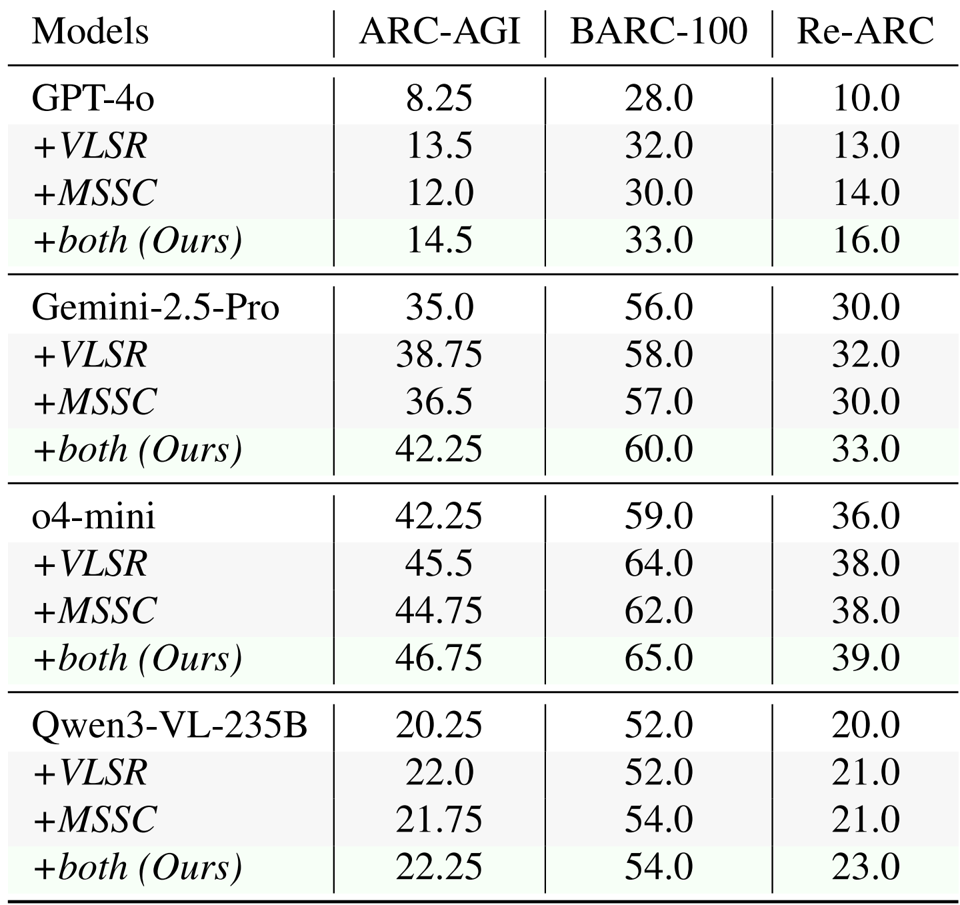
- The proposed VLSR and MSSC strategies consistently improved performance across ARC-AGI, Re-ARC, and BARC benchmarks, boosting baseline results by up to 6.25% for GPT-4o and 7.25% for Gemini-2.5-Pro on ARC-AGI.
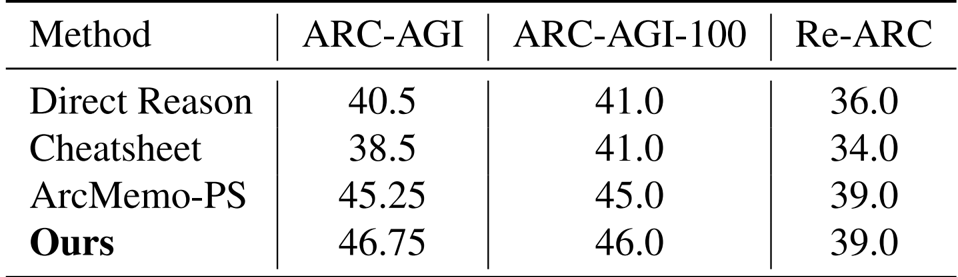
- In comparative evaluations using o4-mini, the method achieved the highest accuracy across all test sets, surpassing the strongest training-free baseline (ArcMemo-PS) by 1.5% on ARC-AGI.
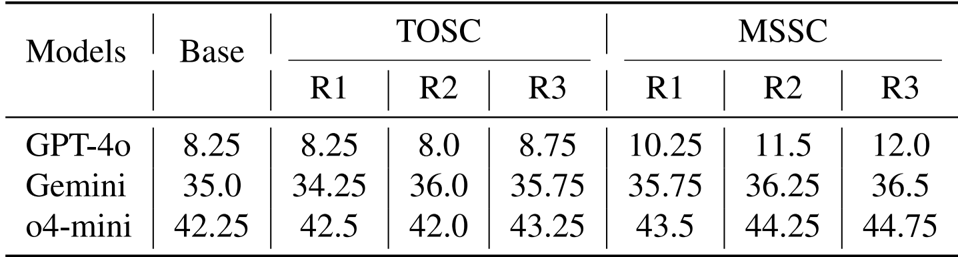
- Analysis of self-correction mechanisms showed that Modality-Switch Self-Correction (MSSC) achieved consistent monotonic gains (e.g., improving GPT-4o scores from 8.25 to 12.0), whereas text-only self-correction provided minimal or negative value.
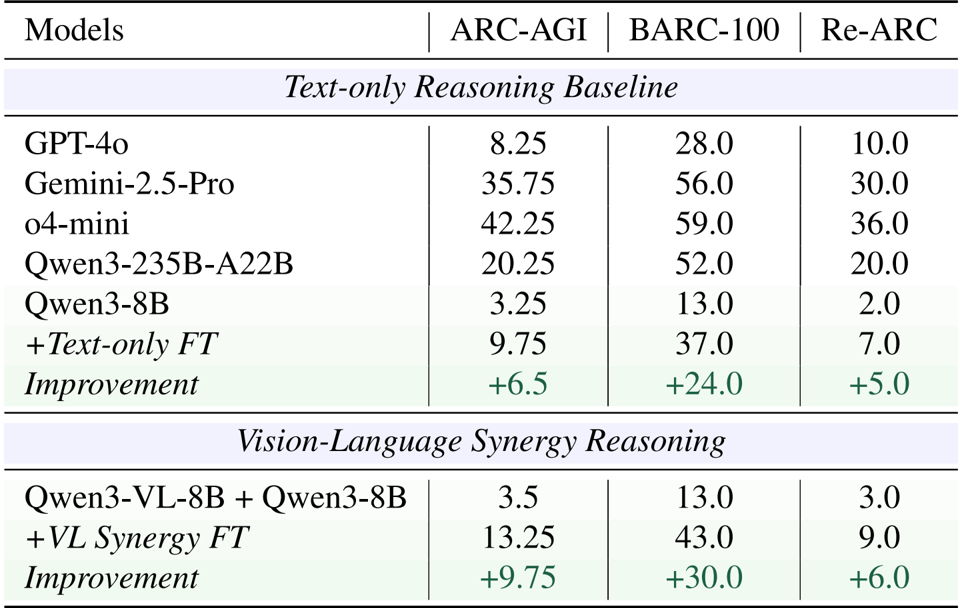
- Fine-tuning experiments on ARC-Heavy-200k demonstrated that vision-language synergy achieved 13.25% accuracy on ARC-AGI, significantly outperforming text-centric fine-tuning (9.75%) and the closed-source GPT-4o baseline (8.25%).
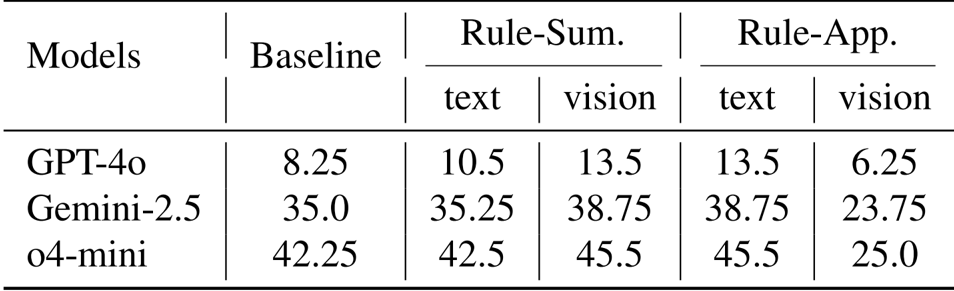
Results show that using visual modality for rule summarization improves performance across all models, with GPT-4o increasing from 8.25 to 13.5, Gemini-2.5 from 35.0 to 38.75, and o4-mini from 42.25 to 45.5. However, applying rules using visual representations in the rule application phase leads to significant performance drops, with GPT-4o decreasing from 13.5 to 6.25, Gemini-2.5 from 38.75 to 23.75, and o4-mini from 45.5 to 25.0.
The authors use a modality-switching approach to improve abstract reasoning, where visual representations are used for rule summarization and textual representations for rule application. Results show that combining both methods consistently improves performance across all models and benchmarks, with the best results achieved when both VLSR and MSSC are applied.
Results show that the proposed method achieves higher accuracy than baseline approaches across all benchmarks, with an improvement of 1.5% over the strongest baseline ArcMemo-PS on ARC-AGI. This demonstrates that visual information provides complementary benefits that text-based memory retrieval alone cannot capture.
Results show that Modality-Switch Self-Correction (MSSC) consistently improves performance over text-only self-correction (TOSC) across all models and iterations, with GPT-4o achieving a 3.75-point increase from Round 1 to Round 3, while TOSC shows minimal gains and even degrades in some rounds. The improvement is attributed to visual verification providing a fresh perspective that helps detect spatial inconsistencies missed during text-only reasoning.
The authors use a vision-language synergy approach to improve abstract reasoning, where visual representations are used for rule summarization and text for rule application. Results show that combining these modalities significantly boosts performance, with the vision-language synergy method achieving an average improvement of 9.75% on ARC-AGI compared to text-only fine-tuning.