Command Palette
Search for a command to run...
UniMoMo: 신규 결합체 설계를 위한 3차원 분자 통합 생성 모델
UniMoMo: 신규 결합체 설계를 위한 3차원 분자 통합 생성 모델
Xiangzhe Kong Zishen Zhang Ziting Zhang Rui Jiao Jianzhu Ma Wenbing Huang Kai Liu Yang Liu
초록
저분자, 펩타이드, 항체 등 표적 특이적 분자 설계는 생물학 연구 및 신약 개발에 필수적이다. 기존 생성 방법들은 단일 도메인 분자에 국한되어 다양한 치료적 요구를 충족시키지 못하거나, 교차 도메인 전이 가능성을 활용하여 모델 성능을 향상시키지 못한다. 본 논문에서는 단일 모델로 여러 분자 도메인의 결합체를 설계할 수 있는 최초의 프레임워크인 UniMoMo(Unified generative Modeling of 3D Molecules)를 소개한다. 특히, UniMoMo는 서로 다른 분자들의 표현을 블록 그래프로 통합하며, 각 블록은 표준 아미노산 또는 분자 조각에 해당한다. 이어서 UniMoMo는 3차원 분자 생성을 위해 기하학적 잠재 확산 모델을 활용하는데, 반복적 전원자 오토인코더를 통해 블록을 잠재 공간 상의 점으로 압축한 후 E(3)-등변 확산 과정을 수행하는 것이 특징이다. 펩타이드, 항체, 저분자에 걸친 광범위한 벤치마크 평가 결과, 우리의 통합 프레임워크가 기존 도메인 특화 모델보다 우수한 성능을 보였으며, 이는 다중 도메인 학습의 이점을 부각한다.
One-sentence Summary
The authors propose UniMoMo, the first unified generative framework for de novo binder design across multiple molecular domains (peptides, antibodies, and small molecules), which represents molecules as graphs of blocks and combines a geometric latent diffusion model with an iterative full-atom autoencoder and E(3)-equivariant diffusion, outperforming domain-specific models and highlighting the benefits of multi-domain training.
Key Contributions
- UniMoMo is the first unified generative framework for designing molecular binders across peptides, antibodies, and small molecules using a single model, with all molecules represented as graphs of blocks where each block is a standard amino acid or a molecular fragment.
- The method employs a geometric latent diffusion model with an iterative full-atom autoencoder that compresses blocks into latent space points, followed by an E(3)-equivariant diffusion process, substantially improving training and inference efficiency via reduced dimensionality and graph size.
- Extensive benchmarks on peptide, antibody, and small molecule design tasks show that the unified framework outperforms existing domain-specific models and demonstrates cross-domain transferability, such as generating binders for the same protein pocket across different molecular types with desired affinity.
Introduction
The design of molecules that bind to target proteins is central to drug discovery, with different molecular types (small molecules, peptides, antibodies) offering distinct therapeutic advantages and thus driving the development of specialized generative models. However, building separate models for each type misses the opportunity to share underlying physicochemical principles and cross-type data, and no existing framework unifies the de novo design of binders across these diverse molecular classes. The authors address this gap with UniMoMo, a unified generative model that represents molecules as graphs of blocks (standard amino acids or molecular fragments) and employs a geometric latent diffusion model: an iterative autoencoder compresses each block into a low-dimensional latent point, after which a diffusion model generates the global arrangement, enabling efficient, full-atom binder design for multiple molecular types from a single model.
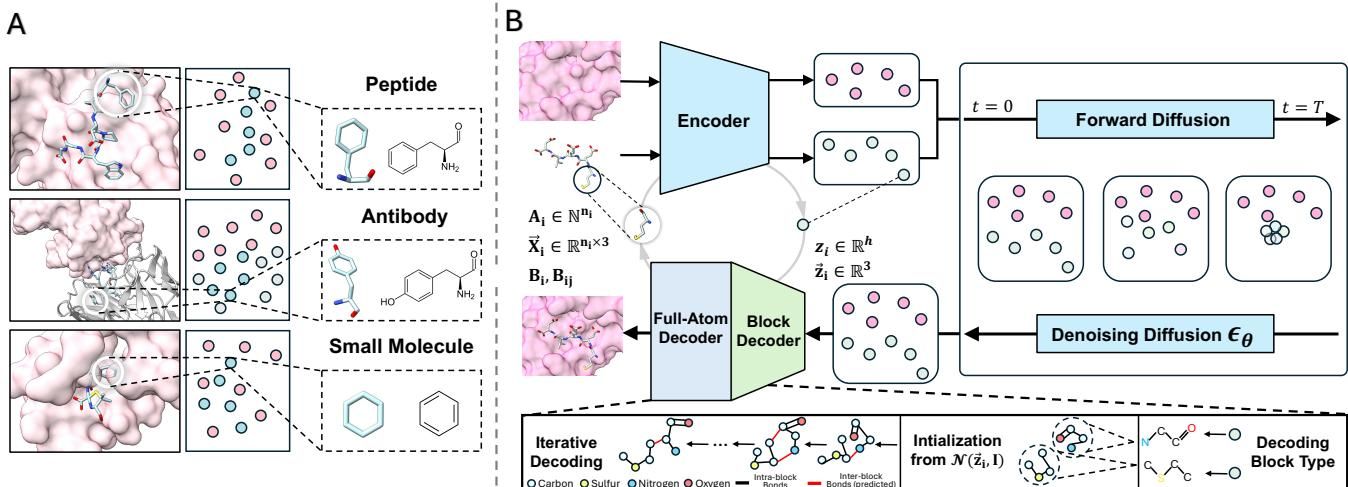
Method
The authors propose UniMoMo, a unified generative framework for 3D molecular binder design. The method relies on a unified molecular representation where a molecule is modeled as a graph of blocks. Each block represents a standard amino acid or a principal subgraph extracted via a principal subgraph algorithm. This representation accommodates peptides, antibodies, and small molecules uniformly.
As illustrated in the framework diagram, the core architecture consists of two main components: an iterative full-atom variational autoencoder and a geometric latent diffusion model.
The iterative full-atom variational autoencoder establishes a mapping between full-atom geometries and a compact latent space. The encoder projects the molecular binder Gx and the binding site Gy into latent point clouds independently:
Zx=Eϕ(Gx),Zy=Eϕ(Gy)For each block, the latent representation includes a latent state and 3D coordinates, sampled from encoded distributions using the reparameterization trick. To regularize the latent space, Kullback-Leibler divergence constraints are applied relative to prior distributions:
LKL(i)=λ1⋅DKL(N(0,I)∥N(μi,diag(σi)))+λ2⋅DKL(N(ri,I)∥N(μi,diag(σi)))During training, random noise is added to the latent coordinates before decoding to enhance the decoder robustness against imperfections introduced by the diffusion process.
The decoder reconstructs the full-atom geometry in two stages. Initially, it predicts the block types for the latent points, which allows retrieving the atom types and intrablock chemical bonds via a vocabulary lookup:
{si}=Dξ1(Zx,Zy),Ai,Bi=Lookup(si,V)Subsequently, a structure module reconstructs the atomic coordinates iteratively, resembling a lightweight flow matching process:
Xit−Δt=Xit+ΔtVitThe time variable decreases from 1.0 to 0.0 in steps, with initial coordinates sampled from a Gaussian distribution. Interblock chemical bonds are predicted based on spatial neighborhoods. The reconstruction loss comprises cross entropy for block and bond types, mean square error for vector fields, and a pairwise distance loss applied at later time steps to refine local geometries. Both the encoder and decoder are parameterized by an equivariant transformer.
The geometric latent diffusion model operates within the compressed latent space to learn the conditional distribution of the binder given the binding site. Before the diffusion process, latent coordinates are normalized. The forward process incrementally adds Gaussian noise to the latent data, transitioning it into an isotropic Gaussian prior:
q(uit∣uit−1)=N(uit;1−βt⋅uit−1,βtI)The reverse process iteratively denoises the distribution to reconstruct the original data. The denoising network, also implemented as an equivariant transformer, predicts the noise added during the forward process. The training objective minimizes the mean square error between the predicted and actual noise:
LLDM=Et∼U(1…T)[∣Zxt∣∑i∥ϵi−ϵθ(Zxt,Zy,t)[i]∥2]By operating in the latent space rather than on full-atom geometries, this approach significantly reduces the computational cost for both training and sampling.
Experiment
UniMoMo is evaluated on three categories of molecular binders (peptides, antibodies, and small molecules) using standard benchmarks, comparing single-domain and multi-domain training variants. The model consistently outperforms domain-specific baselines in binding recovery, structural rationality, and energy, with multi-domain data providing clear improvements in generalization and interaction quality. Qualitative analysis on a GPCR target shows that the model successfully transfers interaction patterns and local geometries across binder types, generating chemically plausible candidates without forcefield relaxation.
UniMoMo (all-domain) substantially outperforms prior peptide design methods in recovering native-like sequences and binding geometries, achieving much stronger binding energy and a higher success rate of improving over native binders. The multi-domain model also yields the most realistic local backbone and side-chain conformations, with clash rates approaching the reference, while diversity remains on par with alternatives. UniMoMo (all) attains a binding energy of -34.35, far closer to the native reference (-37.25) than the best baseline, PepGLAD (-23.12), and its IMP success rate (40.86%) is more than double that of PepGLAD (18.28%). External clash rates are reduced to 0.93% for UniMoMo (all), nearly matching the reference (0.88%), whereas RFDiffusion shows a high 13.58% external clash rate, indicating poor interface packing.

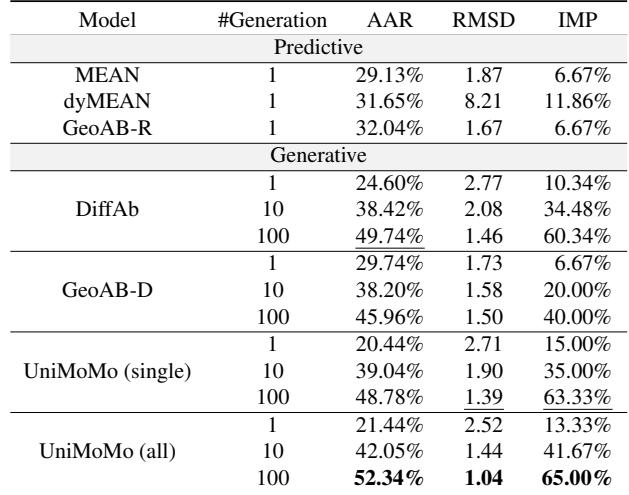
Predictive models achieve higher single-candidate sequence recovery on CDR-H3, but generative approaches benefit sharply from larger candidate pools. UniMoMo ultimately yields the best native-like recovery and, with 100 candidates, improves binding energy beyond native CDRs in a majority of complexes, while multi-domain training further enhances structural rationality. Predictive baselines (MEAN, dyMEAN, GeoAB-R) show single-generation AAR of 29–32% but only modest IMP (6.7–11.9%). Generative DiffAb improves from 24.6% AAR at 1 generation to 38.4% at 10 generations, with IMP rising from 10.3% to 34.5%. UniMoMo surpasses all baselines on IMP when sampling 100 candidates, attaining better binding energy than native CDRs in 65% of complexes. Multi-domain training transfers knowledge across binder types, yielding lower clash rates and more accurate dihedral angle distributions compared to antibody-only training.
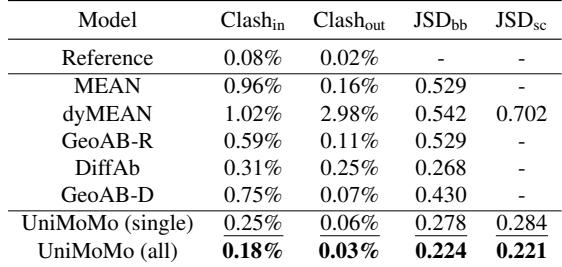
UniMoMo generates antibody CDR-H3 loops with the lowest steric clash rates among all models and achieves a side-chain dihedral distribution far closer to the reference than the only other model reporting it. Its backbone dihedral angle distribution is also highly accurate, competitive with the best baseline. UniMoMo achieves the lowest internal (0.25%) and external (0.06%) clash rates, indicating cleaner geometries than all baselines. UniMoMo obtains a side-chain dihedral divergence (JSD_sc) of 0.284, dramatically lower than dyMEAN's 0.702, showing much more realistic side-chain conformations.
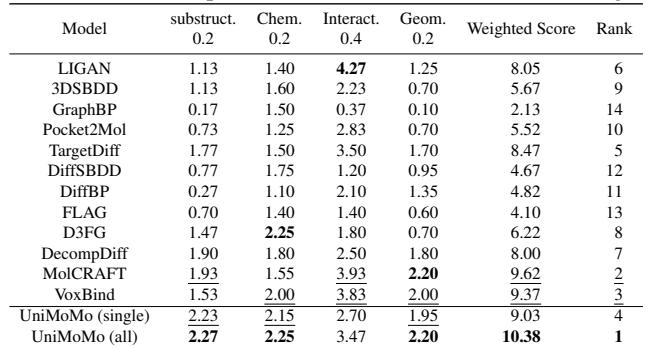
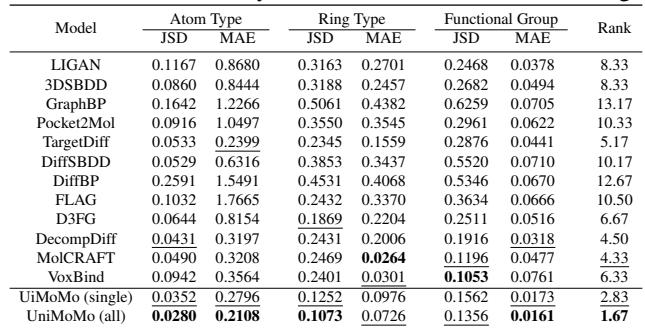
Uni-MoMo achieves the highest overall ranking score in de novo small molecule design, outperforming all evaluated baselines. Its block-level unified representation yields strong fidelity to substructure distributions, favorable drug-likeness and synthetic accessibility, and minimal steric clashes. The model benefits from multi-domain training, which enhances generalization and leads to consistent gains across all evaluation categories. Uni-MoMo attains the top weighted score, surpassing autoregressive, diffusion, fragment-based, and voxel-based methods. It excels in substructure metrics, closely matching reference distributions of atoms, rings, and functional groups. Generated molecules are more drug-like and synthetically accessible, with well-distributed bond lengths and angles and fewer atomic clashes. Interaction profiles closely resemble the reference, indicating stable and meaningful protein–ligand binding. Multi-domain data integration significantly improves performance in every aspect, reducing biases present in single-domain models.
The table compares baseline models on how well generated molecules match reference distributions of atom types, ring types, and functional groups. Diffusion-based TargetDiff achieves the lowest atom-type and ring-type JSD among the listed baselines, while voxel-based LIGAN obtains the smallest functional group MAE. The accompanying text notes that Uni-MoMo surpasses all these baselines, delivering the best overall substructure fidelity. TargetDiff leads the baselines in matching atom-type and ring-type distributions, with JSD values substantially lower than those of GraphBP and Pocket2Mol. GraphBP consistently underperforms across all substructure metrics, showing the highest JSD and MAE for atom types, rings, and functional groups.
Across peptide binder, antibody CDR-H3, and small molecule design tasks, UniMoMo with multi-domain training substantially outperforms prior methods in recovering native-like sequences and binding geometries, achieving stronger binding energies, higher success rates, and more realistic backbone and side-chain conformations with minimal steric clashes. Generative sampling with large candidate pools further boosts native sequence recovery and binding quality beyond predictive baselines, while multi-domain knowledge transfer improves structural rationality and substructure fidelity. The unified block-level representation yields the highest overall ranking scores, demonstrating strong generalization across diverse molecular design problems.