Command Palette
Search for a command to run...
유클라이드 빠른 데이터 공개 (Q1)
유클라이드 빠른 데이터 공개 (Q1)
클러스터링 — 빠른 시작
초록
저희는 Euclid Quick Release 1 관측 데이터(영역 63.1 deg2 포함)에서 식별된 강한 중력렌즈 은하단 군집에 대한 최초의 카탈로그를 제시합니다. 이 카탈로그는 1260개의 은하단 장(field)에 대한 시각적 검증을 통해 도출된 결과입니다. 각 은하단은 식별된 강한 중력렌즈 현상의 수와 타당성을 바탕으로 렌즈 가능성(Plens)을 평가받아 순위가 매겨졌습니다. 구체적으로, 저희는 Plens>0.5인 83개의 중력렌즈를 확인했으며, 이 중 14개는 Plens=1로 거대 방위 호(giant tangential arcs), 방형 호(radial arcs), 그리고 다중 이미지를 포함하여 명확하고 확고한 강한 중력렌즈 현상을 보여주고 있습니다.측정된 렌즈 은하단 군집의 수 밀도(예: Plens>0.9인 경우 약 0.3 deg−2)를 고려할 때, Euclid 임무 전체 기간 동안 4500개 이상의 강한 중력렌즈 은하단 군집을 발견할 것으로 예상됩니다. 주목할 만한 점은, 식별된 은하단 규모의 렌즈 중 이전에 우주 공간에서 관측된 사례는 단 3개에 불과하다는 것입니다. 따라서 Euclid은 가장 높은 확률을 지닌 렌즈들을 포함하여, 나머지 80개 은하단 렌즈에 대한 최초의 고해상도 이미지를 제공했습니다. 식별된 강한 중력렌즈 현상들은 향후 Euclid 관측 데이터에서 중력 호와 다중 이미지를 자동으로 식별하기 위한 딥러닝 모델의 학습에 활용될 예정입니다.
One-sentence Summary
By visually inspecting 1260 cluster fields across 63.1 deg² of the Euclid Quick Release 1, the paper present a catalogue of 83 strong lensing galaxy clusters that provides the first high-resolution imaging for 80 previously unobserved systems and establishes a training dataset for deep-learning models to automatically identify gravitational arcs and multiple images.
Key Contributions
- This work presents the first catalogue of strong lensing galaxy clusters derived from the Euclid Quick Release 1 survey, which covers 63.1 square degrees of sky. The catalogue was compiled through a systematic visual inspection of 1260 cluster fields.
- A probabilistic scoring framework assigns a lensing probability (Plens) to each candidate based on the quantity and plausibility of detected features. This methodology identifies 83 gravitational lenses with Plens>0.5, including 14 objects with definitive signatures such as giant tangential and radial arcs.
- The verified morphological sample establishes a training dataset for deep-learning models designed to automate gravitational arc and multiple image detection in future Euclid data releases. Preliminary measurements indicate a number density of approximately 0.3 high-probability clusters per square degree, supporting the scalability of the detection pipeline for the full mission survey.
Introduction
Gravitational lensing by galaxy clusters serves as a critical probe for mapping total mass distributions, constraining cosmological parameters, and identifying high-redshift galaxies. Prior studies have been constrained by the rarity of strong-lensing systems and the limited fields of view typical of high-resolution optical and near-infrared surveys, which restricts sample sizes and hinders robust statistical analysis. The authors leverage the unprecedented wide-area, high-resolution imaging capabilities of the Euclid mission to systematically identify cluster-scale strong-lensing features and giant arcs in its initial Quick Release data. By conducting the first large-scale visual inspection of approximately 4.4 square degrees using a newly developed screening tool, they generate a foundational catalog that will train machine learning algorithms for future data releases and establish efficient analysis pipelines for upcoming surveys.
Dataset

-
Dataset Composition and Sources
- The authors build the dataset from Euclid Quick Release 1 observations spanning 63.1 square degrees, anchored by two complementary galaxy cluster catalogues.
- The primary photometric subset (DLS) derives from Wen & Han (2024), which combines optical and mid-infrared imaging with spectroscopic data from DESI Legacy Surveys, WISE, 2MASS, SDSS, and DESI.
- The supplementary subset (GCWG) merges 15 independent X-ray, Sunyaev-Zel'dovich, and optical cluster catalogues to recover systems missed by photometric selection alone.
-
Key Details for Each Subset
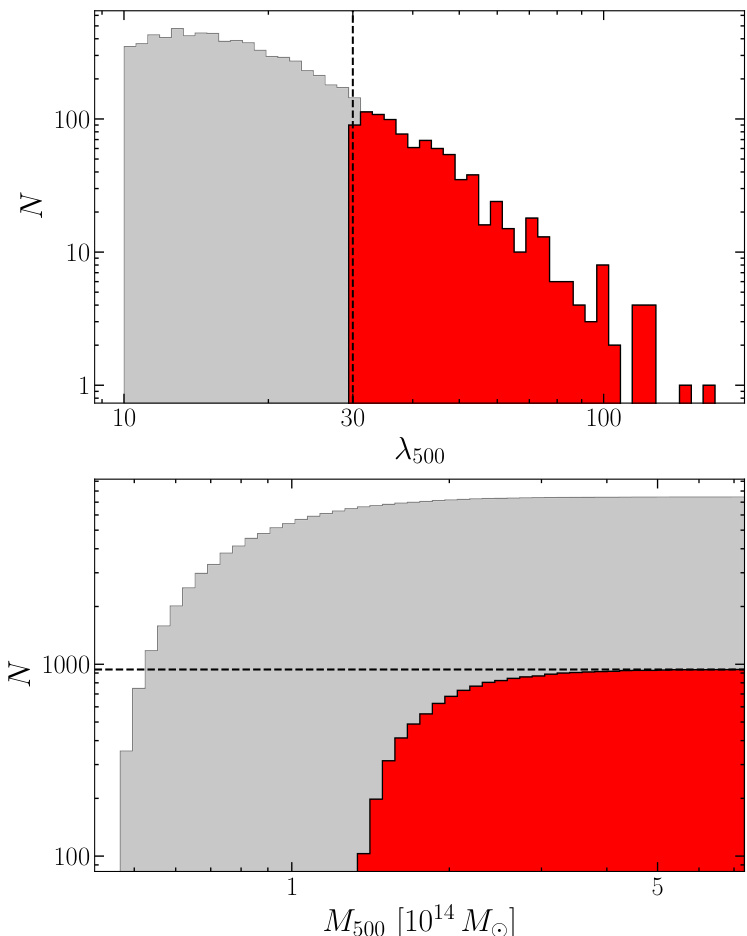
- DLS: 939 candidates after applying a richness threshold of λ₅₀₀ > 30 (approximately M₅₀₀ ≳ 1.36 × 10¹⁴ M☉).
- GCWG: 484 unique candidates within the Euclid footprint, with 117 being entirely new to the combined sample.
- Combined VI Catalogue: 1,056 initial candidates formed by merging both subsets and removing duplicate entries.
- Final Inspected Set: 826 cutouts after filtering out 10 angularly close but distinct redshift systems and 220 edge cutouts containing over 50 percent null pixel values.
-
Processing and Metadata Construction
- The authors generate 4 by 4 arcminute color image cutouts by combining Euclid I_E, Y_E, and H_E bands.
- Each cutout receives a lensing probability score (P_lens) based on the quantity and morphological plausibility of detected strong lensing features such as tangential arcs and multiple images.
- Inspector consistency and scoring stability are tracked through delta P_lens distributions across calibration and main inspection phases.
-
Usage and Training Strategy
- Forty-four independent inspectors visually evaluate the cutouts using a custom interactive tool, ultimately identifying 83 strong lenses (P_lens > 0.5) and 14 high-confidence cases (P_lens = 1).
- The authors extract labeled examples of gravitational arcs and multiple images from the high-probability clusters to serve as ground-truth annotations.
- These real detections will be combined with simulated data to train convolutional neural networks, enabling automated feature detection across the full Euclid mission archive without relying on manual inspection.
Method
The authors leverage a multi-step image processing pipeline to generate colour images from Euclid observations, designed to enhance the visibility of morphological features relevant to strong lensing detection. The process begins with the combination of data from the IE, YE, JE, and HE photometric filters, which are sourced from the Q1 data release covering a total sky area of approximately 63.1 deg2. These bands are observed at the depth of the Euclid Wide Survey (EWS), with the IE filter achieving a signal-to-noise ratio S/N ≥ 10 for extended sources with a full width at half maximum (FWHM) of 0′3 and AB magnitude 24.5 within an aperture of 1′3, while the near-IR bands reach S/N ≥ 5 for point sources with AB magnitude 24.0. All images are resampled to a common spatial sampling of 0′1 per pixel, matching the native resolution of the IE band, with point-spread functions of 0′13, 0′33, 0′35, and 0′36 FWHM for the IE, YE, JE, and HE bands, respectively.
To create the initial colour images, the authors use the STIFF software (Bertin 2012) to map the HE, YE, and IE bands into the Red-Green-Blue (RGB) colour space, assigning them to the red, green, and blue channels, respectively. The software automatically determines the sky background intensity and applies colour balancing, with manual adjustments made to contrast and brightness to improve visibility of low-surface-brightness sources. However, the spatial resolution of the resulting images is constrained by the equal weighting of the IE and near-IR bands, which limits the clarity of fine-scale features.
To address this limitation, the authors implement a two-step enhancement procedure. First, the RGB images are transformed into the CIELAB colour space, which represents colour using three components: L for perceptual lightness, and a and b for chromaticity along the red-green and yellow-blue axes. The L channel is then replaced with the IE band image, effectively using the higher-resolution IE data to drive spatial detail while preserving colour information from the combination of HE, YE, and IE. The resulting image is then remapped back to the RGB colour space. This approach significantly improves the visibility of small-scale morphological features, such as compact star-forming regions in distant galaxies, which are better resolved in the IE band than in the near-IR bands. The final images are saved in the Tag Image File Format (TIF), ensuring compatibility with standard astronomical visualization tools.
The resulting colour images are not intended for scientific analysis, such as multi-band photometry or photometric redshift estimation, due to the non-linear processing and colour manipulation. Instead, they are optimized for visual identification of strong lensing features, such as gravitational arcs and arclets, by enhancing both resolution and colour contrast. A limitation of this method is that the use of the IE band for the lightness channel can attenuate features visible only in the near-IR, such as IE-dropout sources, which may reduce their detectability in the final images.
For the visual inspection of these images, the authors employ the galaxyvote web application, which supports collaborative and systematic analysis of large image datasets. The application's backend is built using the Flask framework to manage URLs and associate them with Python functions that interact with a relational database. This database stores multiple experiments, each with its own image collection, user assignments, and annotations. It also maintains records of user grades, comments, and geometrical markings, such as rectangles drawn to highlight regions of interest. The frontend is implemented using HTML and JavaScript, leveraging the Bootstrap CSS framework to deliver responsive and modern user interfaces.
Each inspection session is configured via a script that initializes the database, populates it with images and authorized users, and defines the number of users required to evaluate each image. Administrators can set the number of evaluators per image, and the system automatically generates assignments to ensure balanced workloads. Users access their personalized workspaces through a login mechanism, where they are presented with a gallery of assigned images. The image viewer is implemented using the OpenSeaDragon JavaScript library, providing a high-resolution, interactive interface with smooth zoom and pan capabilities. The images are preprocessed into the pyramidal Deep-Zoom-Image (DZI) format, enabling efficient tiling and rapid navigation. OpenSeaDragon supports DZI and other tiled image protocols, allowing for seamless handling of large datasets.
The viewer includes several tools to assist users in their analysis. Basic image adjustments, such as contrast and brightness enhancement, are available through the OpenSeaDragonFiltering add-on, enabling users to optimize visibility of specific features. A rectangle drawing tool allows users to mark regions of interest, such as gravitational arcs or multiple images of background sources, and save these annotations directly to the database. A voting panel enables classification of each image into one of three categories: 'Certain Lens' (A), indicating high-confidence detection of strong lensing features; 'Probable Lens' (B), indicating lower-confidence association; or 'No Lens' (C), indicating no detectable lensing features. Users are also prompted to provide textual feedback in a comment box, explaining their reasoning and detailing their observations. This structured approach ensures that both quantitative and qualitative assessments are captured, facilitating a comprehensive evaluation of the images.
Experiment
The visual inspection experiment employed a two-stage blind evaluation protocol in which consortium experts independently assessed Euclid cluster images for strong gravitational lensing features, beginning with a calibration phase designed to train inspectors and validate the assessment methodology. This preliminary stage confirmed the pipeline's robustness and inter-observer consistency across varying user expertise levels, while the subsequent main survey validated the approach's scalability by successfully identifying a substantial population of secure lenses that predominantly peak at redshifts optimized for Euclid's imaging capabilities. Collectively, these results demonstrate that the blind visual framework is a highly reliable tool for large-scale lens discovery, yielding consistent classifications that support accurate survey yield predictions and establish a foundational dataset for future automated detection models.
The authors conducted a visual inspection experiment to identify strong gravitational lenses in galaxy clusters, using a two-phase approach with expert inspectors who graded images without prior knowledge of cluster properties. The results show that clusters receiving unanimous A grades were assigned a lensing probability of 1.0, indicating secure lens candidates, and the methodology demonstrated consistency across inspectors and phases. The analysis also revealed that lensing features were primarily detected in a specific redshift range, with some clusters exhibiting multiple strong lensing phenomena. All clusters with a lensing probability of 1.0 received unanimous A grades from inspectors, indicating secure strong lensing features. The visual inspection process showed consistent results between the calibration and main phases, with minimal variation in lensing probability for repeated cluster assessments. Clusters identified as secure lenses were primarily located in a redshift range where lensing features are most detectable, and some exhibited complex strong lensing phenomena such as tangential and radial arcs.
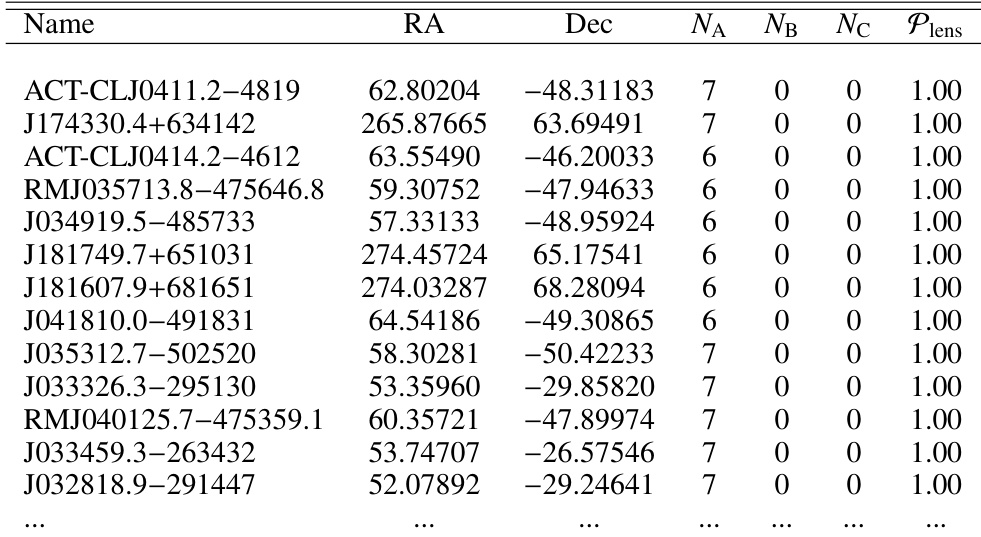
The authors conducted a visual inspection experiment in two phases to identify strong gravitational lensing features in galaxy clusters. The first phase served as a calibration to train inspectors and test the methodology, while the second phase examined a larger sample of clusters to identify potential lensing candidates. Results show consistent grading patterns across inspectors and phases, with a focus on clusters receiving high probabilities of being strong lenses. The visual inspection experiment was conducted in two phases, with the first phase serving as a calibration to train inspectors and test the methodology. Inspection results show consistent grading patterns across different inspectors and phases, with no significant bias observed based on expertise level. Clusters with high probabilities of being strong lenses were identified in both phases, with some secure lenses confirmed in both stages.
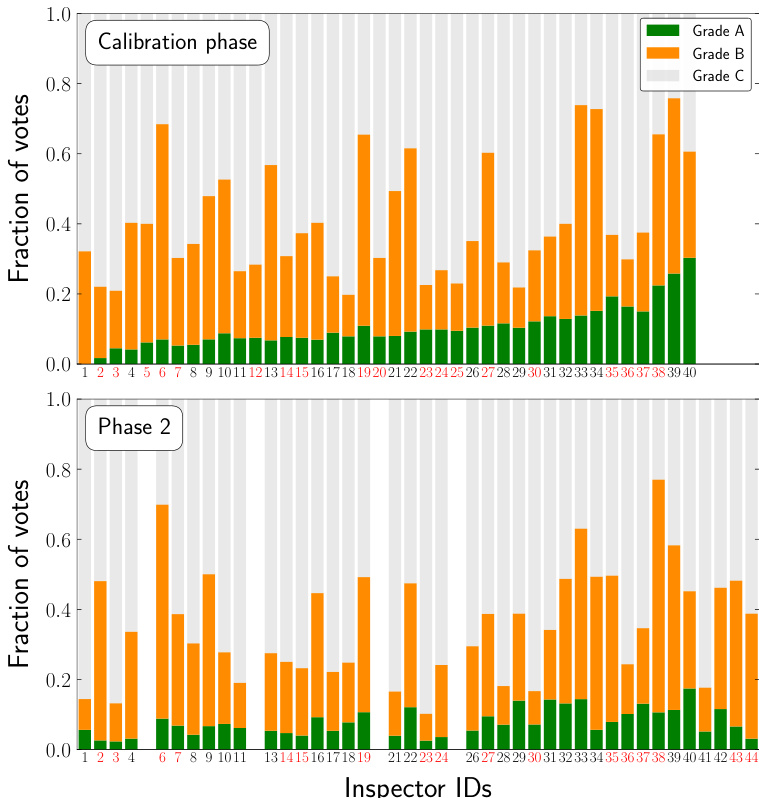
{"summary": "The authors conducted a visual inspection experiment to identify strong gravitational lensing features in galaxy clusters, using a two-phase approach with expert inspectors who graded clusters based on A, B, and C ratings. The results from both phases show consistent grading patterns and identify a set of secure lens candidates with high confidence, as reflected in the probability values derived from the vote distributions. The inspection process was designed to be blind to cluster properties and demonstrated robustness across different inspectors and repeated assessments.", "highlights": ["The visual inspection process used a scoring system based on A, B, and C grades to assign a lensing probability, with secure lenses receiving the highest probability when all inspectors rated them as A.", "The experiment involved two phases with consistent grading practices, and results from both phases showed high agreement in lensing probability assessments for overlapping clusters.", "The inspection identified several secure gravitational lens candidates, with some clusters showing prominent lensing features such as giant arcs and multiple images, indicating their potential for follow-up studies."]
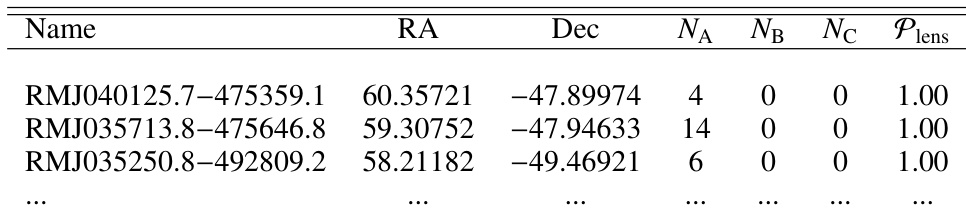
The evaluation utilized a two-phase visual inspection protocol in which expert reviewers blindly graded galaxy cluster images to identify strong gravitational lensing features. This two-stage approach validated the methodology's consistency and robustness, demonstrating high agreement across different inspectors and repeated assessments. Qualitatively, the process successfully isolated secure lens candidates defined by prominent morphological structures like giant arcs and multiple images, predominantly within a specific redshift range. Ultimately, the findings confirm that structured visual evaluation provides a reliable and reproducible framework for identifying high-confidence gravitational lenses.