Command Palette
Search for a command to run...
MegActor: 생생한 초상화 애니메이션을 위해 원본 비디오의 힘을 활용하다
MegActor: 생생한 초상화 애니메이션을 위해 원본 비디오의 힘을 활용하다
Shurong Yang Huadong Li Juhao Wu Minhao Jing Linze Li Renhe Ji Jiajun Liang Haoqiang Fan
MegActor 원클릭 배포
초록
원본 구동 영상은 얼굴 랜드마크와 같은 중간 표현에 비해 얼굴 표정에 대한 더 풍부한 정보를 포함하고 있음에도 불구하고, 초상 애니메이션 분야에서 이러한 원본 영상은 거의 연구 대상이 되지 못해 왔다. 이는 원본 영상에 의해 구동되는 초상 애니메이션이 본질적으로 직면하는 두 가지 과제, 즉 1) 상당한 신원(Identity) 유출 문제와 2) 주름과 같은 관련 없는 배경 및 얼굴 세부 사항이 성능을 저하시키는 문제로 인해 발생한다. 생생한 초상 애니메이션을 위해 원본 영상의 잠재력을 활용하기 위해, 우리는 MegActor라는 선구적인 조건부 디퓨전 모델을 제안한다. 먼저, 신원 유출 문제를 완화하기 위해 일관된 동작과 표정을 가지지만 일관되지 않은 신원(ID)을 갖는 영상을 생성하기 위한 합성 데이터 생성 프레임워크를 도입한다. 둘째, 참조 이미지의 전경과 배경을 분할하고 CLIP을 사용하여 배경 세부 사항을 인코딩한다. 이렇게 인코딩된 정보는 텍스트 임베딩 모듈을 통해 네트워크에 통합되어 배경의 안정성을 보장한다. 마지막으로, 구동 영상의 얼굴 세부 사항이 미치는 영향을 제거하기 위해 참조 이미지의 외관을 구동 영상에 스타일 전송한다. 최종 모델은 공개 데이터셋만으로 학습되었으며, 상용 모델과 비교할 만한 결과를 달성했다. 본 연구가 오픈소스 커뮤니티에 도움이 되기를 바란다.
One-sentence Summary
MegActor is a conditional diffusion model that generates vivid portrait animations from raw driving videos by leveraging a synthetic data framework that creates videos with consistent motion and expressions but inconsistent identities to mitigate identity leakage, integrating CLIP-encoded background segmentation via text embeddings to stabilize the background, and applying appearance style transfer from the reference image to the driving video to eliminate distracting facial details, ultimately achieving performance comparable to commercial models while trained exclusively on public datasets.
Key Contributions
- This work introduces MegActor, a conditional diffusion model that generates portrait animations from raw driving videos by employing a synthetic data generation framework to decouple motion control from subject identity and mitigate identity leakage.
- Robustness to irrelevant background and facial details is achieved through a background segmentation and CLIP encoding module, combined with a style transfer process that maps the reference appearance onto the driving frames to filter out visual noise.
- Trained exclusively on public datasets, the framework achieves animation quality and identity preservation comparable to commercial models, as demonstrated through SOTA comparisons and visual evaluations.
Introduction
Portrait animation enables the transfer of motion and facial expressions from a driving video to a target image while preserving identity and background, powering applications like digital avatars and AI-driven conversations. While recent diffusion-based approaches using text, image, or audio controls have improved visual quality, they struggle with subtle facial movements, rely on unstable external pose detectors, or suffer from identity leakage when trained on raw video data. To overcome these bottlenecks, the authors introduce MegActor, a conditional diffusion model that directly harnesses raw driving videos for highly expressive portrait animation. They address identity leakage through a custom synthetic data framework that decouples motion from appearance, stabilize background generation using CLIP-encoded text embeddings, and apply stylization transfer to filter out irrelevant facial details from the driving footage. This approach delivers robust, pixel-level accurate animations that match state-of-the-art commercial systems while relying solely on publicly available training data.
Dataset
- Dataset Composition and Sources: The authors train the model using publicly available video datasets, specifically VFHQ and CelebV-HQ. To address identity and background leakage, they supplement these real videos with synthetically generated data created via Face-Fusion and SDXL.
- Subset Details and Filtering: The real data originates from VFHQ and CelebV-HQ. The synthetic subsets include AI face-swapping videos generated by pairing each driving frame with a source image from a different individual, and stylized videos produced with SDXL. The authors also apply L2CSNet to measure gaze shifts across frames, isolating approximately 5 percent of the data that exhibits significant eye movements for specialized fine-tuning.
- Training Usage and Mixture Ratios: During the initial training stage, the model consumes a blended mixture of 50 percent real videos, 40 percent AI face-swapping videos, and 10 percent stylized videos. The authors sample frames using a stride of 2 to create 16-frame segments, where one frame serves as the reference and the remaining frames act as both the driving input and ground truth. In the second stage, the model fine-tunes exclusively on the high-gaze subset using a stride of 12 while maintaining the 16-frame segment length.
- Processing and Augmentation Strategies: To minimize background leakage, the authors use pyFacer to detect faces and mask all non-facial pixels to black. They also apply random augmentations to the driving videos, including grayscale conversion and adjustments to size and aspect ratio, which modify facial structure without altering expressions or head poses. All video frames are resized to 512 by 512 pixels before training.
Method
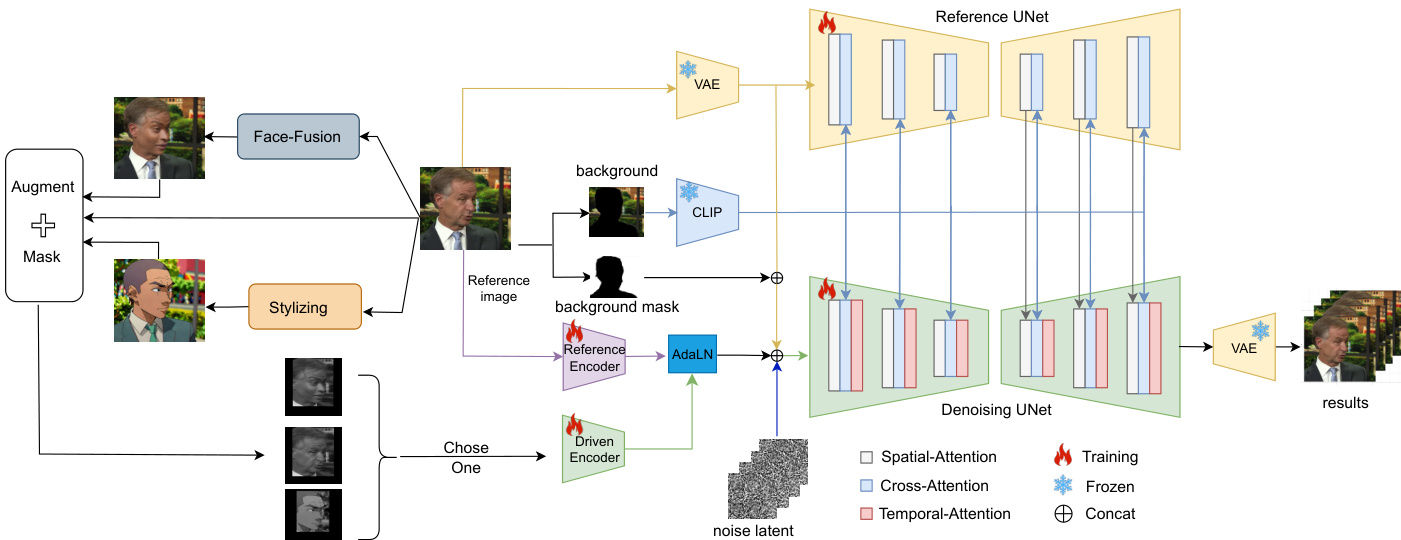
The authors leverage a conditional diffusion model architecture, referred to as MegActor, to achieve vivid portrait animation driven by raw video inputs. The overall framework is designed to address two primary challenges in using raw driving videos: identity leakage and the degradation of performance due to irrelevant background and facial details. The system operates by first processing the reference image and the driving video through distinct pipelines before integrating their features into a unified denoising process.
The reference image is processed to extract identity and background information. A ReferenceNet, based on the UNet architecture of Stable Diffusion 1.5 (SD1.5), is used to encode fine-grained identity and background features. Concurrently, the background region of the reference image is isolated and encoded using CLIP’s image encoder. This encoded background information is then integrated into the model via a text embedding module, replacing the standard text prompt. The extracted global (CLS) and local patch features from CLIP are merged and injected into both the ReferenceNet and the Denoising UNet through cross-attention mechanisms to stabilize the background in the generated output.
For the driving video, a lightweight DrivenEncoder is employed to extract motion features. This encoder consists of four 2D convolutional layers with varying channel sizes and is designed to efficiently process the video frames. The motion features are aligned to the resolution of the noise latents sampled from the diffusion process. To preserve the spatial structure of the pre-trained Denoising UNet, the authors initialize the parameters of the newly added channels in the conv-in layer to zero. The DrivenEncoder is further enhanced by incorporating the reference image as a guide during motion feature extraction. The latent representation of the reference image, obtained via a Variational Autoencoder (VAE), and a foreground mask derived from DensePose are concatenated with the noise latents and motion features before being fed into the Denoising UNet. This ensures that the motion transfer respects the identity of the reference character.
To improve temporal consistency across generated frames, a temporal module is inserted after each Res-Trans layer of the Denoising UNet. This module performs temporal attention between frames, capturing temporal dependencies and enhancing continuity in the animation. The temporal module is fine-tuned separately to optimize its performance without disrupting the pre-trained image generation capabilities of the base model.
The driving video undergoes preprocessing to mitigate identity leakage. A synthetic data generation framework is employed, where face-swapping and stylization techniques are applied to create videos with consistent motion and expressions but inconsistent identities. The stylized video is used during training to reduce the influence of facial details such as wrinkles. Additionally, data augmentation methods, including scaling and aspect ratio adjustments, are applied to the driving video. All non-face regions are masked out to focus the model on the facial motion.
Experiment
The evaluation validates cross-identity portrait generation by animating distinct reference frames using driving videos from multiple datasets. Initial tests on independent video sources confirm that the model accurately preserves background details and subject identity while faithfully transferring complex facial expressions and subtle head movements. A comparative assessment against a state-of-the-art baseline further highlights superior clarity in fine anatomical features and demonstrates overall animation quality on par with leading methods. These qualitative results collectively establish the model's robust generalization and competitive standing in cross-identity animation tasks.
The authors evaluate their model, MegActor, in comparison to existing methods using cross-identity video generation tasks. The results demonstrate that MegActor produces realistic portrait animations with preserved identity and detailed facial features, achieving comparable performance to state-of-the-art methods while supporting open code and weights. MegActor generates realistic portrait animations with preserved identity and detailed facial expressions under cross-identity conditions. MegActor achieves comparable results to state-of-the-art methods, producing clearer outputs in areas like teeth compared to EMO. MegActor supports open code and weights, unlike several other models listed in the comparison.
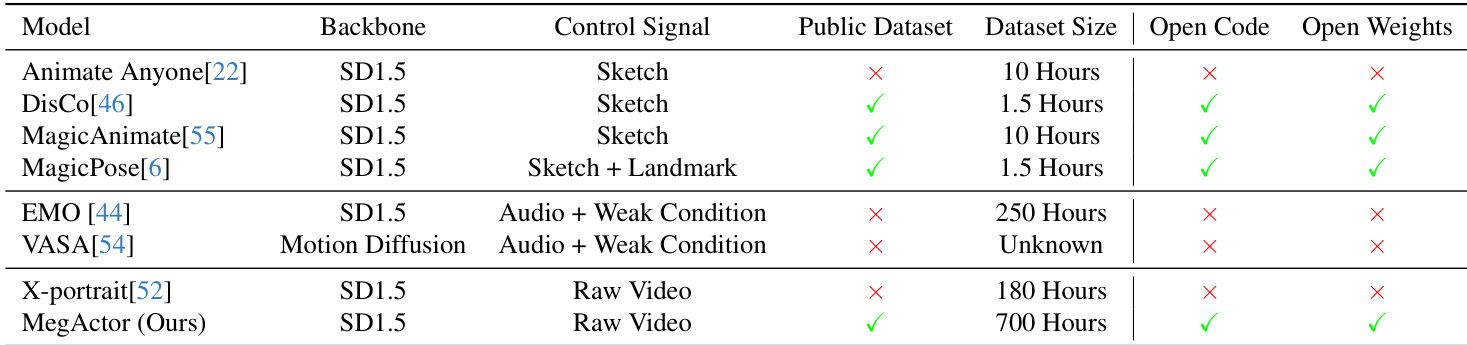
The authors evaluate MegActor through cross-identity video generation tasks to validate its capacity for producing realistic portrait animations that maintain subject identity and fine facial details. Qualitative assessments confirm that the model successfully preserves identity and renders expressive features with clarity that aligns with or exceeds existing state-of-the-art methods. Additionally, the framework establishes a new standard for accessibility by releasing fully open code and weights alongside its competitive performance.