Command Palette
Search for a command to run...
MatterGen: 무기물 설계용 생성 모델
MatterGen: 무기물 설계용 생성 모델
MatterGen 무기물 설계 모델의 원클릭 배포
초록
에너지 저장, 촉매, 탄소 포집과 같은 분야에서 기술적 진보를 주도하기 위해 원하는 특성을 가진 기능성 소재를 설계하는 것은 필수적이다. 생성 모델은 원하는 특성 제약 조건을 바탕으로 완전히 새로운 소재를 직접 생성함으로써 소재 설계에 새로운 패러다임을 제공한다. 최근 진전이 있었음에도 불구하고, 현재의 생성 모델은 안정된 결정체를 제안하는 데 성공률이 낮거나, 매우 제한된 세트의 특성 제약 조건만을 만족시킬 수 있다. 본 연구에서는 주기율표 전반에 걸쳐 안정적이고 다양한 무기물 소재를 생성하며, 광범위한 특성 제약 조건을 향해 생성을 유도하기 위해 추가로 파인튜닝이 가능한 MatterGen이라는 모델을 제시한다. 이를 위해 우리는 원자 유형, 좌표 및 주기적 격자를 점진적으로 정제하여 결정 구조를 생성하는 새로운 확산 기반 생성 과정을 도입한다. 또한, 레이블이 지정된 데이터셋을 사용하여 임의의 특성 제약 조건으로 파인튜닝을 가능하게 하기 위해 어댑터 모듈을 도입한다. 기존 생성 모델과 비교할 때, MatterGen이 생성한 구조물은 더 혁신적이고 안정적일 확률이 두 배 이상 높으며, 국소 에너지 최소점에 15배 이상 가깝다. 파인튜닝 후, MatterGen은 원하는 화학적 조성, 대칭성, 그리고 기계적, 전자적, 자기적 특성을 갖춘 안정적이고 새로운 소재를 성공적으로 생성한다.
One-sentence Summary
MatterGen is a diffusion-based generative model that designs stable inorganic materials by iteratively refining atom types, coordinates, and the periodic lattice, and employs adapter modules for property-guided fine-tuning to yield structures that are more than twice as likely to be novel and stable and more than 15 times closer to the local energy minimum than prior methods, while successfully targeting specific chemistry, symmetry, and mechanical, electronic, or magnetic properties.
Introduction
The rapid discovery of functional materials is essential for advancing energy storage, catalysis, and carbon capture technologies. Traditional experimental workflows and high-throughput screening remain constrained by known chemical spaces and cannot efficiently target specific or conflicting material properties. While generative models offer a promising inverse design alternative, existing approaches frequently produce unstable crystals, rely on narrow element subsets, and struggle to optimize beyond basic formation energy. To address these bottlenecks, the authors introduce MatterGen, a diffusion-based framework that jointly refines atom types, atomic coordinates, and the periodic lattice. The model incorporates trainable adapter modules that enable fine-tuning toward diverse targets such as chemical composition, symmetry, and mechanical or electronic properties. This architecture consistently yields structures that are significantly more stable, novel, and energetically optimized than prior methods, demonstrating robust capabilities for multi-property materials design.
Method
The framework of MatterGen is built upon a diffusion model architecture specifically designed for the generation of crystalline materials, leveraging a joint diffusion process that operates on the fundamental components of a crystal structure: atom types, fractional coordinates, and the lattice. The core of the model is a score network that learns to reverse a carefully designed forward diffusion process, enabling the generation of stable and diverse materials. This process begins with a stable crystal structure, defined by its unit cell containing atom types A, fractional coordinates X, and lattice vectors L, and progressively corrupts it into a random material through a Markov chain. The reverse process, or denoising, is guided by a score network to reconstruct a plausible crystal structure from the noisy state.
The model's architecture is structured to handle the distinct nature of each structural component. The atom type diffusion is formulated as a discrete denoising diffusion probabilistic model (D3PM), which operates on the categorical space of chemical elements. This process uses a masked diffusion strategy where atoms are gradually corrupted into a special masked state, with the goal of learning a score function that predicts the original atom types given a noisy state. The coordinate diffusion is performed on fractional coordinates, which are defined on a flat torus due to periodic boundary conditions. This necessitates the use of a wrapped normal distribution to model the noise, and the model employs a variance-exploding diffusion process to ensure the prior distribution at the final step is a uniform distribution over the unit cell. To account for variations in atomic density across different unit cell sizes, the diffusion variance is scaled by the cube root of the number of atoms. The lattice diffusion is performed on symmetric matrices to ensure rotational invariance and employs a variance-preserving diffusion process, which is modified to have a physically motivated limit distribution. This custom limit distribution is designed to favor cubic lattices with a mean atomic density derived from the training data, guiding the generation towards realistic and stable structures.
The score network itself is an SE(3)-equivariant graph neural network (GNN), adapted from the GemNet-dT architecture, which is designed to be efficient for predicting non-conservative forces. This network processes the atomistic structure and predicts scores for the lattice, atom positions, and atom types. For the lattice scores, the model uses a chain-rule approach, where edge length predictions from the GNN are transformed into lattice transformation scores. A key modification is introduced to ensure these scores are symmetric matrices, as required by the diffusion process on symmetric lattices, by composing the predictions with the Cartesian coordinate matrix. To enhance the model's expressiveness, the GNN is augmented with information about the lattice angles by concatenating the cosine of edge vectors with lattice vectors to the input edge representations, thereby breaking the invariance to unit cell choice. The training objective is a composite loss function that combines the score matching loss for coordinates and lattice, and the D3PM loss for atom types, with appropriate weighting.

Experiment
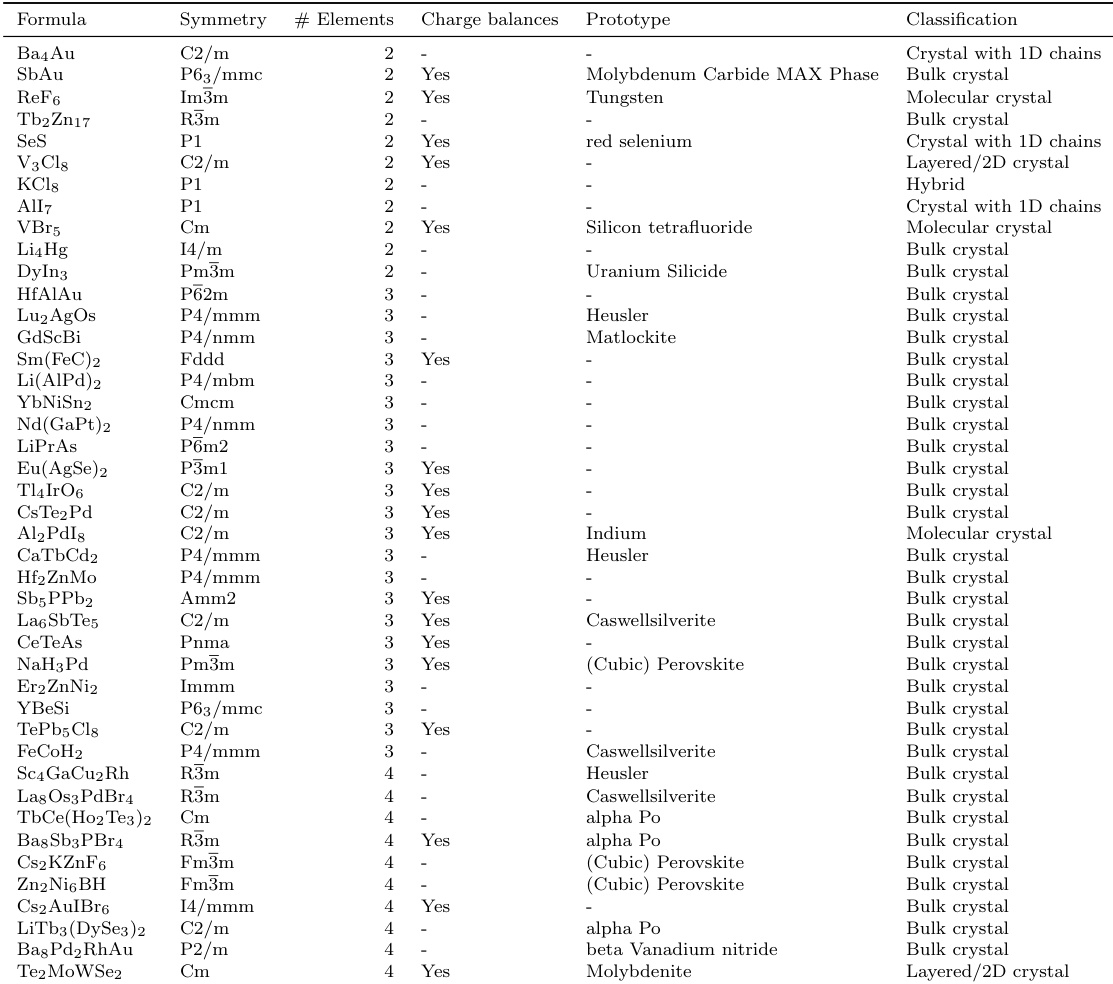
MatterGen was evaluated through fine-tuning experiments targeting specific chemical systems, crystal symmetries, and single or multiple physical properties, with performance benchmarked against traditional substitution, random structure searching, and screening baselines. These experiments collectively validate the model's robust inverse design capabilities, demonstrating its consistent ability to generate stable, unique, and novel structures across diverse chemical complexities and property constraints. Qualitatively, MatterGen efficiently navigates data-sparse regimes and successfully balances competing objectives, such as optimizing magnetic performance while minimizing supply chain risks, ultimately outperforming conventional methods in both discovery rate and computational efficiency.
The authors evaluate the ability of MatterGen to generate stable materials with target chemical compositions, symmetries, and properties by comparing it against substitution and RSS methods. Results show that MatterGen achieves higher efficiency and better performance in discovering novel structures on the convex hull, particularly in complex quinary systems, and effectively generates materials with desired symmetries and targeted magnetic, electronic, and mechanical properties. MatterGen also demonstrates success in designing low-supply-chain-risk magnets by jointly optimizing for high magnetic density and low supply chain risk scores. MatterGen outperforms substitution and RSS in discovering novel stable structures, especially in complex quinary systems with fewer generated samples. MatterGen successfully generates materials with target symmetries, achieving a notable fraction of structures belonging to the desired space group, including highly symmetric ones. MatterGen can generate materials with targeted magnetic, electronic, and mechanical properties, shifting property distributions toward desired values even with limited labeled data, and outperforms screening approaches in finding extreme property candidates.
The authors evaluate MatterGen's ability to generate stable and diverse crystal structures under various constraints, including target chemistry, symmetry, and specific material properties. The model demonstrates strong performance in discovering novel structures on the convex hull for ternary, quaternary, and quinary systems, particularly excelling in complex quinary systems with significantly fewer generated samples compared to baseline methods. It also successfully generates structures with target magnetic, electronic, and mechanical properties, showing a clear shift in property distributions toward desired values, and effectively combines multiple constraints such as high magnetic density and low supply chain risk to guide material design. MatterGen outperforms baseline methods in generating structures on the convex hull, especially in quinary systems, using far fewer samples. The model successfully generates materials with target magnetic, electronic, and mechanical properties, shifting property distributions toward desired values. MatterGen can jointly optimize for multiple constraints, such as high magnetic density and low supply chain risk, producing structures that avoid elements with supply issues.
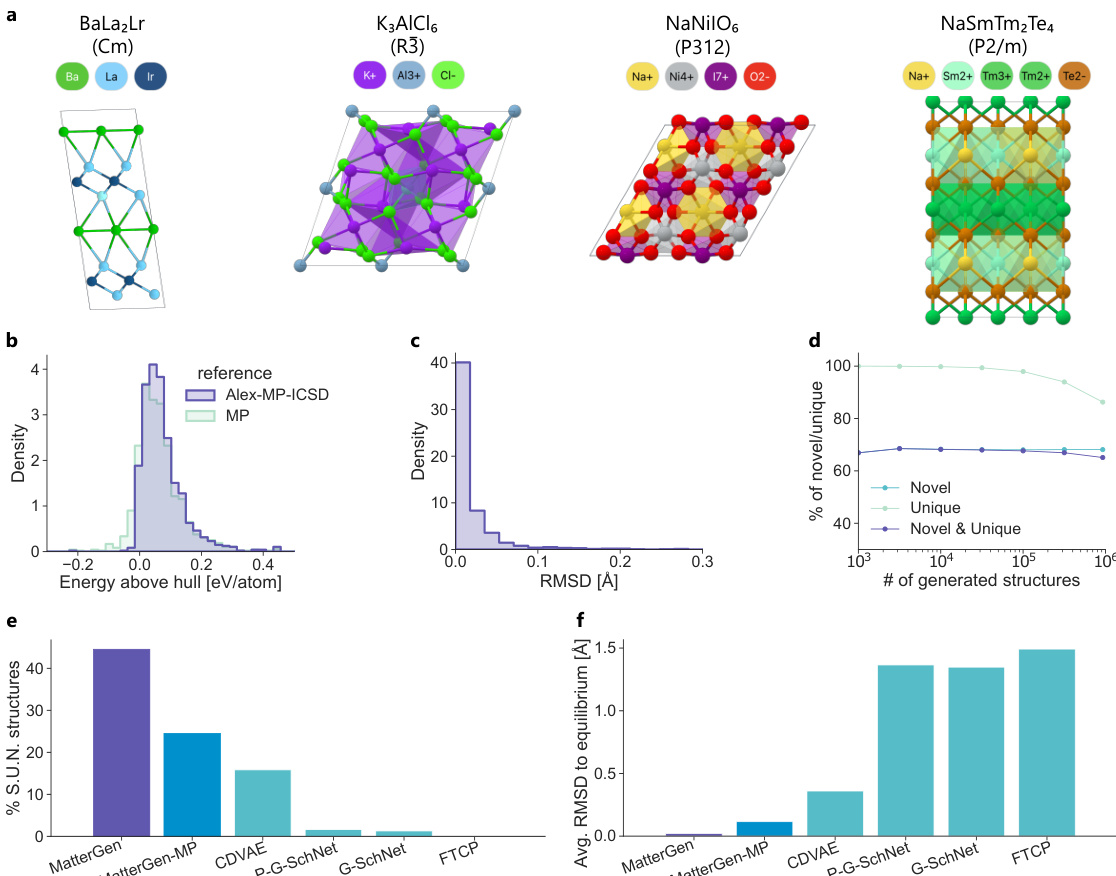
MatterGen was evaluated against substitution and RSS baselines to assess its capacity for generating stable crystal structures under constraints targeting specific chemistries, symmetries, and physical properties. The experiments demonstrate that the model consistently outperforms existing methods in discovering novel stable structures, particularly within complex quinary systems where it requires significantly fewer samples. Qualitatively, MatterGen successfully aligns generated structures with target space groups and effectively shifts property distributions to meet desired magnetic, electronic, and mechanical specifications. Furthermore, it reliably handles multi-objective optimization, such as jointly maximizing magnetic density while minimizing supply chain risk, establishing itself as a robust framework for constraint-driven materials design.